Equipment failures to cost STPUD $3 mil.

The aeration basin at South Tahoe Public Utility District. Photo/Ross Johnson

The aeration basin at South Tahoe Public Utility District. Photos/Ross Johnson

By Kathryn Reed

South Tahoe Public Utility District is facing unexpected multimillion-dollar equipment expenses. Two of the three aeration units at the sewer plant need to be replaced.

When the PVC pipe started to require multiple repairs the material was sent out to be investigated to see why it was failing. The plastic and couplers were falling apart.

Normal PVC pipe that is put in the ground is expected to last 50 to 100 years. These aeration pipes at the plant are 27 years old. Only a handful of companies make this specific pipe for aeration systems and they can make them to the standards they want. The manufacturer told South Tahoe PUD these specific pipes only have a life expectancy of 20 years.

“One would think with manufacturing processes it could be longer,” Paul Sciuto, deputy general manager, told Lake Tahoe News.

It will cost about $3 million to replace the two aerators. The board this summer approved a contract for the design of the first aerator. It’s anticipated it will be operational next spring, with the second one coming on board in 2016.

During the design phase the district will look at what options exist beyond the material and design that is in place now.

Until that time the maintenance team for the district will be extra vigilant to make sure things get fixed when they do breakdown. Epoxy and steel metal bands are two of the methods to do so.

Activated sludge at the sewer plant.

Activated sludge at the sewer plant.

“We have a 4 million gallon river coming at us every day so can’t shut the plant down,” Sciuto said.

That is why there are redundancies built into the system and backups to the backup.

The district has met its treated water quality requirements since 1995 and does not want to mar that record. It’s not like the aeration process can be skipped.

“The aeration basins are a critical part of the biological process at the treatment plant,” Sciuto said. “It’s almost like you see bubbling chocolate milk. It’s pretty uniform when you look at the surface of the water. If there is an area with less bubbles, there is probably a failure in the air pipe.”

The air is helping breakdown the organic material. Air is being blown 24/7. Each basin is about 20 feet by 100 feet.

Usually only one is in operation at a time. However, two were required over Fourth of July.

While the district knew the aerators would eventually need to be replaced, it was not on the capital improvement list for the near future. To deal with the unexpected expense money will be used from the sewer enterprise fund that had been earmarked for other projects. Some work in Diamond Valley and a couple collection system projects will be pushed out a few years. There could be other projects that will be delayed.


Opinion: Time to shed light on CalPERS’ private equity investments

By Peter Scheer

The public has grown accustomed to “pay to play” scandals and other misconduct at CalPERS, the nation’s largest public employee pension plan with over $300 million in investments. Still, the former CEO’s guilty plea entered in federal court last week was shocking even by CalPERS’ standards. Frederico Buenrostro, CalPERS’ top official from 2002 to 2008, acknowledged in his plea agreement with the government that he had taken $200,000 in cash bribes, delivered in paper bags and shoe boxes, to influence CalPERS’ investment decisions in private equity funds.

The paper bags and shoe boxes are a nice touch.

CalPERS and other public employee pensions, struggling to meet soaring obligations to retirees, have turned increasingly to alternative investments, and in particular to private equity deals, in order to boost their overall rates of return. Financial experts disagree about whether this strategy (also popular among college and university endowments) is sound or poses too much risk for “defined benefit” pensions promising specific benefit payments upon retirement. (Think Social Security.)

Regardless of the outcome of that debate, there is no debating that private equity investments lack the transparency of investments in stocks, bonds and other publicly traded securities. There is very little that the public doesn’t know, or can’t easily find out, about CalPERS’ investments in publicly traded securities: their value, performance, amount of leverage (and other measures of risk), fees paid, officers’ compensation–to name just a few. But little, if any, of this information is available for private equity deals.

The “private” in private equity means secret. And secrecy in government decisionmaking, rarely a good thing, is especially dangerous when it hides an agency’s decisions about literally billions of dollars of investments. The secrecy surrounding CalPERS’ private equity investments, combined with the temptations facing CalPERS’ investment staff and directors, and the incentives of private equity managers and their agents, creates a climate in which (to put it mildly) the public interest is almost certain to be subordinated to private interests.

Excessive secrecy made it possible for Buenrostro to take bribes from his friend and former CalPERS’ director, Alfred J.R. Villalobos, and for Villalobos, who is also under indictment, to solicit multi-million-dollar finder’s fees from private equity firms for facilitating CalPERS’ investments in their funds. More recently, the Securities and Exchange Commission has raised questions about whether some private equity firms have ripped off their investors, including public pension funds, by accounting improperly for fees paid to related firms. This emerging scandal is also made possible by excessive secrecy–in particular, the secrecy surrounding CalPERS’ partnership agreements with private equity funds.

Secrecy serves the interests of private equity firms far more than the interests of their investor-clients. Nonetheless, public pensions in California–not only CalPERS, but also CalSTRS, the pension fund for public school teachers, and the University of California’s endowment (which funds faculty pensions, among other things)–prevailed on the Legislature in 2007 to enact, for their private equity deals, secrecy protection that is excessive, unnecessary–and, consequently, dangerous. (The law, an amendment to the Public Records Act, is Government Code section 6254.26).

Although some degree of legal protection may be justified for genuine trade secrets and competitively sensitive business strategies (sections 6254.26(a)(1)&(4)), there is no basis for sealing up specifics on the legal and financial arrangements between CalPERS and its private equity funds. (Section 6254.26(a)(6)). The funds, of course, want to keep these records secret so investor A won’t be able to find out if investor B got a better deal. That certainly doesn’t benefit CalPERS (unless you believe, against all odds, that CalPERS always negotiates the best deal).

More important, secrecy for legal and financial deal terms puts CalPERS at a huge disadvantage in monitoring its private equity investments. The fund managers know everything about the fund investments, while CalPERS knows almost nothing. This all but assures that if an investment is experiencing severe but undisclosed financial difficulties, CalPERS won’t learn of it (until too late). And this all but assures that if CalPERS is getting ripped off–whether due to fraud or mistake, whether on the part of the private equity firm or third-parties–CalPERS will never detect it.

There is no substitute for transparency to uncover and deter abuse in financial investments. It’s time to shed some light on CalPERS’ private equity deals.

Peter Scheer is executive director of the First Amendment Coalition.


Frog comes before fuel thinning at Echo Lakes

The U.S. Forest Service won’t be thinning fuels near Echo Lakes anytime soon.

This is because a judge this week agreed more time is needed to determine the impacts to the yellow-legged frog.

The USFS has agreed not to thin trees in this area on Echo Summit until at least after Oct. 15. Consultations with the U.S. Fish and Wildlife Service will continue until then to determine the effects on the threatened frog.

Dennis Murphy, a UNR research professor who helped draft the Lake Tahoe Watershed Assessment for the federal government, filed a lawsuit against the USFS last fall claiming the Forest Service did not adequately consider the environmental impacts of the project.

No trees have been cut this year.

The court order is that no trees will be cut prior to Labor Day to protect the endangered frog.

Here is a copy of the latest court document.

— Lake Tahoe News staff report


Hiker close to setting record for PCT

By Geoff Baker, Seattle Times

MCKENZIE PASS, Ore. — Seattle native Joe McConaughy smiles as he bounds into a wooded clearing and spots the familiar green truck.

When you’ve speed-hiked 55 miles per day for six weeks over mountains, boulders and creeks, dodging the odd bear and rattlesnake, that dirt-covered Honda Pilot had better be there before the sun sets. On this late afternoon, already 38 miles into his daily effort, the SUV’s presence means McConaughy is guaranteed a 20-minute respite for his battered feet and a coveted peanut butter and jelly sandwich.

The vehicle, dubbed “carne asada,” contains his support crew of three close friends shadowing his attempt to cover the 2,663-mile Pacific Crest Trail in a record-setting 59 days or fewer.

“I need my PB and J right now or I might pass out,” McConaughy, 23, said with a grin as he collapsed into a folding chair set up for him in the grass alongside this part of the trail, about 20 miles from Sisters, Ore.

Missing such crucial checkpoints has posed the biggest threat to McConaughy’s record quest, which began June 18 in Campo, about 15 feet from the Mexican border. Now, some 2,155 miles later, he crossed the Columbia River into Washington at 2:30pm last Friday at least 15 pounds lighter, somewhat beaten up, but with the finish line in sight. Earlier in the week, while still in Oregon, he was optimistic about breaking the record.

“You never want to say the worst is over with because you never know what can happen at any given moment,” McConaughy said as he removed his shoes and socks to pick at his dirt-blackened, callused toes. “But I’m hoping that whatever happens from here on, it’s something I can manage.”

McConaughy expects to reach the trail’s end at the Canadian border near Manning Park, B.C., by Aug. 9 or 10, with a record-smashing completion time of 53 or 54 days. Records are unofficial and reported by those who hike this storied trail on somewhat of an honor system, though McConaughy is carrying a satellite phone that tracks time and progress.

Read the whole story


The truth about Internet slang

By Cameron Hunt McNabb, Salon

In 2007, BBC reporter and presenter John Humphrys wrote an essay pointedly titled: “I h8 txt msgs: How texting is wrecking our language.” In it, Humphyrs lamented that: “the relentless onward march of the texters, the SMS (Short Message Service) vandals who are doing to our language what Genghis Khan did to his neighbours eight hundred years ago. They are destroying it: pillaging our punctuation; savaging our sentences; raping our vocabulary. And they must be stopped.”

“Of course, texting and Internet slang are just the most recent object of such hyperbolic metaphors, and while Humphrys’ piece is an extreme example of this genre of opinion writing, his rhetoric is consistent with the battle cry of texting’s many adversaries.

However, eminent linguist David Crystal is far more nonchalant about texting’s impact on language, and responded directly to Humphrys’ alarms in his rebuttal, “2b or not 2b?,” arguing that “all the popular beliefs about texting are wrong” and that “texting has added a new dimension to language use, but its long-term impact is negligible. It is not a disaster.”

Whatever that impact may be — pure destruction or barely noticeable annoyance — texting’s use of various spellings, abbreviations and speech patterns is actually nothing new for English. There was no standard spelling for the first 1,000 years of the language’s development, giving rise to four or five spellings per word. When the Oxford English Dictionary admitted “OMG” and “FYI” into the official lexicon in 2011, many people were likely surprised to find that the first usages of these abbreviations predate the Internet age, with OMG first occurring in 1917 and FYI in 1941. Similarly, the popular “haha” of modern texting actually first appears in roughly 1,000 AD in Aelfric’s “Grammar.”

Read the whole story


Tahoe distance swimmer relives historic event

Publisher’s note: Erline Christopherson, the first woman to complete a length-wise swim of Lake Tahoe, will talk about her experience Aug. 20 at 6pm at the South Lake Tahoe Library.

By Erline Christopherson

As a young child, I always wanted to be in the water and by age 4 I could swim. As soon as possible, mom had me in swimming lessons. Around age 10, I was race swimming at Robbie’s Olympic Club. I did pretty well, but my love was distance swimming.

Mr. and Mrs. Harold Thurman lived across the street from us in Lodi and we sort of considered them our grandparents. They took my sister, Francine, and me to their cabin at Lake Tahoe when we were ages 8 and 9. The first time I saw the Lake, I told Mr. Thurman I would someday swim across it. He laughed and said, “OK.” When we came home, I told my father what a beautiful lake it was and my dream. He laughed and said, “OK. When you’re ready, just tell me.”

Little did they realize I was serious.

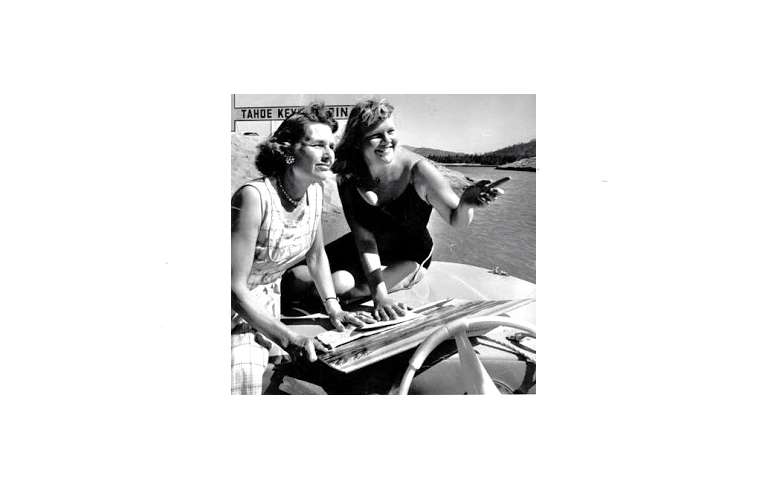
Erline Christopherson, right, with her mother, Elizabeth. Photo/Provided

Erline Christopherson, right, with her mother, Elizabeth. Photo/Provided

When I was 14, I told dad I was ready to start training for distance instead of racing. I read any book I could find on distance swimming, but nothing told what to eat or grease with, or how to train. I was pretty frustrated, but determined. I started swimming laps for hours at a time at the pool, then going to the Mokelumne River and swimming against the current. It was so strong I stayed in one spot for hours.

Mom came up with broth and sugar water. She would cook a roast for hours and then pour off the pure broth. We decided on a Honey Bear squeeze bottle as my drink dispenser.

About a month before each swim, the Thurmans would let Fran, my friend Mary DeMartini and me stay at the cabin. This way I could adjust to the altitude and practice in the lake. I would swim to the mouth of Emerald Bay and then go around the island and back down each morning. Fran and Mary would row the little boat beside me. At that time, there was no traffic on the lake like today.

Dad did not tell me the exact day I was going to swim because he was afraid I wouldn’t sleep. I knew, sort of, because I would swim the width a few days before trying the length to see if I was ready. Dad had decided that we could use the grease he used on the wheel hubs of his hay baler, so that was that. Now, getting it off was another story.

Walt Little, editor of Lake Tahoe News (which was a print publication with no affiliation to the online LTN), interviewed me for his column Little Quotes and KHVR-FM radio (located with the newspaper office). He was very nice to us, as was everyone. We went to the Coast Guard station to ask permission to swim, as we didn’t know if there were rules against it. The people there were very kind, saying they couldn’t give us permission, but the lake is so big they wouldn’t look for me.

My first attempt was Aug. 30, 1961 at age 15. We started at Bijou Beach straight up the state line to Cal-Neva Lodge. Just one mile from shore the Coast Guard came out to get me. We had been fighting storms for five hours and dad’s boat was swamped. They were bailing water. I had been in the water 18 hours, being pushed backward with waves hitting me in the face and over my head. There were times I was down in the slough of a wave so high dad couldn’t see me. It was getting dangerous for everyone. Dad said, “This great lake really gave us a beating.”

So, at age 16 we did all the same practices, but decided to go north to south and come in at Tahoe Keys, which was just being built. We hit storms again. About 3 miles out I was battling waves and swimming straight up and down. Colette, my sister, dived in and coaxed me out. I had been swimming 16 hours and mom was seasick.

Three weeks later, dad decided he had the answer — we would start earlier. It was now or never. On July 29, 1962, we started at 2am to beat the storms. It was scary to swim in the dark all alone. Dad tried to keep a spotlight on me. We were all anxious for dawn to break. Fran sang songs, making up words that were about me. Her voice was so beautiful, echoing over the lake in the stillness of the morning. She gave me comfort in the darkness of the night.

Wes Stetson, Thurmans’ neighbor at Tahoe, had a seaplane and gave tours over the lake to tourists. His daughter, Sierra and I were friends. He flew over and landed, telling dad he was following the shoreline and I was swimming farther than I had to, also telling us when I was in a current and going backward so I could change my stroke.

This time our goal was North Shore. The storms started rolling in around 3pm, so we headed for Dollar Point. The water was so clear I could see the bottom; 30 feet down. Finally, after 13 hours, 37 minutes, I was on the shore. The waves were so rough dad had to bring the boat in a quarter mile down shore. I walked to the boat with everyone beside me. It was a wonderful feeling.

Sacramento sportscaster Stu Nahan came a few days earlier and took pictures of us playing and training in Lake Tahoe. After the swim, he interviewed me. It aired on the 11pm news so I never got to see it — it was past my bedtime and I was not allowed to stay up. I was treated no differently than my sisters — there were chores to do on the ranch and mine were still mine.

I love Lake Tahoe — the most beautiful lake in the world, in my opinion. Its waters comfort me, like being covered in silk. I love to stand and just look at its beauty.


7 candidates qualify for SLT council election

South Lake Tahoe will have seven people to choose from in November to fill the three City Council seats.

Incumbents Tom Davis, Brooke Laine and Angela Swanson are on the ballot. Former Councilman Bruce Grego, former candidate Austin Sass, and newcomers Wendy David and Matt Palacio round out the field.

Suzie Alessi is running uncontested for another term as city clerk. Dave Olivo has no challengers to retain his seat as city treasurer.

El Dorado County Elections Department had not updated its list so Lake Tahoe News is refraining from listing candidates for other South Shore races until it is complete.


Kingsbury Grade road restrictions returning

With recent completion of reconstruction work on the bottom, commercial section of Kingsbury Grade, the Nevada Department of Transportation  is on schedule in advance of the September closure to through traffic.

Since the project’s start in May, nearly 1.5 miles of roadway have been reconstructed, including excavation of nearly 7,000 cubic yards of old road and placement of 10,300 tons of new asphalt. Thus far, 1,400 linear feet of storm drain pipe have also been installed. Road reconstruction and paving work from the base of the highway at Highway 50 to Pine Ridge Drive was completed at the end of July.

Roadside work such as signage, utility and drainage improvements will continue, with single lane closures and delays of up to 30 minutes during overnight hours through August.

Beginning Sept. 2 to October, Kingsbury Grade will be closed to through traffic near the summit, just east of Tramway Drive. During that time, non-permitted through traffic will not be able to travel through the Kingsbury summit area between Lake Tahoe and the Carson Valley. Residences and businesses located on Kingsbury Grade will continue to be accessible in via Highway 50.


Stranded fish rescued in Truckee River

By Associated Press

RENO — Volunteers joined Nevada wildlife officials this week in a rescue mission to save thousands of stranded trout and other fish from irrigation ditches that have been cut off from Truckee River water supplies due to drought in the Reno area.

Two dozen wader-clad rescuers splashed through the knee-deep ditches that soon will be going dry, netting an estimated 6,000 fish over two days.

Most were returned Wednesday to the Truckee River near Verdi, just west of Reno, where a rare stretch of wet August weather helped boost flows the past few days with more than an inch of precipitation.

Wildlife officials say the moisture helped, but it doesn’t put much of a dent in the lingering drought, now in its third year.

“We’re trying to make sure the fish in there get a second chance,” Nevada Department of Wildlife spokesman Chris Healy said.

“Nobody likes to see a natural resource go to waste. We would have seen a lot of fish go to waste,” he told the Reno Gazette-Journal.

The Truckee Meadows Water Authority shut off flows last week to the ditches that deliver river water to power generation and hydroelectric plants the authority operates.

“With the drought conditions, the water is going to disappear from these canals,” said Kim Toulouse, volunteer program manager for the state wildlife agency. “All the fish that are in the canals are basically stranded.”

The fish salvage was just one action state officials have been forced to pursue due to the unusually dry conditions. NDOW began plating trout raised in its Mason Valley hatchery into the river and the area’s urban ponds in February, the earliest time in 20 years.


Musician reflects on how S. Tahoe shaped her

Nikki G credits her Tahoe roots for her music success. Photo/Callie Giovanna

Nikki G credits her Tahoe roots for her music success. Photo/Callie Giovanna

By Jen Marchain

Henry David Thoreau said, “Go confidently in the direction of your dreams. Live the life you’ve always imagined” – a simple sentiment so often difficult to achieve in such a consumable world of distraction and strife. But for South Lake Tahoe native Nikki Grant, she is keeping it real and all in perspective.

A rare soul, Nikki G (as she is known) is an artist and powerhouse percussionist, performing in front of thousands of people in acts like Street Drum Corps, Katy Perry, 30 Seconds To Mars, Family Force Five and many more. She’s charged toward her dreams with wild abandon, successfully connecting her creative ideas to its intended target while all the while never losing sight on the foundation that got her there in the first place – her spirit of family and home.

Tell me about your first memory of playing music?
Nikki G: On the long stretch of California driving from Northern California to Southern California, my family would fill the eight-hour journey with car songs and show tunes. I had a part specifically designed for the young age of 1, 2, 3 and 4. I remembered by the age of 4 being excitably anxious as my family sang a capella harmonizing to songs like “Winter Wonderland” and waiting patiently to add my musical contribution.
As I entered the world of ensembles I remember my first elementary school concert, specifically the moment when the band director announced me as the youngest member. I was so small that when I was introduced I had to lift my mallet high above from behind the concert bass drum in order to be recognized.

Q: How influential was music in your family?
A: I was born straight into a musical family starting with the matriarchs, being my grandparents. Their children who would soon have children and then great-grandchildren made the musical family ignite. Even most of those married in were musicians; there was never a dull moment at family reunions. Some refer to my family as the new age, “Partridge Family.”

Q: What was it like growing up in Lake Tahoe?
A: The beauty that surrounds those who are born and raised in Lake Tahoe is immeasurable and somewhat distracting. In any upbringing it’s only a matter of time before you start to discover there’s an outside world. The enrichment that Tahoe provides from the education system, the outdoor education and the closeness of the community is part of the fuel that gave me, a small town girl, the courage to set out and capture the dream.

First and foremost my musical family gave me my foundation in music and in life but the Lake Tahoe Unified School District arts program further fostered my hopes and dreams. The music program gave the essential environment needed to not only prepare me for my future career but truly gave me an outlet that fostered my life’s dream. Not only did my family and friends support my musical likings but so did my band directors as did my peers. I was very fortunate to be known in my community as, “The Little Drummer Girl.”

I cannot emphasize enough on the importance of arts in the community of South Lake Tahoe. I know for a fact my life could have been drastically different and I can guarantee many of my musical/art program peers would feel the same. There are a handful of us out in the world making our musical dreams come true and I hope there are many generations after us that can state the same affirmation.

Q: Who were your earliest mentors?
A: My earliest and most important mentors were my family members, offering a vast variety of everything from classical pianists, musical directors, band directors, percussionists to DCI Drum/Bugle Corps.

My mother and father took great care to foster and nurture my musical journey, teaching me the foundations of music while doubling on piano and percussion. I was very fortunate to have the best of two worlds, my mother being a classical pianist and my father being a musical director/vocalist. I was not only able to receive a high education in music, but I had many outlets to express my art through recitals, festivals, musicals, and much more. In fact, my first experience on the road, at the age of seven, touring was with my parents performing in the musical “Godspell”.

As I branched out beyond my family, I was very fortunate to be able to work with many phenomenal musicians and instructors. Some of which were band directors JJ Clause, Linda Kurek and drum instructor Eric Hellberg who still provide richness in the arts to the community of South Lake Tahoe. I also had the rare opportunity to work under the direction of one of the greatest mentors of my musical life, Brian Farnon, who worked with many of the musical greats such as Spike Jones.

Every person, and many more, plays an important role in the community of South Lake Tahoe. They have all supplied generations with the vast knowledge of the arts that ended up to be the start of many musicians’ careers, including my own. With my mother and father reaching into their fourth decade of commitment to the community and many more who have dedicated with them and before them, South Lake Tahoe is a resource that will become a great example of the benefits of the arts not only in the education system but for all communities.

Q: What influences or inspirations (or experiences) did you gain in your childhood that pushed you forward in your career?
A: I can remember the very moment and the very place that I realized my dream. It was in the third grade on the playground at Tahoe Valley Elementary School, atop the metal igloo after school staring at the clear blue sky saying to myself, “I want to be a musician. I want to play in a band with all of my friends and help people feel happy.” Even though the definition was childlike and I didn’t have any knowledge of what that dream truly contained, my heart was set on sharing the healing powers I received daily from music with as many people as my lifetime would permit.

Q: What barriers have you faced in your career?
A: Coming from a small town I was able to have a lot of hands on experience through the arts, especially since Lake Tahoe was a hub for outside touring acts. I was surrounded by musicians two or three times my age, which became a very welcoming and fostering environment. Even though I was very blessed with an incredibly supportive family and community, nothing could have truly prepared me for the outside world. I had to merely experience stepping out of the safety bubble, called home, for myself.

I not only faced the change in culture, the realities of the industry, but the nature in which it stood, which wasn’t always a good nature.

Unfortunately the dream that shined so bright was being darkened by challenges I couldn’t have foreseen. As time went by, traveling city to city, I couldn’t have pre-determined the capacity of struggles, heartache and turmoil I was about to experience.

Every artist has a story, even when the media and the magic of Hollywood make someone seem like an overnight success, it’s usually not true. If you take the time to find the real story, you’ll see much more than the overnight magic; everyone has a story. I was on the road, making my story and having the highest highs and the lowest lows. I was adjusting being away from home, family and friends, which is still a hardship, but it’s because of the support of all of those aspects that I wasn’t beaten down by the, sometimes scary, outside world.

Even though the majority of the time I was faced with being the only female drummer, having to pass up amazing opportunities due to not being male, knowing no one, learning how to become street smart, facing fears daily, and feeling very overwhelmed; I truly believe my absolute love for music, the unwavering commitment of my supporters and my hometown brought me to where I am today, which is full of accomplished dreams. All of us have barriers in many different ways whether it’s an internal or external factor. But I truly believe that each of us has some passion, a desire, something that pulls at our heartstrings and we only have one life to embrace the dream. Tomorrow is never promised, so live your dream today.

Q: Your album “heART” seems profoundly tethered to your soul. As an artist, how do you prepare yourself to create something so personal and why is it important for you to share it broadly through art?
A: “heART” came about at a time of artistic struggle. I’d been experiencing a lull in my creative spark and I was coming to an age of realizing I had nothing to call my own. I wanted to tap into a part of musical soul, which had been left untouched. So I did what I thought was most beneficial, I took a summer off and went home.

Every time I would go home it would bring back so many memories from my past, especially since my parents left my childhood bedroom exactly the same. Going home for the summer not only put me in a supportive environment, but making my old room into a studio to compose was the best environment to feel safe enough to face my musical fears. Writing for any artist based on the naked truth within your soul is scary, especially when you have no idea what will come about. I had no clue; in fact I had trouble with the process for quite some time.

I’d worked so long in different groups, living in the Hollywood scene that I had somewhat been molded into what every different gig required and not allowed to flourish being just, me. At first I thought I’d write the next top hit or pop/rock song, well those were so forced that it made the process of composing got more frustrating. It wasn’t until I reached out to my parents that I started to truly tap into tethering my soul.

I remember my mom saying, “You can’t force yourself against what’s innately in you, if you just let the music naturally flow it will be perfect because you’ll be expressing the honest truth inside your heart.” My dad would sit down and make lyrics up, purposefully write a humorous song just to get me out of the boxed mindset and to instill one of the most important aspects of creating, which is the enjoyment of the process.

Without being home, without my parent’s guidance and my musical journey up until that point, “heART” wouldn’t have existed. It was proof that all good things take time; you can’t rush the real deal.

I put myself in a safe zone, surrounded by those who could help me thrive whether musically or spiritually and from there on out I made myself one promise; to be myself, to hold no bounds, and to let my heart be heard.

Q: You’ve had a lot of success with the Street Drum Corp project. What other things are you working on these days?
A: I’ve had the pleasure of working with Street Drum Corps for the past eight years; it’s been quite an adventure.

I never thought I’d be touring the world, playing for thousands, let alone being on television doing what I had been doing with close friends at South Tahoe High starting at the young age of 15. I created a Trash Can Trio at South Tahoe High and we quickly became the feature at rallies, games, concert and events. We also occasionally got in trouble for making loud music is how I would choose to describe our sound of metal trash cans, poles, fences, etc., around campus. I could have never foreseen making a living off of what was construed as ruckus, chaos, but all in the same, music.

In the music world I’m defined as an independent artist or freelance artist, which allows me to work in many different projects. I’ve played with many acts in and around the Los Angeles basin, have worked in the studio recording everything from albums to soundtracks, and have even had the privilege of composing and performing on the big screen for an internationally released commercial for the Starz Channel. All in all, I believe an artist’s life never stands still and as time progresses so will my projects. The artist never stops; it’s a blessing and a curse.

Q: What is the overall message you hope to convey in your music and your style of playing?
A: I have a deep passion for music, no matter what genre or what type of music I perform. My goal is to break the barrier we sometimes place between audience and performer because to me it’s not about the show, it’s about the story, it’s how the music makes you feel and the communication that has more power than you may realize, the power to unite. The message I’ve always tried to convey is the message of unity. Music is innate in each of us and I’ve experience and see the healing powers of music throughout my whole life.

Even as I stared up at the sky at Tahoe Valley Elementary School, with stars in my eyes, I could have never imagined all the dreams within a dream that have come true. I’ve learned that although you may have a dream, your perseverance and hard work will lead you toward the unimaginable. It happened to me it can most definitely happen to you. I feel very fortunate and proud to be from South Lake Tahoe and to be able to affirm that my dreams have come true, a dream that at one point seemed impossible. Coming from a small town one might think the possibilities are limited, but I hope that my life can be proof that no matter where you’re from life is limitless.