Time to figure out what you’ll spend in retirement

By Jeff Gorton

Age 85 is a bad time to go broke.

Budgeting how you spend money before retirement can often be a misleading measurement of how you’ll actually spend it during retirement.

Spending 40 hours a week at work not only earns you a paycheck, it also keeps you from spending money on more vacations, matinee screenings at the movie theater, extra trips to the mall or shopping online. You need to be exceedingly realistic in your planning, and the five years before retirement are actually the most crucial in solidifying post-employment stability.a

To prevent a rude awakening during retirement, Gorton makes certain his clients start with a written income plan (WIP). He reviews the benefits and importance of this “living document”:

• A comprehensive list of life expenses paints a clearer picture. For a 65-year-old married couple today, there is a 72 percent chance that at least one spouse will live to age 85; a 45 percent chance that one will live to age 90, and an 18 percent chance that one will reach age 95, according a recent study from the CDC National Center for Health Statistics. You may not think of listing things like pet care, yard maintenance, and regular visits to salons or spas. But if you enjoy those services now, you may want them during retirement, and you might find that you underestimated the real cost of maintaining your desired lifestyle. And, that’s not including gifts to children and grandchildren.

• The forecast of a two-legged stool. A WIP helps you appreciate the reliability of retirement income. What sources of income do you anticipate having? Traditionally, retirement funding has been viewed as a “three-legged stool,” implying a balance between Social Security, retirement plans and savings/investments. As the Baby Boom generation ages, Social Security benefits may decrease — and the age at which an individual can collect benefits may increase. Changes in employment may affect retirement plans. As a result, the third leg of the stool, savings/investments, may become even more important.

• Who is authoring your WIP? As with all written documents, you must always consider the source. What you may not realize is that a financial planner is liable to have a stake in selling you a financial product. Just like a retailer may have an incentive to move certain brands of products, many planners are incentivized to have you invest in specific financial vehicles from major institutions. What plan works best for you? Seek advice from an expert who isn’t trying to sell you something, such as an independent firm.

If you don’t have a written income plan, then you’re just hoping things will work out.

Jeff Gorton is a certified public accountant and a certified financial planner specializing in individual tax and retirement planning.



Volunteers needed for Lake Tahoe Marathon

The Lake Tahoe Marathon needs a few more volunteers to help pass out T-shirts and race numbers on Sept. 27 and Sept. 28 at the expo located inside the Lake Tahoe Resort Hotel in South Lake Tahoe.

Interested volunteers may call Les Wright at (530) 559.2261 or show up at the volunteer meeting on Sept. 25 at 5:45pm at the hotel.


Drive-through flu vaccination clinic available

The El Dorado County Health and Human Services Agency, Public Health Division is conducting a drive-through community flu vaccination clinic on Sept. 26 from 1-4pm at the El Dorado County Fairgrounds, located at 100 Placerville Drive in Placerville.

People can get their flu vaccine while staying in their cars.

The cost of the vaccine is $10, but no one will be denied service due to inability to pay; cash or check accepted. Seniors and other high risk individuals are especially encouraged to get vaccinated.

The flu vaccine will be offered in both the shot and nasal mist forms. The nasal mist flu vaccine can be given to healthy, non-pregnant individuals who are 2 through 49 years of age. Parents should bring their child’s immunization records.

The Public Health Division will be conducting additional low-cost community flu vaccination clinics during October and November. For a complete list of flu clinic dates and locations go online or call (530) 621.6188.


Farmers question what weed killers do to soil

By Stephanie Strom, New York Times

ALTON, Iowa — The puny, yellow corn stalks stand like weary sentries on one boundary of Dennis Von Arb’s field here.

On a windy day this spring, his neighbor sprayed glyphosate on his fields, and some of the herbicide blew onto Mr. Von Arb’s conventionally grown corn, killing the first few rows.

He’s more concerned, though, about the soil. During heavy rains in the summer, the runoff from his neighbor’s farm soaked his fields with glyphosate-laden water.

“Anything you put on the land affects the chemistry and biology of the land, and that’s a powerful pesticide,” Von Arb said.

But 20 miles down the road, Brad Vermeer brushes aside such concerns.

He grows “traited,” or biotech, corn and soy on some 1,500 acres and estimates that his yield would fall by 20 percent if he switched to conventional crops and stopped using glyphosate, known by brand names like Roundup and Buccaneer.

In short, it is just too profitable to give up.

“Local agronomists are starting to say we have to get away from Roundup,” Vermeer said. “But they’re going to have to show me that conventional genetics can produce the same income.”

The local differences over glyphosate are feeding the long-running debate over biotech crops, which currently account for roughly 90 percent of the corn, soybeans and sugar beets grown in the United States.

While regulators and many scientists say biotech crops are no different from their conventional cousins, others worry that they are damaging the environment and human health. The battle is being waged at the polls, with ballot initiatives to require labeling of genetically modified foods; in courtrooms, where lawyers want to undo patents on biotech seeds; and on supermarket shelves containing products promoting conventionally grown ingredients.

Now, some farmers are taking a closer look at their soil.

Read the whole story


Snippets about Lake Tahoe

motorcycle • When motorcycle and bicycle riders are stopped at a traffic signal, they may be unable to trigger a green light to proceed. Starting Oct. 1 in Nevada, if cyclists have waited for two traffic light cycles, they may legally move through the intersection on red, but only after safely yielding to pedestrians and other traffic.

• A federal appeals court ruled that New Jersey cannot legalize sports gambling.

• The seventh annual Poker Run to benefit Austin’s House raised nearly $10,000 to help local children in crisis.

• El Dorado County Elections Department will be observing National Voter Registration Day on Sept. 24 by setting up tables and chairs outside Building C in Placerville to register people or people may do so online.

• South Lake Tahoe’s dog agility equipment at Bijou Dog Park will be unveiled Sept. 22 at 1pm.


Dates on food products confuse consumers

By Mary MacVean, Los Angeles Times

Ted Labuza ate sour cream on Tuesday that was two weeks past its due date. And lived to tell the tale.

Dana Gunders went to the market and found fat-free milk in quarts that had no date label; the half-gallon had a “sell-by” date, and another container from a different brand had a “best-by” date.

Even though nearly all consumers make some decisions about what to throw away based on those stamped dates, they cannot rely on them, said Gunders, food and agriculture staff scientist at the Natural Resources Defense Council.

She is the coauthor of a report issued Wednesday by the NRDC and the Harvard Food Law and Policy Clinic.

Those dates are manufacturers’ suggestions for when an item is at its peak, or are efforts to help stores manage their inventory — not indications of food safety, the report says.

Read the whole story


LTCC engages locals to pave future path

By Kathryn Reed

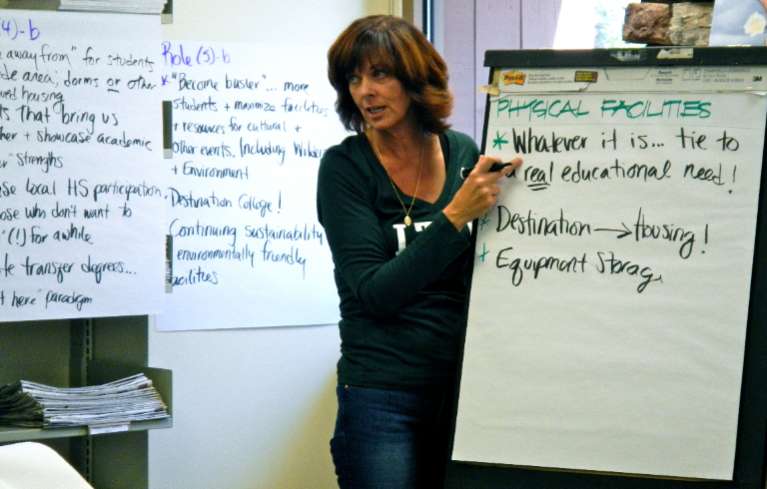
Build dorms. Be a cultural center. Become a destination college. Be an economic engine for the community. Provide students with the skills local businesses need. Keep classes for lifelong learners.

Those are some of the overriding themes that emerged from a daylong visioning session at Lake Tahoe Community College.

More than 90 people spent the better part of Sept. 20 addressing six main issues. Nearly half in attendance work at the college, with the remainder being community members, K-12 representatives from both sides of the state line, agency folks, and businesspeople. The emphasis was to find out what they want the South Lake Tahoe institution to look like in 2020. The attendees were divided into groups and then reconvened in the afternoon to go over what each had come up with.

First the participants individually answered questions and then discussed them as a group before presenting responses to everyone.

Virginia Boyar, LTCC dean of Career and Technical Education, leads one of the groups Sept. 20 in coming up ideas of the college's future. Photo/Kathryn Reed

Virginia Boyar, LTCC dean of Career and Technical Education, leads one of the groups Sept. 20 in coming up ideas for the college’s future. Photo/Kathryn Reed

Questions were:

• What role does LTCC have in the community? And what does the community need LTCC to become?

• Who are the students of LTCC? Who should we be serving that we are currently not reaching? What does the student body of LTCC look like in 2020?

• What are the educational programs that LTCC should offer? What signature programs should LTCC be known for? What are the workforce training needs of this community? What are other community needs that LTCC can help address?

• What does the learning environment of the college look like in 2020? What technology should the college have to support the educational programs laid out?

• What does the LTCC campus look like in 2020? What new buildings does it have? What is housed in those buildings?

• What are sources of revenue for the college? What are the opportunities that the college needs to be aware of? In what ways is the community willing to work together with the college to make this vision a reality?

“Overall it was very rewarding to see all the energy in the small group sessions. People truly have a vision of what they believe Lake Tahoe Community College should look like in 2020,” LTCC President Kindred Murillo told Lake Tahoe News after the day was over. “We accomplished what we set out to do which was to learn how people see the college in the future. The faculty, staff, and board of trustees will work very hard to make Lake Tahoe Community College that ‘center of the arts, cultural, and educational activity’ for the south Tahoe basin.”

Friday’s community message will be massaged in the coming months, with the plan for a more defined vision to be unveiled June 7 when the college celebrates its 40th anniversary.

Murillo started the day by saying the reason for the visioning was primarily for the students. Then she added, “If we don’t know where we are going, how do we get there?”

She went into detail about the changing demographics of the college – a good thing, she said, because it’s starting to better mirror what the community looks like.

Murillo touched on how the state funds community colleges and how many of the classes people like to take – arts and physical education – aren’t reimbursable by the state so they can’t be offered in the way people have been used to. The lifelong learners are not part of the state’s plan anymore – in many ways Sacramento has removed the community part of community college.

But LTCC is striving to find a way to retain that community element.

Certificate, associate of arts or even bachelor degrees in disciplines that lead to jobs in Tahoe was an overriding theme in groups. Expanding the fire academy into an AA and incorporating it into a larger public safety program has been talked about on campus. Creating programs involving environmental sciences, snowsports, hotel and restaurant management, and forestry were broached in the visioning workshop.

Some people foresee the bulk of classes being offered online in the future, while others aren’t sure the traditional teacher-classroom will go away.

LTCC staff members are in different places when it comes to what the future will look like. Some were shocked to learn how technologically evolved K-12 is on the South Shore.

“Some of the best teaching I see is a teacher going from an interactive white board to YouTube to slides to a child’s presentation,” Lisa Noonan, superintendent of Douglas County School District, said. “They’ve used six or seven different devices by the end of class.”

Lake Tahoe Unified Superintendent Jim Tarwater said how students in second grade are learning how to do PowerPoints.

In a different group, it was agreed that standing at the front of a classroom lecturing ad nauseam is not going to work with the students entering college today. Simple things like having round tables instead of traditional individual desks was suggested.

More than once it was suggested that any new building should meet LEED certification to be environmentally the best it can be.

Student safety, improved parking, providing technical language classes for English learners, allowing corporations to have naming rights to buildings or facilities to raise money, being the thread that binds the community – those were just a few of the suggestions or areas to focus on that came out of the visioning session.


Certain foods may combat Alzheimer’s

Today is World Alzheimer’s Day.

Studies continue to show a healthy diet and exercise can reduce the risk for Alzheimer’s, in some cases by more than 50 percent. Blueberries, a top brain food, are rich in anthocyanins and shown to improve learning and recall in studies at the University of Cincinnati.

Clinical researcher Neal Barnard is an advocate for starting the day with foods that strengthen memory. The following recipe is from Jason Wyrick.

Breakfast Smoothie (Serves 2)

1 very ripe banana (with plenty of brown speckles)

2 C frozen fruit (such as berries, mangoes, strawberries, banana, orange, and pineapple)

1 C nondairy milk (almond milk or soy milk)

Combine all the ingredients in a blender. Start your blender on the lowest setting and slowly crank it up as the smoothie starts to puree. If you start with your blender at high, you’ll end up with smoothie splattered all over the top of your blender and probably will have to stop your blender several times to get the smoothie ingredients to rest back on the blades. Once you’re up to optimal speed, blend for about 2 minutes to get everything smooth.


Editorial: GOP acting spiteful

Publisher’s note: This editorial is from the Sept. 19, 2013, Sacramento Bee.

House Republican leaders have shown how far they are willing to go to cave to the tea party faction. They signaled on Wednesday that they are willing to shut down the federal government if they don’t get their pipe dream to defund Obamacare.

They simply are unwilling to acknowledge that the Patient Protection and Affordable Care Act, which they call Obamacare, is the law of the land.

Those under age 65 who don’t get health insurance through their employer, Medicare or Medicaid will be able to enroll in an “exchange” starting Oct. 1 to buy health insurance that starts January 2014.

Many other provisions already have taken effect. Congress passed and President Obama signed Obamacare into law in 2010. The U.S. Supreme Court upheld the constitutionality of the law in June 2012.

Read the whole story


Local authors to unite at Douglas library

The Douglas County Public Library is bringing local authors to the Minden branch on Oct. 2 from 4:30 to 6:30pm.

This free event will feature appearances by Todd Borg, Mike White, David Antonucci, Gary Cage, Bob Chambers, Luke Hart, Ron James, Sandie La Nae, Christy Olesen, Josée Perrine, Jodie Ruana, and Luther Watson. They will sell their books, meet readers, and sign autographs.

The library is located at 1625 Library Lane in Minden. For more info, call (775) 782.9841.