College grads working where a degree not required

By Alana Semuels, New York Times

In a packed pub in midtown Manhattan, Ryan Flagherty is surrounded on three sides by people clamoring for his attention.

He spins one way and pours a shot of vodka into a glass, then turns around and wedges a lime into a bottle of Corona, pushing it across the counter. Ignoring the annoyed gaze of a bulky man on his right, he turns again to a touch-screen register to ring up the sales.

It’s just a minute out of the grueling, physically demanding eight-hour shift that will last long into the night. But Flagherty, 28, isn’t complaining.

With the generous tips of New Yorkers and his pick of shifts, he pulls in around $80,000 a year as a bartender. It’s more than he was offered for various office jobs he considered when he arrived in the city, even though he’s highly educated.

“I have a master’s in economics and I’m bartending in New York,” he said with a shrug. “It’s a good way to make money.”

A college degree once all but guaranteed a well-paying job and higher earnings than high school graduates. But fewer of these good jobs are now available because of both long-term economic changes and the lingering effects of the Great Recession.

Read the whole story


Snippets about Lake Tahoe

basketball• Registration is open for this year’s Youth Basketball League at Kahle Community Center in Stateline. For more information, call (775) 586.7271.

• South Tahoe Alliance of Resorts donated $5,000 to Christmas Cheer in South Lake Tahoe.

• Here is the Sierra roadwork schedule from Caltrans for the coming week.

• The Optimist Kid’s Fun Run is Sept. 28 at 2pm at Pope Beach. There are races for infants to 13. For more info, contact Terry Powers at (530) 545.2087

• The Squaw Valley Design Review Committee, an advisory board for the county supervisors and the Planning Commission is seeking applicants to fill three open seats. Click here for an application.


Calif. expands rights to noncitizens

By Jennifer Medina, New York Times

LOS ANGELES — California is challenging the historic status of American citizenship with measures to permit noncitizens to sit on juries and monitor polls for elections in which they cannot vote and to open the practice of law even to those here illegally. It is the leading edge of a national trend that includes granting drivers’ licenses and in-state tuition to illegal immigrants in some states and that suggests legal residency could evolve into an appealing option should immigration legislation fail to produce a path to citizenship.

With 3.5 million noncitizens who are legal permanent residents in California, some view the changes as an acknowledgment of who is living here and the need to require some public service of them. But the new laws raise profound questions about which rights and responsibilities rightly belong to citizens over residents.

“What is more basic to our society than being able to judge your fellow citizens?” asked Jessica A. Levinson, a professor at Loyola Law School, referring to jury service. “We’re absolutely going to the bedrock of things here and stretching what we used to think of as limits.”

Read the whole story


Fall starts off with snow on higher peaks in Tahoe

Heavenly Mountain Resort's tubing hill's first snow of the season. Photo/Provided

Heavenly Mountain Resort’s tubing hill’s first snow of the season. Photo/Provided

With the thermometer in the 30s this morning, it’s going to be a chilly Lake Tahoe Ironman. By 7:30am Sunday the first swimmers were out of the water.

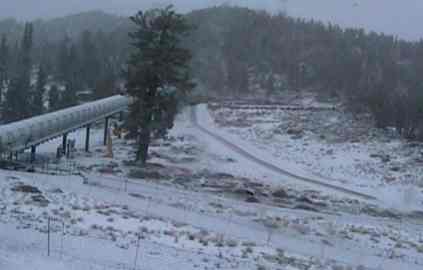
For their bike and run in the Tahoe-Truckee area the athletes will get to see snow on the higher peaks in the Lake Tahoe Basin.

A quick one-day storm brought snow to the higher elevations, but flakes were also reported falling in Meyers. Most of the basin was soaked by rain on Saturday.

It’s only supposed to hit 59 degrees today as a high, but it should be 70 on Monday on the South Shore.

A chance of snow returns to the forecast Wednesday night into Thursday.

— Lake Tahoe News staff report


Then and now: S. Tahoe retains beach ownership

old-lede

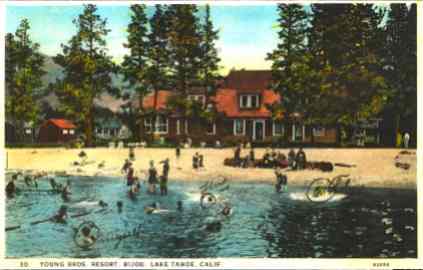
This postcard of Young’s Resort is courtesy of Theresa and Darrell Eymann.

old

Lake Tahoe shoreline, circa 1930. Photo/Lake Tahoe Historical Society Museum

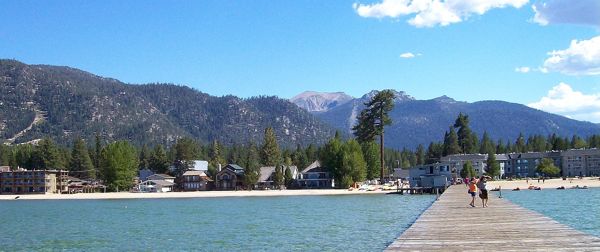
Young’s Resort stood where today what we identify mostly as Timber Cove and the historic Conolley’s in South Lake Tahoe.

The hotel was recently renamed Beach Retreat & Lodge.

Today’s 700 foot pier at the city-operated Conolley Beach is the longest pier on Lake Tahoe.

— Bill Kingman

Circa 1930s. Photo/Lake Tahoe Historical Society Museum

Circa 1930s. Photo/Lake Tahoe Historical Society Museum


Lake Tahoe shoreline 2013. Photo/Bill Kingman

Lake Tahoe shoreline 2013. Photo/Bill Kingman


Network of Lake Tahoe bike trails increasing

By Kathryn Reed

TAHOE CITY – Piece-by-piece agencies in the basin are putting together a comprehensive bike trail system with the goal of eventually being able to ride a bike around Lake Tahoe on something other than a state highway.

At this month’s California Tahoe Conservancy meeting the board awarded $500,000 to the Tahoe City Public Utility District to build a one-mile section in Homewood that will link Tahoe City with Sugar Pine Point State Park.

TCPUD has 22 miles of trails that are well used. It’s estimated 400,000 people are on the paths each year. And there are only 7,000 permanent residents in the area.
Today cyclists must ride next to traffic in Homewood. That will change next summer. Photo/LTN

Today cyclists must ride next to traffic in Homewood. That will change next summer. Photo/LTN

Most of the new trail will be Class 1, meaning it will be separated from traffic. It will be 8-feet-wide, with 2-foot shoulders. Part of the trail will be Class 3, meaning next to a vehicle lane. This is when it veers off Highway 89 and goes onto San Souci Terrace.

A new bridge will also be built to cross Madden Creek.

The plan is for the trail to be constructed on the west side of the highway in 2014. This will be concurrent with a Caltrans water quality project.

The total cost of this one mile is $1,557,970. The North Lake Tahoe Resort Association has contributed $600,000, the Tahoe Fund $34,375 and Placer County $25,000. The remaining nearly $400,000 is expected to come from a grant, additional county park fees or TCPUD capital funds.

The trail will be striped in front of Homewood Mountain Resort. If JMA Ventures, the property owner, redevelops the resort, then it would be mandated to put in a more formal bike path to complement what will be constructed next summer.

Also on Sept. 19, the CTC board agreed to award Placer County $500,000 for it to buy a 19.5-acre parcel from NV Energy that will be used for the Dollar Creek Shared-Use Trail project.

The 2.2-mile section of trail will tie into the TCPUD’s 22 miles of trails on one end and to Kings Beach on the other.

Connections beyond the parcel that was just bought will involve the U.S. Forest Service because that is where its ownership begins.

Larry Sevison, board chairman, said Northstar is interested in creating a loop that would link up with the newly acquired property.

There is also a cross country ski resort that abuts the parcel.

“We are talking to the ski center. There is a bridge crossing Dollar Creek that could be upsized for their groomer,” Jon Mitchell with Placer County told the board.

This means the trail could become accessible year-round.

The first priority is to get the trail built and then land ownership will be discussed. CTC, Placer County, California State Parks and North Tahoe Public Utility District all own a slice of where the trail will go.

The entire network of trails helped the North Lake Tahoe area in May to receive the League of American Bicyclists’ bronze level Bicycle Friendly Community.


Opinion: Cooperation key to saving Lake Tahoe

By Clem Shute

The unanimous passage of SB630 by the California Legislature marks the end of an era of controversy and the beginning of an era of renewed cooperation between California and Nevada. The passage of this bill means a renewed commitment by the two states to cooperate in achieving the environmental thresholds established by the Tahoe Regional Planning Agency.

It also ends the possibility that the 45-year-old agreement between the states to work together on Tahoe issues would cease. And, it gives the states’ support to TRPA in going forward with the recently adopted Regional Plan update.

How did we get here? Frustration over the inability of TRPA to update its Regional Plan manifested itself in the form of legislation passed in Nevada to withdraw from the Compact due in large part to the perceived gridlock in getting anything done. This frustration further showed when in August 2011 three United States senators and the two governors gave TRPA a deadline of December 2012 in which to update a plan which had remained largely unchanged since 1987.

Clem Shute

Clem Shute

In fairness to TRPA, efforts to update the plan had been ongoing for many years but a lack of consensus prevented action. In response to the deadline established by our elected leaders, TRPA began an intense effort to update the plan. A committee of the Governing Board held more than 15 hearings on possible provisions of an updated plan. Consensus was reached on some 90 percent of the issues but serious disagreements continued on major environmental policies. The two states stepped in and created a bi-state consultation process which was able to close the gaps and bring consensus for the updated plan.

It is important, particularly to me, that this consultation process resulted in increased environmental protections for Lake Tahoe without increasing the amount of development allowed. The Regional Plan update was adopted by the TRPA Governing Board on Dec. 12, 2012.

Both states have recognized the significance of the updated plan. They worked to remove obstacles to implementation of the new plan and set a course for renewed cooperation. Nevada repealed its law which threatened withdrawal from the Compact and California’s SB630 carries forth the agreement between the states to support TRPA’s efforts to improve the environment at Lake Tahoe.

However, we cannot break out the Champagne yet. A fly in the ointment in the form of a legal challenge by the Sierra Club must be overcome. That organization has done much to protect the environment over the decades. But, due to apparent misunderstandings on its part of what is in the plan, coupled with an attitude of full opposition unless it gets all of what it wants, the lawsuit is an obstacle to complete implementation of the Tahoe plan. I have urged the Sierra Club and anyone interested to look at the facts.

The strict growth controls that have been in effect since 1987 remain. Science has shown us that small particles released from pavement, old buildings and highways are a large cause for loss of lake clarity. The new plan emphasizes replacement of that infrastructure thereby improving lake clarity. Some 1,200 parcels are expected to be protected or restored. The number of new homes that can be built is reduced from 300 per year to 130. The plan will reduce reliance on the automobile and reduce greenhouse gas emissions as required by California’s SB375. There is an emphasis on removing development from environmentally sensitive areas. The new plan is not perfect but will achieve the environmental thresholds established by TRPA. It deserves the unfettered chance to be implemented without the cloud of litigation.

Now that Nevada and California have made an unqualified commitment to help TRPA, we at TRPA are poised to work together toward the common goal of a Lake Tahoe that remains as Mark Twain observed, “the fairest picture the whole Earth affords.”

Clem Shute is an appointee of California Gov. Jerry Brown to the TRPA Governing Board, was chair of the Regional Plan Update Committee, and is current chair of the Regional Plan Implementation Committee.


Placer County progressing with Tahoe plan

Placer County is continuing to update planning documents for the Lake Tahoe Basin as well a having public workshops and releasing two planning documents.

Now available are the Placer County Tahoe Basin Policy Document Existing Conditions Report and the Placer County Kings Beach Vision Plan.

The Existing Conditions Report analyzes environmental resources and hazards, and land use and infrastructure. The report also discusses items that need to be addressed as part of the County’s Community Plan Update and new Area Plans for the Basin.

The Kings Beach Vision Plan is part of the Tahoe Basin Community Plan Update. Both documents may be found here.

Also part of the planning update process is a series of public workshops. Input received at the workshops will help shape the Tahoe Basin Community Plan policy document. All workshops will take place in the North Tahoe Event Center, 8318 North Lake Blvd., Kings Beach:

  • Sept 25, 5-6:30pm. Topic: Conservation;
  • Oct 9, 5-6:30pm. Topic: Land Use, Community Design & Development Potential;
  • Oct 23, 5-6:30pm. Topic: Recreation, Public Services & Facilities;
  • Nov 6, 5-6:30. Topic: Transportation.

For more information, contact Crystal Jacobsen at cjacobse@placer.ca.gov or (530) 745.3000.


Live Violence Free looking for money

The 14th annual Sunset Gala to benefit Live Violence Free is Sept. 27 from 6-9pm.

The event is at Harvey’s Top of the Wheel. This is the biggest fundraiser of the year. Money raised provides funds for all of the organization’s programs and services offered to survivors of domestic violence, sexual assault and child abuse.

The night is used to celebrate the strength of survivors.

Tickets are $60 each. For more info, email info@liveviolencefree.org.


Census: Median income, poverty rate unchanged

By Annie Lowrey, New York Times

WASHINGTON — For the first time in half a decade, median household income did not decrease and poverty did not increase in 2012, the Census Bureau said in the release of a major annual report on poverty, insurance and earnings.

The report depicts an economy that has so far failed to improve the lot of most households, with growth failing to lift incomes and leaving about 46.5 million Americans in poverty.

Median household income, adjusted for inflation, halted its fall at $51,017, about where it was the previous year. That is down about 9 percent from an inflation-adjusted peak of $56,080 in 1999, though the real economy has grown about 28 percent since then. Income is also down about 8.3 percent since 2007, when the economy started to contract.

Read the whole story