LTCC board contemplates 2014 bond measure

By Kathryn Reed

The bulk of the buildings on the 164-acre campus of Lake Tahoe Community College have been funded by the state of California. But that might change next year.

For more than a year college board members have been discussing the possibility of asking local voters to pass a general obligation bond that would help create new facilities. John Palmer with Orrick, Herrington & Sutcliffe law firm discussed the legal implications, process and options with the board on Sept. 24.

At the Oct. 8 meeting the board will likely vote on a reimbursement resolution. This would not obligate the college to go forward with the bond, but it’s the next step in the process.
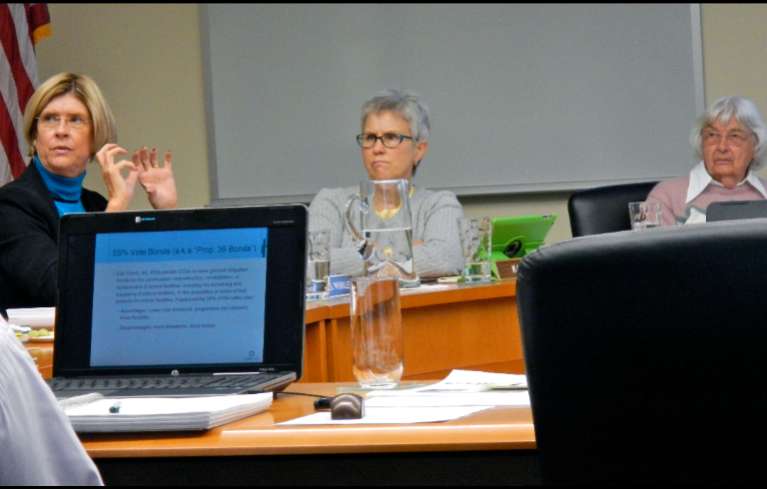
LTCC President Kindred Murillo, from left, talks as board members Karen Borges and Roberta Mason listen. Photo/Kathryn Reed

LTCC President Kindred Murillo, from left, talks about a possible bond as board members Karen Borges and Roberta Mason listen. Photo/Kathryn Reed

LTCC is one of eight college districts in the state to have never gone to voters with a general obligation bond.

The college is looking at possibly asking voters in November 2014 to approve a bond of probably no more than $38 million that would be paid back in 25 years.

The college has a list of $43 million worth of improvements, but doesn’t believe the higher amount is something the voters would stomach.

Another concern is the other tax measures that could be on that ballot. South Lake Tahoe is contemplating a snow removal tax hike and the local library is expected to ask voters to renew that tax.

When local voters went to the ballot in spring 1974 they agreed to tax themselves 72 cents on every $100,000 of assessed property value. (This was pre-Proposition 13.) Voters were asked to create the college district, approve the tax that would buy the land, and select the board members. (Roberta Mason and Fritz Wenck were on the original board and are still board members.)

Hazel Hoak, who was El Dorado County’s assistant superintendent of schools, became the interim president until the board that September hired Jim Duke to be the college’s first full-time president. (Hoak will be at the college’s 40th anniversary celebration in June.)

Classes started in fall 1975 at a motel on Highway 50. In 1988, the first building opened on the campus people know today. It is state dollars that have funded most every building on campus. There was a local capital campaign for the Haldan Art Gallery and library. The debt on that is paid for from money the college receives through redevelopment money and rent from the U.S. Forest Service.

And it is state money that would help LTCC achieve what it wants for the next decade. Kindred Murillo, college president, said the goal is to double what taxpayers approve through matching dollars from the state.

Today when the state gives money for facilities it expects the college to come up with half of the funds for the project.

LTCC is going forward with plans to make improvements. It has made the short list with the state for a remodel for efficiency grant. The bond money would provide the needed matching funds. The plan is to modernize the science lab, upgrade technology on campus and make energy upgrades.

LEED certified buildings were brought up at last week’s visioning session, which points to the community already wanting the college to be a leader in energy efficiency.

The college has also asked the state for money to build a public safety training facility. This would go close to where the U.S. Forest Service offices are. The college is also talking to city officials about this project because it could include a fire station. (The city has long wanted to update the outdated station across from South Tahoe Middle School.) It’s also possible the college site could be a command center in the event of a major emergency like the Angora Fire.

Murillo would like part of the safety piece to also include another exit point in case of an emergency. This might be via South Tahoe Public Utility District. Putting in automatic door locks and being able to communicate with every classroom in the event of an emergency are other foreseeable improvements. So are cameras in the parking lot.

Other facilities the college would like to construct include residential housing for students. A public-private partnership is possible.

An environmental science building could have multiple uses – including being a university center for a four-year program.

Another upgrade would be the possibility of creating an early childhood development center that could incorporate the Child Development Center on campus with Tahoe Parents Nursery School.

While a decision has not been made, the bond counsel on Tuesday touted the option of going the route where only 55 percent of the voters need to say yes. More requirements come with that type of bond compared to the usual two-thirds needed for a tax measure, but it can also be easier to pass.




Regional sports hall of fame to add 4 members

The Reno Tahoe Winter Games Coalition will honor premier sports figures and their endeavors at the third annual Reno Tahoe International Sports Hall of Fame dinner gala on Nov. 23 at the Atlantis in Reno.

The four inductees are:

· Pam Buckner: Born and raised in Northern California, Buckner moved to Reno in the early 1980s during the prime years of her career on the women’s pro bowling tour. By then her legend on tour had already been cemented.On Aug. 26, 1979, during a national tournament in suburban Detroit, Buckner became the first woman in competitive bowling history to roll back-to-back perfect 300 games. The lefthander captured numerous titles while also representing Ebonite as a national bowling equipment sales manager. She has coached hundreds of kids to bowl in Reno since moving here in 1981 and still does so at the High Sierra Lanes, which also hosts the annual Pam Buckner Open.

· Rusty Crook: Crook’s athletic endeavors started early. While attending Reno High School he became a state diving and pole vault champion. He was a member of the University of Denver NCAA championship ski team before returning to the University of Nevada where he competed in gymnastics and skiing. Crook is a retired Washoe County School District physical education teacher and also coached a variety of sports during his 30-year tenure. He is the founder and former director of the Mt. Rose Falcon Ski Team and former technical director of the junior ski program. Crook has earned several state and national distinctions for his skiing and track and field instruction.

· Frank Hawkins: Born and raised in Las Vegas, Hawkins earned a full football athletic scholarship to the University of Nevada in 1977 after his graduation from Western High School in Las Vegas. Hawkins became the first of a long line of “Nevada Backs” in Chris Ault’s high-octane offense. A four-year starter, “The Hawk” amassed 5,333 rushing yards, the fourth highest total in college football history. A three-time All-American, Hawkins was drafted by the Oakland Raiders in 1981 and played for the team during his entire seven-year football career, highlighted by his role as the starting fullback for the 1983 Super Bowl champion Raiders after their move to Los Angeles. Upon retirement, Hawkins returned to his native Las Vegas and was elected to the City Council. He owns a company that builds affordable housing in low-income neighborhoods and is the president of the Las Vegas NAACP.

· Bob Tallman: Born in Winnemucca, Tallman learned the cowboy way. Realizing his future wasn’t in athletics but rather in talking about them, Tallman found his way to becoming an announcer on the rodeo circuit. Tallman announced his first event, an amateur rodeo, in his native Winnemucca in 1970 and within five years was on the microphone at the National Finals Rodeo. He revolutionized rodeo announcing by painting a picture for fans rather than just blurting out a name and a result. Tallman has been enshrined in numerous regional and national rodeo Hall of Fames and has recently cut back his schedule to allow for other endeavors including spending time tending the family ranch in Poolville, Texas, his online meat seasonings business and The Bob Tallman Charities Foundation that raises funds for a Houston area pediatric hospital and a cowboy crisis fund.

· Scholastic Achievement Awards: This honor, created in 2012, is awarded to deserving athletes, teams or schools recognized for their accomplishments in the field of play and/or the classroom and the community. Receiving the honor this year is:

Jack Rovetti and Drew Rippingham: These two young athletes became fast friends as teammates on the Swope Middle School track and field team. Both eighth-graders during last school season, Rovetti, who has Down’s syndrome, was befriended by Rippingham at the beginning of the season but it was the final race of their season that cemented both in the hearts and minds of all those who love sport for its purest of reasons – camaraderie and sportsmanship.

· Special Recognition: Leland Hernandez: This longtime Reno resident has devoted decades of time, talent and “treasure” to promote and enhance sports in Reno-Tahoe. Hernandez was a longtime co-owner of the Class-A Reno Silver Sox minor league baseball team that called Moana Stadium home. Since the early 1990s he has been a staunch supporter of the region’s efforts to bring the Olympic Winter Games back to Reno-Tahoe. Hernandez remains an honorary member of the highest order to the Reno Tahoe Winter Games Coalition.

The event begins at 5:30pm. Reserve tickets by calling (775) 622.1889.


Opinion: Calif. lawmakers not truthful with ballot measures

By Dan Walters, Sacramento Bee

As the ballot measure evolved into California’s primary public policy tool over the last three-plus decades, clever people were paid large sums of money to figure out how to persuade voters. They adopted deception – there’s no other word for it – as a technique.

Dan Walters

Dan Walters

Measures were written that purported to do one thing while semi-secretly doing another, based on a cynical, although perhaps realistic, assumption that a significant number of voters would ignore details and act on first impulse.

Proposition 25, placed before voters in 2010 by Democratic politicians and their allies, principally unions, was one of many examples.

Its true underlying purpose was to change the legislative vote requirement on state budgets and so-called trailer bills from two-thirds to a simple majority, thus cutting Republicans out of the process. But the wording of the measure implied that its major purpose was to punish the Legislature for missing a June 15 deadline for passing a budget.

Read the whole story


‘How to Say No’ topic of workshop

Creating boundaries is an important aspect of doing business. Tahoe Regional Young Professionals is hosting a workshop titled “How to Say No.”

Alexis Robin of Nourish Life Coaching will be the keynote speaker Oct. 16 from 5:30-6:30pm.

The event will be at the Lake Tahoe South Shore Chamber of Commerce’s board room in Stateline.

TRYP Professional Development Workshops are free for members and $10 for non-members.


Truckee man arrested in death of motorcyclist

By Bill Lindelof, Sacramento Bee

The Sacramento County Coroner’s office has released the name of a motorcyclist killed Monday when a car pulled in front of him on Greenback Lane near the entrance to Negro Bar State Park.

The motorcyclist was identified as 41-year-old Shane Curtis Clark. His hometown was not available.

Folsom police determined that the driver of the car, Kaman Tate Hobbs, 23, of Truckee was operating his vehicle while in possession of a suspended California drivers license. Also, Hobbs’ young son was in the vehicle and not properly restrained.

Read the whole story


Snippets about Lake Tahoe

George Runner

George Runner

• George Runner will participate in a discussion with Betty Yee on “The State Board of Equalization – What It Does and How It Works.” The discussion will focus on the board’s formal powers and roles and explore the different views each board member has on tax policy in California. It will be Sept. 26 at 9:45am at Lake Tahoe Resort Hotel in South Lake Tahoe.

• Powdr Corp. received a 2013 Green Power Leadership Award from the U.S. Environmental Protection Agency. Powdr owns Boreal and Soda Springs Resort among others.

• Heavenly and Kirkwood resorts, through the Vail Resorts Echo program, partnered with South Lake Tahoe for the fourth annual Vail Resorts Echo Day on Sept. 21. The 312 people volunteered to revamp Bijou Community Park by laying sod to build a family picnic area, painting signs and picnic tables, planting shrubs, clearing bushes, redistributing wood chips, resurfacing the skate park, raking the volleyball courts, picking up trash, and cleaning up the bicycle path on Al Tahoe Boulevard.

• Soroptimist International of Tahoe Sierra is sponsoring an all school assembly at South Tahoe Middle School with Brett Eastburn. He was born without arms or legs and is an accomplished athlete and now a motivational speaker. The event is Sept. 26 at 1pm.


Snowmaking may not save ski resorts

By Jakob Schiller, Powder

The first time I went to my local ski area last year — Sipapu Ski and Summer Resort in northern New Mexico — there was one run open and almost all the snow was man-made. To any bird flying over it must have been quite a scene: a mostly brown hill with a thin, continuous patch of white running from top to bottom.

But there I was, season pass in hand, anxious to put skis to snow. I’d waited all summer to strap on my boards and it seemed more important to finally be making turns than to worry about what it all meant. I was hungry. Still, the question lingered in the back of my head: What was the cost of this absurdity?

Porter Fox, whose book “Deep” was excerpted in the September issue of Powder, says the snowpack in the Cascades is down 20-40 percent because of climate change. Here in the Rockies, the spring snowpack is down 20 percent. Climatologists estimate that two-thirds of ski resorts in Europe might have to close by 2100 and only four of the 14 major resorts on the East Coast might be afloat at that same time.

According to a report cited in a study released by Protect Our Winters and the Natural Resources Defense Council, “Park City, Utah will lose all mountain snow pack by the end the century while Aspen Mountain, Colorado snowpack will be confined to the top quarter of the mountain under a higher emissions scenario.”

To compensate for a lack of snowfall that has already dramatically declined, 88 percent of North American ski areas make snow, although according to an article in High Country News, some resorts are trying to mitigate the impacts as best they can. Heavenly Mountain Resort uses computers to run its snowmaking operation, which helps make it more efficient. And Loveland Ski Area in Colorado has found a way to capture the runoff from its manmade snow and store the water so it can be reused. Both strategies are creative, but no amount of computerization or runoff capture will offset the amount of snow these large areas will need to make and the battles that will be fought over the water to make it.

Snowmaking is already a contentious issue in the West and several recent cases point to the kinds of problems that will undoubtedly crop up as other resorts turn to snow cannons to make sure they have enough snow on the slopes for opening day.

Read the whole story


STHS launches homecoming with annual parade

The South Tahoe High School Homecoming Parade will begin Sept. 28 at 10am at the corner of Al Tahoe Boulevard and Highway 50.

It will end at the high school.

The parade is the kickoff event to a weeklong celebration of homecoming activities culminating with the football game and high school dance on Oct. 4.

The South Tahoe High School Alumni Foundation is coordinating the event. The class of 1963, celebrating its 50-year class reunion, will be the marshals of the parade and will be followed by classmates from the classes of 1964, 1966 (The Rebels), 1967, 1968, and 1973 (celebrating 40-year reunion!).

The South Tahoe High School will welcome back alumni by participating in the parade featuring the pep band, cheerleading squad, football and volleyball teams, class spirit trucks and others are expected to join in the festivities.

Also joining the parade will be members of the Corvette Club, South Tahoe Refuse, Cardinale Toyota, Lake Tahoe Golf Course, A Fighting Chance vehicle (sponsored by Soroptimist International of South Lake Tahoe), Pop Warner Cheer Squad and several other community entries.

KTHO/KOWL will be announcing the parade on the corner of Tahoe Keys Boulevard and Highway 50 as the parade passes by.

Russell Foulk (1980) will be inducted into the alumni Wall of Honor and will also be featured in the parade.

Foulk is an assistant clinical professor at the University of Washington Department of Ob/Gyn, and the University of Nevada School of Medicine. He routinely teaches medical students, residents and general education courses. He is also the medical director of the Nevada Center for Reproductive Medicine. He is the only board-certified reproductive endocrinologist in Northern Nevada and has expertise in all areas of reproductive medicine and advanced reproductive technologies.


Fire restrictions lifted in Lake Tahoe Basin

The U.S. Forest Service Lake Tahoe Basin Management Unit lifted fire restrictions on national forest lands today.

“The arrival of cooler, wetter weather brings safer conditions and has allowed us to lift restrictions on Forest Service managed lands,” Forest Service Fire Chief Kit Bailey said in a press release. “Even though restrictions will be lifted, we still need hikers and campers to use caution with campfires, stoves, barbecue grills and cigarette smoking.”

While fire restrictions imposed in the summer will be lifted, the Lake Tahoe Basin Management Unit adopted a set of fire regulations in 2004 that restrict where campfires are allowed year-round. Most of the Lake Tahoe backcountry is “stove only” with a valid campfire permit. This regulation applies within the Desolation Wilderness, where a stove only regulation has been in place for more than 10 years.


Obama lenient with Indian gaming

By Julie Bykowicz, Bloomberg

As President Obama began his first term in January 2009, an Arizona Indian tribe saw a long-awaited opportunity to jumpstart a plan to build a 225,000-square-foot casino not far from the Cardinals’ football stadium.

Five years earlier, through a special company, the Tohono O’odham Nation purchased land outside Phoenix, 160 miles north of the tribe’s Sells city headquarters on its Tucson-area reservation. Now, having waited out a freeze on casino construction on property distant from a tribe’s reservation by President George W. Bush’s administration, it submitted the project to Obama’s U.S. Department of the Interior — eight days after Inauguration Day.

Tohono found this White House friendlier. The tribe won initial federal approval and then overcame lawsuits filed by state and local officials and competing tribes. There’s one last obstacle: Congressional legislation that would scuttle the project.

The U.S. House last week approved the legislation, and it now moves to the Senate.

“The Bush administration would not have gone in this direction,” said Representative Trent Franks, an Arizona Republican who sponsored the bill. “Obama is trying to gain favor with tribal entities. They seem to believe that all of the negatives associated with gambling are subordinate to the political advantage that they believe it brings them by approving these projects.”

Read the whole story