Knowing when to pop the cork on fine wine

By Will Lyons, Wall Street Journal

Fine-wine collectors know the drill well. Every year, you allocate a small sum to buy a case of that special wine you know will improve your cellar. Having bought it on release, you lay it down for maturing until the time comes when its tannins, fruit and acidity are perfectly aligned and the wine is approaching its optimum taste.

Well, that’s the theory. In reality, every collector faces the intriguing question of whether to pull the cork or to leave the wine quietly maturing for another year.

In this information age there is a swathe of resources to call upon. Specialist wine magazines, columns like this, books, websites and high-end wine merchants are constantly reviewing and updating tasting notes on recent vintages and will be able to give you a steer on the present condition of a particular wine. But for those who regularly buy wine to lay down, there are a few catchall rules worth committing to memory.

Any fine wine, well made and stored properly, will last much longer than you think. I categorize fine wine as anything costing more than £15 a bottle from one of Europe’s recognized classic regions such as Bordeaux, Burgundy and the Rhône in France or Barolo in Italy. I’d also include German Riesling, Champagne and wines from Napa.

Wine has an uncanny ability to surprise and I have tasted wines from every decade of the last century and a few from the century before that have tasted far younger than their years.


Read the whole story


Study: Tropics threatened by global warming

By Neela Banerjee, Los Angeles Times

WASHINGTON — Polar bears and penguins are usually the first creatures that come to mind when considering the likely victims of global warming, but a new study finds that fish, coral and other inhabitants of the tropics will be the first to take the brunt of climate change.

An analysis of global temperatures over the last 150 years combined with forecasts generated by 39 independent models concludes that animals in areas closest to the equator will be forced to cope with temperatures that are outside their historical range in as little as about 15 years.

Although organisms all over the world will have to find ways to adapt to higher temperatures, animals in the tropics are particularly vulnerable, researchers said. Conditions in the tropics stay in a narrower range than in other places on the planet, so it takes a smaller shift to put creatures in peril, said biologist Eric Post, director of the Polar Center at Penn State.

Read the whole story


Calif. water officials to go after illegal pot grows

By Matt Weiser, Sacramento Bee

California water quality regulators will soon begin inspecting illegal marijuana growing operations in the Central Valley and Sierra Nevada, reversing an earlier ban intended to protect employees.

At a meeting Friday in Rancho Cordova, the Central Valley Regional Water Quality Control Board directed staff to begin cooperating with other agencies to inspect marijuana grows, which have emerged as a major source of environmental damage in many rural counties.

The board and its staff are charged with protecting streams and groundwater in the state’s vast interior, a region encompassing 37 counties and 40 percent of California’s land area. It also includes the western flank of the Sierra Nevada, a sparsely populated and rugged region favored by marijuana growers.

“The environmental impacts are significant,” said Pamela Creedon, the water board’s executive officer. “If we don’t get some kind of control over this, we’re going to have some serious damage being done.”

Marijuana growers encompass a spectrum of individuals, from gravely ill cancer patients growing their own small supply of medicinal marijuana under the legal authority of California’s Proposition 215 to undocumented immigrants working on behalf of violent multinational drug cartels.

Read the whole story


Poets bring life to their words at LTCC reading

More than 50 people were treated to an insider’s view of what it takes to be a successful and published poet

Robert Krut, winner of the 2012 Melissa Lanitis Gregory Poetry Prize and UC Santa Barbara instructor, and Patricia Smith, nationally acclaimed writer, poet, performer and distinguished visiting professor and writer-in-residence at Sierra Nevada College in Incline Village, read selections of their work before answering a variety of questions.

Patricia Smith and Robert Krut

Patricia Smith and Robert Krut

The two read their works before an appreciative crowd at Lake Tahoe Community College on Oct. 11.

Both knew at an early age they wanted to be poets.

“I identify myself as a storyteller because the story is first and foremost,” Smith said.

Both said it’s necessary to treat writing like a job. Smith writes a minimum of 10 pages a day. That could be notes or revising work. Krut makes verbal notes to himself as he makes his commute from Los Angeles to Santa Barbara. They find inspiration for their work wherever they are, no matter what they are doing.

Krut said one poem evolved from a collection of random texts he sent himself while standing outside a glitzy nightclub.

Krut’s “This is the Ocean” was released by Bona Fide Books in Meyers on Friday. It is available online.

Smith’s latest book – “Shoulda Been Jimi Savannah” – came out this year. Her books are also available online.

— Lake Tahoe News staff report


El Dorado, Placer contractors caught in sting

By Mark Glover, Sacramento Bee

Seventy-five people may face criminal charges after being caught in six simultaneous statewide undercover sting operations conducted this week by the Contractors State License Board.

Among those arrested during CSLB’s fall “California Blitz” were two registered sex offenders, two individuals with multiple prior felonies, three who had an active arrest warrant and a handful of people using contractor license numbers not belonging to them.

CSLB said 13 arrests were made in Placer County and eight in El Dorado County. Other arrests were made in Fresno, Monterey, San Bernardino and Riverside counties.

Read the whole story


State money to help with roads in Tahoe region

El Dorado and Placer counties are the beneficiaries of California Transportation Commission funds.

Some of the $359 million allocated this week for 36 projects is headed this way.

Projects include:

· $6.6 million to replace the Sly Park Road undercrossing near Pollock Pines. Construction is scheduled for spring of 2014.

· $2.4 million at the junction of highways 89 and 28 in Tahoe City to install a drainage system for roadway improvement safety.

· $95,000 for a class I bike path from Clay Street to Bedford Avenue in El Dorado County. This project will provide viable transportation alternative to cyclists, pedestrians, and equestrians by providing safe and direct route in Placerville.


Old South Shore campground being rehabbed

By Kathryn Reed

TAHOE CITY – While work has been going on at the 8.117-acre former Tahoe Pines Campground since the California Tahoe Conservancy purchased it for $4.018 million in 2008, more substantive improvements could come late next summer.

The CTC board at its September meeting was given an overview of what staff is contemplating to do to this area long the Upper Truckee River in Meyers. Definitive plans will be forthcoming at the March or June meeting at which time funding will be sought.

The former Tahoe Pines Campground includes 915 linear feet along the Upper Truckee River. Photos/Kathryn Reed

The former Tahoe Pines Campground includes 915 linear feet along the Upper Truckee River. Photos/Kathryn Reed

Peter Eicher, who is spearheading the project for the CTC, said a guesstimate at this time is about $400,000 will be needed.

“There will be a lot of ripping out of old pavement, and (adding) new pavement and a new bridge,” Eicher told the board at the quarterly meeting. It’s likely the bridge will not be built for vehicle use.

The goal is to provide river access for the public. While people could put in there to kayak or canoe along the Upper Truckee River, that isn’t going to be encouraged. This is because this section to Elks Club is more difficult to navigate, includes snags across the river and the need to potentially dodge golf balls.

A trail to the river is planned, along with casual spots to sit. No restroom facilities will be installed. A gate will prevent access during the winter – at least to vehicles. About 12 parking spaces are planned.

Eicher said his crew is trying to strike a balance of providing access, but not needing to provide daily maintenance to the area because the Conservancy doesn’t do that sort of thing. It is considered a low-level use site.

Making the land function better is a primary goal.

In 1932 Alma Mater started the campground. From 1983 until when the CTC bought the land the Poulen family ran it. Little evidence of the 59 campsites remains.

When the Conservancy board was given a tour of the area in 2008, Greg Poulen told many stories about the flood of 1996. A loud clang would echo through the campground. Another barbecue pit had been dislodged and was banging along the rocks in the raging river.

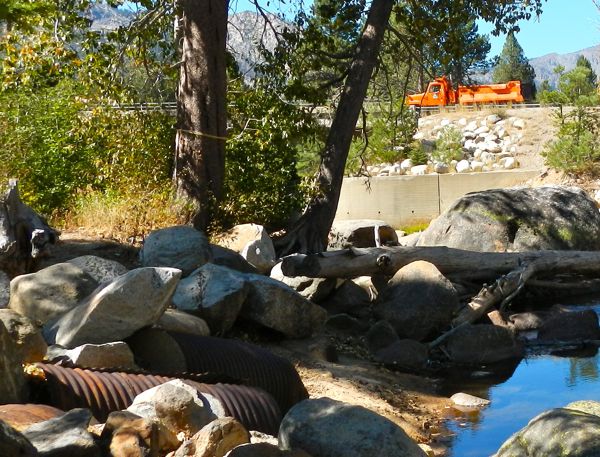
A cement filled culvert, foreground, is near the river. And vehicles on Highway 50 roar by the property.

A cement filled culvert, foreground, is near the river. And vehicles on Highway 50 roar by the property.

What is left today is compacted and disturbed land, a bridge that is sketchy at best, concrete filled culverts, and boulders in the river.

The Conservancy has put up some fencing, has taken down trees and is already seeing vegetation start to naturally re-establish in some locations.

“This area is prone to flooding. Our designers are looking at that,” Eicher said. The floodplain will be worked on so the groundwater table rises and the ecosystem works in a way that would be reminiscent to before the campground was put in.


Letter: Cash mob a success at Gunbarrel

To the community,

The Cash Mob lunch on Oct. 8 at Gunbarrel Tavern & Eatery was a success.

Fifteen people showed up to try a variety of menu items including beer can chicken, shrimp ‘n grits, and jalapeno bacon mac ‘n cheese at the newest restaurant in the Heavenly Village.

Gunbarrel Tavern officially opened their doors on Aug. 30 with a ribbon cutting and grand opening ceremony. TahoeChamber’s Cash Mobs help grow the local economy by supporting local businesses in an innovative fashion – in the case of Cash Mobs – guests just show up and purchase lunch.

Cash Mobs also help support TahoeChamber’s commitment to providing relationship building opportunities and promoting the community. On behalf of the chamber board, staff, and ambassadors, a huge thank you goes out to the staff at Gunbarrel Tavern and the lunch mob attendees.

Jessica Cunningham, Lake Tahoe South Shore Chamber of Commerce


Study: Treatment for strokes needs improving

By Melissa Healy, Los Angeles Times

Having a stroke, or even a transient ischemic attack (a TIA, often called a “mini-stroke”) can be a costly watershed in a person’s life. Statistically, it deducts years from patients’ lives. But it claims another toll too: in quality of life after the stroke has happened. New research tallies the combined cost of those two very different measures, and suggests that current treatments for stroke aren’t doing nearly enough to minimize strokes’ true cost.

The study, published Wednesday in the journal Neurology, is an exercise in health economics that seeks to generate a fuller picture of a disease’s cost. That calculation gives insurers, hospital administrators and public health officials a better — and hopefully more humane — basis for deciding which treatments are most “cost-effective.”

If a treatment for stroke — the costly administration of the clot buster called tissue plasminogen activator, or tPA, for instance — saves people from dying when properly used (as it does), that’s a plus. But if it also reduces disability and allows more stroke patients to return to fuller function than they would have without it, that’s even better. The treatment has not only added years to life, it has added life to years, and that makes it a better treatment.

Read the whole story


Campaign mailings coming from El Dorado County-owned building

By Laura Cole, CBS-13

The campaign for a water district seat is generating controversy after a mailer was linked to a developer whose address happens to be a building owned by the county.

It’s not too often a little-watched race for the El Dorado Irrigation District makes news, but a flyer sent to voters’ homes this week is not only generating controversy, but it has one county leader calling it illegal.

The ad warns of skyrocketing water rates, and endorses irrigation district candidate Richard Englefield.

The mailer is paid for by the El Dorado County Farmers Businesses And Homebuilders For Responsible Water Policy.

CBS13 tracked down who is behind that political action committee. Documents with the state connect the group to area developer Parker Development Group.

But the address clearly listed on the ad is 542 Main Street in Placerville. That’s the Chamber of Commerce, which is housed in a county-owned building. The chamber is getting a steal of a deal, paying $1 a year for a five-year lease.

Read the whole story