Debating what to do with all the wood in the forests

By Lauren Sommer, NPR

The record-breaking wildfire in Yosemite National Park is almost fully contained, two months after it started. The blaze calls attention to a problem across the Western U.S. — after a century having its fires routinely extinguished, the forests are overloaded with fuel.

A heated debate has flared up about what do to with that forest fuel. California is hoping to reduce its fire risk through renewable energy, but some worry about the environmental costs of thinning the forests.

The forest right after a big fire is incredibly quiet. There are no birds. No bugs. No pine needles rustling in the breeze. Just row after row of blackened trees. Their bark feels like charcoal.

At more than 400 square miles, the Rim Fire is the largest Sierra Nevada fire in recorded history.

For decades, the Forest Service tried to put out every fire by 10 in the morning after it started. Small trees grew in, and during the Rim Fire they became ladders, carrying flames up to the tree tops and leaving just charred trunks. But just across the road, it looks entirely different.

Brett Storey thinks there’s a solution. He’s a program manager for Placer County and he’s showing me around a recycling facility between Tahoe City and Truckee.

The plant would turn tree branches and scrap into a gas that runs a generator, supplying about 1,500 homes with electricity. It would be fueled by Forest Service projects within 30 miles.

Read the whole story


Red Ribbon Week contest under way all month

The 28th annual Red Ribbon Week is this month and the National Family Partnership has launched its monthlong national contest.

Ten families across America will win $1,000 for their school and an iPad for their home. This campaign is for prevention of drug and alcohol abuse by youth. More info about the contest is online.

Winners will be announced Dec. 6 and recognized at winning schools throughout December.

Red Ribbon Week is the nation’s oldest and largest drug prevention campaign, reaching more than 80 million people nationwide.

The DEA is co-sponsoring this year’s national contest.


Chamber hosting 3 business workshops

Mann, Urrutia, Nelson, CPAs & Associates will present a three-part workshop series for business owners.

The workshops will take place Oct. 23, Oct. 30 and Nov. 6 at 10am in the Lake Tahoe South Shore Chamber of Commerce conference room in Stateline.

Topics will include the different options for structuring your company, accounting and financials, and strategies for business owners.

The workshops are free for chamber members and $15 for prospective members. Attend all three or just one.

For more information or to register for the workshops, email Emily@TahoeChamber.org or call (775) 588.1728, ext. 303.


Shutdown — a $24 bil. hit to U.S. economy

Publisher’s note: Sens. Dianne Feinstein (D), Barbara Boxer (D) and Harry Reid (D) voted to end the government shutdown and raise the debt ceiling, Sen. Dean Heller (R) voted against it; Reps. Tom McClintock (R) and Mark Amodei (R) voted against it.

By Toluse Olorunnipa, Kathleen Miller and Brian Wingfield, Bloomberg

Gum Tong owns a diner in Washington, D.C., and Matt Bellinger charters fishing boats in the Florida Everglades. They have this in common: The shutdown of the U.S. government cost them money they will never get back.

Pete’s Diner & Carryout, a 50-year-old Capitol Hill eatery frequented by House Speaker John Boehner, lost about 80 percent of its usual business, said Tong, surrounded by empty seats and Halloween decorations. Bellinger missed out on $1,000 a day in canceled charters because Everglades National Park was closed.

“What people have been doing in droves is saying ‘We’ll go to Disney World,’ or ‘We’ll cancel our trip and go home’,” Bellinger said in a telephone interview. Nineteen groups dropped plans for four-hour fishing trips.

“I can’t make that money back,” he said. “It’s gone.”

The U.S. economy is big and resilient. Now with the 16-day shutdown ended and the threat of a U.S. default at least delayed, economists will probably look back on this as a glitch, one of those passing crises that seem so common nowadays.

For people like Tong and Bellinger, and for thousands of small businesses, this was no glitch. It’s money that can’t be easily recovered, creating a long-term ripple effect — with the holidays approaching — that will be difficult to forget.

Business leaders say they are nervous. Companies from Knoll Inc. to NCI Inc. have said they expect the shutdown to affect fourth-quarter revenue. Knoll, an officer furniture maker, expects about $10 million of government business to be pushed into next year, Chief Executive Officer Andrew Cogan told analysts Wednesday on a conference call.

Americans were the most pessimistic about the nation’s economic prospects in almost two years in October, as concern mounted that continued political gridlock will hurt the expansion. The monthly Bloomberg Consumer Confidence Index expectations gauge plunged to minus 31, the lowest level since November 2011, from minus 9 in September, a report showed today.

Standard & Poor’s Ratings Services yesterday said the shutdown has shaved at least 0.6 percent off of fourth-quarter 2013 gross domestic product growth, or taken $24 billion out of the economy.

Read the whole story


Snippets about Lake Tahoe

tom davis• South Lake Tahoe Mayor Tom Davis will give a state of the city address on Nov. 5 at 9am at Lake Tahoe Airport.

• Tahoe Donner is hosting a winter job fair Oct. 19 from 11am-6pm at the Northwoods Clubhouse located at 11509 Northwoods Blvd.

• Charter Communications customers in the South Lake Tahoe area will soon have access to more than 150 high definition channels as part of an all-digital upgrade. Charter this summer began clearing all analog signals from its local network, making way to add more than 130 HD channels in El Dorado, Placer and Douglas counties.

• “Lake Tahoe: Can We Save It?” is a 30-minute documentary produced by KQED television producer Gabriela Quiros. It examines the lake’s storied history and the small army of scientists and others who are working daily to turn back the clock to a time when you could see 100 feet down into its blue waters.


Crews quickly extinguish fire near Amacker Ranch

A brush fire behind the Amacker Ranch on the South Shore burned about a 100-foot-100-foot swath of land.

“It was next to a hiking trail. It could have been anybody or anything at this time,” Brad Zlendick, Lake Valley battalion chief, told Lake Tahoe News.

The investigation into the cause of the Oct. 16 fire on this state-owned parcel is ongoing.

“It’s still very dry and we are still in fire season so be very careful,” Zlendick warns. He added if people see smoke they know is not from a controlled burn, they should call the fire department.

— Lake Tahoe News staff report


Indian casino boosting minimum wage to $10.60/hour

By Brian Hickey, KCRA-TV

JACKSON — Employees at the Jackson Rancheria Casino will soon have a starting wage that is $2 higher than the statewide minimum of $8 per hour.

The Indian casino, owned and operated by the Jackson Rancheria Band of Miwuk Indians, announced that in January, pay for its employees will start at $10.60 per hour.

The raise will mean an increase of nearly $5,000 a year for several hundred employees currently making the statewide minimum wage of $8 per hour.

Read the whole story


Lake Tahoe unfolds along slice of Rim Trail

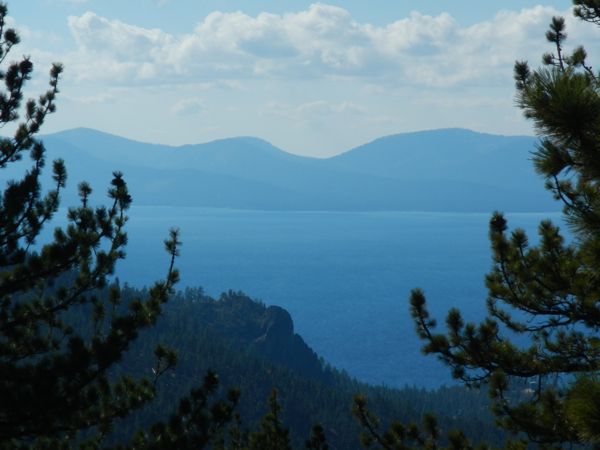
Outstanding views of Lake Tahoe along the Tahoe Rim Trail near Spooner Summit. Photos/Kathryn Reed

Outstanding views of Lake Tahoe along the Tahoe Rim Trail near Spooner Summit. Photos/Kathryn Reed

By Kathryn Reed

SPOONER SUMMIT – If you think Spooner Summit is busy now, you really would not have liked traveling this route more than a century ago.

A dirt road and a railroad line were in this area in the late 1800s. This was a critical link between Placerville and Virginia City during the Comstock era. It was all about logging and silver in those days. Much of the wood that was harvested was used to build the mines in Nevada.

Today Spooner Summit the road – or Highway 50 – is the main path between South Shore and Carson City. But the summit itself is the gateway to some spectacular hiking.

At the trailhead on the south side of the highway are numerous signs depicting the history of the area.

“In 1860, French-Canadian entrepreneur Michele E. Spooner acquired about 640 acres of land with the idea of starting up a sawmill, a shingle mill and a hotel. He named the area Spooner Station. Ten years and several business partners later, Spooner had acquired interest in flumes, a toll road, and other businesses, and controlled a total of 1,840 acres surrounding the summit that now bears his name,” reads one of the signs.

Spooner sold his flumes and toll road in 1872 to Duane Bliss and H.M. Yeringon.

It was President William McKinley who in 1899 created the Lake Tahoe Forest Reserve. This agency predated today’s U.S. Forest Service. When that government body came into being in 1905 this land became part of the USFS.

The four-lane road was built in the 1950s.

A spectacular aspen grove marks the start of the trailhead. Yellows and oranges were shimmering in the sun last Saturday. The day use area is awash in autumn colors.

We had our choice of destinations: Genoa Peak Road 3 miles, Ridgetop Lake View 5 miles, Kingsbury Trailhead 12, Kingsbury Grade 14, or Tahoe City 102.

These are all along a section of the Tahoe Rim Trail that neither Sue nor I had been on before. One day we’ll hike all 165 miles. We might set a record for the most number of years for full-time residents to do so.

I was hoping to do an out-and-back to the Ridgetop Lake View. However, my pulled muscles from a tennis match a couple weeks earlier said, “You have got to be kidding.” We did the 6-mile roundtrip to Genoa Peak Road.

We are thinking of finishing the other side of the trail to Kingsbury on our bikes next year.

A couple mountain bikers passed us and there was clear evidence equestrians had been out recently. Those who were hiking were bundled up to ward off the crisp chill in the air, which became more pronounced as an afternoon breeze picked up.

While the largest dose of fall colors is at the start of the hike, evidence of the changing seasons dots various spots along the way.

“It’s a collision of seasons,” is how Sue described the mountainside in the distance with the aspens and snow.

Various groves of Douglas fir made her want to pick out a Christmas tree right then and there. Many were not more than a Charlie Brown tree.

While we didn’t make it to the ridge view, there are ridges and there are views. And they are outstanding views of Lake Tahoe. And being so high, they are also vast views.

Spooner Summit is at 7,150 feet and the hike is a gradual climb, with the steepest (and it’s not really steep) section at the start.

Briefly the colorful tree-lined Spooner Lake on the other side of the highway is visible.

The single-track trail is in great shape. Splotches of snow on the ground are a clear sign winter is closer than summer. Just don’t be fooled by the first road you come to. It’s not Genoa so you have not gone 3 miles.

—-

Getting there:

From South Lake Tahoe, take Highway 50 east. At the top of Spooner Summit on the right before descending into the valley is a parking lot. If the lot is full, there are also spaces on the highway.

ngg_shortcode_0_placeholder (Click on photos to enlarge.)


Letter: Sierra Club loses local conservation leader

To the community,

Well-known conservationist Bob Anderson and his wife, Grace, were on a 70th birthday trip to climb Mount Kilimanjaro in the Serengeti National Park in Kenya when a van accident caused fatal head injuries to Bob and injured Grace.

The couple had completed their successful climb of the over-19,000-foot high mountain.

Bob served as president of the local bi-state Tahoe Area Sierra Club for several years. He was also a member of LTFAC, the Lake Tahoe Federal Advisory Committee to TRPA, as well as a board member of the Washoe Meadows Community Group. In addition, Bob was a board member of the Tahoe Institute for Nature Studies.

Bob had a long history of successful conservation campaigns in Montana before he met and married Grace Proulx of Meyers. The two shared an interest in energy transmission, as well as hiking, backpacking, and climbing. Bob was a former two-term elected member of the Montana Public Utilities Commission.

As a seasoned conservation activist and prominent commissioner, Bob brought his great skills to managing the local Sierra Club group as the issues of the proposed Regional Plan became more and more worrisome regarding the impacts on Lake Tahoe. Bob was very effective and will be remembered by many for his conservation efforts in the Tahoe basin.

The Tahoe Area Sierra Club is stunned by the loss of Bob and our hearts go out to his wife, Grace, who was injured in the accident. We look forward to Grace’s recovery and return to her beloved cabin in Meyers, where she entertained her small grandchildren with great pleasure. Grace has been the leader for planning and producing the club’s fund-raisers for the past four years.

Laurel Ames, Tahoe Area Sierra Club conservation chair


Study: Nutrient pollution threatens ecosystems

By Tony Barboza, Los Angeles Times

National parks from the Sierra Nevada to the Great Smoky Mountains are increasingly being fertilized by unwanted nutrients drifting through the air from agricultural operations, putting some of the country’s most treasured natural landscapes at risk of ecological damage, a study has found.

Thirty-eight of 45 national parks examined by scientists are receiving doses of nitrogen at or above a critical threshold that can harm sensitive ecosystems, such as lichens, hardwood forests or tallgrass prairie, scientists found.

Scientists looked at nitrogen oxides and ammonia that are released by vehicles, power plants and farms and carried on air currents into national parks, including those in some of the most remote areas of the West.

Read the whole story