Then and now: Stateline club site becomes county facility

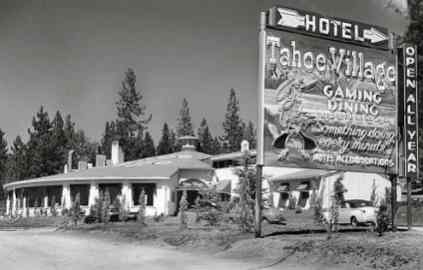
Tahoe Village in Stateline in 1950. Photo/ Pomona Public Library Frasher Collection

Tahoe Village in Stateline in 1950. Photo/ Pomona Public Library Frasher Collection

The original Tahoe Village (1946-51) was on Highway 50 near Kingsbury Grade in Nevada, although an Internet search today may refer to a different development.

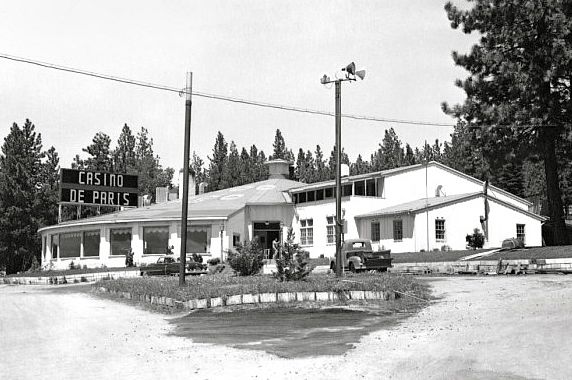
Casino De Paris Photo/Special Collections Department UNR

Casino De Paris Photo/Special Collections Department UNR

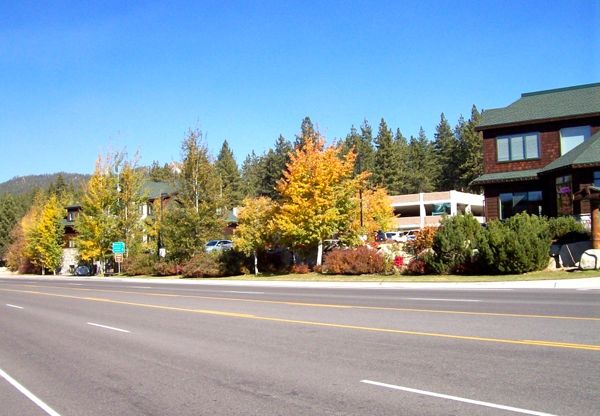
Douglas County buildings today. Photo/Bill Kingman

Douglas County buildings today. Photo/Bill Kingman

Notice the sign’s vertical notation Open All Year. This was in the early 1950s era when most Lake Tahoe resorts and casinos closed after Labor Day until the next Memorial Day.

Later, this location became the Casino De Paris (1952-54) and lastly Oliver’s Club until 1963. Oliver Kahle (rhymes with mail) eventually saw that property become today’s Douglas County Administrative Center shortly before his death in the late 1980s.

Today, his name adorns Kahle Drive, Kahle Park, Oliver Park GID, and the Kahle Community Center.

— Bill Kingman


It takes billions of dollars to preserve and improve Lake Tahoe’s environment

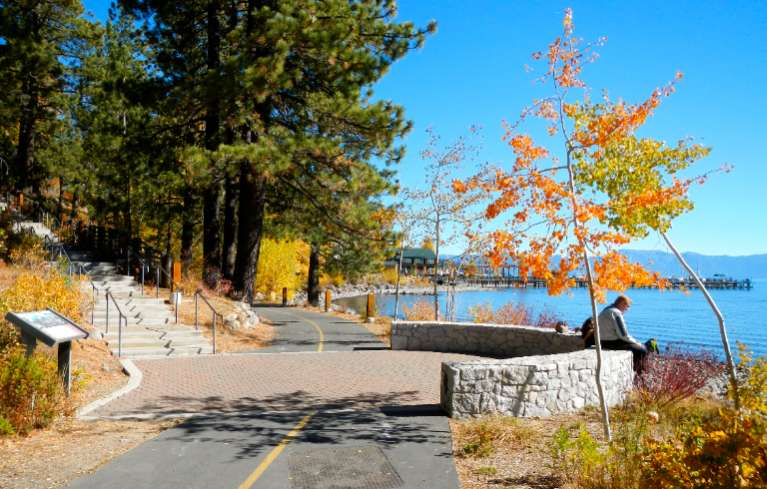
Lakeside Trail in Tahoe City is decorative, has interpretive signs, seating and endless views of Lake Tahoe. Photos/Kathryn Reed

Tahoe City’s Lakeside Trail is decorative, has interpretive signs, seats and endless views of Lake Tahoe. Photos/Kathryn Reed

By Kathryn Reed

TAHOE CITY – A catastrophic inferno like the Rim Fire could wipe out the more than $1.4 billion worth of improvements that have been made to Lake Tahoe through the Environmental Improvement Program.

That was the warning Julie Regan, external affairs chief with the Tahoe Regional Planning Agency, issued Oct. 18.

While 50,000 acres in the Lake Tahoe Basin have received a fuels treatment – or thinning – to make them more fire safe, many have never been touched.

“We can choose our fire. It’s a matter of will and funding,” Mike Vollmer, TRPA forest fuels manager, said.

The TRPA officials along with others were speaking during a tour of a handful of the more than 400 EIP projects that have been completed in the last 15 years. The EIP was created out of the inaugural environmental summit in 1997.

Having trees be spaced out, branches not dangling on the ground and brush removed can help prevent a canopy fire. A goal of thinning is to create terrain that would keep fire on the ground.

Vollmer said a healthy forest has between 90 and 100 trees per acre, whereas there are places now in the basin with 400 trees per acre.

But all of this thinning takes money and that is practically an endangered species these days. If the Lake Tahoe Restoration Act is reauthorized, it calls for $135 million going to fuels reduction projects.
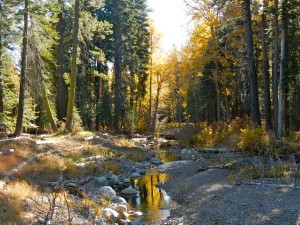
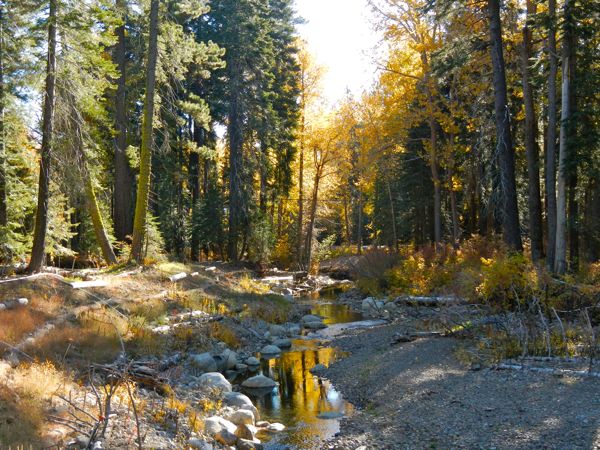
Blackwood Creek near Lake Tahoe was restored by the California Tahoe Conservancy, while the U.S. Forest Service fixed the upper watershed.

Blackwood Creek near Lake Tahoe was restored by the California Tahoe Conservancy, while the U.S. Forest Service fixed the upper watershed.

Money is an issue with most of the improvements.

It cost $12 million to build one mile of trail along the lakefront in Tahoe City.

It’s considered an economic benefit considering more than 400,000 people use it each year. Known as the Lakeside Trail, it’s a definite showcase as the entire lake is visible, with snow on the higher elevations and aspens at lake level. A play area is being used, cyclists are out, and pedestrians are brushing past.

Kelli Twomey, with Tahoe City Public Utility District – the lead agency on the trail project, and Wally Auerbach with Auerbach Engineering spoke of the collaboration needed to get the trail built, how it was a redevelopment project, and that besides recreation it brought water quality and other improvements to the area.

Keeping fine sediment out of the lake is a major component of most environmental improvement projects. Stuart Roll with the California Tahoe Conservancy pointed out how the 54-acre Blackwood Creek project is an example of how restoration of a channel can reduce dirt from clouding Lake Tahoe.

This area has been logged twice and had a quarry in the creek. Banks were steep, the forest was so thick the aspen stand couldn’t thrive, and a user-created trail to Eagle Rock was steep. Now the channel meanders more naturally, sediment reaching the lake has been dramatically reduced, aspens are in full bloom, and a new trail to Eagle Rock has been established.

Milfoil near the dam in Tahoe City.

Milfoil near the dam in Tahoe City.

The federal government shutdown prevented the milfoil removal project by the Tahoe City dam from starting, so it will be delayed until next year.

The plan is to put black tarps on the invasive weed to kill it.

There is so much milfoil that it almost covers the width of the channel near the dam. The weed comes from Lake Tahoe and is making its way down the Truckee River. (It’s also going up the Upper Truckee River.)

Tahoe Keys on the South Shore is the largest area with milfoil. Boats distribute it to the rest of the lake via propellers. It’s possible one day herbicides could be applied to kill the milfoil.

But it was pointed out that it’s near impossible to eradicate any of the aquatic invasive species. It’s all about controlling them.

Opinion: What did we learn from the shutdown?

By Patrick Stelmach

Government is simply a word for the things we decide to do together. And if there is one lesson that the recent 16-day government shutdown taught us, it is this: there are a lot of things we Americans have decided to do, together, and people were angry when these things were taken away.

Michelle Langbehn and hundreds of other cancer patients were heartbroken when they were denied potentially life-saving treatment protocols after the shuttering of the National Institutes of Health. World War II veterans rebelled when they couldn’t visit the monuments in Washington. Wildland firefighters were justifiably upset when they were forced to work, putting their lives in harm’s way, without pay. And it all had a ripple effect – when Yosemite National Park was closed, when spending by government agencies ground to a halt, when thousands of federal workers in Rep. Tom McClintock’s district were, in effect, furloughed, it drained $24 billion out of the U.S. economy, according to the S&P index.

This all supposedly was a fight over Obamacare, but actually it was about much, much more. The conflict centered on a fundamental question: What is the rightful place of government in our lives? During the shutdown, several competing philosophies emerged.

One philosophy, embraced by Rep. McClintock and the Tea Party faction of the GOP, held that government has no role in our lives, save for the bare essentials (and even those were threatened by the shutdown). And they were willing to sacrifice our economy to get their way. It is a shame that Rep. McClintock voted no on the measure to end the government shutdown and to avoid default, after seeing weeks of demonstrations outside his office calling for a budget deal.

The day before the vote, Oct. 15, Michelle Langbehn and California Fair Share delivered the petition signed by over 140,000 Americans urging Congress to end the shutdown and help her fight cancer. Michelle shared her inspirational story and said, “I stand here as a voting American whose voice is being ignored. We, the citizens, are the losers. We voted for politicians, like Tom McClintock, who shut down the government and put American lives at risk. We deserve better.”

The second philosophy, and one that we at California Fair Share believe in, along with most Americans, is pretty different: Let’s do all we can for an economy that works for all of us, and that gives the most people a chance at a fair shot at a good life. And a shutdown that nearly destroys all progress toward this goal is almost antithetical to this philosophy.

Is there any question that this second approach is embraced by the majority of Rep. McClintock’s constituents? Consider that after the rise of Sen. Ted Cruz and after the Tea Party overran Republican leadership in the House, an NBC/Wall Street Journal poll found that only 24 percent of respondents held a positive view of the GOP -– the lowest such finding in the poll’s history.

And now, government is up and running again, much to the relief of Californians who want to take their families camping in Yosemite and small-business owners, from Truckee to Oakhurst, who rely on the outdoor recreation community for their livelihoods.

But the budget fights are not over. Government is only funded until January, and the issue of the debt ceiling will return a month later. Now is a good time for all of us to reflect on the proper role of government in our lives and our priorities as a nation, and, most importantly, how we might align these two things.

Patrick Stelmach is the state organizer for California Fair Share.


2-day Placer County supes meeting in Tahoe

The Placer County Board of Supervisors will meet in North Lake Tahoe Oct. 21-22.

During Tuesday’s session, the board will consider authorizing Chairman Jim Holmes to sign two letters to Gov. Jerry Brown that detail Placer County’s concerns about the proposed Bay Delta Conservation Plan and will receive an update on proposed improvements to Fanny Bridge and the nearby intersection of highways 28 and 89.

Monday’s agenda features a grand-opening celebration for the Domus Development Project at 2pn at 204 Chipmunk St. in Kings Beach; and a ribbon-cutting and tour of the Community House at 3:30pm at 265 Bear St. in Kings Beach.

On Tuesday, the board will convene its meeting at 9am in the North Tahoe Events Center, 8318 North Lake Blvd. in Kings Beach.

Tuesday’s meeting will conclude with a tour of the Museum of Sierra Ski History and 1960 Winter Olympics. The museum is located in the Boatworks Mall, 760 N. Lake Blvd. in Tahoe City.


Creating a healthy forest

Mike Vollmer, TRPA forest fuels manager, talks Oct. 18 about what it takes to create a healthy forest.


Prescription drug take back day set for S. Tahoe

People may turn in their unused prescription drugs in South Lake Tahoe on Oct. 26 from 10am-2pm.

Bring medications for disposal to Safeway at 1020 Johnson Blvd., South Lake Tahoe. The service is free and anonymous.

Last April, people in the U.S. turned in 371 tons of prescription drugs at more than 5,800 sites operated by the DEA and its thousands of state and local law enforcement partners.

Rates of prescription drug abuse in the U.S. are alarmingly high, as are the number of accidental poisonings and overdoses due to these drugs. Studies show that a majority of abused prescription drugs are obtained from family and friends, including from the home medicine cabinet.

Flushing meds down the toilet or throwing them in the trash pose potential safety and health hazards.


Women slowly making difference in Congress

By Casey Capachi, Washington Post

As the fiscal impasse began to show signs of breaking Wednesday on Capitol Hill, one group may have emerged as a voice of reason all along: female lawmakers.

“I know my colleagues are tired of hearing about the women in the Senate,” Sen. Susan Collins, R-Maine, said with a smile on Wednesday, before continuing to give “kudos” on the Senate floor to those involved in the bipartisan proposal to end the shutdown and temporarily raise the debt ceiling to avoid default.

Six of the fourteen senators behind the compromise that the House approved Wednesday night are women.

“In my experience, women are much more willing to sit down together, build consensus and try to get to ‘yes’ without really clobbering the other side and leaving them bloody,” said Rep. Debbie Wasserman Schultz, D-Fla., in an interview with PostTV’s “InPlay” on Tuesday.

Wasserman Schultz, who is also chair of the Democratic National Committee, said that even though the end result of the budget debate remains “elusive,” one thing has become clear.

“What I think the issue is is that we don’t have enough women in positions of authority to actually make that move and negotiate,” said she said. “That’s why if we get more women elected, more women will be able to move up and be in that position of power.”

Read the whole story


Howl’oween Party all about dogs

Tahoe Best Friends’ fourth annual Howl’oween Party is Oct. 27.

Costume contest categories include: scariest, funniest, most original, best owner-dog look-alike, and best in show.

There will games for the whole family as well as photo opportunities.

Tahoe Best Friends is at 2197 Ruth Ave. in South Lake Tahoe off Third Street.

The event is from 1-2:30pm.


Lake Tahoe Blue hockey

The Lake Tahoe Blue were on a roll the weekend of Oct 11-12, racking up three wins for their first season in South Lake Tahoe. Formerly the Bay Area Seals, the Blue are aiming for their chance at a WCHL championship.


Snippets about Lake Tahoe

pumpkinds• Treat Street returns to the Pine Cone Acre Motel in South Lake Tahoe on Oct. 31 from 5-8pm. Click on the flyer for more info.

• According to AAA, 63 percent of people look for free breakfast and 51 percent free Wi-Fi when choosing a hotel.

• Barton doc Keith Swanson is being inducted into the Midwestern State Athletic Department’s Hall of Honor. He earned NAIA All-America honorable mention following his senior year of 1966-67.

• The Douglas County Public Library in Minden and Zephyr Cove will be closed Oct. 25-26 for Nevada Day. The Minden Library will reopen on Oct. 28 at 10am. The Zephyr Cove Library will resume its normal schedule on Oct. 30 at 11am.