Chef Irvine to serve up food tips at Harrah’s

Robert Irvine is the featured celebrity chef for the fourth annual South Lake Tahoe Food and Wine Festival at Harrah’s and Harveys Lake Tahoe on Nov. 9-10.

Irvine is the of Food Network’s “Dinner Impossible,” “Restaurant: Impossible” and “Worst Cooks in America”.

The event includes tasting, discussions, presentations and demonstrations by celebrated food and wine experts.

The weekend begins with the Grand Market – Beyond the Fork at Harrah’s.

Additional events on Saturday evening include: Wine 101, a guided tour to the world of wine and winemaking; Wines That Rock, a tasting of exotic wines accompanied by an appreciation of timeless rock music; and Mixology 101,”where participants will learn the basics of building some of the most classic cocktails.

Irvine will star in two featured events: Chef in the Kitchen and Chef on Stage.

That Sunday is an afternoon of ribs, beer and football at the Ultimate Tailgate: Blues, Brews and BBQ hosted by Robert Irvine. Some of the best BBQ chefs will be on hand to show people how to be master their own grill.

For more information, event prices and to purchase tickets go online.



Demand for tequila not good for the land

By Ted Genoways, Bloomberg

To slake North America’s seemingly bottomless thirst (sales have almost tripled since 1995), and to meet growing demand in Asian and European markets, tequila producers have tripled the production of pure agave over the past decade through new growing, production, and distillation methods.

But these methods, scientists warn, have left the region vulnerable to severe ecological impacts.

Connoisseurs, meanwhile, complain that tequilas produced by the new methods are of such low quality that they can be enjoyed only by the frozen margarita crowd.

After decades of focusing exclusively on increased foreign sales, tequila producers may finally be forced to ask: How big is too big?

Read the whole story


Scientists find link between achy joints, weather

By Melinda Beck, Wall Street Journal

The Wolff family of Paramus, N.J., was eyeing the gathering clouds and debating whether to cancel a planned park trip when 6-year-old Leora piped up with an idea: “Let’s call Grandma. Her knees always know when it’s going to rain!”

Leora’s grandmother, Esther Polatsek, says she started being sensitive to the weather in her 20s, when a fracture in her foot would ache whenever a snowstorm approached. Now 66 and plagued by rheumatoid arthritis, Polatsek says she suffers flare-ups whenever the weather is about to change.

“It’s just uncanny. Sometimes it’ll be gorgeous out, but I’ll have this awful pain. And sure enough, the next morning it rains,” she says. “It may be just a few drops, but it makes my body crazy.”

Do weather conditions really aggravate physical pain?

It is one of the longest running controversies in medicine.

Hippocrates in 400 B.C. noticed that some illnesses were seasonal. The traditional Chinese medicine term for rheumatism (fengshi bing) translates to “wind-damp disease.”

But modern scholars have gotten inconsistent results in studies that tried to match weather patterns to reported pain symptoms—leading some to dismiss the connection as highly subjective or all in sufferers’ minds.

“People’s beliefs about arthritis pain and the weather may tell more about the workings of the mind than of the body,” concluded the late Stanford psychologist Amos Tversky in the mid-1990s, after comparing the pain reports of 18 rheumatoid-arthritis patients with local weather conditions for a year and finding no connection.

Still, other studies have linked changes in temperature, humidity or barometric pressure to worsening pain from rheumatoid arthritis and osteoarthritis, as well as headaches, tooth aches, jaw pain, scar pain, low-back pain, pelvic pain, fibromyalgia, trigeminal neuralgia (a searing pain in the face), gout and phantom-limb pain.

Scientists don’t understand all the mechanisms involved in weather-related pain, but one leading theory holds that the falling barometric pressure that frequently precedes a storm alters the pressure inside joints. Those connections between bones, held together with tendons and ligaments, are surrounded and cushioned by sacs of fluid and trapped gasses.

Read the whole story


Eldorado National Forest to begin controlled burning

Prescribed burning in the Eldorado National Forest will resume as soon as air quality and vegetation conditions are right, possibly this week.

Residents of Pollock Pines and travelers along Highway 50 will see smoke rising from a 250-acre prescribed burn planned on Peavine Ridge about a mile north of Pollock Pines and west of the community of White Meadows. The Peavine Ridge prescribed burn will provide additional wildfire protection to Pollock Pines and White Meadows. An information board with details about the burn will be posted at Sierra Vista Shell Station in Pollock Pines.

The Forest Service also plans to continue burning along the Mormon Emigrant Trail west of Silver Fork Road.

For any additional call Nickie Washington at (530) 621.5237 or email nickielwashington@fs.fed.us.


Students give back by helping animals

Two Incline Village students are taking part in Dance in the Sun for Animals, a nonprofit organization that helps kids help animals in need.

Rowan and Mary Jane Hatchett

Rowan and Mary Jane Hatchett

Teacher Heidi Timinsky founded DSA with the goal of empowering children to realize that they can make a positive difference in the world through helping animals in need.

DSA is set up to run as a completely kid-powered organization. Children can take a hobby, interest, or event that affected them and an animal they care about, then set goals and make a plan to help. Once goals are completed, kids can download a certificate. Their stories, photos and artwork are uploaded to the website’s Kids in Action page.

Rowan and Mary Jane Hatchett, students at Lake Tahoe School in Inlcine, recently launched DSA. Other students immediately began planning ways they could help animals. Ideas included a bake sale to raise money for a tiger sanctuary; having a garage sale and sending the proceeds to help snowy owls; volunteering at the local humane society; and using their allowance to help animals in the rainforest.

More info is online.


Firefighting community says farewell to Underhill

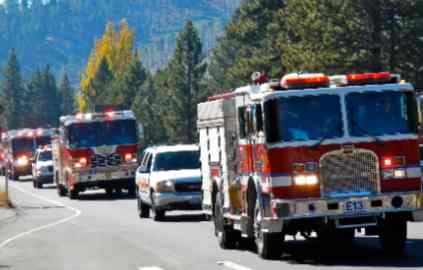
A massive contingent of firefighting units passed through South Lake Tahoe this afternoon en route to St. Theresa Catholic Church where the services for Mitch Underhill started at 2pm. A CareFlight helicopter flew overhead, following the line of emergency vehicles along Highway 50 from Lake Valley to the church.

The 34-year-old Lake Valley firefighter died Sept. 29. The cause of death has not been released.

Underhill was born and raised in South Lake Tahoe.

Firefighters from throughout North California and in the Tahoe basin are part of the procession. Photo/LTN

Firefighters from throughout Northern California and in the Lake Tahoe Basin are part of the Oct. 20  procession. Photo/LTN

— Lake Tahoe News staff report


Study: Sitting all day is unhealthy

By Michael J. Joyner, Outside

We all know that sitting around is bad for your health, and that exercising is good for you. But what happens to people who exercise regularly and then sit around all day?

This is one of the hot new topics in exercise and public health research. The idea is that sitting around all day limits the positive effects of your workout or other forms of non-structured physical activity you might be getting.

In a large study from Australia more than 200,000 people.

For the 150,000 healthy people in the study (including those who didn’t exercise), there was a dose response relationship between more sitting and all-cause mortality. This simply means more sitting was associated with more mortality. The sitting mortality relationship was also blunted in the people who got any exercise during the week—a little bit of activity can stop some, but not all, of the negative effects of a lot of sitting.

Read the whole story


Truckee’s Coldstream draft EIR recirculated

The Coldstream PC-1 draft EIR is being recirculated for an additional 45 days to address new impacts in biological and natural resources and historic and cultural resources.

Since circulation of the original draft EIR, the project applicant has made minor refinements to the design of the project and two new technical studies have been prepared as part of the permitting process for the project. These studies resulted in the availability of new technical information, including a new wetland delineation for off-site portions of the project and an updated archaeological inventory survey for the project site. The updated archaeological inventory survey includes identification of one prehistoric site which was inadvertently overlooked in previous cultural resource surveys prepared for the specific plan. The updated survey describes the site in detail and provides a Historic Properties Treatment Plan.

The comment period ends Nov. 22. Written comments should be sent to Jenna Endres, Town of Truckee, Planning Division, 10183 Truckee Airport Road, Truckee, CA 96161 or jendres@townoftruckee.com.

To view copies of the partially revised document click here.


Nevada Preservation Office has money to give out

Applications for federal historic preservation grants administered by the Nevada Historic Preservation Office will be accepted until Dec. 6 at 5pm.

Grant funding is provided by the National Park Service as part of the Land and Water Conservation Fund, and is used to support the preservation efforts of government agencies and nonprofit organizations.

Grants may be used to support building rehabilitation, historic preservation surveys and projects that promote heritage tourism throughout the state.

Priorities for the 2014 funding cycle include surveys and National Register nominations for mid-20th century architectural resources and for threatened historic and prehistoric archaeological resources.

The Preservation Office encourages first time applications from local governments and nonprofit organizations, particularly those from rural communities.

For additional information or an application, call (775) 684.3450.


Study: Blame biology for unempathetic adolescents

By Sue Shellenbarger, Wall Street Journal

The teen years are often fraught with door-slamming, eye-rolling and seeming insensitivity, even by kids who behaved kindly before. Some parents worry that they’re doing something wrong, or that their children will never think of anyone but themselves.

New research shows that biology, not parenting, is to blame.

In adolescence, critical social skills that are needed to feel concern for other people and understand how they think are undergoing major changes. Adolescence has long been known as prime time for developing cognitive skills for self-control, or executive function.

“Cognitive empathy,” or the mental ability to take others’ perspective, begins rising steadily in girls at age 13, according to a six-year study published recently in Developmental Psychology. But boys don’t begin until age 15 to show gains in perspective-taking, which helps in problem-solving and avoiding conflict.

Adolescent males actually show a temporary decline, between ages 13 and 16, in a related skill—affective empathy, or the ability to recognize and respond to others’ feelings, according to the study, co-authored by Jolien van der Graaff, a doctoral candidate in the Research Centre Adolescent Development at Utrecht University in the Netherlands. Fortunately, the boys’ sensitivity recovers in the late teens. Girls’ affective empathy remains relatively high and stable through adolescence.

Read the whole story