Salmonella outbreak highlights flaws in food safety system

By Katharine Mieszkowski, Center for Investigative Reporting

Each month, the U.S. Department of Agriculture publishes a list calling out chicken processing plants across the country that have failed salmonella testing. Notably absent from its October report: the three Foster Farms plants in Central California that have been linked to a virulent outbreak.

Those facilities in Fresno and Livingston easily passed, receiving high marks from federal inspectors for controlling the human pathogen on their young chicken carcasses, according to Daniel Engeljohn, assistant administrator with the USDA’s Food Safety and Inspection Service.

But inspectors don’t routinely test the chicken for salmonella once it’s chopped up into parts, like drumsticks, breasts and thighs, to be packaged and sold. And it’s in that secondary processing that food safety regulators speculate the contamination may have spread.

The outbreak has exposed weaknesses in the country’s food safety system, which is designed to spot salmonella at one stop in the journey from the typical bird’s birth to its perch in the supermarket refrigerator case. And, even as the plants continue operating, neither federal regulators nor Foster Farms officials have publicly pinpointed the cause of the outbreak.

There are no federal rules for how much salmonella is acceptable in chicken parts. Federal regulators say they’re developing them. But even if those rules had existed already, it is unlikely they would have caught the problem at the Foster Farms plants.

And if inspectors had raised the alarm before the outbreak of foodborne illness, the best they could have done is pressure the plants to improve their processes. A famous court case involving beef and salmonella found the USDA did not have the authority to close a plant that consistently failed its testing for the human pathogen.

Meanwhile, the rate of salmonella infection in the United States is holding steady with no sign of going down, while Europe has managed to cut its rate dramatically in a five-year period, according to the European Food Safety Authority. That’s in part because some European countries test for salmonella at the beginning of the process – when the chickens are being raised for slaughter.

In the current outbreak traced to the California Foster Farms plants, 338 people had been reported infected with seven strains of salmonella Heidelberg as of Oct. 17. Those strains are antibiotic-resistant, which might be contributing to the high rate of hospitalization associated with the outbreak. It has sickened people in 20 states and Puerto Rico, though most of the cases have occurred in California. For every reported illness from salmonella, the Centers for Disease Control and Prevention estimates 29 more cases might remain unreported, putting the likely toll closer to 10,000 infections.

Since January, federal inspectors have documented food safety violations at the three Foster Farms plants, including fecal material on carcasses. But federal food safety officials say those violations are no worse than what you’d see in a typical chicken processing plant.

And those same plants had such a strong record on salmonella that their young chicken carcasses were tested for it by federal inspectors only about once every two years, Engeljohn said.

In the most recent tests, which took place within the year, fewer than 2 percent of the carcasses tested were tainted with the human pathogen. Under federal rules, no more than 7.5 percent of broilers tested should show evidence of the bacteria, which underscores that some salmonella is tolerated in chicken meat in the United States.

At these three Foster Farms facilities, something appears to have gone wrong later in the process. Exactly what happened is still unclear. If the company knows what happened, it has not disclosed it.

The federal government does not typically inspect chicken for salmonella once it’s been chopped into parts from whole. It did so at these three plants once the outbreak happened, though the rates it discovered were only slightly higher than those found at other plants across the country.

The government estimates 24 percent of all chicken parts have salmonella at plants nationwide. The Foster Farms plants had between 25 and 27 percent.

In response to the outbreak in early October, the USDA’s Food Safety and Inspection Service threatened to shut down the plants by withdrawing its inspectors, who have to be on-site for the plants to operate. Under pressure, the company said it would implement new processes. The plants stayed open.

One change at the plants: Chicken parts now will be washed with an antimicrobial treatment, according to the USDA. This is done already at another Foster Farms plant in Washington state, where federal inspectors found a much lower rate of salmonella on chicken parts.

“They’re treating their parts with an additional antimicrobial treatment, which all of the rest of the industry does not use, which we’re encouraging the industry to do,” Engeljohn said. Regulators do not have the authority to mandate that all plants adopt that treatment.

Yet, even if the federal government develops performance standards for salmonella on chicken parts, the USDA is unlikely to shut down facilities that do not meet those standards before people get sick. A pivotal 2001 court case, Supreme Beef Processors v. USDA, found that the agency cannot close a meat processing plant that consistently fails salmonella testing because, in this country, the bacteria is not considered an “adulterant” in meat.

That means it’s treated as an unfortunate food safety hazard and a natural constituent of poultry that consumers should cook properly to destroy. Once something is considered an adulterant, like E. coli O157:H7 in ground beef, it cannot legally be sold as food for humans unless it has been inactivated by cooking or some other process.

When a poultry plant fails its salmonella testing, federal inspectors put pressure on the company to improve its processes. Plants that have failed also are tested more often to ensure they’re cleaning up. If a facility repeatedly fails these tests, the agency can threaten to withdraw its inspectors to shut it down. But it is unlikely that the USDA will actually do so, or else risk being sued as it was in the Supreme Beef case.
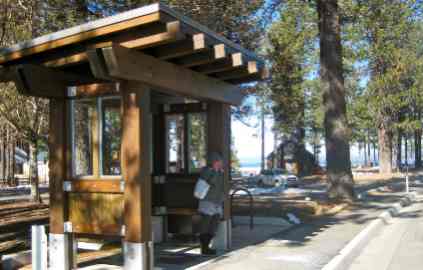


Shelters added in South Tahoe for bus riders

Bus riders now have shelter in South Lake Tahoe. Photo/Provided

Bus riders now have shelter in South Lake Tahoe. Photo/Provided

It’s going to be lot more comfortable waiting for a bus this winter in South Lake Tahoe with the addition of six covered shelters.

The structures are located on Highway 50 in front of South Tahoe Middle School, by the senior center, South Lake Tahoe Library, El Dorado Center, corner of Ski Run Boulevard and Highway 50, and next to Lakeview Commons.

Tahoe Transportation District installed the shelters along with bike racks, bear-safe trash cans, seating, and weather protection for riders.

Additional structures along Pioneer Trail will be put in this fall.

Two of the shelters are pre-fabricated aluminum frames and glass that match existing shelters on the South Shore, while the remaining four are a new design and constructed of redwood timber and glass.

Each is wired for future installation of real-time passenger information technology to alert riders of the estimated arrival of the next bus.

The total construction cost of the six units was approximately $212,000 including materials, labor, site work and installation.


NV Energy’s quarterly earnings drop

By Kristy Totten, Las Vegas Review-Journal

Cool weather, refunds to consumers and merger-related costs held down NV Energy earnings in the third quarter.

The utility reported Friday a third-quarter net income of $187.2 million, or 79 cents per share — $36 million less than third-quarter earnings in 2012, which totaled $223.2 million, or 94 cents per share.

In September, the Nevada Public Utilities Commission ordered NV Energy to refund $10 million to customers in Southern Nevada, and $4.5 million to customers in Northern Nevada. The PUCN permits NV Energy to raise rates to make up for income lost to energy-conservation efforts, but the utility overcollected in 2012.

“The commission recently completed its annual review and directed us to refund 2012 revenues collected through (energy efficiency implementation rates), based on the finding that we earned more than our authorized rate of return last year,” said Kevin Bethel, NV Energy vice president and chief financial officer, during a conference call.

Read the whole story


It’s just about time to fall back an hour

Don’t forget to set your clocks back an hour tonight before you go to bed.

At 2am Nov. 3 it’s time to return to standard time.

The whole reason for this, according to the federal government, is energy and fuel savings.

Daylight saving time returns March 9.


Barton Health buying multiple properties, building cogeneration plant at hospital

By Kathryn Reed

Barton Health has been on a bit of a property buying spree as well as deep into plans to be more energy efficient.

The South Lake Tahoe health care system just closed escrow on four buildings on Emerald Bay Road, two of which the organization was renting. One is used for Barton University and the other physician billing.

“To reduce costs in the long term, Barton Health purchased the buildings as the cost of purchase was less than the rental of the buildings,” Rich Belli, director of Facilities Administration, told Lake Tahoe News.

Barton now owns these buildings on Emerald Bay Road. Photo/LTN

Barton now owns these buildings on Emerald Bay Road. Photo/LTN

Barton has also purchased the Ponderosa Glass building that is next door on the west side. The address for that is 1119 Emerald Bay Road, while the other properties are 1111, 1113, and 1115 Emerald Bay Road.

“It is unclear what Barton will do with the Ponderosa building once the lease is up. Barton still rents some buildings and could move other offices to those buildings or expand a new service to the community in that building,” Belli said. The lease expires in three years.

Renters in the other buildings will be able to continue to operate their businesses for the foreseeable future.

Dave Cooper had owned the 1111, 1113, 1115 properties. He is the same property owner who recently sold land and a building to South Lake Tahoe in the industrial area. The city intends to relocate its fleet of snow removal equipment there.

As part of the purchase agreement with Barton, Cooper agreed to pave the back lot so there is now adequate parking. The back of what is known as Barton University had long been just dirt. Tahoe Regional Planning Agency required erosion control measures be put in at the same time.

TRPA has also signed off on all the permits for Barton Memorial Hospital to build a utility plant that will replace the 40-year-old facility. The Governing Board approved the proposal at its October meeting.

“As part of the project, Barton will be adding a cogeneration plant that will produce roughly 75 percent of our own electricity and will enable the hospital to reuse the excess heat to provide heat to the hospital. This will save the hospital on utility costs moving forward,” Belli said.

It’s estimated the hospital will save $200,000 on utility bills with the cogeneration plant.

Construction is expected to start next year. The Office of Statewide Health Planning and Development still needs to give its OK.

The new building will be south of the emergency room entrance. The floor area will be 6,555-square-feet, and the building will be 41-feet-tall. Even though existing buildings range from 25 to 37 feet in height, the TRPA staff report said the taller building “is consistent and compatible with these other structures and uses.”

The staff report also said, “The new (central utility plant) building will incorporate several new and sustainable technologies including equipment for heating and cooling, domestic hot water, medical air and medical vacuum systems, process and humidifying steam, gas powered cogeneration equipment, and two new diesel engine-driven generators that will provide emergency power for the hospital in case of loss or interruption of utility supply.”

The current plant, also located outside the hospital, will become storage.


Editorial: Calif. higher education needs to evolve

Publisher’s note: This editorial is from the Oct. 22, 2013, Los Angeles Times.

The California Master Plan for Higher Education decreed that it was the job of the state’s community colleges to train students for technical careers and for the sort of semi-professional occupations that generally require a two-year associate’s degree. Those who wanted a bachelor’s degree — and the sort of jobs that go with one — could move on to either California State University or the University of California.

But the master plan was written during the postwar baby boom, and like many of us who were born back then, it’s beginning to develop wrinkles. In 1960, the year the plan was approved, office manager jobs required only a high school diploma. Now most employers require a bachelor’s degree for this job and others like it. At the same time, fewer Californians are able to afford a four-year education. Many don’t live within commuting distance of a Cal State or UC campus, and living expenses are the greater part of college costs.

So it makes all the sense in the world to expand the degrees that community colleges are allowed to confer. A proposal now under consideration by the chancellor’s office, for instance, would allow community colleges to grant bachelor’s degrees in nursing.

Read the whole story


Master gardeners to be trained in El Dorado County

UC Cooperative Extension is looking for adults interested in helping others learn about gardening and landscaping to apply to train as a master gardener volunteer.

UCCE master gardener volunteers learn university-based scientific information and then share that knowledge with the gardening community. Master gardener volunteers are people of all ages and from all walks of life with a common desire to help others learn about gardening and landscaping.

Any resident in the counties of El Dorado or Amador may apply. First priority is for El Dorado County residents.

Residents of Amador County will train in El Dorado County but will be Amador County master gardeners.

Applicants need Internet access because most communication will be through email and websites.

Sign up online.

It’s necessary to attend one of the training overview meetings. They are Nov. 14 from 7-8pm and Nov. 15 from 10-11am in Placerville. RSVP to (530) 621.5528.

The 18 weekly classes start Jan. 31. They will be from 9am-3pm in Jackson. Only one class may be missed.

For more information, contact Robin Cleveland at (530) 621.5528 or rkcleveland@ucanr.edu.


Calif. draft water plan lacks substance

By Bettina Boxall, Los Angeles Times

State officials Thursday released the draft of a new California Water Action Plan that doesn’t include much action.

The 17-page document covers little new ground, outlining familiar water policy goals with few details of how they will be achieved.

Among the goals:

• Make water conservation a “way of life” in California.

• Develop local supplies such as recycled water to make regions more self-reliant and reduce their need for imported water.

• Expand the state’s water storage, whether in the form of new reservoirs or groundwater reserves.

• Improve flood protection and provide safe drinking water for all communities.

• Restore important ecosystems.

Read the whole story


Russia struggling to be ready for Olympics

By David Wharton and Sergei L. Loiko, Los Angeles Times

MOSCOW — Clouds of dust. Piles of rubble. Muddy roads and construction sites.

Oleg Rubezhansky looks around Sochi and says: “We live like in a besieged town during the war.”

His Russian city is not under attack, it is scrambling to finish preparations for the 2014 Winter Olympics with less than 100 days remaining until the opening ceremony.

And Rubezhansky, who owns a local newspaper and television company, is not alone in his concern.

Work delays, massive cost overruns and allegations of corruption have marked the run-up to these Games. Some weather forecasters are predicting a warm winter with not enough snow to cover ski runs and snowboard halfpipes.

Just as worrisome, Russia’s new anti-gay legislation has triggered a sustained international outcry among political leaders and athletes.

Read the whole story


Online tool helps property owners devise BMPs

Tahoe Regional Planning Agency has created a GIS-based online tool that allows property owners and contractors to design BMPs.

It is available online for free.

It was created because of the dwindling funds for on-site best management practices evaluations.

To use the BMP Designer, property owners should have knowledge of the following:

  • The direction water flows on the property;
  • Where utilities are located;
  • Proximity to a stream environment zones or seasonal high groundwater;
  • Locations of existing BMPs;
  • Existing vegetation, lawns, planter bed/boxes, trees, rock outcroppings, retaining walls;
  • Flat or depressed areas for use as possible infiltration basins;
  • Driveway shape and varying slopes;
  • Gutter and downspout locations;
  • Photos and other information about the property.

TRPA staff will be available to provide instructions on using the BMP Designer at the TRPA offices in Stateline on Wednesdays between 9am-noon and 1-4pm through Dec. 18. Call (775) 589.5202 or email bmp@trpa.org for an appointment.