‘The Counselor’ disappoints at nearly every turn

movie reviewBy Jeremy Miller

I went into “The Counselor” with hopes standard to what I expect from Ridley Scott, especially with the cast line-up and writer. However, I was quickly disappointed.

“The Counselor” stars Michael Fassbender, Javier Bardem, Brad Pitt, Penelope Cruz, and Cameron Diaz. The screenplay was written by Cormac McCarthy (“No Country for Old Men” — the novel), who made it very clear that he needs to stick to books.

Counselor (Fassbender) is a high-end lawyer looking to further indulge his lavish lifestyle by making investments in the drug scene. He’s courting (clever?) Laura, a beautiful and mysterious woman played by Penelope Cruz. He’s the retired playboy looking to settle down and she’s the perfect one to do it with.

movieCounselor is buddied up with Reiner (Bardem) who’s an associate involved in the drug game and together they plan on opening a club. Reiner is tied up with Malkina (Diaz), a ferociously desirable woman full of sexual flare. From the get-go you worry about her; she’s just very obviously out there. Despite warnings from both Reiner and a middleman named Westray (Pitt) Counselor decides to risk it all and play his hand at the deal. As large-scale drug trades usually do, and as the trailer makes it very clear, something goes wrong.

The story quickly turns to every man for himself, and quickly spins out of control. That’s about all I have on the plot.

Here’s why I give it a low rating. Cameron Diaz is an actress I’m fond of and sure I respect her, but for some reason she just wasn’t doing this character the way it should have been done. There were times that she just nailed it, but others she missed so completely I couldn’t take her seriously. Cormac gave screenwriting a shot, and he failed miserably. The story is OK. It’s your average drug trafficking story but with way too many insightful, preachy monologues.

Even the Mexican Cartel who is seemingly incapable of rational thought has the most epic of monologues. The plot is extremely overdone, half the people I’ve spoken to about the film had only one question: “What the hell just happened?”

I don’t blame them. It moved too fast and didn’t have enough substance to really hold you there. The couple next to me gave up after an hour and just left.

Now, don’t get me wrong, there were a few times during the movie that I sat back and said “damn I’m into this” … but they were few. Thinking back the only parts I actually enjoyed were those with Javier. He brings such magic to the screen, even with a script that’s barely tolerable. Also thinking back, he didn’t have any monologues. These monologues were so over the top, it was face to palm every five seconds. They would see the most minute object or occurrence and ramble for four minutes about all the symbolism and meaning it had and how it relates to death and the world and on and on. Terrible.

I’m not sure what Ridley Scott was thinking, but it was bold to support such a rambunctious script. I’m a Ridley Scott fan (obviously, who isn’t) and for the first time I can say I am extremely disappointed.

South Lake Tahoe resident Jeremy Miller has more movie reviews online.


Snippets about Lake Tahoe

ted gaines• State Sen. Ted Gaines, R-Roseville, was one of nine legislators to receive an A grade from the Howard Jarvis Taxpayers Association.

• Reno-Tahoe International Airport on Nov. 8 is adding nonstop service to Portland on Alaska Airlines.

• Lake Tahoe Community College Nordic Ski Center offers season and day use passes for the 2013-14 season. Five to 7 kilometers of trails will be maintained and groomed two to three times per week for classic and skate skiing on the college campus. The season pass offers access to the groomed trail system from dawn to dusk, seven days a week. Contact the college for more info.

• Molly Huckleberry has been hired as Barton Health’s public information officer.

• Artemis is opening a second location in South Lake Tahoe in the spring. It will replace Wildman at the Ski Run Marina.


$4 mil. Lake Forest Water System upgrades complete

After six years and nearly $4 million, Tahoe City Public Utility District has completed the acquisition and full replacement of the Lake Forest Water System.

Most of the money to upgrade the 80-year-old system came from grants. The state and Placer County were integral partners.

The water system suffered from poor water quality, lack of fire suppression, inadequate storage, and shallow, undersized water lines. In 2007, these safety problems spurred 72 percent of the customers of the Lake Forest Water System to petition TCPUD to acquire and rebuild the water system.

The court had to intervene after negotiations with the owners failed.

In 2011, TCPUD began construction and the final phase of the project was completed this October. The system includes 27 fire hydrants and more than 10,000 linear feet of new water lines serving 123 businesses and residences.


Scientists oppose logging bills in Congress

By Scott Sonner, AP

More than 200 biologists, ecologists and other scientists are urging Congress to defeat legislation they say would destroy critical wildlife habitat by setting aside U.S. environmental laws to speed logging of burned trees at Yosemite National Park and other national forests and wilderness areas across the West.

The experts say two measures pushed by pro-logging interests ignore a growing scientific consensus that the burned landscape plays a critical role in forest regeneration and is home to many birds, bats and other species found nowhere else.

“We urge you to consider what the science is telling us: that post-fire habitat created by fire, including patches of severe fire, are ecological treasures rather than ecological catastrophes, and that post-fire logging does far more harm than good to the nation’s public lands,” they wrote in a letter mailed to members of Congress Friday.

One bill, authored by Rep. Doc Hastings, R-Wash., would make logging a requirement on some public forestland, speed timber sales and discourage legal challenges.

The House approved the legislation 244-173 in September and sent it to the Senate, where it awaits consideration by the Committee on Energy and Natural Resources. The White House has threatened a veto, saying it would jeopardize endangered species, increase lawsuits and block creation of national monuments.

Hastings, chairman of the House Natural Resources Committee, said wildfires burned 9.3 million acres in the U.S. last year, while the Forest Service only harvested timber from about 200,000 acres.

Hastings’ bill includes an amendment by Rep. Tom McClintock, R-Granite Bay, which he also introduced as separate legislation specific to lands burned by this year’s Rim Fire at Yosemite National Park, neighboring wilderness and national forests in the Sierra Nevada.

“We have no time to waste in the aftermath of the Yosemite Rim Fire,” McClintock said at a subcommittee hearing in October. “By the time the formal environmental review of salvage operations has been completed in a year, what was once forestland will have already begun converting to brushland, and by the following year, reforestation will become infinitely more difficult and expensive.”

The Rim Fire started in August and grew to become one of the largest wildfires in California history. It burned 400 square miles and destroyed 11 residences, three commercial properties and 98 outbuildings. It cost $127 million to fight.

Members of the House Natural Resources Committee remain optimistic the Senate will take up Hastings’ bill before the end of the year, said Mallory Micetich, the committee’s deputy press secretary.

“We have a lot of hazardous fuel buildup, and it will help alleviate some of the threat of catastrophic wildfires,” she said.

The scientists see it differently.

“Just about the worst thing you can do to these forests after a fire is salvage-log them,” said Dominick DellaSala, the lead author of the letter. “It’s worse than the fire itself because it sets back the recovery that begins the minute the fire is out.”

DellaSala, chief scientist at the conservation group Geos Institute in Ashland, Ore., was on a team of scientists that produced the U.S. Fish and Wildlife Service’s final recovery plan for the spotted owl in 2008.

Many who signed the opposition letter have done research in the field and several played roles with the U.S. Forest Service and Fish and Wildlife Service in developing logging policies for the threatened northern spotted owl in the Pacific Northwest.

“Though it may seem at first glance that a post-fire landscape is a catastrophe ecologically,” they wrote, “numerous scientific studies tell us that even in patches where forest fires burned most intensely, the resulting post-fire community is one of the most ecologically important and biodiverse habitat types in western conifer forests.

“Moreover, it is the least protected of all forest types and is often as rare, or rarer, than old-growth forest due to damaging forest practices encouraged by post-fire logging policies.”


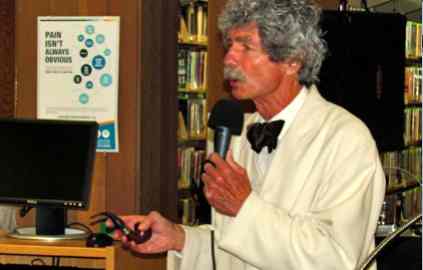
Twain delights patrons of S. Tahoe library

McAvoy Layne as Mark Twain entertains library supporters Nov. 4. Photo/Denise Haerr

McAvoy Layne as Mark Twain entertains library supporters Nov. 3. Photo/Denise Haerr

Sprinkling a bit of truth with a ton of humor, the sold-out crowd was transported to a time with Mark Twain walked the shores of Lake Tahoe.

McAvoy Layne entertained a large group Sunday at a fundraiser for the South Lake Tahoe Library. He is a legendary Twain impersonator.

Sharing his take on what happened when a fire that Twain and a friend started got out of control, Layne said, “I like to take credit for the first prescribed burn up here.”

Sitting in the library chairs and couches, enjoying adult beverages and hearty appetizers, it was a bit like an adult storytime as Layne carried on about days gone by.

The second volume of Twain’s autobiography came out this fall, with the third and final volume set for release in 2016. Asked why his words are being published more than 100 years after his death, Layne said, “Because only a dead man can tell the truth.”

The money raised from the Nov. 3 event will be used by Friends of the Library to bring programs to the South Lake Tahoe Library.

— Lake Tahoe News staff report


Barton cheeseballs for sale

Barton Auxiliary cheeseballs are available. They are only on sale this time of year and they sell out.

The are available at:

· Barton Memorial Hospital Snowflake Lobby, 2170 South Ave., Nov 6, 10am-1pm.

· Carson Valley Medical Center, 1107 Highway 395 Gardnerville, Nov. 13, 10am-noon.

· Festival of Trees and Lights, MontBleu, Stateline, Dec. 5–8, times vary.

Proceeds benefit Barton Memorial Hospital.

For more info, call Pearl Parks at (530) 543.1416 or Linda Coffman at (530) 577.0328.


Ex-Tahoe exec to run Calif.’s largest Indian casino

By Peter Hecht, Sacramento Bee

ROHNERT PARK — Anita Silva, 82, never felt deprived by her humble upbringing in a drafty shack with no indoor plumbing on a reservation in Sonoma County. Despite economic hardships, she said simply, “I didn’t remember that there were any.”

Silva, a tribal elder for the Federated Indians of the Graton Rancheria, instead reflects on her years working in Indian health care, on her grandchildren and great-grandchildren – and on how much she loves playing the slots at Northern California tribal casinos. She still talks excitedly about the 94 bucks she won at the Dry Creek rancheria in one glorious payout two years ago.

Now, in the culmination of an improbable journey, Silva and fellow tribal members are about to get their own casino – and the proceeds from perhaps the grandest and most lucrative tribal gambling establishment in California.

On Tuesday, the 1,300-member tribe will open its Graton Resort & Casino, an $800 million development in the Sonoma County wine country. Situated next to Highway 101 in Rohnert Park, it will be the closest tribal casino to San Francisco and is expected to instantly rival Thunder Valley Casino Resort in Lincoln for supremacy in the California gambling market.

Industry analysts say the new development – with 3,000 slot machines and 144 gambling tables beneath chandeliers that glitter with 24,000 pink glass flower petals – may transform gambling in California, intensifying competition among high-end resorts and the pressure to build casinos near major highways and urban centers.

“This is the bear – no, make that the $800 million gorilla,” said Ken Adams, a Reno-based casino industry analyst. “It certainly is going to grow the total amount of gaming revenue in California. It’s going to force Cache Creek and Thunder Valley to respond competitively. … We’re off to the races.”

Cheryl Schmit, an anti-gambling advocate who is fighting a major casino development another tribe plans near Highway 99 in Madera County, said the Graton resort and its prime location may signal a gambling future far different than voters envisioned when they approved tribal casinos in California.

“Here we have this massive Las Vegas-style casino very close to an urban area at the gateway to San Francisco,” Schmit said. “Everyone is pushing forward. We’re going to wake up in a few years and California will be a full-service gaming state.”

A 2012 Standard and Poor’s market assessment said the Graton resort, to be managed by Las Vegas-based Station Casinos Inc., could generate annual gambling revenue of more than $530 million by 2016. General manager Joe Hasson, who formerly ran the Harrah’s and Harveys resorts in Stateline, said the opening is being promoted in the Bay Area market with radio and TV spots airing with “such frequency that we could elect someone governor.”

Read the whole story


Kingsbury Grade crash victims out of hospital

Three of the four people injured in a two-car crash Friday on Kingsbury Grade have been released from the hospital.

The driver of the vehicle that crossed the center line was admitted to Renown Medical Center in Reno with non-life threatening injuries.

Nevada Highway Patrol troopers told Lake Tahoe News that on Nov. 1 at 2pm Dora R. Aranda, 27, was on Kingsbury Grade about three miles east of Highway 50 when her Toyota collided with a Subaru driven by Donna M. Janaczek, 59, of Zephyr Cove.

“For reasons still being investigated, Aranda allowed her vehicle to drift toward the right roadway edge and then over corrected her vehicles steering to the left resulting in her vehicle to travel into the path of Janaczek’s vehicle. The left front portion of the Toyota struck the left front of the Subaru and all four motorists’ sustained injuries,” Trooper Chuck Allen told Lake Tahoe News.

Aranda’s passengers, Melissa J Dominguez, 28, of Rialto and Christopher M. Ashlock, 23, of San Diego were treated and released from Renown, as was Janaczek.

The crash is still being investigated and no charges have yet been filed, Allen said.

— Lake Tahoe News staff report


Report: Global wine shortage growing by the case

By Roberto A. Ferdman, Atlantic

It isn’t only France that’s suffering from a dearth of wine — it’s the entire world, says a report released last week by Morgan Stanley Research.

And the shortage is only getting worse.

Last year, global supply for wine already barely exceeded demand. Adjusting the demand to include non-wine uses (such as making vermouth), there was actually an undersupply of about 300 million cases, marking the largest such shortfall in almost 50 years.

​Morgan Stanley Research

At the current pace, a global shortage of wine is fast approaching. “Data suggests there may be insufficient supply to meet demand in coming years, as current vintages are released,” the report says.

The problem is something of a two-headed monster.

Global wine consumption has been on the rise almost without interruption (save for a short stint between 2008 and 2009) since the late 1990s.

The U.S. and China, in particular, have been drinking more. The U.S., which guzzles roughly 12 percent of the world’s wine, has seen its per capita consumption double since the start of the century. And China, which is now the world’s fifth largest import market, has doubled its consumption not once, but twice in the past five years.

Read the whole story


Truckee ready to help community at Christmas

Volunteer Charlene Gamet, top center, along with her daughter and grand-daughters, staffs the Truckee Community Christmas collection barrels to help collect food donations last year at the Truckee Safeway.

Volunteer Charlene Gamet, top center, along with her daughter and granddaughters, staffs one of the Truckee Community Christmas collection barrels. Photo/Provided

The Truckee Community Christmas nonprofit organization is again overseeing toy, food, and coat drives that provide staples to local families and individuals just before Christmas each year.

Locals who place donated items in collection barrels that are placed throughout the community between Nov. 30 and Dec. 18, and marked with the Truckee Community Christmas square red logo, can be assured that their contribution will stay in the community to directly help a local family in need. All collected goods are distributed to recipients who have undergone a thorough application and review process. These individuals include low income families, teen moms and their babies, seniors who are home-bound and other deserving residents.

To help, go online www.TruckeeCommunityChristmas.com to find out how to donate, what to donate, where collection bins are located, how to volunteer and more.