Snippets about Lake Tahoe

elvis• The Rock and Roll Hall of Fame and Museum will honor Elvis Presley with a special exhibit featuring specific highlights of his career, including the rehearsal schedule from his 1971 Stateline performances.

• Sierra Surgery Hospital, in partnership with Carson Tahoe Health, has been named Top Performer on Key Quality Measures by the Joint Commission, the leading health care accrediting organization in the U.S.

• Here are the roadwork schedules from Caltrans for the coming week for El Dorado-Tahoe and Sierra.

• Iris Lazz, professional snowboarder from Lake Tahoe, has a blog with several recipes she is sharing.

Forbes magazine lists Squaw Valley as the fifth best ski resort and Mammoth No. 7.


Website will focus on N. Nevada products

USDA Rural Development Nevada is providing a $25,200 grant to develop a website that will promote buying local products and services.

Buy Local Rural Northern Nevada includes Douglas, Churchill, Humboldt, Lyon, Mineral, Pershing and Storey counties. Rural Washoe County is also part of project.

The goal of the website is local businesses will be able promote themselves for free and the consumer will then know where to buy local products. It will be open to any type of business.

For more info, contact Dave Asher at (775) 224.2242.


Study: Coffee cuts the risk of getting diabetes

By Allison Aubrey, NPR

If you go back to the 1970s, people with a serious coffee habit often had an accompanying habit: smoking.

And that’s why early studies gave coffee a bad rap. Clearly, smoking was harmful. And it was hard for researchers to disentangle the two habits. “So it made coffee look bad in terms of health outcomes,” Harvard researcher Mehr Stampfer explained to me.

But, fast forward a quarter century and the rap on coffee began to change.

As we’ve reported, recent meta-analysis studies have found that people who drink coffee regularly are at lower risk of depression, and perhaps Alzheimer’s too.

Now, there’s further evidence that coffee also helps cut the risk of developing type-2 diabetes. In the most recent , researchers found that drinking two or more cups of coffee per day was associated with a 12 percent decreased risk of developing the disease. And even decaffeinated coffee seemed to cut the risk, though not as much as the caffeinated kind.

Of course, the most significant risk factor for type-2 diabetes is weight. And, indeed, the study found that coffee’s protective effect didn’t seem to hold up as well in overweight people.

Read the whole story


Then and now: Landscaping improves area

xxx

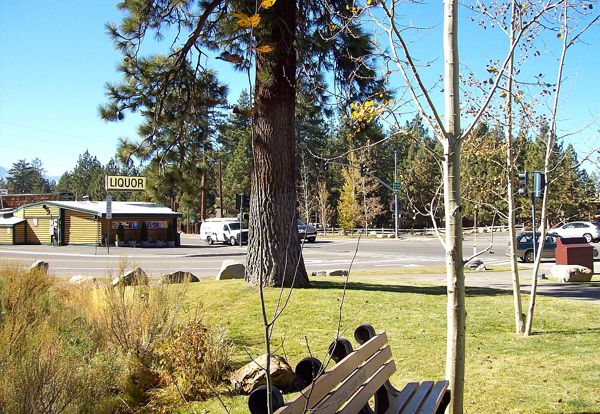
Swiss Village Motel no longer exists. Photos/Bill Kingman

xxx

What the area looks like in 2013.

The long-standing Tahoe Bottle Shop remains today, while the Swiss Village Motel, the Fern Road intersection, and Joe Montoya’s Stateline Shell (distant grey building) seen in the 2002 photo have been replaced with today’s landscaping.

In the 1960s, prior to the “LIQUOR” sign, two large poles supported a huge electric Harrah’s marquee straddling over the bottle shop building.

The strategic positioning of that brightly-lighted marquee made it head-on visible to motorists on Highway 50 approaching from as far away as Ski Run Boulevard, listing Harrah’s entertainment attractions in large plastic letters.

A very strong windstorm one afternoon (I think mid-1965) felled the marquee, shattering it on the ground next to the building. It was never replaced, as that was about the time when billboards and off-premise signage became prohibited in the new city of South Lake Tahoe.

That windstorm also destroyed much of the drive-in theater movie screen on Glenwood Way in Bijou.

— Bill Kingman


USFS plans to move historic Tahoe fire lookout

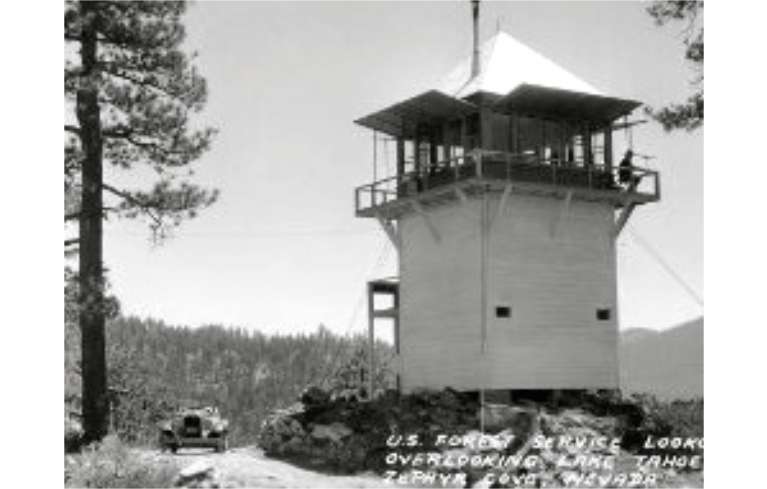
This U.S. Forest Service fire lookout may be moved to Spooner Summit. Photo/USFS

This U.S. Forest Service fire lookout may be moved to Spooner Summit. Photo/USFS

By Kathryn Reed

Technology has almost rendered fire lookouts obsolete. Still, there is one from the 1930s that is going to get a new lease on life in the Lake Tahoe Basin.

The U.S. Forest Service wants to move the Zephyr Point lookout to White Hill, which is above the agency’s firehouse at Spooner Summit. This is where the old White Hill ski lift was located.

The wooden structure was built in 1932. It was staffed through the late 1960s. After that fire crews would go to the lookout when thunderstorms rolled though to see if lightning had ignited a fire.

More recently telecommunication equipment was stored at the lookout, but that use has since ended.

“The current location is a somewhat urban industrial location. At one time it was in a remote spot on a mountain,” John Maher, USFS heritage resources program manager, told Lake Tahoe News. “Now it’s on private property and we don’t have easy access to it.”

In 1997, the fire lookout was listed on the National Register of Historic Places. One reason for not just dismantling the lookout is because of the historical significance.

Maher described the lookout as “in better than moderate condition, not excellent condition.”

There are strict guidelines as to improvements that can be made based on its being a historical structure.

“We also want it to be functional,” Maher said. “It would be used probably during thunderstorms to look for lightning-started fires.”

Plus, moving the lookout will allow public access. No new trails are planned. However, the current road would likely need to be improved so Forest Service employees could access it.

Maher said it’s possible the snowmobile tours out of Zephyr Cove could use the lookout as a stop.

The cost to build a foundation, move the lookout and add interpretive signs is estimated to be a little more than $10,000. Not all of the money is in hand. Once the forest supervisor has signed the environmental assessment it is predicted that money could become available.

The Forest Service also plans to work with the National Historic Lookout Register, which enlists volunteers to help with such relocation projects.

The other lookout in the basin, but also is not staffed, is at Angora on the South Shore.

The Forest Service is studying the environment aspects of the project now. Comments will be taken until Dec. 13. More info is available online. Depending on the comments received, a decision by the forest supervisor could be made by mid-February.


Opinion: Time to support early childhood education

By Patrick Stelmach

While stumping across the nation recently in favor of early childhood education, U.S. Secretary of Education Arne Duncan discovered something interesting: More Republican governors than Democrats have increased funding at the state level for preschool programs.

Actually, this should come as no surprise. Strong early education programs enjoy majority support from Americans of every ideological bent – Democrats, Republicans, even self-identified Tea Party members support it. Why? Because providing a better, stronger education for our children is not a partisan issue.

Think about it. There is no Republican way to teach children how to read and there is no Democrat way to teach kids how to add and subtract. There is no Blue State way to teach geography and no Red State way to teach Social Studies. Education in America has always been a bipartisan effort.

But here’s the problem. Democrat and Republican governors who want to provide expanded access to good childhood education programs face competition and constraints. Human service needs caused by the worst recession in more than a generation remain dire. Health care costs, exacerbated by our aging population, aren’t going away. And good, quality pre-K programs – the kind every American would want their kids enrolled in – do not come cheap.

All of this spells the need for a new state-federal partnership. And that’s the idea behind legislation filed this month in Congress. The Strong Start for America’s Children Act, sponsored in the House by Reps. George Miller, D-Martinez, and Richard Hanna, R-N.Y., and in the Senate by Sen. Tom Harkin, D-Iowa, would help states and local school districts improve and expand high-quality, full-day preschool programs for 4-year-olds with the goal of making sure they are ready to learn.

The need for this is now – and any cop, prosecutor, business leader, teacher or economist can tell you why. When children participate in high-quality early learning programs in the first five years of life, they do better in school, get higher-paying jobs, rely less on social programs and contribute more to the economy. Such programs improve health; reduce the need for special education, educational remediation and welfare; reduce high school dropout, juvenile justice and incarceration rates; and increase home ownership, employment and economic productivity.

It’s not just about helping children, although for many of us, that would be a desirable outcome by itself. It’s also about making our economy stronger and our workers more capable of competing in a global economy. Think of the prosperity that will flow from a strong education system if the U.S. 10 years from now found herself with the world’s best and strongest early childhood education programs.

So what can we do? A good place to start is to encourage Rep. Tom McClintock, R-Granite Bay, to climb on board and support the new legislation. It’s an opportunity for Rep. McClintock to not only reflect the will of his constituents, but also bypass the partisan gridlock in Washington and do what’s right for his district and for our children.

Patrick Stelmach is state organizer for California Fair Share. California Fair Share stands for an America where everyone gets their fair share, does their fair share, and pays their fair share; and where everyone plays by the same rules. Find out more online


Isolation doesn’t have to be a permanent state

By Christian E. Megrelis

Emotional isolation is a growing problem, with more than one out of three adults aged 45 and older describing themselves as chronically lonely, up from one out of five a decade earlier.

The contributing factors are easy to identify: high unemployment; marriage rate at a historic low; increased reliance on technology over face-to-face communication.

The main problem of tomorrow is that people are becoming inwardly focused and cut off from their neighbors.

The global crisis is not only economical but individual. Especially in the industrialized nations, we are pulling farther away from our human connections to our own detriment.

Emotional isolation, which is on the rise according to a 2010 AARP study, has been found to cause or exacerbate a number of diseases, from Alzheimer’s to cancer, and is as high a risk factor for mortality as smoking.

There’s quality of life to consider as well. Lonely people are not happy people, hence the increased stress that causes physical illness. But we can change, individually and collectively, if we heed the wisdom that has endured for 2,000 years.

Here are five time-tested steps anyone can take to reconnect and restore happiness:

· Work on loving everyone – from the stranger on the bus to your worst enemy. This is difficult, I admit, but you don’t need to do it perfectly to see the benefits. How does one take this from intellectual concept to practice? With humanitarian acts. Stop and help the person who has fallen down. Smile and say something kind to the harried store clerk. And give – not just what’s easy to give, like the old clothes you no longer wear. Share your money, your time, your resources.

· Don’t judge! Another that’s deceptively simple but gets easier with practice. Passing judgment on others is actually a very selfish act; we do it in order to feel better about ourselves, but it really isn’t effective in that regard. When you catch yourself commenting negatively about someone else, whether loud or in your mind, stop yourself and consider your own flaws. Honesty demands you focus on and correct those before your neighbor’s.

· Forgive. Holding a grudge or seeking revenge for perceived wrongs is a primitive impulse response. Forgiveness is a cerebral sentiment that comes from the cortex of the brain – the source of reason. Reason is what allows us to resist dangerous primitive impulses in able to achieve more far-sighted objectives, such as social life, which is impossible without forgiveness.

· Do good that makes a difference. Feeling we have no purpose in life or being unsure what our purpose is can lead to despair or indifference often resulting in sterile ambition, delusion or conceit, all of which serve to isolate us from others. We all have a purpose, whether or not it’s easily discernible. Whatever place is yours in society, bring your brick every day to the never-ending construction of a happier world and you will quickly recognize your purpose.

· Have faith. You don’t have to subscribe to a particular religion or follow dogmatic rules to have faith. It’s actually harder than that. Faith is the belief that there is something greater than us, the creator of the world in which we live, guiding all with an order and a purpose. Faith may be – and often is – marked by periods of doubt, but it should be the compass to which you return. Faith brings with it a connection to all other living things.

Achieve, or at least work toward, these five steps and the result will be hope.

Hope is happiness – a state of mind that transcends ordinary happiness.

Christian E. Megrelis has master’s degrees in engineering, business and political studies. He is the founder of Exa International, a multinational engineering company, and vice chairman of the International Union of Economists. He is also the former vice chair of the United Bible Societies, a major world publisher of the Bible.



Kids staying warm with coat donation

More than 600 students from South Lake Tahoe schools recently received a new jacket for the winter.

Each year the Kiwanis, with the generosity of grants from the El Dorado Community Foundation, Antique and Classic Boat Society/Classic Wooden Boat Show, and the American Century Championship, is able to purchase these jackets. Eventually the service club would like to buy boots and snow pants for the youth.

Go online to find out more about the project.


Land trust hosting spaghetti dinner

Saint Joseph Community Land Trust is hosting a Give Thanks Spaghetti Dinner on Nov. 21 from 6-8pm.

It’s an opportunity for the group to give thanks to members and supporters.

Cost is $5.

The dinner will be at Grace Hall at Saint Theresa Church, 1041 Lyons Ave., South Lake Tahoe.


Court decision good for readers, bad for writers

By Sophia Pearson and Bob Van Voris, Bloomberg

Google Inc.’s project to digitally copy millions of books for online searches doesn’t violate copyright law, a federal judge ruled, dismissing an eight-year-old lawsuit against the largest search-engine company.

Google Books provides a public benefit and is a fair use of copyrighted material, Judge Denny Chin in Manhattan ruled today. The project, which has scanned more than 20 million books so far, doesn’t harm authors or inventors of original works, Chin said.

“Google Books provides significant public benefits,” Chin wrote. “It advances the progress of the arts and sciences, while maintaining respectful consideration for the rights of authors and other creative individuals, and without adversely impacting the rights of copyright holders.”

Chin’s decision comes more than two years after he rejected a proposed $125 million settlement in the case filed by The Authors Guild, which represents writers. The group sued in 2005 alleging that Google, owner of the world’s most popular search engine, infringed copyrights by scanning and indexing books without writers’ permission.

Paul Aiken, the Authors Guild’s executive director, said in a statement today that the ruling is a “fundamental challenge” to copyrights and that his group plans to appeal.

Read the whole story