Calif. tries to find a balance with water needs

By Karen Weise, Bloomberg

A century after William Mulholland’s Los Angeles aqueduct first began watering the Southland, the water wars in California show no sign of abating.

The state reached a milestone on Monday in its effort to balance equal-but-conflicting goals: channeling more water to dry farmland and cities while restoring the natural habitat already hurt by the state’s thirst.

California has released details of a $25 billion plan to run two tunnels under the Sacramento-San Joaquin Delta. The tunnels would divert water from supplies north of the delta to existing pumps on its southern edge that push water to Southern California and the agricultural land of the Central Valley.

By forcing the water underground for 35 miles, the plan also calls for the restoration of more than 80,000 acres of habitat in the delta, which houses 56 species of plants, fish, and wildlife that have been struggling. The area’s current system of fragile earthen levees are vulnerable to a nightmare scenario known as “California’s Katrina.”

The state’s twin reports explaining the conservation proposal and the impact of the water project span some 34,000 pages; the “highlights” brochures alone total more than 170 pages. The reports look at 14 alternatives but focus on the one favored by Gov. Jerry Brown.

Read the whole story


Concern about non-college bound girls

By Claudio Sanchez, NPR

Kyrah Whatley, 17, is a bright student with pretty good grades. But the thought of spending two to four more years in a college classroom is depressing, she says.

Masonry, on the other hand, intrigues her. “I’m a kinesthetic learner. … I learn with my hands,” she says.

That’s why Kyrah is thinking of joining the Navy as a certified mason right after she graduates from Buchtel High School in Akron, Ohio.

A new poll from NPR, the Harvard School of Public Health and the Robert Wood Johnson Foundation finds that the majority of parents feel their child’s school is preparing students for college. But 4 in 10 say that schools do not sufficiently prepare students who will not attend college — and parents of girls are even more likely to be concerned than parents of boys.

Read the whole story


K’s Kitchen: A tasty soup that warms the insides

By Kathryn Reed

Only one food warms me up through and through – that’s soup.

I could have soup every day and never get tired of it. But I do like trying new recipes.

k's kitchenThe one below did not disappoint. It is from the September issue of Cooking Light magazine.

Besides being ideal on a cold winter day or night, it’s easy to make.

I used veggie broth. And because a carton has 4 cups I used the whole thing. It meant the soup was a little thinner and less green, but the flavor was still outstanding. I also used more garlic, but to me garlic is practically a food group. I made it easy and bought cheese that was already shredded. I also skipped the parsley because it’s more of a garnish than anything else. But if you are serving this to guests, the parsley would make it look pretty, as would a few grinds of fresh pepper.

 Broccoli-Cheese Soup

3 C unsalted chicken stock

1¾ C broccoli florets, coarsely chopped (about 8 ounces)

1 C diced yellow onion

½ C chopped carrot

3/8 tsp salt

¼ tsp freshly ground black pepper

2 garlic cloves, minced

¾ C half-and-half

4 ounces shredded reduced-fat extra-sharp cheddar cheese, divided

¼ C fresh flat-leaf parsley leaves

Combine first 7 ingredients in a large saucepan; bring to a boil. Reduce heat, and simmer 10 minutes or until broccoli is tender. Pour soup into a blender. Remove center piece of blender lid (to allow steam to escape); secure lid on blender. Place a clean towel over opening in blender lid (to avoid splatters). Blend until smooth. Return soup to pan. Stir in half-and-half and 2 ounces cheese. Top evenly with remaining cheese and parsley.


Poll: Californians have no desire to split state

By David Siders, Sacramento Bee

Officials in Siskiyou and Modoc counties may want to secede from California, but the rest of the state has no desire to see them go.

Just one-quarter of California voters support allowing the state’s northernmost counties to break away from California, according to a new Field Poll.

Fifty-nine percent of registered voters statewide oppose such an effort, according to the poll. Opposition to the effort is bipartisan, with majorities of Democrats, Republicans and independent voters all opposed.

Read the whole story


Free radon kits available for Nevadans

Free radon test kits are available through Feb. 28 at University of Nevada Cooperative Extension offices and partner offices statewide.

Radon is a radioactive, colorless, odorless and tasteless gas that comes from the ground. It accumulates in homes and can cause lung cancer.

During National Radon Action Month in January the Nevada Radon Education Program will offer presentations at various locations. Test kits will also be available at the presentations.

Scheduled presentations are:

Jan. 2 – Washoe County Cooperative Extension, 4955 Energy Way, Reno, at 6pm.

Jan. 7 – Spanish Springs Library, 7100A Pyramid Lake Highway, Reno, at 6pm.

Jan. 8 – Northwest Reno Library, 2325 Robb Drive, Reno, at 5pm.

Jan. 9 – Sierra View Library, 4001 S. Virginia St., Reno, at 3:30pm.

Jan. 11 – North Valleys Library, 1075 N. Hills Blvd. No. 340, Reno, at 11am.

Jan. 22 – South Valleys Library, 15650A Wedge Parkway, Reno, at 6pm.

Jan. 27 – Tahoe Regional Planning Agency, 128 Market St., Stateline, at 6pm.

Jan. 28 – UC Davis/Tahoe Environmental Research Center (TERC) at Tahoe Center for Environmental Sciences, 291 Country Club Drive, Incline Village, at 6pm, with a reception at 5:30 ppm

Jan. 29 – CVIC Hall, 1604 Esmeralda Ave., Minden, at 6pm.

Jan. 30 – Carson City Sheriff’s Office, 911 E. Musser St., Carson City, at 6pm.


Holiday albums a lackluster genre

By Hannah Karp, Wall Street Journal

Two years ago, it looked as if Christmas albums could help save the record business. But now the holiday genre appears to be losing its sparkle, amid a dearth of releases from giant stars.

Kelly Clarkson’s album, “Wrapped in Red,” released in October, has sold a few hundred thousand copies, but it is trailing sales of the Christmas album from the cast of reality TV’s Duck Dynasty. “Duck the Halls: A Robertson Family Christmas” has sold more than 360,000 copies, according to Nielsen SoundScan.

Those numbers are shy of last year’s top releases at this time, and they pale in comparison to Michael Buble’s “Christmas” in 2011, which was the second-best selling album that year, selling more than 2.5 million copies in 2011 and nearly a million copies more since then.

Read the whole story


Animals in Tahoe trash a continual problem

By Kathryn Reed

Mattresses continue to be the No. 1 large bulk item that Clean Tahoe picks up. Televisions are a close second.

Catherine Cecchi, executive director of the nonprofit, updated the South Lake Tahoe City Council on Tuesday about what her organization has been up to.

“We have a number of problem properties where a bear or other animals are in Dumpsters every night,” Cecchi said. “We’ve posted signs on Dumpsters. Some don’t have lock bars or a clip.”

Eventually, repeat offenders get referred to the city’s code enforcement officers. Cecchi said improvement comes when code enforcement gets involved.

In the past year, the two Clean Tahoe crewmembers have gone to 1,657 illegal dumpsites in the city. Between the city and in the basin portion of El Dorado County 583 cubic yards of trash have been picked up.

Earlier in the Dec. 10 meeting, South Tahoe Refuse President Jeff Tillman said that starting March 3 trash pick up will start at 7am.

“We hope residents will no longer put garbage out the night before,” Tillman said.

This is designed to cut down on the number of animals getting into garbage and creating a mess.

Clean Tahoe is looking at getting a grant for bear resistant containers to help with the chronic garbage problems.


Trails dominate South Shore rec discussion

By Kathryn Reed

Build the bike path that would link Meyers to Stateline.

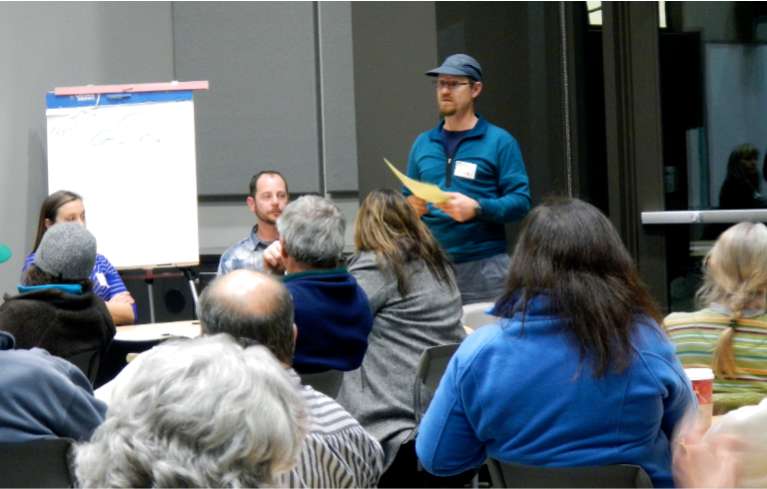
That was the idea that received the largest number of votes from the more than 50 people who attended a recreation meeting Dec. 11 at South Tahoe High School.

Consultants putting together the South Lake Tahoe-El Dorado County Recreation Master Plan wanted to hear from the public what they would like the South Shore to look like five and 10 years from now.

Peter Fink talks Dec. 11 about ideas his table has for recreation on the South Shore. Photo/Kathryn Reed

Peter Fink talks Dec. 11 about ideas his table has for recreation on the South Shore. Photo/Kathryn Reed

There will be another meeting tonight from 6:30-8:30 at Kahle Community Center in Stateline. Douglas County has hired the same firm to work on a recreation plan at the lake. The goal is to have a seamless sense of recreation that eliminates jurisdictional boundaries, at least on the South Shore.

Other areas of interest are building an amphitheater, creating a centralized multi-use facility, expanding the city’s recreation center, eliminating Campground by the Lake and using it for recreation, and providing better information to locals and tourists about what the area has to offer.

Improving what is in the ground, signs pointing to where things are, being known for something other than skiing, homegrown festivals and events, promoting what’s here – those were some the things people envision.

In the end, the summary of the night was, “We envision an accessible interconnected and sustainable system of diverse year-round recreation opportunities. Our parks, facilities, trails, events and programs reflect our character, heritage, environment and shared future for recreation in the South Shore.”

While months ago the powers that be spoke of how this plan would get into the need for ball fields so large tournaments could come to town, that was not broached Wednesday night. Nor did it rise to the top of the list during surveys.

A cohesive, well thought out trail system is what people want. They are tired of bike trails that abruptly end as well as sidewalks. And they want trails that would drop them off at areas of interest, including recreation destinations.

A draft of the master recreation plan is expected to be released in the spring.

More information about the plan is online. From that website it’s possible to signup for email updates from El Dorado County.


Opinion: California budget surplus is misleading

By Autumn Carter and Adam Tatum

Apparently, all is well in California. However, politicos and average citizens probably disagree on that point.

Last month, a report by the California Legislative Analyst’s Office said we should expect annual budget surpluses through 2019-20, including nearly $10 billion surpluses each year starting in 2017-18.

Essentially, based on tenuous predictions that have traditionally missed the mark, the LAO is arguing that California’s fiscal troubles are over. Nothing could be further from the truth.

One problem is that the optimistic forecasts rely too heavily on big assumptions while discounting the extent of existing problems.

For instance, they assume that from now to 2019-20, the economy and real estate markets will grow robustly, that the stock market will steadily improve each year, and that legislators will keep their spending under control. Perhaps most concerning, they assume that policymakers will continue ignoring the growing unfunded liabilities associated with public employee retirement benefits, thereby allowing those rising costs to further crowd out public services in the budget.

As Gov. Jerry Brown recently stated, “We have deferred maintenance on our roads, that is serious; we have unfunded and growing liabilities in our pension and retiree health – state, university and local level. That’s real.”

Indeed, it is real. Unfortunately, health, retirement, corrections and debt costs are expected to grow in the coming years, placing continued strain on any California budget – surplus or not.

There is an inherent problem with relying too heavily on long-term forecasts. While they provide value, they merely illustrate a picture of what the future would look like if all assumptions hold true. To their detriment, forecasts are fundamentally rooted in unreliable assumptions.

Further, the LAO took an outdated, 20th-century approach to budget forecasting. It restricted its forecast to money in the general fund, or main operating budget, and ignored special funds. Years ago, special funds accounted for only 20 percent of the state budget. Today however, they account for 33 percent of total state spending. Thus the forecasts completely ignore an increasingly significant portion of the budget.

The LAO has no economic crystal ball, so as with any long-term forecast, error is virtually inevitable. Yet, LAO’s forecasting history is littered with inaccuracies.

For instance, in 2006, the LAO predicted that California would have $128 billion in general fund revenue in 2012. In actuality, the state had only $87 billion in 2012, reflecting a 32 percent shortfall. While the LAO’s short-term forecasts have underestimated revenue by an average $1.4 billion since it began three- to five-year forecasts in 1998, its long-term forecasts have overestimated them by an average $8.8 billion.

Consistently inaccurate forecasts bring into question how well the LAO can claim to assess the condition of the underlying economy they reflect.

The report outlines a possible approach to using the forecasted surpluses. It suggests using the additional revenue to fund infrastructure, increase funding to existing programs, create new programs, pay down the state’s “wall of debt,” build an $8 billion reserve by 2016-17, and reduce taxes.

While it acknowledges the state’s massive outstanding retirement liabilities, the report suggests committing only an additional $500 million each year – or $3 billion by 2019-20 – to address them. That is nowhere near what’s actually required to stabilize the state’s severely underfunded retirement systems.

Today, the California State Teachers’ Retirement System and the state’s retiree health care program have unfunded liabilities of $71 billion and $64 billion, respectively. CalSTRS expects to deplete its money by 2043, and many estimate a date closer to the 2020s. To fully fund these plans, the state would have to begin paying an additional $4.5 billion to CalSTRS and an additional $4.9 billion for retiree health care each year starting today.

These retirement systems are expensive, but legally, the state is bound to pay the guaranteed benefits they provide to retirees. Finally funding the systems fully would consume the annual forecasted surpluses, transforming them into deficits. Leaving the systems chronically unfunded would raise their annual costs and crowd public services even more. Surplus or not, there is no painless solution here.

California still has serious obligations that its policymakers have ignored and neglected for too long. Californians now pay substantially more to receive substantially less, and repairing the extensive damage goes far beyond predicting higher revenue that may never materialize. Even if the forecasts prove true, all is certainly not well in California.

Autumn Carter is executive director of California Common Sense, a nonpartisan nonprofit think tank specializing in government fiscal policy and analysis. Adam Tatum is California Common Sense’s research director.



Largest private land holding in Tahoe sold

By Kathryn Reed

It took more than seven years and for the price to drop $55 million before Tranquility got a new owner.

Tranquil Investments LLC bought the Zephyr Cove property for $45 million. When it first went on the market in 2006 the asking price was $100 million. It is the largest private land holding in the Lake Tahoe Basin.

This staircase is designed to look like the one on the Titanic. Photo/Chase International

This staircase is designed to look like the one on the Titanic. Photo/Chase International

In 1996 Joel Horowitz, co-founder of Tommy Hilfiger, and his wife, Ann, bought the 210-acre undeveloped property for $4.5 million from South Shore developer Falcon Capital, which was run by Randy Lane. Falcon bought it in a bankruptcy deal involving Wayne Newton for $2.51 million. The Bourne family, who owned the Singer Sewing Machine Co., are the original property owners. The Bourne Meadow is on the other side of Highway 50 from this parcel.

It took 30 months to build all the structures. There are nine bedrooms, 14 full baths, five half baths and room for 16 vehicles.

The main house, which feels like a museum, is 27,000-square-feet. Most of the furnishings come with the house. The marble floor entrance was built to resemble the New York City Library – a couple lion statues are out front just like in the Big Apple. Then there is the replica of the Titanic staircase. A rectangular mezzanine level is a library. The theater seats 19.

Near the main house is the 5,000-square-foot guesthouse, which feels more like Tahoe. It has the only wood fireplace. Ten small gas fireplaces are on the property.

Across the drive is the 5,000-square-foot wood-framed caretakers’ quarters. A 1,400-square-foot log cabin art studio is on the far side of the natural, private lake.

Beyond the guesthouse is a 4,000-square-foot wood barn and stable. Near the stables is the 4,000-square-foot wood-framed and steel trussed gymnasium with basketball court.

A tunnel connects the glass mosaic pool and spa to the main house.