Then and now: Publications come, go and grow
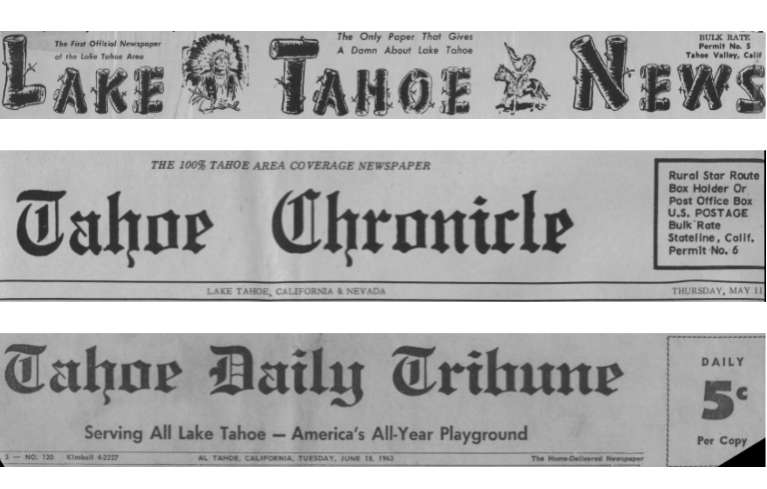
newspapersChristopher “Flip” Brandi printed Lake Tahoe News since the 1950s. It generally appeared Wednesdays, and later two days a week.

The offices and printing press eventually were in the block building now housing Verizon Wireless on Highway 50 near Tahoe Keys Boulevard (next to Steamer’s).

In a rear room of that building also were the audio facilities of KHVR-FM (“Heavenly Valley Radio”), 99.9, which survived barely a year in 1961, transmitting from Heavenly’s parking lot. Brandi held an interest in KHVR-FM along with Harrah’s engineer Jack Dumars. There were too few FM listeners (or FM radios) in 1961.

The Tahoe Daily Tribune also published two days a week in the early 1960s, always on days alternate of Brandi’s paper. It additionally sub-billed itself as the Tahoe Sierra Tribune. Chapman Wentworth was the publisher in 1963.

Usually we had one or the other local newspaper on four weekdays of each week.

Do you remember the Tahoe Chronicle weekly on Thursdays? It was started in 1963 at “Stateline, California” by Edwin B. Brown and William Dolan. The pictured masthead is dated Thursday, May 11, 1967.

My thanks to Bob Rockwell of South Lake Tahoe who loaned me these historic newspapers. I am scanning various memories from them for future sharing here on what has become our modern — and daily — local news source.

– Bill Kingman


Spectacular views spill forth after easy climb

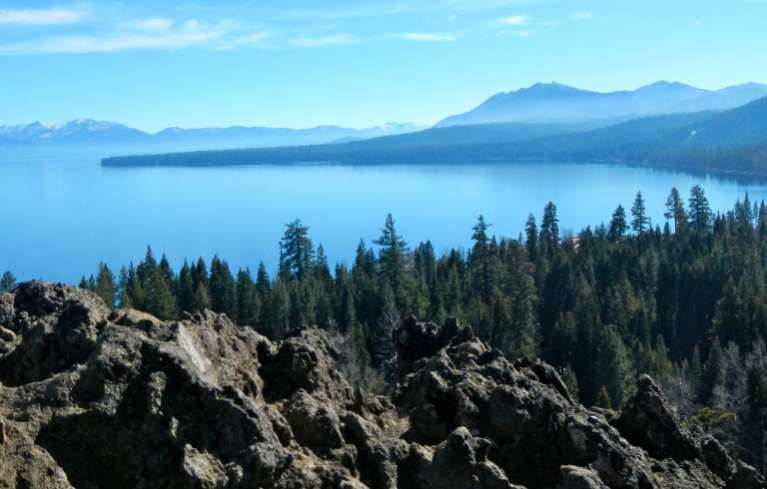
Views of Rubicon Point and Mount Tallac from Eagle Rock. Photos/Kathryn Reed

Views of Rubicon Point and Mount Tallac from Eagle Rock. Photos/Kathryn Reed

By Kathryn Reed

TAHOE CITY – Eagle Rock has to be the easiest hike in Lake Tahoe to get some of the most stunning views. It’s like having an eagle’s-eye view of the basin.

Eagle Rock has always been popular among those who knew about it. But now it is getting even more attention because a designated trail was created. It used to require scrambling up the rocky backside to get to the top.

When we scampered up there two weeks ago the dirt trail was narrow, with a gradual climb. It’s only 1,800-feet long.

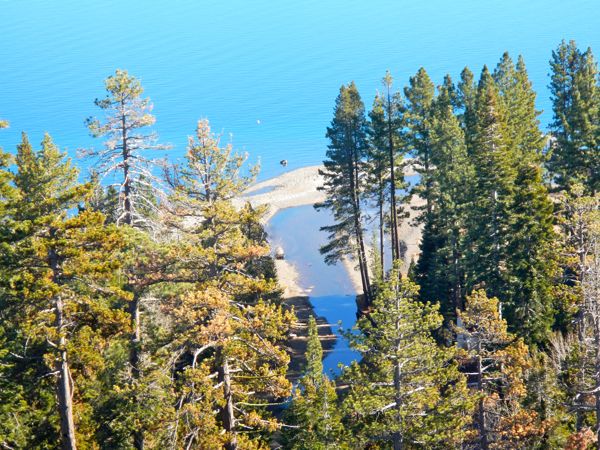
Blackwood Creek flows into Lake Tahoe.

Blackwood Creek flows into Lake Tahoe.

Signs at the trailhead said it’s a moderate hike. I would say for those who are used to hiking in Tahoe it’s an easy hike. The only “difficult” part is a bit of rock scrambling at the top. This might be where poles would come in handy for anyone with balance or knee issues.

It’s 250-feet of volcanic rock at the top. This in itself makes it such a change from the usual granite that dominates the basin.

Like so many places in the basin, this used to be a special spot for Native Americans. However, white people knew about Eagle Rock in the 1880s. At one time there was a gazebo at the top. With how exposed the area is, it’s easy to see how it could be a hot vista in the summer.

There is a California State Lands Commission marker at the top that is dated 1979.

The California Tahoe Conservancy in 1987 acquired the 54.5-acre property that includes Eagle Rock for $450,000.

The Conservancy in 2012 completed a more than $4 million restoration project in the Blackwood Creek Watershed. This area contributed more sediment to Lake Tahoe than any other watershed in the basin – more than 1,900 tons a year.

The Eagle Rock trail is in the watershed. Part of it was built in 2011, with the second and final phase finished this year.

It’s easy to see where Blackwood Creek spills into Lake Tahoe.

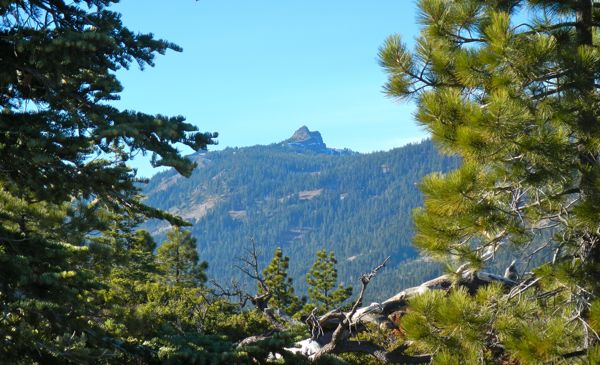
Rubicon Peak

Rubicon Peak

The sweeping views make it a must-do hike. It takes about 15 minutes to get to the top. Rubicon Point and Mount Tallac dominate the southern view. Immediately to the south are Homewood’s ski runs. Heavenly’s upper trails are distinctly outlined in white. To the rear is Rubicon Peak. Private piers dot the landscape to the north.

—-

Getting there:

From South Lake Tahoe, take Highway 89 north. The trail is between Chamber’s Landing and Sunnyside, on the left. There is parking on the left side, but there is no visible trailhead sign that can be seen while driving. There is a large “Lower Blackwood Creek Restoration Project” sign. The trailhead sign is to the right of that.


Letter: Festival of Trees and Lights a success

To the community,

This year’s Festival of Trees and Lights was once again a huge success. The six-day event is a collaborative effort between Barton Health staff, community and Auxiliary volunteers, and sponsors.

Thank you to everyone who volunteered, decorated a tree or a wreath, donated an auction item, or sponsored one of our many events.

A special thanks to Barton Foundation’s volunteer steering committee who worked all year long to ensure the event was a magical experience. Kudos to Santa for his long hours and constant cheer, to Dreu Murin who has taken our event to “new heights,” and to the designers and schools for creating such gorgeous trees.

Many people braved the Friday and Saturday snowstorm to celebrate the holidays with us. A total of 2,832 people attended at least one of the festival’s activities and an additional 200 patrons enjoyed the Tallac Association’s play “The Best Christmas Pageant Ever.”

At the evening gala we celebrated Barton’s 50th birthday with a gold and red theme – a tribute to the Barton Auxiliary, Barton Health’s dedicated volunteers and hospital greeters. The live auction featured the auxiliary’s famous cheeseballs, a standup paddleboard, an African safari, and an adorable puppy.

All funds raised will support Barton’s cardiology programs. We appreciate all of you who participated and helped invest in the health of our community.

Happy Holidays!

Kindle Craig, executive director Barton Foundation


White places second in Dew Tour superpipe

The top four finishers in men’s snowboard superpipe finals at the Dew Tour in Breckenride are from the United States.

Sixteen riders competed in what is a qualifying event for the Olympics.

The 600-foot pipe is longest one built today.

Greg Bretz of Mammoth upset favorite Shaun White. White, who rides for Northstar, had to settle for second. Taylor Gold rounded out the podium. Bretz is the first person to beat White in nearly four years.

 — Lake Tahoe News staff report


Wise wins Dew Tour freeski superpipe

By Alliance of Action Sports

David Wise, who skies for Northstar, won the Dew Tour men’s freeski superpipe final at Breckenridge.

Like the qualifier, a stacked roster of 14 freeskiers — following both Torin Yater-Wallace and Simon Dumont each having to pull out following falls in the practice just before the final — had two opportunities to throw down a run toward a win, and a spot on the inaugural U.S. Olympic Freeskiing Team.

During the first round of runs we saw some serious tricks pulled, but unfortunately we also saw some serious competitors come up short.

With more speed and amplitude, Wise’s second run upped his score to a staggering 92.60 that would maintain as the top score for the remainder of the event.

Aaron Blunck was second and Lyman Currier third.

Read the whole story


Researchers getting to the root of vitamins

By Carl Zimmer, New York Times

In 1602, a Spanish fleet was sailing up the Pacific coast of Mexico when the crew became deathly ill. “The first symptom is pain in the whole body that makes it sensitive to touch,” wrote Antonio de la Ascensión, a priest on the expedition. “Purple spots begin to cover the body, especially from the waist down; then the gums become so swollen that the teeth cannot be brought together, and they can only drink, and finally they die all of a sudden, while talking.”

The crew was suffering from scurvy, a disease that was then both bitterly familiar and deeply mysterious. No one knew why it struck sailors or how to cure it. But on that 1602 voyage, Ascensión witnessed what he considered a miracle. While the crew was ashore burying the dead, one sick sailor picked up a cactus fruit to eat. He started to feel better, and his crewmates followed his example.

“They all began to eat them and bring them back on board so that, after another two weeks, they were all healed,” the priest wrote.

Over the next two centuries, it gradually became clear that scurvy was caused by a lack of fruits and vegetables on long-distance voyages. In the late 1700s, the British Navy started supplying its ships with millions of gallons of lemon juice, eradicating scurvy. But it wasn’t until 1928 that the Hungarian biochemist Albert Szent-Gyorgyi discovered the ingredient that cured scurvy: vitamin C.

Szent-Gyorgyi’s experiments were part of a wave of early-20th-century research that pulled back the curtain on vitamins. Scientists discovered that the human body required minuscule amounts of 13 organic molecules. A deficiency of any of the vitamins led to different diseases — a lack of vitamin A to blindness, vitamin B12 to severe anemia, vitamin D to rickets.

Today, a huge amount of research goes into understanding vitamins, but most of it is focused on how much of them people need to stay healthy. This work does not address a basic question, though: How did we end up so dependent on these peculiar little molecules?

Read the whole story


Snippets about Lake Tahoe

no parking• South Lake Tahoe City Attorney Tom Watson finally wrote the title and summary for the Tahoe4Tahoe group regarding repealing paid parking by South Lake Tahoe. Now signatures must be acquired before it goes on the ballot.

• Gov. Jerry Brown reappointed Carl Goff, 54, of Placerville to the California Apprenticeship Council.

• When Aspens, the low income housing in South Lake Tahoe opens, six units will be designated as specialty mental health, meant for those homeless, risk of homelessness, and mental health issues, including having a child with a mental illness.

• South Lake Tahoe’s Live Violence Free needs an executive director.

• Wendy David remains president of Lake Tahoe Unified’s school board for another year. Barbara Bannar is clerk of the board.


Christmas light installation a growing industry

By Stephanie Gleason, Wall Street Journal

At Christmas time, Shirley Pepys often sits across the street from her home in Newport Beach and covertly listens to the oooohhs and aaaahhs of delighted passersby.

Pepys, a retired business owner, has been decking her home with boughs of holly — and much more — for the past 20 years. With each year, the décor has become more elaborate. Her display now features twinkling lights, illuminated snow, a family of faux penguins and a four-minute light show coordinated to “Carol of the Bells.”

Everything is custom built. But not by Pepys. For the past two years, she has enlisted Dillon Wells, an audiovisual professional, and his family to put together the full display, paying under $15,000 for the whole shebang.

More Americans are forgoing the difficult and sometimes risky endeavor of installing their own holiday lights, asking professionals to take their place on the ladder. National chain Christmas Decor, which has 40,000 clients across the U.S., says it has seen sales increase 11 percent every year for the past four years.

Read the whole story


Nevada officers targeting drinkers during holidays

More than 25 law enforcement agencies in Nevada are participating in Joining Forces will be cruising the state’s roadways between now and Jan. 6.

Officers will be targeting impaired drivers who not only pose threats to themselves, but innocent passengers and other road users.

Officers said the holiday season continues to be the most hazardous period on the nation’s roadways for impaired driving. One reason is because of the number of holiday parties and celebrations.

Here are tips to keep the community safe:

• Consider a non-alcoholic party

• Designate sober drivers, not drivers who agree to drink less

• Hire licensed caterers trained to judge guests’ alcohol consumption

• Reserve a block of hotel rooms

• Plan a safe and sober way to return to your home before going out

• If you see a drunk driver, contact local police by calling NHP or 911

• If people you know are about to drive impaired, take their keys and help get them a ride with a sober driver.


2013 fire season below average

By Bettina Boxall, Los Angeles Times

A wildfire season that began with dire warnings that dry conditions had set the stage for a year of flames across California and the West turned out to be one of the nation’s quietest in the past decade.

Although 2013 was marked by two high-profile blazes, one in California and the other in Arizona, nationally the total wildfire acreage of 4.15 million is far below the 10-year average of 6.8 million acres.

In California, the number of wildfires was high, but the amount of land that burned was slightly less than the 10-year average, according to state and federal figures. As always, weather was the deciding factor.

Read the whole story