Malbec’s status rising in Argentina

By Florence Fabricant, New York Times

In Argentina, where the malbec grape is king, winemakers have put a different and intriguing spin on what is usually known as a Bordeaux blend. Instead of the typical mix of Cabernet Sauvignon, Cabernet Franc and Merlot, they are relying primarily on Cabernet and Malbec.

Malbec because it dominates the vineyards of Mendoza, the country’s largest wine region. And Cabernet because making a top-of-the-line Malbec blend seems to beg for its cachet, especially if you have French partners.

“Cabernet Sauvignon has always been considered classier than Malbec,” said Alejandro Vigil, the head winemaker at Bodegas Catena Zapata, a top Argentine producer based in a stunning Aztec-style winery in Mendoza with the high Andes in the background. “It’s more noble, has more prestige and is more expensive.”

Read the whole story


Snippets about Lake Tahoe

natalie yanish• Natalie Yanish is now president of the South Tahoe Association of Realtors.

• Jan. 16 from 5:30-8:30pm is Lake Tahoe South Shore Chamber of Commerce’s annual charity mixer at Riva Grill. Proceeds will be donated to Christmas Cheer and Bread & Broth. Cost is $20 for members, $30 for non-members. Buy tickets online.

• Here are the El Dorado-Tahoe and Sierra roadwork schedules from Caltrans for the week.

• Tahoe Blue Vodka and the Lake Tahoe Visitors Authority are looking for mixologists to come up with a vodka drink. Submit entries online.

• Elvis Presley would have turned 79 on Jan. 8 and the Carson Valley Inn is celebrating with Elvis Week Jan. 6-11.


Calif. undecided on legalizing recreational pot

By Peter Hecht, Sacramento Bee

On New Year’s Day in Colorado, state-licensed marijuana stores will begin selling pot purely for pleasurable consumption.

Colorado, already home to the nation’s most regulated medical marijuana industry, expects to open its first two dozen stores selling recreational cannabis users up to an ounce of pot each. Another 400 applications are pending for retail marijuana shops, commercial cultivators or pot product producers. In Washington, where voters also legalized recreational marijuana use in November 2012, the state is reviewing a flood of applications for 340 state licenses for marijuana stores expected to begin opening this spring.

Now in California, where a recent Field poll showed 55 percent voter support for marijuana legalization beyond medical use, four pot legalization ballot initiatives have emerged as contenders for the November ballot. Yet in the home of America’s largest marijuana economy, advocates remain hesitant about moving forward – and putting the necessary money on the line – to qualify a California pot legalization vote next year. They remain uncertain over the state’s political climate and are frustrated by failure of lawmakers to set rules governing California’s medical marijuana trade, once estimated at $1.5 billion, in the face of federal raids on cannabis businesses.

Read the whole story


Opinion: Storage — Calif.’s most important water issue

By Dan Walters, Sacramento Bee

The release last week of detailed plans for building water tunnels beneath the Sacramento-San Joaquin Delta touches off a legal and political battle that could take years to resolve.

The tunnels, however, are merely one aspect of securing an adequate and dependable water supply for the state – and perhaps not even the most important aspect.

The tunnels, if built, would allow some Sacramento River water to bypass the environmentally stressed Delta on its way to the head of the California Aqueduct near Tracy.

However, a more fundamental issue is whether there will be enough water, when needed, to satisfy the 25 million Californians who draw water from the aqueduct and farmers, while enhancing the Delta’s deteriorated habitat for fish and other Delta wildlife.

The state’s largest reservoir, by far, is the snowpack that accumulates in the Sierra during winter months and is released into the Sacramento-San Joaquin river systems as warmer spring and summer weather melts the snow.

Read the whole story


Full moon snowshoe on West Shore

A ranger will lead a 90-minute full moon snowshoe tour at Sugar Pine Point State Park on Jan. 18.

It begins at 7pm. A beginners’ clinic will start at 6:30pm.

Wear warm, layered clothing, waterproof hiking boots and bring a flashlight. S

pace is limited and reservations are required by calling West Shore Sports at (530) 525.9920.

The $25 fee per adult includes parking, snowshoes and guided tour. Children 12 and under are free.

Proceeds benefit the Sierra State Parks Foundation.


Ganong closer to making U.S. Olympic team

By USSA

BORMIO, Italy — Travis Ganong (Squaw Valley) closed the 2013 calendar with another positive stride toward his first Olympic Winter Games with a tie for 10th in a rugged Bormio downhill to lead the U.S. Ski Team.

Starting second, Ganong powered though snow at the top of the notorious Stelvio and through rattling bumps in the middle section to post his best Audi FIS Alpine World Cup finish of the season.

Norwegian Aksel Lund Svindal, who skied in relatively clear conditions, skied a flawless line to win the race for the 25th World Cup victory of his career.

Marco Sullivan (Squaw Valley) also landed in the points for the U.S. Ski Team with 22nd.

Bode Miller (Franconia, N.H.) was rocked hard through the middle section and bounced low on the traverse to finish outside the top 30.

Austrian Hannes Reichelt was second with Canadian Erik Guay third for his second straight downhill podium.


Then and now: Lodging on the South Shore

bk-1According to E.B. Scott’s book “The Saga of Lake Tahoe”, Ephraim “Yank” Clement opened his three-story Yank’s Hotel on homesteaded land at the South Shore of Lake Tahoe in 1875.

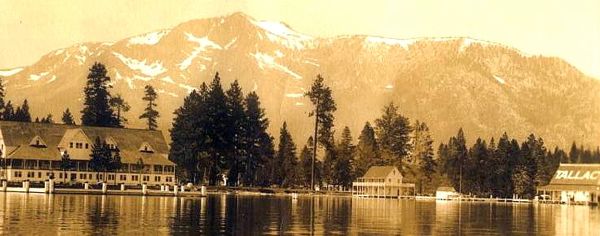
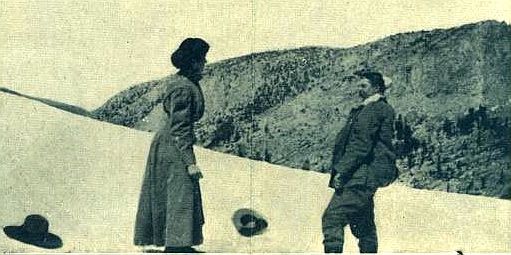
Upon being purchased by Elias “Lucky” Baldwin in 1881, the bk-2hotel was renamed the Hotel Tallac (aka Tallac Casino) in recognition of adjacent Mt. Tallac and its famous “T” snow cross (photo No. 1).

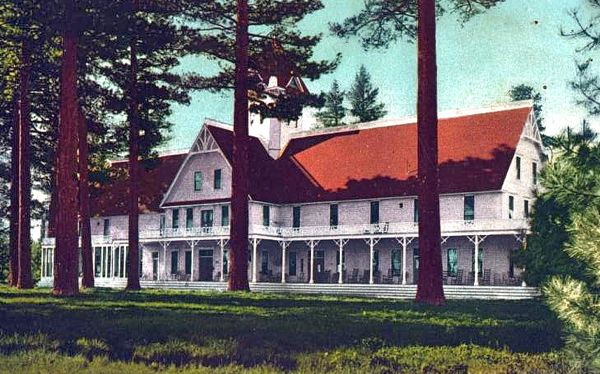
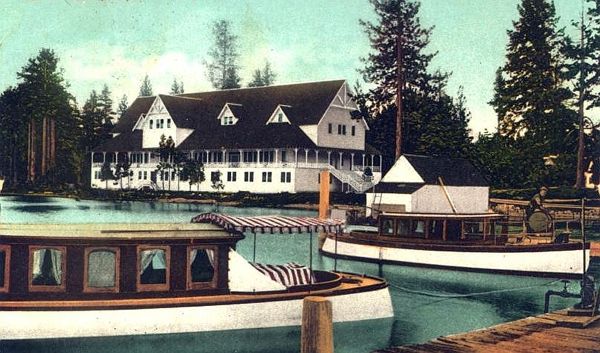
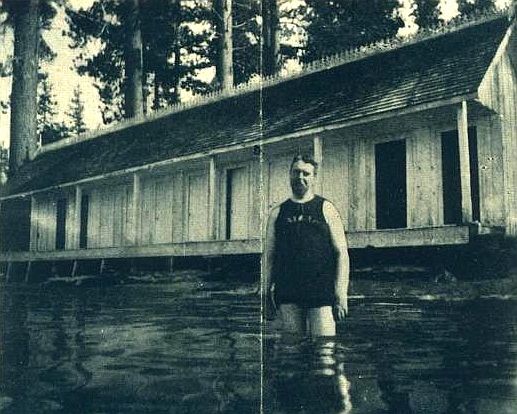
bk-3Hand-colored postcards dated 1908 (photos Nos. 2 and 3) show the majestic hotel. Room rates were $3 per day (without bathroom) or $5 per day (with a bathroom) for one person. Total capacity of the hotel and cottages was 250 people.

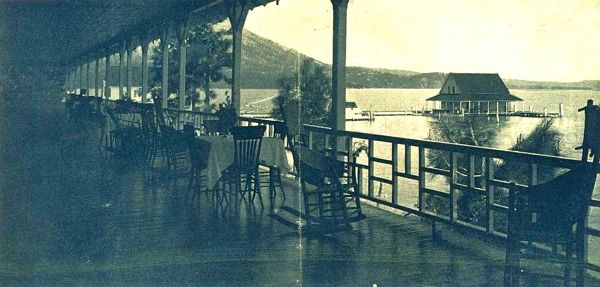
A promotional brochure from the early 1900s shows the view from the casino porch (photo No. 4) and the era attire of its bk-4customers at play (photos Nos. 5 and 6).

The brochure quaintly states: “AUTOMOBILING: Tallac is easy of access. Every season a great many autos make the trip to Tallac from Los Angeles and San Francisco. A good mountain road and any good machines can make the trip. Mrs. Joseph Chanslor, of Los Angeles, made the trip from Sacramento to Tallac in eight hours.”

bk-5The brochure also emphasizes the Truckee-to-Tahoe City train connecting to the steamers Tahoe and Nevada and Meteor going to the Tallac.

The hotel was razed in 1927. Many artifacts of the hotel and the 2,000-acre Baldwin Estate are on display in the Baldwin House Museum at the Tallac Historic Site next to Camp Richardson.

bk-6All brochure info, photos and postcards are courtesy of Theresa and Darrell Eymann.

— Bill Kingman


Fire leaves raw beauty along snowshoe trek

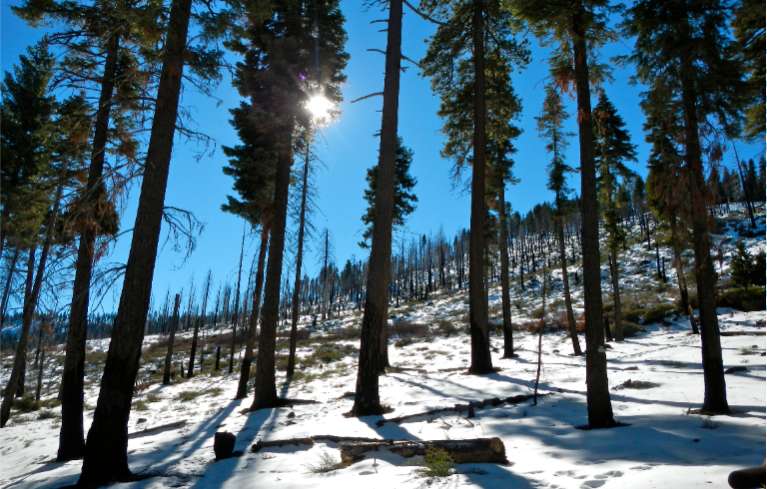
The Angora Fire forever changed the landscape of Gardner Mountain. Photos/Kathryn Reed

The Angora Fire forever changed the landscape of Gardner Mountain. Photos/Kathryn Reed

By Kathryn Reed

FALLEN LEAF LAKE – Traipsing through the woods it all looked so different – partly because it was covered in snow, partly because we were going the opposite the direction we are used to and mostly because we were on snowshoes instead of a bike.

Riding from South Tahoe High School to Fallen Leaf Lake is a standard summer-fall mountain bike ride. But last weekend we left a car on 13th Street by the school and started on Fallen Leaf Lake Road.

But before we headed back toward the first car, the three of us took off for Fallen Leaf Lake via the campground. A family of four from out of town, based on their accents, was taking photos near the glassy, picturesque lake with a snow-covered Mount Tallac in the background. We did the same.

While the shoreline is free of snow, we were happy to have our snowshoes for the remainder of the trek. Snow depth matters to some extent for snowshoeing, but fortunately going over a bare spot here or there doesn’t require taking your equipment into the shop.

We cross to the other side of Fallen Leaf Lake Road and head south through the closed U.S. Forest Service gate.

With so many offshoots in this area it would be easy to not end up where you intended. However, it would be hard to get lost. A hard left and you will eventually be on Highway 89, going straight will get you to the Gardner Mountain neighborhood.

At the start we see tracks from a large vehicle, like a tractor. We’re not sure what it was doing out there.

A small aspen grove with its white bark adds contrast to the dominant pines.

It doesn’t take long and we are where the Angora Fire of June 2007 ravaged the landscape. Beyond the obvious remaining charred trees it is also so open here. The start of the route is denser – like what this whole area once was like.

We veer to the right to stay high enough so we will come out at the far end of the STHS’ football field. Had we gone even higher we would have been able to see Lake Tahoe – something that wasn’t possible before the fire.

Looking uphill the remains of the fire are more evident. It’s hard to find a tree that is alive. A pile of logs is a reminder of how this area is still being restored.

We also pass the many markers for the pet cemetery.

Freel and Jobs peaks come into view directly in front of us.

At times the trail is wide enough so Sue, Brenda and I can walk together, while other times we are single-file.

It’s relatively flat, which is a good thing considering Brenda is dealing with a rather recently surgically repaired knee and I have a raw heel from a previous snowshoe.

But the bounty of beauty we are immersed in is what matters. It’s a good jaunt to get the snowshoe legs into shape for the season.

ngg_shortcode_0_placeholder (Click on photos to enlarge.)



Opinion: Eating habits start in the womb

By Kristin Wartman, New York Times

The solution to one of America’s most vexing problems — our soaring rates of obesity and diet-related diseases — may have its roots in early childhood, and even in utero.

Researchers at the Monell Chemical Senses Center, a nonprofit research organization in Philadelphia, have found that babies born to mothers who eat a diverse and varied diet while pregnant and breast-feeding are more open to a wide range of flavors. They’ve also found that babies who follow that diet after weaning carry those preferences into childhood and adulthood. Researchers believe that the taste preferences that develop at crucial periods in infancy have lasting effects for life. In fact, changing food preferences beyond toddlerhood appears to be extremely difficult.

“What’s really interesting about children is, the preferences they form during the first years of life actually predict what they’ll eat later,” said Julie Mennella, a biopsychologist and researcher at the Monell Center. “Dietary patterns track from early to later childhood but once they are formed, once they get older, it’s really difficult to change — witness how hard it is to change the adult. You can, but it’s just harder. Where you start, is where you end up.”

This may have profound implications for the future health of Americans. With some 70 percent of the United States population now overweight or obese and chronic diseases skyrocketing, many parents who are eating a diet high in processed, refined foods are feeding their babies as they feed themselves, and could be setting their children up for a lifetime of preferences for a narrow range of flavors.

The Monell researchers have identified several sensitive periods for taste preference development. One is before three and a half months of age, which makes what the mother eats while pregnant and breast-feeding so important. “It’s our fundamental belief that during evolution, we as humans are exposed to flavors both in utero and via mother’s milk that are signals of things that will be in our diets as we grow up and learn about what flavors are acceptable based on those experiences,” said Gary Beauchamp, the director of the Monell Center. “Infants exposed to a variety of flavors in infancy are more willing to accept a variety of flavors, including flavors that are associated with various vegetables and so forth and that might lead to a more healthy eating style later on.”

Read the whole story


Verizon improves web speed in El Dorado County

Calling, downloading apps and surfing the web on the Verizon Wireless network is now easier and faster for residents and travelers in El Dorado County because of additional 4G LTE cell sites in El Dorado Hills, Greenwood and Pilot Hill.

The sites improve wireless coverage and capacity in the following areas:

El Dorado Hills: At Oak Meadow Elementary School, south to Suncoast Lane, along Highway 50, and west of El Dorado boulevard

Greenwood: Along Highway 193, Dam Creek Road, Wild Lilac Lane and Coon Creek Road

Pilot Hill: Along Highway 49 around Majestic View Road, Greenwood Creek, Black Rock Lake and Pilot Peak Road.