Celebrating 2014 atop Elephants Back
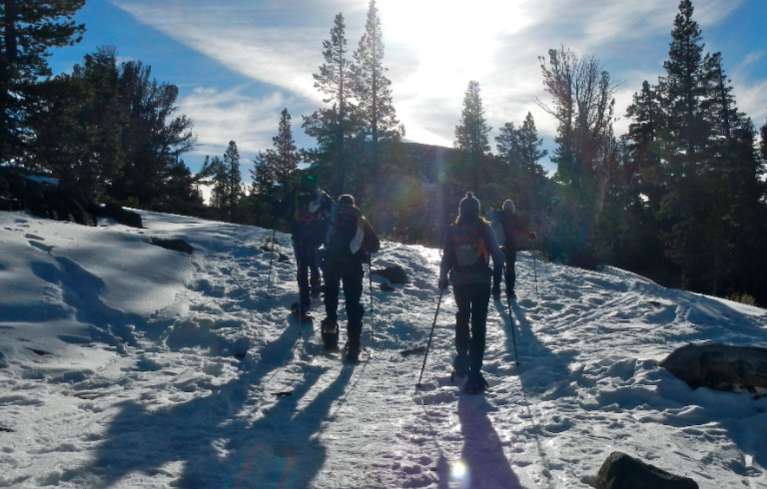
Elephants Back loom ahead of the snowshoers on Jan. 1. Photos/Kathryn Reed

Elephants Back looms ahead of the snowshoers. Photos/Kathryn Reed

By Kathryn Reed

Starting the New Year surrounded by the beauty of nature in the company of friends should become a tradition.

Craig and his six women – me, Sue, Donna, Suzy, Carolyn and Trish – started 2014 with a snowshoe to the top of Elephants Back in the Mokelumne Wilderness.

It was one of those incredibly perfect Lake Tahoe days: the sun beaming down, the sky a deep blue with streaks of white clouds, not even a wisp of wind at the top.

If only those moments could be bottled.

We took our time last Wednesday. Donna’s gadget recorded us being in the wilderness for about four hours, but only two of which actually involved walking. We did put in 4.61 miles, gained 1,168 feet in elevation and went to 9,584 feet.

Photo stops were a necessity, as was a leisurely lunch at the top.

One reason for choosing this excursion was thinking there would be more snow compared to lake level, which is rather barren. Plus, much of the trail is exposed so there was less likelihood of ice being an issue.

The trail starts off narrow, so we are in a line. The snow is hard in this section, so the claws on the snowshoes are welcome. So are the poles for a better sense of balance. Sun filters in between the tall pines.

It doesn’t take long for Elephants Back and Round Top Peak to show themselves.

Plenty of people have been here before us. While it’s nice to not be breaking trail, there are too many trails at times. We know the direction we should be headed and have plenty of daylight, so it’s no big deal. But I would imagine it would be a bit disconcerting for those who are unfamiliar with the area.

At one point Frog Lake was on our left and Woods Lake to our right in the distance. I never saw them. But in the summer I always see Frog Lake on my way to Winnemucca Lake. Part of this trail is also a segment of the Pacific Crest Trail. We never saw that trail indicator either.

Pausing we turn around and in the not too far distance is Caples Lake. From this perspective it looks large and completely covered in ice. I can only imagine the fishermen are out there enjoying their sport.

At the base of Elephants Back the snow is like sugar. While it’s ideal for our purposes, it will pose an avalanche danger once more snow arrives. This consistency does not make for a good base.

It’s not until we are part way up Elephants Back that we are able to see a frozen Winnemucca Lake at the base of Round Top. Earlier we had passed a couple who had spent the night there. That would have been one heck of a way to ring in the New Year.

On our way out we saw people headed to Round Top with the intention of skiing down. I shook my head thinking I hope those are rock skis they have on.

We took our snowshoes off to make it up the loose volcanic rock of Elephants Back. There was no way to snowshoe to the top. But that didn’t matter.

The views at the top of Elephants Back are some of the best to be had in such a short distance – especially since the expanse of beauty spills forth in every direction.

Getting there:

From South Lake Tahoe, go west on Highway 50. Turn left on Highway 89. At Pickett’s Junction, go right on Highway 88. At the top of Carson Pass, park on the left. The trailhead is by the building.

A sno-park permit is required between Nov. 1-May 30. The closest place to the trailhead to buy one is at Sorensen’s Resort. Or they may be purchased online. The cost is $25 for the season or $5 per day. It’s a $94.50 fine if caught parking without a permit.

ngg_shortcode_0_placeholder (Click on photos to enlarge.)



Opinion: Let Rim Fire terrain heal naturally

By Monica Bond and Richard L. Hutto

Hardly anyone rejoices when they hear of a catastrophic fire raging through a forest. And yet the fact is that the hottest, most severe fire is as ecologically necessary and beneficial for Western forests as rainfall or sunlight.

The announcement Dec. 6 by the Stanislaus National Forest that it plans to conduct clear-cut logging and artificially replant the Rim Fire burn area near Yosemite is predictable, but ignores the fact that severely burned forests are living, thriving habitats that always have been a natural part of Western forest ecosystems.

Anyone having the opportunity to experience a severely burned forest like the Rim Fire is blessed with a cacophony of birdsong, the hum of insects, and a wildflower and pollinator show like nowhere else on the planet. Where else to harvest a fire morel or to see fire moss?

Fire-killed trees attract legions of insects that flourish in the wood beneath the charcoal bark and in the new shrubs and flowers. Many bird species seek out severely burned forests specifically for this rich insect food source. One species in particular, the black-backed woodpecker, is found in vastly greater numbers in severely burned than in unburned forests.

Along with other woodpecker species, black-backs excavate their nest holes in the dead trees, which then provide nesting sites for other animals that can’t make their own nest cavities. The species is the best-adapted woodpecker in the world for extracting beetle larvae from fire-killed trees, and has become an icon for the ecological importance of severely burned forests.

Unfortunately, it’s hard to dispel the myth that forest fires are nothing but bad. And the myth perpetuates expensive, ecologically damaging and unnecessary fire suppression and logging (all funded by taxpayers, of course) in places far from where fire threatens human lives and property.

It’s time for the media to provide an ecologically literate perspective on forest fires. Forest “restoration” after severe fire is completely unnecessary because severe fire itself restores habitat for fire-dependent species. More to the point here, post-fire salvage logging – an activity perpetuated by fire hysteria, and demanded by House resolutions 1526 and 3188 – always inflicts serious ecological damage to the forest system, as dozens upon dozens of studies have shown. We encourage everyone to visit the Rim Fire area and see for themselves the transformative power of severe fire and nature’s exuberant response.

We need to look at the science, rather than listening to outdated and sometimes self-serving myths about the villainy of forest fire. Severe fires create an important and rare habitat – one that we should celebrate and protect. This will only happen if enough people learn the truth and speak out in its defense.

Write or call the U.S. Forest Service to ask foresters to leave the Rim Fire area near Yosemite unlogged and natural.

Write or call your congressional representative to say you support the 250 forest scientists who signed a letter opposing any new legislation, such as HR1526 or 3188, which would harm these unique burned-forest systems.

Monica L. Bond is a principal scientist with the Wild Nature Institute and Richard L. Hutto is a professor of biology and wildlife biology at the University of Montana.


BLM offering free access on select days

The Bureau of Land Management will waive recreation-related fees for visitors Martin Luther King Jr. Day on Jan. 20, Presidents’ Day weekend Feb. 15-17, National Public Lands Day on Sept. 27 and Veterans Day on Nov. 11.

Much of Nevada is controlled by the BLM. The BLM manages and facilitates recreational activities across more than 245 million acres in the U.S.

Other fees, such as overnight camping, cabin rentals and group day use, will remain in effect.

More information is available online.


Water, prison, budget issues face Calif. lawmakers

By Melanie Mason and Patrick McGreevy, Los Angeles Time

SACRAMENTO — Returning to the Capitol on Monday after a four-month recess, state lawmakers are set to tackle water issues, prison overcrowding and a budget debate that will be shaped largely by the state’s rosier economic outlook.

Other factors will also affect legislative decisions in 2014: election-year politics, internal leadership battles and a continuing federal corruption investigation into allegations that Sen. Ronald S. Calderon, D-Montebello, accepted bribes to exercise influence on bills.

Officials have predicted a $2.2-billion surplus when the current fiscal year ends in June. The state’s improved financial footing could set off new battles over whether to restore social services slashed during the recession or hold off on any significantly higher spending. Early budget proposals from legislative leaders have attempted to strike a balance. Gov. Jerry Brown will release his budget plan Friday.

Read the whole story


Elephants Back snowshoe

Elephants Back near Carson Pass provides for some stunning views no matter the season.


Nev. Supreme Court justices set to file for re-election

By Cy Ryan, Las Vegas Sun

CARSON CITY — Chief Justice Mark Gibbons and Justice Kristina Pickering both plan to file for re-election to the Nevada Supreme Court on Monday, the opening day for judicial candidates to submit their candidacies.

Gibbons is seeking a third six-year term and Pickering is asking for a second term on the state’s highest court. Gibbons becomes chief justice of the seven-member court Monday, taking over from Pickering.

The Nevada Constitution says only justices in the last two years of their term are eligible to be chief justice. Pickering served the first year and Gibbons will be chief justice for 2014.

Read the whole story


Meetings don’t have to be a waste of time

By Berny Dohrmann

In survey after survey, meetings get knocked by everyone from employees to senior executives as being among the biggest waste of work hours.

In one poll, by Office Team, 45 percent of senior executives said their firms would be more productive if they banned all meetings at least one day a week.

The problem that often occurs –- beyond the obvious, like lacking a clear agenda -– is the underlying current of competition that each person brings to the table.

Competition pulls people apart; cooperation brings them together. Signs that competition is causing unproductive meetings include one or two people dominating the floor; individuals touting their achievements; people consistently failing to contribute their ideas because they fear being criticized or ridiculed.

The drive to compete is so ingrained in most of us, we often don’t recognize it.

We get it culturally. We learn it in school. It’s often reinforced within our own families as we’re growing up. We have to be aware of that and identify the culture we want, then set about creating it – beginning with our meetings.

Cooperative meetings yield far better results. People working together toward a goal are more efficient, more productive, and even happier. The group pulling together toward the same goal will achieve that goal far more quickly than individuals each pulling in opposite directions.

How can you turn competition into cooperation – and wasted meetings into fruitful gatherings? Here are some suggestions:

• Begin instituting culture change by rewarding cooperative behavior. When someone makes a suggestion that can help another individual or department, publicly acknowledge and praise that teamwork. Encourage inter-departmental interest, empathy and even personal bonds by allowing employees from one area to shadow employees from another. Remind everyone that when one department succeeds, everyone succeeds. Look for managers and employees who tend to be naturally cooperative and enlist them as mentors and leaders to encourage and spread the new culture.

• Identify and curb competitive behavior in meetings. Avoid discouraging the behavior with tactics that rely on public criticism, scorn or ridicule. Rather, set egalitarian standards, such as time limits for each person to speak, and stick to them. When someone strays off topic, discern whether he or she is sharing a potentially valuable idea or seeking a personal competitive advantage (i.e. by laying blame, self-promoting, etc.) before steering him back on topic.

• Participation is essential to cooperation. Require everyone to participate in meetings. Circulate the agenda in advance with the stated expectation that each attendee will come to the table prepared to address at least one item – even if it’s not an item within their area of responsibility. Participation is a key component of a cooperative work group and making it the norm is often as simple as getting everyone into the habit.

Berny Dohrmann is chairman and founder of CEO Space International, one of the largest support organizations for business owners.


FDA questions unreported robot surgery injuries

By Robert Langreth, Broomberg

When Sheena Wilson, 45, underwent robotic surgery for a hysterectomy in May, she didn’t know the Intuitive Surgical Inc. system used by her doctor was previously tied to a variety of injuries for the same procedure.

Her rectum was badly burned in the operation, said Wilson, a mother of two from Parlin, N.J. Now she is on long-term disability, fearful of losing her job and facing a third corrective surgery, she said in a telephone interview.

“If I had known there were other people who had injuries, I would never have done this surgery,” said Wilson, who has filed suit against Intuitive and her doctor. “Whatever they have in place is not working.”

The use of complex medical devices is exploding. Last year, Intuitive’s da Vinci robotic surgery system alone helped doctors perform more than 350,000 surgeries in U.S. hospitals.

Doctors at Barton Memorial Hospital in South Lake Tahoe use the da Vinci.

Patients like Wilson, whose lives depend on the proper use of increasingly complex high-tech medical equipment, often can’t get a complete picture of potential problems.

While a U.S. database lists reports of deaths and injuries sent to the Food and Drug Administration, the agency has no authority to force doctors to contribute. And while hospitals are supposed to report, they often don’t, critics say.

Indeed, a Bloomberg review of reports for operations with Intuitive’s robotic system found dozens of injuries that went unreported for years. Meanwhile, details of other patient problems involving use of the company’s product, cited in legal papers or in interviews with patients, were missing entirely.

Read the whole story


Snippets about Lake Tahoe

trees• Truckee is recycling Christmas trees at the Tahoe Donner Clubhouse through Jan. 27 and curbside Jan. 13-17. Trees must not be decorated. And those placed at the curb must be cut into 3-foot segments.

• Here are the El Dorado-Tahoe and Sierra roadwork schedules from Caltrans for next week.

• As a fundraiser, Thunderbird Lake Tahoe is offering monthly culinary classes with chef Anne Wiles. For more info, call (775) 832.8752.

• Barton Health’s Occupational Health Services has moved to the Stateline Medical Center at 155 Highway 50, Ste. 203, Stateline.


Calif. law banning dogs in bear hunting has impact

By Phillip Reese, Sacramento Bee

Hunters killed fewer bears in California in 2013 than during any other year in the last two decades, a trend that many agree is a direct consequence of a new law that bans hunters from using dogs to track bears.

California has a sometimes-complicated relationship with its roughly 33,000 bears. They are a beloved symbol of the state’s rugged history; they are a nuisance to some residents who live where development meets the forest; they are a source of excitement and sport to those who hunt. And they can be a cause for worry to state officials trying to minimize bear attacks on humans.

Supporters of the ban said it prohibited an unsportsmanlike, cruel practice. Opponents pointed to the long history of hounding and said it was a reasonable way to control the bear population and reduce attacks on people.

Read the whole story