Senior gambling addiction rates soaring

By Lynn Stuart Parramore, AlterNet

Atlantic City boasts fabulous amenities for America’s senior citizens. See the broad boardwalk, perfect for fresh air and exercise. Notice the limited-mobility seniors rolling along on rented scooters and the wheelchair-bound joining the fun at easily accessible slot machines and blackjack tables. Feast your eyes on dozens of exotic and affordable buffets, and don’t miss the drug discounts and free lunch coupons handed out at every turn. All day and far into the night, the buses zip to and from retirement centers, carrying promises of excitement. And did you hear? Tony Bennett’s here tonight, crooning all those songbook classics grandma knows by heart. And she’s not going alone. She found a date on an Atlantic City senior hookup site.

Look: just over there is your neighbor Mr. Jones, professional man and pillar of the community. At 68 he’s the picture of respectability and sound judgment.

Only now he’s hunched over a blackjack table, hands trembling over a stack of plastic chips. Mr. Jones has blown through $200,000 of his retirement savings so far this year. He has fallen behind on his house payments. His children, who live far away, don’t have a clue what Dad has been doing every afternoon these last few months since Mom died. Mr. Jones keeps his habit a secret. Once a sunny optimist, he feel humiliated. Mr. Jones hates the person he has become.

Seniors are the fastest growing population of gamblers. They are gambling away their income, their savings, and their chance for a secure future. When they lose, they can’t make it up or start over. It’s a no-win game, driven by a greedy industry united in unholy alliance with policy makers and politicians who turn a blind eye to the social and economic costs of gambling.

Read the whole story


Mood change may help with procrastination

By Sue Shellenbarger, Wall Street Journal

Procrastinators, take note: If you’ve tried building self-discipline and you’re still putting things off, maybe you need to try something different. One new approach: Check your mood.

Often, procrastinators attempt to avoid the anxiety or worry aroused by a tough task with activities aimed at repairing their mood, such as checking Facebook or taking a nap. But the pattern, which researchers call “giving in to feel good,” makes procrastinators feel worse later, when they face the consequences of missing a deadline or making a hasty, last-minute effort, says Timothy Pychyl (rhymes with Mitchell), an associate professor of psychology at Carleton University in Ottawa, Canada, and a researcher on the topic.

Increasingly, psychologists and time-management consultants are focusing on a new strategy: helping procrastinators see how attempts at mood repair are sabotaging their efforts and learn to regulate their emotions in more productive ways.

Read the whole stoy


Dorothy Farnon — 1926-2014

It’s not often that it’s a good thing when people associate you with Scrooge. But Scrooge is the legacy of Dorothy and Brian Farnon.

Dorothy Farnon

Dorothy Farnon

Dorothy Farnon died Jan. 3. She was 87.

Brian died in 2010.

The couple wrote an original production of “Ebenezer Scrooge”, which was staged of Harrah’s Lake Tahoe from 1982 through the late 1990s. It was a productions that is still talked about today by those who saw it or were in it.

Dorothy was born in Pennsylvania on Aug. 26, 1926. She and her family later moved to Chicago where she began taking dance, gymnastics and piano lessons. Being a gifted lyricist from a young age, she wrote the alma mater for her university.

In Chicago she danced at Chez Paris where she met her future husband, Brian Farnon, who was performing alongside such notables as Frank Sinatra and Sammy Davis Jr.

They moved to Los Angeles where she continued her dancing at the Moulin Rouge. She later formed The Farrells, a song and dance duo.

Dorothy was a talented choreographer and lyricist, teaching hundreds of students to dance and perform.

She and Brian wrote the Christmas song “Christmas Land” performed by Tony Bennett.

Dorothy, Brian and their sons moved to South Lake Tahoe in 1967. She had a thriving dance studio in South Lake Tahoe for many years, presenting annual recitals.

She will be remembered for her quick wit, love of animals and people, life, and Christmas.

Dorothy was philanthropic, donating to such organizations as Barton Memorial Hospital, Lake Tahoe Humane Society, Lake Tahoe Wildlife Care, and Lake Tahoe Boys and Girls Club. To continue this tradition, in lieu of flowers, donations may be made in Dorothy’s name to: Lake Tahoe Humane Society, P.O. Box PET, South Lake Tahoe, CA 96158 or Lake Tahoe Wildlife Care, 1485 Cherry Hills Circle, South Lake Tahoe, CA 96150.

Dorothy is survived by her sons, Michael and Brian Farnon; grandchildren, Matthew Farnon and Meghan Farnon Tompkins; great-grandson, Brody Tompkins; and stepdaughters, Sharon Crigler, Charmian Carr, and Darlene Parker.

There will be an open house to celebrate Dorothy’s life on Feb. 8 from 10am-1pm at Edgewood Tahoe in Stateline. Click here for details and to RSVP.


Squaw Valley Olympics — a first in many ways

By Kathryn Reed

The 1960 Winter Olympics at Squaw Valley set the stage for future Games in ways that organizers could not have foreseen. It was the first to have the athletes housed in a contained area close to the action, the first for a downhill racer to use a composite ski, the first to have a computer to tabulate scores, the first to have a theatrical opening and closing ceremony, the first for biathlon and the first to be broadcast live throughout the country.

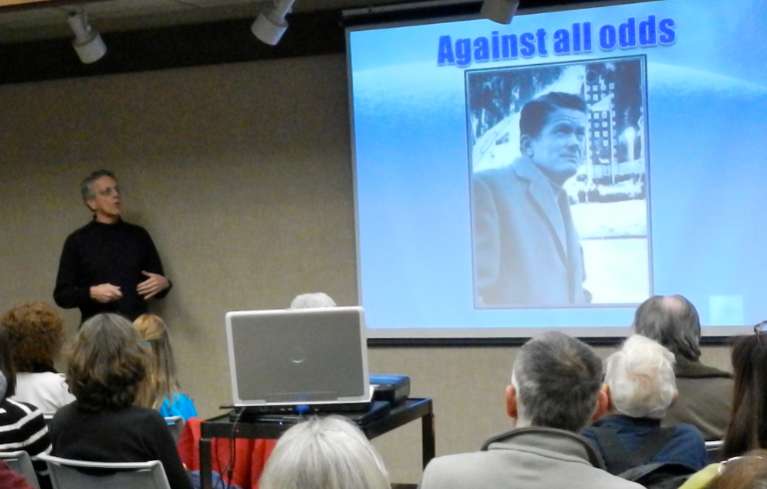
David Antonucci spoke Jan. 7 to a crowd of more than 60 people at the South Lake Tahoe Library about how the Olympics came to the Tahoe area 54 years ago and what they were like.

Antonucci is the author of “Snowball’s Chance: The Story of the 1960 Winter Olympic Games Squaw Valley & Lake Tahoe” and “The 1960 Winter Olympics” – the latter being more photos than words.

His interest in the Games occurred somewhat accidentally. The Tahoma resident began investigating the trails he could see around his house. They turned out to be cross country trails used during the Games.

David Antonucci talks Jan. 8 about how Alex Cushing secured the 1960 Winter Olympics at Squaw Valley. Photo/Kathryn Reed

David Antonucci talks Jan. 8 about how Alex Cushing secured the 1960 Winter Games at Squaw Valley. Photo/Kathryn Reed

At the time they were all on private property so all the structures were torn down. But now much of the land is part of Sugar Pine Point State Park, trails have been resurrected, and cross country and biathlon events are staged there.

Antonucci recognized Martin Hollay, who was in the audience. Now in his 90s, Hollay helped build the 20-kilometer trail system.

With all the construction, the cross country events had to be moved 15 miles south near Tahoma.

Much has been written about how Alex Cushing, then owner of Squaw Valley ski resort, didn’t expect the U.S. Olympic Committee, let alone the international folks to award his one lift, two-rope tow resort the Olympics. But they did. And in the intervening four years a destination for the world to embrace was created.

Antonucci explained why Highway 89 between Truckee and Tahoe City is so wide. It was so three lanes of traffic could get to Squaw in the morning and three lanes could leave when the day’s competition came to a close.

Plans for Interstate 80 were on the drawing board. Construction between Sacramento and Truckee was put on the fast track to get people to the Games.

Blythe Arena was built so the heat extracted from the ice-making unit would melt the snow on the roof. Someone forgot about that fact and in 1983 the roof collapsed because of a heavy snowload.

Two A-frame structures allowed spectators to watch multiple events at once. Only the men’s downhill finished mid-mountain.

The Seabees were brought in to make a temporary parking lot out of snow and sawdust.

“Originally they wanted to pave the meadow,” Antonucci said.

IBM needed an entire building for its one computer that was used for scoring. This was the first Olympics where athletes didn’t have to wait hours to know the results. Twenty-six people were needed to operate the 5 megabyte machine.

Antonucci had many stories to tell of athletes in various sports for different countries, including the original hockey team that beat the Russians and took home gold after beating the Czechs.

—-

Notes:

David Antonucci will speak and give a slideshow presentation at the Museum of Sierra Ski History in Tahoe City on Jan. 16. The Olympic Museum Mixer is from 5:30-7:30pm and is part of the Olympic Heritage Celebration.


Editorial: Time to worry about unfunded liabilities

Publisher’s note: This editorial is from the Jan. 8, 2014, Sacramento Bee.

Senate Democrats announced legislation on Tuesday to expand kindergarten to help 4-year-old children get off to a strong start in school, at a cost of $198 million a year. It’s a great idea.

So is this: Paying the debt Californians incurred by promising to provide public school teachers with secure pensions. The California State Teachers’ Retirement System estimates that the cost to fully fund the teachers’ pension debt will be almost $4.5 billion in the coming year, $4.6 billion the year after that, and more in each subsequent year.

CalSTRS calculates that 30 years from now – and many veteran teachers who retire now will live another 30 years – the annual cost of fully funding the system will be $13.9 billion.

Read the whole story


LTWC to offer spring training for volunteers

Lake Tahoe Wildlife Care’s annual volunteer training is May 17-18.

The class is limited to 60 people. People must take the class in order to help with the rehabilitation of animals.

Registration will begin in February via LTWC’s website.


Sports victories, baby booms linked

By Erin Beresini, Outside

It’s possible sports victories trigger local baby booms. In fact, a study published in the latest issue of the British Medical Journal claims just that.

On May 6, 2009, Spanish researchers wrote, Football Club Barcelona’s Andrés Iniesta scored a last minute goal against Chelsea FC, earning Barça a spot in the UEFA Champions League Final. That night, Catalonians celebrated by shooting off fireworks, and banging pots and pans, among other things. Nine months later, the Catalonian birthrate shot up 45 percent, according to an informal survey of five local hospitals.

While not scientifically investigated to the extent of Catalonia’s so-called “Iniesta generation,” other sports victories have also been fingered in local baby booms.

Take the “Red Sox phenomenon” of 2005, for instance. Nine months after the Red Sox beat the St. Louis Cardinals in the 2004 World Series, the Boston Globe reported anecdotal evidence that a lot of Red Sox fans had, um, banged pots and pans in celebration.

New Zealanders got busy after the All Blacks defeated France—in Oz—to win the Rugby World Cup in 2011. Nine months after the victory, the New Zealand Herald reported that maternity units at local hospitals were overflowing with women in labor.

Read the whole story


Poison kills more than the intended animal

By Denise Upton

There’s a threat looming out there. A threat to our wildlife we are supposed to be living in harmony with. Many of us are unaware of this threat.

Here’s the scenario: We’re sitting in our living room and “something” catches our eye running across the floor. Did we really just see something? Then we open the pantry and find droppings. It’s confirmed. Mice have moved into your house and you have to get rid of them. Quickly!

We run to the hardware store and we have a choice of old-fashioned snap traps where we have to remove the dead mouse carcass or how about those nifty bait stations where the mice go in get some poisoned bait and we never see them again. Sounds like a no brainier, right?

Well, let me get you up to speed on what really happens when the mice “take the bait” so to speak.

First of all, let me give you a little lesson in rodenticide 101. The most popular brand of poison bait is D-Con. The key ingredients are brodifacoum, bromadiolone, difethialone or difenacoum. These are all what they call “second generation” rodenticides and are anti-coagulants that result in death from internal bleeding.

In June 2012, the EPA announced they are starting the process to ban second-generation rodenticides from the consumer market. In March 2013 the EPA started regulatory action to remove 12 D-con products from shelves of some retailers as the company Beckitt Benckisen (the manufacturer of D-Con) has refused to voluntarily remove these products. Even if these actions are imposed, you will still be able to purchase these products at some farm and ranch supply stores.

Why all the fuss over a few mice and some poison bait stations? Mice are not where the story ends. It’s just the beginning. Thousands of dogs and cats are exposed to this bait and injured or killed every year even though the bait stations are “supposedly” sealed. From 1993-2005 12,000 to 15,000 children under the age of 6 were reported to have exposure to rodenticides as reported by Poison Control.

As wildlife rehabilitators, what we see is exposure to our wildlife.

Secondary exposure occurs when wildlife consumes dead or dying rodents that have eaten poison bait. Since it is a slow acting poison it is often eaten over several days by rats and mice causing the deadly substance to accumulate in the animals’ systems reaching many times the lethal dose in their tissue. Predatory or scavenging wildlife that feed on them fall victim to secondary poisoning. Some of the animals affected are grey fox, coyote, kit fox (federally endangered), raccoon, fisher marten, bobcat, mountain lion, black bear, golden eagle, great horned owls, barn owl, all the hawk species and virtually anything that consumes rodents.

In essence we are killing our natural pest control species.

Ninety-two percent of all raptors in San Diego County tested positive, 79 percent of endangered San Joaquin kit foxes showed signs of anti-coagulant in their blood, and of 104 mountain lions tested since 2005 82 had the deadly poison in their system.

Since many of these animals typically retreat to their dens, burrows or other hiding places in the final stages of anti-coagulant poisoning, the numbers of non-target wildlife being killed by these compounds may be much higher.

Here in Tahoe we have many vacation homes that are only used during the summer. It’s common for these homeowners to purchase multiple boxes of D-Con and toss them under their homes to control the “mouse problem” while they are away during the winter. “Out of sight, out of mind” so to speak. While they are away the rodents consuming this bait, which can include our local squirrels and chipmunks which are also rodents, may leave the area under the house and become easy targets for our hungry wildlife.

I remember the call we received about a pine marten in someone’s garage. When we live trapped the sick animal we could tell he was in very bad shape and died soon thereafter. Within the next few days we got calls of two more pine martens in the same garage. We were able to save and release one of them. This garage was full of all sorts of stuff, but somewhere amid all of it was D-Con, which poisoned the mice and in turn killed the pine martens that consumed them.

Not many people have even seen these beautiful animals here in Tahoe and to see them die a slow agonizing death was heartbreaking.

We’ve received a record number of raptors at LTWC last year – eagles, hawks and owls. Some had obvious injuries and some were just found sitting on the ground for no apparent reason. Without expensive blood tests we can never be sure, but we suspect some sort of poison. Some of these animals -after they died from “something” are sent to fish and wildlife labs for further testing, as this has become a widespread issue throughout the state and the entire country.

We live in Tahoe among a multitude of wildlife. We battle voles in our lawn, squirrels in our attics and bears under our porches. There exists a delicate balance among our wildlife. By poisoning our mice we are in turn killing the very species such as hawks, coyotes and owls – to name a few – that control our rodents naturally.

Here’s a perfect example: Last summer my neighbor had a huge lawn and lots of voles to go with it. He also had a resident hawk that spent the day sitting atop a tree watching for his chance to help control these lawn pests. Day after day this same hawk swooped down and took off with a vole in his talons. Amazingly, last spring, as the snow melted, he didn’t seem to have the same vole problem. Nature had done what it does best – controlled the problem naturally compliments of our neighborhood hawk.

I know people see coyotes and immediately think of them as pet eating carnivores when they are actually omnivores. Did you know that up to 80 percent of their diet could consist of rodents dependent on where they live? Did you know that bears are actually attracted to the smell of D-con under your house?

I won’t even begin to talk about the illegal marijuana growers in our national forests killing multitudes of our wildlife by putting out deadly poisons in tin cans known as “wildlife bomb” surrounding their camps killing everything and their offspring that is unfortunate enough to come in contact with it. This is all to protect their crops and camps. This is why wildlife is being found miles away from any civilization dead and dying from these toxic poisons. If you want to read more on this, here’s a link.

We can do our small part to protect our wildlife. Please educate yourself before you reach for that box of rodent bait with any of the ingredients listed above. There are alternatives such as snap traps, catch and release traps (please no glue traps). Find the entrances the rodents are using and seal them or as a last resort bait stations with ingredients that do not cause secondary poisoning to our local wildlife. We have an obligation to keep the delicate balance of nature in line and to think twice about what or who is affected when we take the easy way to control that little mouse you just saw run across your floor. You could be killing more then the little mouse.

Denise Upton is president of the Lake Tahoe Wildlife Care board.



Burglary suspect arrested in Kings Beach

A Merced man is behind bars accused of multiple burglaries in the North Lake Tahoe area.

Jason Woodral

Jason Woodral

Jason Woodral, 35, was booked into the Placer County Jail on Jan. 8 on eight counts of burglary. His bail was set at $200,000.

Early Wednesday, sheriff’s deputies responded to the Kings Beach Laundromat for a reported burglary in progress. The subject was caught in a residential area.

Investigators believe Woodral is responsible for burglaries at local businesses in Kings Beach, including the Kings Beach Laundromat, Kings Beach Car Wash, Tahoe Cutting Company and Tahoe Pilates Studio.

Woodral had an outstanding arrest warrant stemming from a burglary committed in Merced in 2009.

— Lake Tahoe News staff report


No snow: Aramark — sleds, boat cruises impacted

Publisher’s note: This is one of a series of blurbs about how the lack of winter is impacting businesses in the Lake Tahoe Basin. If you have an idea, please email it info@LakeTahoeNews.net.

Zephyr Cove Resorts is being hit extremely hard by the lack of snow this winter.

The snowmobiles have not been fired up all season. The opening date has been pushed back three times. Now the projected start date is Jan. 15, but that is weather dependent.

Snowmobiling is a $1.7 million money generator – usually – for Aramark. Aramark has the concession at the resort and also operates the two South Shore paddle-wheelers.

The M.S. Dixie paddle-wheeler is no longer able to get into Emerald Bay because the water level is so low. It gets to the edge and then turns around. Reservation specialists have finally been told this and have changed what they tell the public to be the truth.

A spokeswoman from Aramark, which runs the sled and boating operations, failed to return phone calls.

— Lake Tahoe News staff report