Common sense needed with dry conditions

By Teri Mizuhara

With the lack of rain, our local vegetation is tinder dry. All you have to do is go outside to hear the crackle and crunch of pine needles and leaves under your feet.

Add wind to this scenario and you are looking at very critical fire conditions — red flag conditions.

We are responding to wildfires almost daily, which is not at all normal for January in the foothills of the Sierra. We have increased our staffing levels to meet the need and can quickly augment that if it becomes necessary, but we need everyone’s help if we are to remain fire safe.

Fire safety tips for red flag conditions:

· Do not burn when it is windy. As illustrated by the Colby Fire near Glendora last week, wind can cause a small fire to become a raging wildfire.

· Do not drive into tall dry weeds or brush because your vehicle can catch the vegetation on fire since the exhaust system of your vehicle is hot enough to ignite a fire. If you must pull to the side of the road, make sure the area is clear of vegetation.

· Do not use gas powered equipment when it is warm and windy because a single spark can cause a wildland fire which can quickly grow out of control. Wait for a day when there is no wind and work in the early morning hours or after 6pm when the humidity is higher and a chance of a wildfire is lessened.

We understand that many people are taking advantage of this weather and are outdoors creating additional defensible space around their homes. We want to encourage this, but at the same time, we want folks to be fire safe.

Following these fire safety tips will allow you to work safely in your yard.

Teri Mizuhara is with the El Dorado-Amador unit of Calfire.


Mancuso, Cook have best super G races of season

By USSA

CORTINA d’AMPEZZO, Italy -– Julia Mancuso (Squaw Valley) continued to gain momentum toward Sochi with seventh place Thursday in an Audi FIS Alpine World Cup super G in Cortina for her best race of the season.

Stacey Cook (Mammoth Mountain) added to the U.S. momentum with ninth, her best super G finish since 2007. Austria’s Elisabeth Goergl won the race, which was a replacement for the canceled super G race last weekend due to a powerful winter storm that sidelined the weekend’s speed events.

The athletes take on downhill Friday, another replacement event, followed by a downhill and super G scheduled Saturday and Sunday in Cortina. The U.S. Olympic selection period ends on Sunday and official team nominations will be announced that afternoon. Leanne Smith (N. Conway, N.H.) was on track for a solid result when she was bumped wide while clearing a gate in the middle of the course and did not finish.

Julia Ford (Holderness, N.H.) and Jackie Wiles (Aurora, Ore.) just missed scoring points with 31st and 34th respectively. Laurenne Ross (Bend, Ore.) finished 36th.


Learn how new laws affect Calif. businesses

The Truckee Donner Chamber of Commerce and the North Lake Tahoe Chamber/CVB/Resort Association in partnership with the Sierra Human Resources Association are offering 2014 Legal Update for California Business Leaders and Managers on Jan. 31 from 9am to noon.

The event will be at the Hampton Inn, 10918 Brockway Road, Truckee.

Attendees will be taught about laws that take effect in 2014 and how they impact employers; the California legislative update and California law updates; important U.S. Supreme Court and California rulings; significant agency regulations, opinions and trends to watch in 2014; and best practices and practical advice to prepare your organization for employment law compliance in the New Year and beyond.

The workshop will be lead by Walter Stella of the Miller Law Group in San Francisco. Stella has more than 20 years of experience representing companies in all aspects of employment law and related litigation, including wage and hour class action suits involving trade secret theft, wrongful termination, discrimination, retaliation and harassment.

Attendees are able to submit a specific question in advance in confidence so it can be addressed anonymously by the attorney once registered.

Early bird registration is $50/person for SHRA and SHRM members, $55/person for chamber members and $65/person for non-members. Walk-in registration is $65/person for chamber and $70/person for non-members. To register and for more information about the workshop, call Laura Moriarty at (530) 573.0224 or Patricia Barrett at (530) 587.8808. Attendees may register by credit card online.


Study: Old trees keep growing — in girth

By Richard Harris, NPR

Like other animals and many living things, we humans grow when we’re young and then stop growing once we mature. But trees, it turns out, are an exception to this general rule. In fact, scientists have discovered that trees grow faster the older they get.

Once trees reach a certain height, they do stop getting taller. So many foresters figured that tree growth — and girth — also slowed with age.

“What we found was the exact opposite,” says Nate Stephenson, a forest ecologist with the U.S. Geological Survey, based in California’s Sequoia and Kings Canyon national parks. “Tree growth rate increases continuously as trees get bigger and bigger,” Stephenson says.

The General Sherman, a giant sequoia in California’s Sequoia National Park, is more than 2,000 years old, and is thought to be the largest tree (by volume) in the world.

Read the whole story


Lack of moisture threatens El Dorado vineyards

By Kathryn Reed

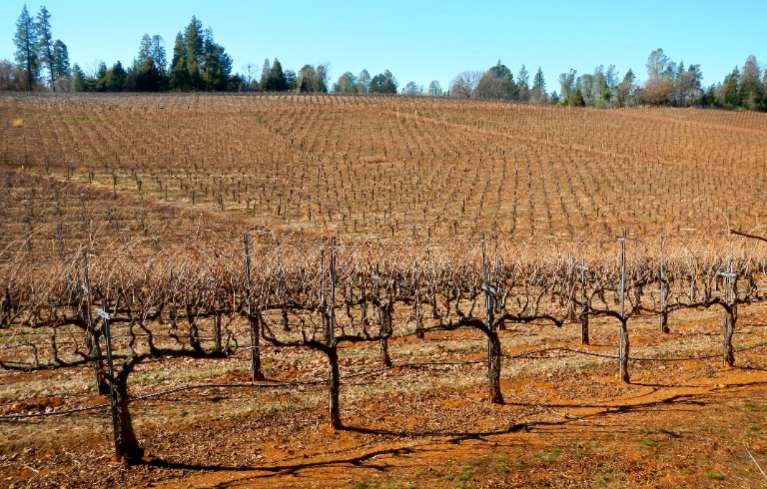
PLACERVILLE – Brittle brown. That’s what the El Dorado County wine country looks like.

While the vines are normally dormant this time of year, the ground between them is usually a lush green. Instead, it’s barren.

Rick Wickham has never seen is so bad in the 30 years he has been in the vineyard management business. Meyers Ranch Vineyards Services Co. based in Somerset manages nearly 800 acres. Most are in El Dorado County, with some in Amador County. The acreage covers 34 vineyards for about a dozen wineries.

“In El Dorado County our aquifer is recharged from snowpack and that doesn’t look good. Most in El Dorado County are on well water and well water is affected by the gallons per minute you can pump,” Wickham told Lake Tahoe News.
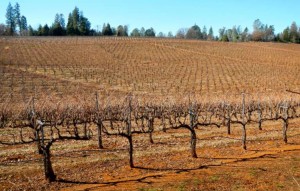
Vineyard manager in El Dorado County are worried because of lack of rain this winter. Photo/Kathryn Reed

Vineyard managers in El Dorado County are worried because of lack of rain this winter. Photo/Kathryn Reed

Eldorado Irrigation District supplies many vineyards with water. A drought stage has not been enacted – yet. But with Gov. Jerry Brown declaring last week that the state is in a drought, water districts are apt to follow suit. This could be especially troubling in the heart of the summer when Mother Nature could decide to unleash a heat wave.

In a meeting of vineyard managers on Jan. 13 the talk was about how everyone is worried about water.

Lynn Wunderlich, a UC Cooperative Extension farm advisor, is giving a drought seminar for farmers on Feb. 20 at UC Davis. Wickham is sending several of his people to it.

January 2014 is set to go down in the books – for many locations in California – as one of the driest and warmest on record.

Charlie Jones, owner of Lava Cap Winery in Placerville, said in a normal year about 38 inches of rain falls. Last year about 25 inches fell. To date about 5 inches have accumulated. He, too, has been in the business for 30 years and has never seen it so bad.

Soil in El Dorado County is alluvial and granitic so it does not hold water well. This is the opposite of Amador County where it is more like clay and traps water better.

One way to test the soil for water is with a neutron probe. Usually this is done in early June, with the presumption irrigation will start in mid-June if need be. But Wickham started probing this month and is finding alarming results.

“It’s as low as it normally would be in September,” Wickham said.

Jones knows of people who are watering the vines so the water will freeze to the plants. This forms an insulation.

It’s not just El Dorado County vineyards that are threatened by the lack of rain. Paso Robles has an ordinance that bans planting of new crops that need irrigation.

The soil is also warm. This is a prelude to bud break. One way to combat that is to water now so the soil gets colder.

“We are very fearful they are going to start sprouting,” Davell Hays of Chateau Davell in Camino told Lake Tahoe News.

As a micro-winery with less than 5 acres, there is even less wriggle room for Chateau Davell if winter never comes.

If buds start sprouting now or in the coming weeks, it’s likely the fruit would be damaged or wiped out with a hard freeze. Freezes often come to the foothills as late as May.

One thing Jones has going for his vineyards is that the slope allows for a great deal of air movement, which helps prevent frost.

Deciding when to prune is on everyone’s mind. Typically pruning is done later in El Dorado County because of the threat of a hard frost.

Jones is considering a double prune, which could buy him two weeks.

“The other thing that affects us is weed control. It requires rain within 22 days of application,” Wickham said. “We should be doing weed control now and we are holding off for a little better precipitation in the weeks to come.”

But the forecast is not looking like anything different than what has been the norm for weeks — sun and warmth.



Opinion: Football is the problem, not Title IX

By Jonathan Zimmerman, Los Angeles Times

In 1975, Nebraska Sen. Roman Hruska warned a congressional hearing that college football was in mortal danger. The threat came from Title IX, the 1972 measure that outlawed sex discrimination in educational institutions receiving federal financial assistance.

To comply with the law, Hruska feared, colleges would have to equalize athletic budgets for male and female sports, and the only way to do that would be to raid the football budget.

He need not have worried. College football budgets have skyrocketed; at most Division I schools, 80 percent of all sports funds go to two men’s sports: football and basketball. To comply with Title IX, schools have cut other sports instead.

Read the whole story


Snippets about Lake Tahoe

barton• Terry Orr and Jonathan Finnoff, physicians with Tahoe Orthopedics and Sports Medicine, will volunteer as U.S. Ski Team physicians at the 2014 Winter Olympics.

• The February issue of Sunset magazine has a feature on why people should live certain places. Kings Beach is a runner-up for “Best Place to Postpone Your Career”.

• Tangled Roots Writing is offering creative writing, poetry and blogging workshops. More info is online.

• Jamie Anderson, Maddie Bowman, and Hannah Teter – who all call Meyers home and ride for Sierra-at-Tahoe – will be at the X Games in Aspen this weekend. Then they will be going to the Winter Olympics.

• The D and Golden Gate casinos in Las Vegas are accepting bitcoins at hotel front desks.


No snow: Tahoe Donner resorts closed until it snows

Publisher’s note: This is one of a series of blurbs about how the lack of winter is impacting businesses in the Lake Tahoe Basin. If you have an idea, please email it to info@LakeTahoeNews.net.

Sun. No snow. Highs in the 40s and 50s. More of the same is in the forecast.

That combination forced Tahoe Donner Downhill and Tahoe Donner Cross Country to close Jan. 20. And they will remain shuttered until the conditions change. The resorts had been open sporadic days, trying to make a go of it in the season of no snow.

The Truckee downhill resort had made upgrades for this season that have barely been used. A 700-square-foot yurt was installed to provide a slopeside warming area for people taking lessons. It includes a large deck.

— Lake Tahoe News staff report


U.S. at bottom of pack to help working moms

By Sheelah Kolhatkar, Bloomberg

Bloomberg News has just completed an investigation into the plight of working mothers in America, and it’s not a pretty picture. Only 12 percent of those employed get paid time off to care for a new baby, according to U.S. Labor Department statistics. Only three states have programs offering paid family leave — California, since 2004; New Jersey, since 2009; and, as of last month, Rhode Island.

“Papua New Guinea is the only other nation that doesn’t provide or require a paid maternity leave, according to information on 185 countries compiled by the United Nations’ International Labor Organization,” Bloomberg reports. “It recommends 14 weeks off at a level no lower than two-thirds of previous earnings.”

Those who pay attention to the work-family debate have been aware of this for a long time. What is startling is how stubbornly it remains a non-issue in policy circles; even with increasing numbers of women now serving in Congress—20 in the Senate and 78 in the House, the highest ever—legislation that tries to address the current inadequate pregnancy and family policies is largely absent.

Currently, the Family and Medical Leave Act, which was passed in 1993, guarantees workers at companies with 50 or more employees 12 weeks of unpaid leave. The problem is that many people can’t afford to take it. Larger companies tend to offer more generous benefits, which have been shown to correlate strongly with an increase in women returning to their jobs after having a child.

Read the whole story


Kirkwood skier on podium in Freeride World Tour

Josh Daiek, who rides for and lives in Kirkwood, placed second Jan. 22 in the men’s ski competition of the SWATCH Freeride World Tour.

The event took place at Courmayeur Mont Blanc in Italy and was the first of six events on the FWT this season.

Daiek’s run began with two massive cliff drops that earned the appreciation of the event’s judges and spectators. He earned a score of 87.5, only 1 point of the day’s leader, Loïc Collomb-Patton of France.

Daiek will have home field advantage when the tour arrives at Kirkwood Mountain Resort on March 1.