Music & Arts Fest
South Shore Music & Arts Festival, Mt. Tallac Brewery, South Lake Tahoe. (530) 573.0566
South Shore Music & Arts Festival, Mt. Tallac Brewery, South Lake Tahoe. (530) 573.0566
Tahoe Olympic historian David Antonucci leads a lecture and walking tour of the 1960 Winter Olympic sites as part of the continuing Squaw Valley Institute speaker series. The event begins at the Squaw Valley Chapel with an optional picnic and hike of the West Shore Olympic Biathlon site in the afternoon. A $10 donation is requested, and a separate $15 charge for the West Shore hike (includes a boxed lunch).
Be Ember Aware is a movie about keeping your house safe from fire. The free showing will be at Sierra House Elementary School, 1709 Remington Trail, South Tahoe. www.nvfsc.org
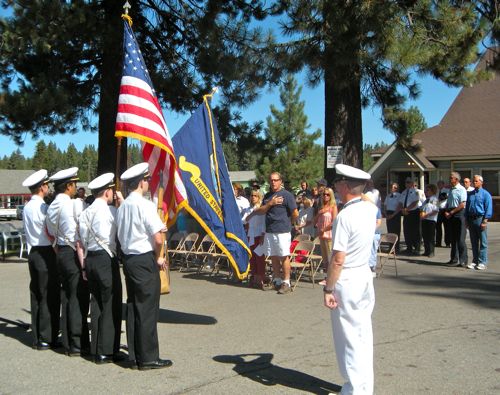
The JROTC color guard and South Lake Tahoe residents at the Sept. 11 ceremony. Photo/Kathryn Reed
By Kathryn Reed
Flags flew at half-staff throughout the country on Friday — and Tahoe was no different.
Patriots Day, as Sept. 11 has been named, has become a time to reflect on those who lost their lives eight years ago when terrorists hijacked four planes and forever changed the lives of most Americans.
South Lake Tahoe’s ceremony focused on the importance of first responders. More than 400 died when the Twin Towers in New York were reduced to ash. It doesn’t matter if it is called heroism or they were “just” doing their job — they paid the ultimate sacrifice.
Much was said about the local men and women in uniform as the back row was filled with South Lake Tahoe firefighters, South Lake Tahoe police officers and El Dorado County sheriff’s personnel.
The more than 60 people in attendance at the American Legion also were told not to forget Tim Smith and Brandon Williams — two young men with ties to the South Shore who died fighting in Iraq.
“I think this was the best we’ve had,” Carol Olivas, secretary for the American Legion, said of this year’s ceremony. “It seemed like everyone had a little fire in their speeches.”
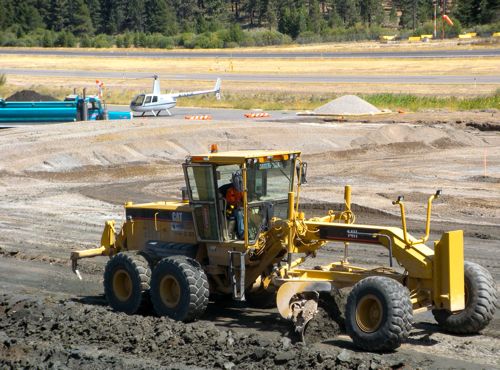
Construction at Lake Tahoe airport will continue into October. Photo/Kathryn Reed
By Kathryn Reed
A pilot watching the construction at Lake Tahoe Airport on Friday said the ramp was so bad you could lose an airplane in one of the holes.
Although that sentiment is a gross exaggeration, the truth is the state of disrepair was so bad that pilots would avoid the area for fear of having asphalt sucked into an engine.
A $2.5 million grant from the FAA is paying to for the terminal ramp area to be resurfaced with concrete. The work is expected to be finished by the end of October.
“The asphalt (was) in extremely poor condition, making it hazardous for aircraft to transfer across the ramp and park at the ramp,” said Sherry Miller, airport director.
Besides the ramp work, a de-icing system is being installed.
“There was some question whether we needed this or not because we don’t have commercial service and the smaller planes don’t like to leave in winter weather,” Miller said.
The couple of planes that are de-iced each year use a mist system that Miller said does not reach the ground and therefore didn’t present a contaminant issue for the nearby Upper Truckee River.
The new system with have an oil-water separator.
With the FAA paying for the system, now seemed a good time to install the de-icer while the area is a construction zone.
By Kathryn Reed
 Massive boulders provide an obstacle course of sorts. Lakefront homes are called the architectural tour. Osprey and eagle nests provide intimacy with wildlife. Sore muscles at the end of the day prove it was a good workout.
Human powered recreation on Lake Tahoe is not new, but it is gaining in popularity.
Kayaking is still the predominate mode of transportation, with the less stable canoe occasionally seen plowing the waters, and the more coordination-strength sport of paddle boarding booming the last couple of years.
“We are finding the people who are kayaking on the lake tend to be affluent and tend to be older,” said Sue Rae Irelan, who is the California Tahoe Conservancy’s liaison to the Lake Tahoe Water Trail Committee. “They are not the testosterone teenager that you might find kayaking on a river.”
Retailers are noticing more people renting kayaks. Irelan also pointed to a large contingency of second homeowners who paddle.
Public land owners with their partners are making a concerted effort to put out a coordinated message. Coalition members include both state parks systems, public utility districts, South Lake Tahoe, CTC, U.S. Forest Service and business owners.
“Part of what we are doing is we’ve been trying to consider what do kayakers need and where can we help facilitate this use where there are conflicts,” Irelan said.
One issue is the lack of parking where paddlers want to put in. Incline has storage for non-motorized boats. Lakeview Commons in South Tahoe will, too. The idea is kayakers could bike or take public transit to the boat storage so parking issues are eliminated.
Education is another part of the equation, with invasive aquatic species topping the list.
“The message we are sending is that whenever you move a boat from one body of water to the next it ought to be cleaned, drained and dry,” Irelan said. “When it’s taken out of the water they need to be turned over and drained so the water goes back into the water it was taken from.”
Another issue is how California and Nevada allow access to private land. In the Golden State, the public has access to land that is below the high water mark.
“Last year and this year that can be the majority of the beach in some places. It is completely legal to land a kayak there and sit on a beach even if you are in front of a house,” Irelan explained.
In the Silver State no public trust easement exists with private property. This means landing on a private beach in Nevada is equivalent to trespassing.
Because of this, vast portions of the East Shore are off limits. Under human power it’s a long haul at times.
Irelan said this year and over the next several years public agencies will work to provide signage that explains to those on the water that there may be no public access for 10 miles, or that a particular parcel is OK or not OK to land on.
Circumnavigating the entire 72-mile shoreline is not for the novice paddler.
To make this endeavor a bit more comfortable, the water trail committee is working on a lodge-to-lodge program, starting with the South Shore. Dennis Liebl, one of the committee’s founders, said the idea is still in the conceptual stage.
In theory a paddler could go from one lakefront lodging facility to the next. Their belongings would be transported for them. Tour guides might be part of the equation. Evening activities like special dinners, wine tastings and spa treatments may be part of the package.
“We would like to see it grow around the lake, except the East Shore has no lodging,” Liebl said.
Some kayakers take camping gear with them. Again, the East Shore is lacking such amenities, something the committee would like to eventually rectify.
Liebl got involved in the water trail in 2003 when Tahoe Tomorrow was started. His committee was tasked with helping tourism. The members liked the idea of a water trail. That idea had first been broached by Bob Kingman, who at the time worked for the CTC. He won the Big Idea award at the SMG Tourism Conference. Kingman joined the committee and was key to making the trail a reality.
“Our purpose is to promote kayaking use on the lake, boat safety and some of the other issues like invasive species,” Liebl said.
Although the trail has always existed in theory, promoting it, developing a map, creating a website and offering events all came about when the committee came along.
Lifetime membership costs $25. Maps are available at retailers throughout the Lake Tahoe Basin and at www.laketahoewatertrail.org.
With Tahoe Tomorrow going by the wayside, the LTWTC has its nonprofit status under the Tahoe Truckee Community Foundation.
The committee usually puts on two events a year. The spring event was at Sand Harbor. The September event was nixed as organizers focus time on the lodge-to-lodge project.
A couple multi-day trips are planned through Tahoe Adventure Company — Sept. 24-27 and Oct. 1-4.
For information about the trips, call (530) 913.9212.
Sierra Recovery Center is no longer an independent nonprofit. This summer became part of Elko-based Vitality Unlimited.
“We aren’t carpetbaggers coming into South Lake Tahoe,” CEO Dorothy North said. “We are members of the community. We are here to build on and improve what has been here a long time.”
The board of directors in May voted to make the change, though the idea had been discussed for months.
Betsy Fedor is out as executive director and everyone else at the South Lake Tahoe rehab center had reapply for their jobs, though no guarantee was made they’d be rehired.
VU has offices throughout Nevada, with this being the first one in California.
“Vitality Unlimited’s mission is to create new paths to better lives by providing services and programs that promote positive life choices, improve the quality of life, and reduce the number of people dependent on alcohol and other drugs,” the website (www.vitalityunlimited.org) says.
For now, the changes amount to cosmetic improvements, according to North.
By EDC Health Services Department
September is National Recovery month — a time to highlight the issue of alcohol and drug use, and the hope that comes with recovery from addictions.
“El Dorado County, like other places across the United States, has its share of people who are struggling with drugs and alcohol,” said Shirley White, program manager for El Dorado County Alcohol and Drug Programs. “The worsening economy has not helped, as people who are having a hard time financially may turn to drinking or substance abuse as a way to cope or escape.”
The federal Substance Abuse and Mental Health Administration estimates that 23.2 million Americans aged 12 or older currently need treatment for a substance abuse disorder. Many baby boomers (Americans born between 1946 and 1964) are continuing to use illicit drugs as they grow older, causing the rate of illicit drug use to go up in the 50 to 59 year old age segment of the population. And although the rate of illicit drug use among youths aged 12 to 17 has declined in recent years, young people are starting to use substances at an earlier age.
The campaign, which celebrates its 20th anniversary this year, emphasizes the need for communities to work together to educate people and their families about substance use disorders, and to support people in their recovery efforts.
“People experience recovery in different ways,” said White. “Some recover on their own; others recover through treatment and/or the assistance of self-help, mutual aid groups, or medication-assisted therapies. Addiction is a disease, and just like any other chronic illness, it can be recovered from. The support of family, friends, employers, and other concerned community members can help make recovery lifelong.”
In El Dorado County, there are a number of different substance abuse treatment options. El Dorado County is fortunate to have many recovery support networks and collaborative partners that offer a range of services such as residential treatment, individual and group counseling and community based support groups. Some of the programs are geared specifically for women or men, while others offer programs tailored to youth. These partners include:
EDCA Lifeskills, (530) 622.8193
New Morning Youth and Family Services, (530) 622.5551
Progress House, (530) 642.1715
Family Connections, (530) 626.5164
Sierra Recovery Center, (530) 541.5190
Tahoe Youth & Family Services, (530) 541.2445
El Dorado County also has programs such as Proposition 36 Drug Court, Dependency Drug Court, Juvenile Drug Court, DUI Drug court and other programs designed to give the individual the opportunity to access substance abuse treatment. “In addition to traditional treatment services, a well rounded recovery support network complements this process and is central for successful rehabilitation from substance use,” said White.
By Kathryn Reed
Former Red Cross employee John Hellman is behind bars in El Dorado County Jail in Placerville on charges stemming from allegedly taking money that was intended for survivors of the 2007 Angora Fire.
Hellman’s bail was set at $150,000. He is charged with 11 counts of grand theft.
He is accused of taking $16,000 from the organization that was assisting the 254 households that lost their homes in the June 2007 fire on the outskirts of South Lake Tahoe.
The 49-year-old was arrested by authorities in August in Texas and then extradited to California.
The Sacramento Red Cross office discovered what it calls “financial malfeasance” in January during a regular audit.
“In the course of the internal audit we came across some discrepancies,” said Carol Evans, spokeswoman with the Red Cross in Sacramento.
She said her organization wants Hellman to pay back the money he allegedly stole.
Hellman had an office in the Community Disaster Resource Center in South Lake Tahoe. This group was formed after the June 2007 Angora Fire to help people living in the burn area.
Sierra Pacific Power says power will be restored at 9pm to residents in the Meyers area.
The company is calling it a circuit lockout.