Snippets about Lake Tahoe

slt• South Lake Tahoe wants the public’s input on outdoor retail displays. Click here to take a survey.

• Berkeley’s Tuolumne Camp will relocate to Echo Lake because the Rim Fire burned down the campsite last year.

• Not everyone can be Olympian. But this story will tell you how to dress and be equipped like one. t

• There will be a free flu shot clinic Feb. 6 from noon-4 at Nevada County Pubic Health Department Joseph Center, 10075 Levon Ave., Suite 202, Truckee.

• Mirabelle French restaurant in Stateline is looking for a buyer.


CDC: Medical bills a burden for many U.S. families

By Karen Kaplan, Los Angeles Times

A crushing medical bill can cause money problems not just for a cash-strapped patient but for his or her entire family. Data from the Centers for Disease Control and Prevention show more than one in four U.S. families recently experienced a financial burden due to the cost of medical care.

Among Americans who participated in the National Health Interview Survey in 2012, 8.9 percent said they were currently having problems paying a medical bill and another 7.6 percent said they had been in that situation sometime in the previous 12 months. In addition, 21.4 percent of those surveyed said they were in the process of paying off a medical bill over an extended period of time.

Altogether, 26.8 percent of people reached by the interviewers said they experienced some type of financial burden due to medical bills in the previous year, according to a report released Tuesday by the CDC’s National Center for Health Statistics.

Read the whole story


Tahoe Fund looking for projects to finance

Tahoe Fund is seeking environmental improvement projects in the Tahoe basin that will restore lake clarity, improve outdoor recreation, and build a stronger sense of stewardship in the region.

The organization plans to build a portfolio of projects in need of monetary support that can attract donations from individuals, businesses and foundations. The board of directors will choose a handful of projects to be 2014 signature projects and the focus of the fund’s summer fundraising activities.

Eligible projects must be able to demonstrate that all environmental permits will be obtained, have strong community support, and have other sources of funding identified. Further details may be found here.


Nevada cancer patients already Super Bowl winners

By AP

RENO — From the point of view of two Nevada cancer patients, there will be no losers at Sunday’s Super Bowl.

One will be at the game with his family, and the other one made it all possible with a little help from the NFL and a Lake Tahoe research center founded by the family of the late Oakland Raiders great Gene Upshaw.

Gary Kasden of Incline Village had just completed an exhaustive series of chemotherapy treatments at the Gene Upshaw Memorial Tahoe Forest Cancer Center in December when he learned he’d won a Super Bowl trip as part of a fundraising raffle for the center.

But Kasden got the flu, then came down with double pneumonia, scuttling his trip. He reached out to the Northern Nevada Children’s Cancer Foundation, which found a deserving replacement in 16-year-old Kody Beach of Spring Creek in Elko County.

Beach, who was diagnosed with cancer last summer, found out at a surprise luncheon with his family at a Reno restaurant on Thursday. He took off for New York City on a flight Friday with his older brother, Cory, and parents, Kirt and Carmen.

“I never thought something like this would happen to me,” Kody told the Reno Gazette-Journal.

Over the past five months, the teen has had five surgeries and undergone months of treatment as the disease metastasized into his lungs and reached stage IV cancer, the most advanced stage. But he continues to receive regular chemotherapy treatments and his parents remain optimistic about his prospects for recovery.

“This is great. I think it will rejuvenate him,” Kirt Beach said. “He’s been strong through the whole process, stronger than us, but at some point depression starts to set in because you can’t go to school and you go through all these treatments and every week you have to go to the doctor. This is unbelievable.”

Kody’s unexpected football fairytale began when Kasden and his wife, Megan, won a pair of tickets with the all-expense paid trip in the Gene Upshaw Memorial Fund Super Bowl Raffle

Upshaw, who went on to lead the NFL players’ union, was a regular at the annual American Century Championship celebrity golf tournament at Stateline before his death from cancer in 2008.

After Kasden’s doctor ruled out the trip, his wife said they started a search for someone who believed, “Going to the Super Bowl is my dream.”

The Tahoe Forest Health System Foundation helped enlist the Northern Nevada Children’s Cancer Foundation to track down Kody. A football fan since his youth, his father said he would “watch ESPN 24/7 if you allowed him.”

The news only got better when the NFL mistakenly mailed four tickets instead of two, then told the family to keep them.

Megan Kasden said it was meant to be.

“I honestly don’t believe in coincidences,” she said. “I believe in angels.”

Upshaw’s widow, Terri, said she was thrilled.

“Gene did it. Gene is looking down,” she said. “That’s just the kind of guy he was. He would have loved this story.”


El Dorado County man sentenced in nonprofit embezzlement

By Cathy Locke, Sacramento Bee

An El Dorado County man who formerly served as treasurer of the Lions Education Foundation has been sentenced to two years in prison for embezzlement.

Kent Maloney pleaded guilty to embezzling more than $200,000 from the nonprofit entity, which is associated with the Lions Club International, according to the El Dorado County District Attorney’s Office. Maloney was sentenced Wednesday in El Dorado County Superior Court and remanded into custody immediately after sentencing.

Read the whole story


Latinos about to be Calif.’s largest racial-ethnic group

By Mark Hugo Lopez, Pew Research Center

According to Gov. Jerry Brown’s new state budget, Latinos are projected to become the largest single racial-ethnic group in the state by March, making up 39 percent of the state’s population. That will make California only the second state, behind New Mexico, where whites are not the majority and Latinos are the plurality, meaning they are not more than half but they comprise the largest percentage of any group.

California’s demographers also project that in mid-2014, the state’s residents will be 38.8 percent white non-Hispanic, 13 percent Asian American or Pacific Islander, 5.8 percent black non-Hispanic, and less than 1 percent Native American.

But the state’s demographics in 2014 are very different from what they had been. In 2000, California’s 33.9 million residents were 46.6 percent white non-Hispanic, 32.3 percent Latino, 11.1 percent Asian American or Pacific Islander, 6.4 percent black non-Hispanic and about 1 percnet Native American. In 1990, white non-Hispanics made up more than half (57.4 percent) of the state’s then 29.7 million residents, while 25.4 percent of Californians were Latino, 9.2 percent were Asian American or Pacific Islander, 7.1 percent were black non-Hispanic and about 1 percent were Native American.

Read the whole story


Acting saves ‘The Wolf of Wall Street’

movie reviewBy Jeremy Miller

“The Wolf of Wall Street” is the latest from master filmmaker Martin Scorsese. It stars Leonardo DiCaprio, Jonah Hill, Matthew McConaughey, Margot Robbie and Kyle Chandler.

The three-hour epic centers on the rise and fall of Jordan Belfort (DiCaprio), a young and very ambitious stockbroker on Wall Street. He moves to Wall Street wanting to get in on the action, and quickly decides to stray away from the corporate ladder and do things his way. Joined by a few quirky characters, including his No. 2 Donnie Azoff (Hill) he turns a broker firm of 20 employees into 250 with a perfectly rounded sales script he wrote himself.

Essentially, the firm made their money pushing worthless penny stocks onto rich people and took 50 percent commission off each and every sale. Along the way, the “crew” delves into the world of drugs, prostitution, and any other activity that warrants an R rating.

movieEventually they catch the attention of the FBI, especially agent Patrick Denham (Chandler) who confidently pursues Jordan and his buddies, just waiting for them to screw up overtly. Jordan has to evade the FBI while also upholding his playboy image, along with the managing of his now very successful firm. But how long can he keep it up? Bam! There’s the plot.

The film is packed full of fancy cars, elaborate houses, the craziest parties, and most things the average person only fantasizes about while scratching the $2 ticket purchased at 7-Eleven that day.

Aesthetically the film is decent, pretty standard cinematography and the cast, not the visuals, delivers most of the power. Leonardo definitely out-did himself (won the Golden Globe) and I sense he’s favored for the Oscar. Jonah Hill is who really stuck out to me, however. He created a wonderfully entertaining character and was hands down the comedic drive behind the film.

I enjoyed the story and felt it moved well and I was satisfied when it was over. There’s just one problem that warranted the 3/5 rating. I felt like I was watching a modern day reimagining of “Goodfellas”. As soon as I had this epiphany, I realized that it is almost the exact same film. Plot points, story line, even the timing was the same. If you’ve seen one, you’ve seen the other. That bummed me out. The stories are similar, so I don’t put it all on Mr. Scorsese, and it’s still a wonderful film, but that just took away from my experience. Also, unlike “Goodfellas”, the three-hour run time of “Wolf” was noticed. I must have checked my watch three or four times toward the end just waiting for credits to roll which is never a good indicator. Overall, the film was good, acting was awesome, it was fun and explosive, but I didn’t feel it held to the Scorsese standard of a game changer.

South Lake Tahoe resident Jeremy Miller has more movie reviews online.


Land deal protects sage grouse in Douglas County

By AP

RENO — Thousands of acres of ranchland along a scenic river in southern Douglas County will be protected under a conservation easement.

A deal announced last week preserves about 3,800 acres of the Fairfield Ranch, a move conservationists and land managers say will protect critical sage grouse habitat and the area’s natural values.

Ranch owners Alan and Cindy Horn donated the conservation easement along with a stewardship endowment to the Nature Conservancy.

“Patience, perseverance and the generosity of the ranch owners made this shared dream a reality,” said Duane Petite of the conservancy’s Eastern Sierra Nevada program.

The deal was four years in the making and involved talks with the Horns, the conservancy and state and federal agencies, the Reno Gazette-Journal reported.

Parts of the ranch straddle nearly three miles of the West Walker River and is considered vital habitat for a distinct subspecies of sage grouse that lives only along the Nevada-California line.

Ted Koch, Nevada supervisor for U.S. Fish and Wildlife, said the deal demonstrates the value of conservation easements in protecting habitat for the bistate sage grouse, which experts say number only about 5,000 birds.

The Fairfield Ranch area provides particularly valuable habitat, said Tony Wasley, director of the Nevada Department of Wildlife.

“Fairfield Ranch has important wet meadows that are one of the most critical habitats to sage grouse in this arid environment,” Wasley said. “This easement has significant conservation value and is important to the long-term viability of sage grouse in the bistate area.”

The U.S. Fish and Wildlife Service proposed in October to list the bistate sage grouse as threatened under the Endangered Species Act. The proposal would designate about 1.8 million acres as critical habitat.

Public comments on a draft measure are being accepted through Feb. 10.

Those birds are separate from the greater sage grouse population, which is also under consideration for listing. Found in 11 Western states, the Fish and Wildlife Service will determine whether the greater sage grouse deserves protection as a threatened or endangered species by 2015.


Classic pianist to play in Stateline

The second annual W’intermezzo at Edgewood Tahoe is Feb. 20 at 6pm.

Money raised that night by Soroptimist International of South Lake Tahoe will be spent in the community.

Pianist Deborah Dewey will play classic pieces.

Tickets are $40 in advance, $45 at the door. Price includes a pre-concert wine reception. Call (775) 741.3501 to purchase tickets.


Tahoe immune from drastic Calif. water rules

By Kathryn Reed

While state water officials scramble to contend with a worsening drought, Lake Tahoe taps are not going to go dry.

Water purveyors in the Lake Tahoe Basin use groundwater or the lake.

And while the lake level is dropping at a time when it should be replenishing, there are so many acre-feet in it that the lack of rain and/or snow would have to continue for quite a few years to impact water users in the basin.

Who is likely to be affected are marina owners and the affiliated businesses when it comes to getting recreational boats into the water and commercial boats to the dock.
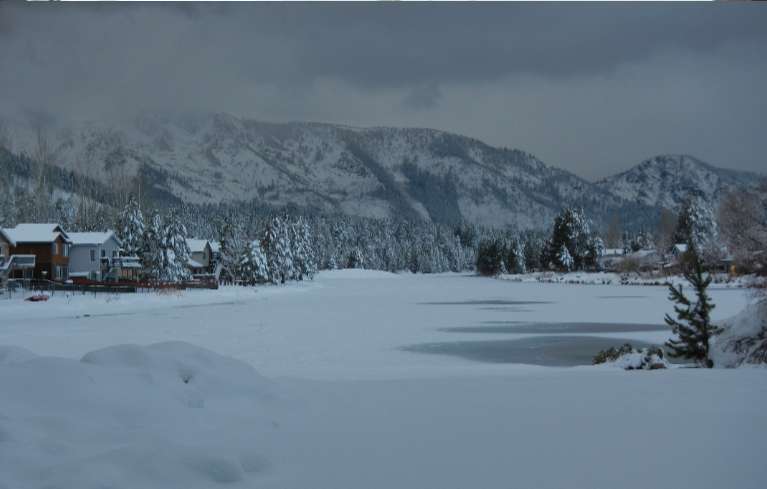
While it looks like winter in Lake Tahoe, California remains parched. Photo/Kathryn Reed

While it looks like winter in Lake Tahoe, California remains parched. Photo/Kathryn Reed

Private well owners could also be impacted as the groundwater is depleted.

South Tahoe Public Utility District is not worried, as its wells are between 200 and 600 feet deep. The district, the largest water company in the basin, is completely on well water. If need be, another well could be drilled. But doing so comes with a $2 million price tag.

District staff members will make a presentation to the City Council on March 18 about how the drought is affecting STPUD.

Water from Lake Tahoe flows into the Truckee River at the dam in Tahoe City and then it goes to Nevada. Nevada water users in the Reno-Sparks area are impacted by Tahoe’s water level.

The basin is in the Nevada watershed – not California. Because of this the drastic news out of Sacramento on Friday does not affect Tahoe directly.

But the residents of Tahoe will be affected because the drought severely impacts farmers. It means fewer crops will be planted and the price of food will go up. Fisheries are being hurt. The drought is affecting the environment as well as the economy, and it will get worse the longer it stays dry.

Simply put, for most of California the demand for water is greater than the supply.

It was announced Friday that entities that receive water from the State Water Project will get zero water. This is the first time that has happened in the 54-year history of the agency. SWP services 25 water agencies that supply water to 25 million people and approximately 750,000 acres of irrigated farmland.

This decision could be revised if it begins to snow and rain. For now, those agencies will have to rely on well water, local reservoirs and other supplies.

“We are two-thirds through the wet season. The state would have to experience heavy rainfall every other day through May to get back to normal. Even then we would face drought conditions,” Mark Cowin, Department of Water Resources director, said during the Jan. 31 press conference in Sacramento.

The decisions on Friday will affect municipal water users, farmers and fisheries. The goal is to share the pain and not point fingers.

Charlton Bonham, director of the state Department of Fish and Wildlife, said his agency has never been in this predicament.

“It is about making really hard decisions in a real time basis where we may have to accept some impact now to avoid a much greater impact tomorrow,” Bonham said.

There is concern the salmon run is threatened because they cannot get upstream to spawn. Delta smelt and other fish are also on people’s radar as water levels decrease.

Actions that have been taken:

• CDFW restricted fishing on some waterways due to low water flows worsened by the drought. More rivers and streams could be impacted in the coming weeks.

• Gov. Jerry Brown declared a drought state of emergency in January.

• CalFire hired 125 additional firefighters to help address the increased fire threat due to drought conditions.

• California Department of Public Health identified and offered assistance to communities at risk of severe drinking water shortages.

Tom Howard, executive director of the state Water Resources Control Board, signed an emergency order Friday to alter the flow of water from reservoirs. This is so some will be saved in storage if things continue to be dry or get worse.

Public health and safety will play a role in how much is released; so will the need to keep salt water from San Francisco Bay out of the Delta.

This is the third dry year for California. The last significant drought was in 1976-77. Reservoirs are lower today then they were then. And the snow survey on Thursday revealed a record low for water content at 12 percent. Lake Oroville, the principal State Water Project reservoir, is at 36 percent of capacity when normally it is at 55 percent this time of year. Shasta Lake, California’s and the federal Central Valley Project’s largest reservoir, is at 36 percent capacity when it should be at 54 percent.

“Today is a stark reminder that we all have to save every drop we can in our homes and places of work. Conservation is always important, but today it’s an absolute necessity,” Cowin said.

Brown has called on all Californians to voluntarily reduce water usage by 20 percent.

South Tahoe PUD does not expect to ration water this summer. Customers have already been on an odd-even watering schedule. What is likely to change is the district will enforce that policy.

“This summer we expect to up our efforts at water conservation,” Richard Solbrig, general manager of STPUD, told Lake Tahoe News. “If you look at the bigger picture, water conservation is the right thing to do. We should not be wasting water.”

Solbrig said the district is likely to make a more concerted effort to promote the turf buyback program, rebates for replacing old washing machines, education about taking shorter showers, running full dishwashers and turning off the spigot while brushing teeth.

He knows people will start irrigating sooner than usual if it does not rain or snow more this winter.

“If people are not water conscientious and careful, that demand peak will increase compared to the previous year,” Solbrig said.

This in turn means a greater depletion of the groundwater.

Solbrig said for his agency’s needs it doesn’t matter if it rains or snows — both fill the aquifer. But there is no substantive moisture in the forecast.