Calif. drought-relief bill being fast-tracked

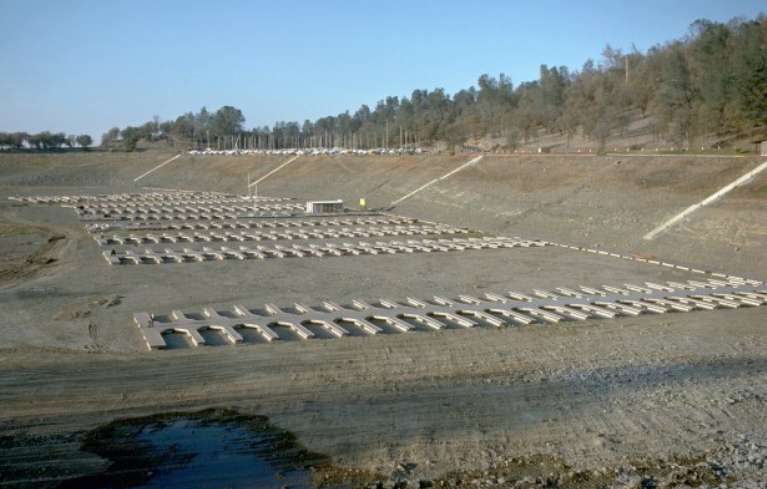
Boat slips in Folsom Lake in a drought (1976).  The reservoir was at 18 percent of capacity on Tuesday (Jan. 7, 2013). Source: California Department of Water Resources

Boat slips in Folsom Lake during the 1976 drought. Photo/California Department of Water Resources

By Rory Carroll, Reuters

California’s senate leader is preparing a $644 million emergency drought relief bill designed to quickly fund shovel-ready projects to combat the state’s severe water shortage, according to a draft of the bill.

The wide-ranging effort would fast-track water supply projects, speed up funding for expanded use of recycled water and stormwater capture projects, and better monitor and manage groundwater resources.

California is facing its worst drought in decades. State officials have said it is likely to force for the first time a complete cutoff this year in state-supplied water sold to 29 irrigation districts, public water agencies and municipalities up and down the state.

Read the whole story


CTC changing the focus of its mission

By Kathryn Reed

California Tahoe Conservancy outlined Tuesday how it is transitioning from being an agency that buys land so it would not be developed to one that is collecting commodities associated with land to further development.

Patrick Wright, executive director of the state agency that is based in South Lake Tahoe, and Peter Eicher, planner with the agency, gave a presentation to the City Council on Feb. 4 about the Tahoe Livable Communities Program. Under that umbrella come the Conservancy Land Acquisition and Land Bank programs.

ANALYSIS

The land bank program has existed for decades, but only recently has made headlines because of the Conservancy’s selling and trading property.

“Perhaps some lands could be used for better things than open land space,” Eicher told the council.

Wright said the agency is looking at its nearly 5,000 parcels in the Lake Tahoe Basin to determine if it’s better to shift from acquisition mode to selling in order to better meet the state’s priorities – which is greenhouse gas emissions, and the mandates of the Tahoe Regional Planning Agency Regional Plan – which is dense development in town centers.

Tahoe is unique in that commercial floor area (CFA), tourist accommodation units (TAU) and coverage are commodities. This means a parcel is worth more than just the land. How much of the dirt can be built on – aka coverage – is valuable. It’s possible to buy a parcel and transfer coverage to another area, therefore rendering the first parcel unbuildable.

It’s also possible to transfer CFA and TAU to other jurisdictions. South Lake Tahoe has a rule on the books that the council must approve such transactions.

The basin does not operate as a true free market society. It’s about who has money to buy these limited commodities.

With the CTC budget drying up, it needs to find another way to generate money. Going into the Tahoe-centric commodities business is how it can stay afloat and presumably stay relevant.


CHP detain firefighter while he’s working

By Pauline Repard, San Diego Union-Tribune

CHULA VISTA — A California Highway Patrol officer handcuffed and detained a Chula Vista firefighter for refusing to move his engine out of traffic at a crash scene Tuesday night, prompting a nationwide storm of online commentaries on Wednesday.

The firefighter had parked the engine behind an ambulance in the fast lane of Interstate 805 near East Naples Drive, where a sedan had flipped over a concrete guard rail and two people were reported injured.

Chula Vista Fire Chief Dave Hanneman said fire crews are trained to position their rigs to block oncoming traffic.

Read the whole story


CalFire ordered to pay $30 mil. for Moonlight Fire

By Denny Walsh and Sam Stanton, Sacramento Bee

In a blistering ruling against CalFire, a judge in Plumas County has found the agency guilty of “egregious and reprehensible conduct” in its response to the 2007 Moonlight Fire and ordered it to pay more than $30 million in penalties, legal fees and costs to Sierra Pacific Industries and others accused in a CalFire lawsuit of causing the fire.

The ruling is the latest twist in an epic legal battle that began not long after the fire erupted on Labor Day 2007, scorching more than 65,000 acres in Plumas and Lassen counties.

Sierra Pacific, the largest private landowner in California, was blamed by state and federal officials for the blaze, with a key report finding it was started by a spark from the blade of a bulldozer belonging to a company working under contract for Sierra Pacific. But company officials have steadfastly denied responsibility and have accused CalFire and the U.S. Forest Service of conspiring to cover up their own shortcomings that allowed the fire to rage out of control.

Read the whole story


Drug forfeiture money rolls into El Dorado County

El Dorado County will receive more than a quarter million dollars in forfeited narcotics proceeds.

Cash, bank accounts, and a house on 10 acres in Placerville were forfeited from two El Dorado County residents. Robert Edward Mulready, 50, of Placerville, and Duane Patrick Petersen, 40, of Shingle Springs, were charged in U.S. District Court with conspiring to cultivate marijuana and distribute it out-of-state. Last year, Mulready was sentenced to 3½ years in prison, and Petersen was sentenced to 22 months in prison.

The U.S. Attorney’s Office has given $230,600 to the El Dorado County Sheriff’s Department and $32,900 to the El Dorado County District Attorney’s Office. Both agencies assisted in the investigation of the interstate marijuana-trafficking ring that resulted in a federal prosecution.

“The arrest, prosecution and asset forfeiture of proceeds from this criminal operation should send a strong message that federal and local law enforcement will not allow such operations to continue,” Sheriff John D’Agostini said in a statement.

The Department of Justice’s equitable sharing program is designed to enhance cooperation among federal, state, and local law enforcement agencies through the sharing of proceeds resulting from federal forfeitures. The amount shared with state and local law enforcement agencies is based on the degree of the agencies’ direct participation in the case.

This case was the product of an investigation by the Drug Enforcement Administration and the Western El Dorado County Narcotics Enforcement Team.

— Lake Tahoe News staff report


1 person dies in series of I-80 spin outs

By Nick Janes, KOVR-KMAX

SODA SPRINGS — A woman was killed by a car spinning out of control in Interstate 80 in the Sierra on Thursday.

Traffic on I-80 was brought to a standstill after the accident killed the woman near Soda Springs.

It started when a Lexus spun out and someone stopped to help.

The man and woman got out of their car as it was being towed out, and then a second Lexus spun out.

Read the whole story


Polar Bear Swim in Carnelian Bay

The 25th annual Polar Bear Swim is March 1.

Each year hundreds of spectators line the pier and deck at Gar Woods Grill in Carnelian Bay to watch hardy souls brave the frigid waters of Lake Tahoe.

Following the swim, participants have access to hot tubs on the Gar Woods deck to warm their bodies. Complementary appetizers are provided to all following the race and cash prizes are awarded to the winning swimmers.

Festivities begin at 11:30am and the race starts at 2:30pm.

Swimmers may register online for $30 in advance or pay $35 the day of the event.


Snippets about Lake Tahoe

pang• John Pang is retiring April 4 after being fire chief at Meeks Bay for 19 years.

• Tahoe City Cross Country ski area is open – again.

• On Valentine’s Day, Dutch Bros. Coffee at 1449 S. Carson St. in Carson City is offering a free medium drink in exchange for three nonperishable food items to help Food for Thought fight hunger.

• Volunteers are needed March 17-21 for the Science Expo in Incline Village. Sign up online.

• Check out Hannah Teter leading the Special Olympic snowboarders:


Meyers residents rally to fight for their beliefs

By Jessie Marchesseau

MEYERS – Flyers stating: “There is a new plan for Meyers, and it’s not good” and “A multi-acre, multi-level resort with almost 500 parking spaces: Have you heard of the ‘Catalyst Project’?” helped bring out a throng of citizens Thursday night.

Concerned Meyers residents organized the Feb. 6 community meeting to discuss the implications of provisions in the new Meyers Area Plan. Area plans something that came about because of the Tahoe Regional Planning Agency’s year-old Regional Plan.

The meeting at Lake Valley Fire Department in Meyers was a full house. There was standing room only, with people sitting on tables around the perimeter of the room and a crowd where some of the latecomers got stuck near the door.

Maps detail development opportunities in Meyers and the basin. Photo/Jessie Marchesseau

Maps detail development opportunities in Meyers and the basin. Photo/Jessie Marchesseau

Jennifer Quashnick, a Meyers resident and main presenter for the evening, said the idea for the meeting came about after the Catalyst Project was released about a month ago. People kept approaching her and asking questions about the project and the plan. It seemed residents really didn’t know what was going on, so she and a handful of others organized the meeting as a way let people know what changes could be coming to Meyers.

Quashnick is a consultant for area environmental groups and was involved with in the TRPA’s planning for the Regional Plan update.

“Frankly, I think people maybe got a little duped,” she said of how Meyers was treated in the RPU.

Quashnick discussed the RPU’s rezoning of Meyers into a high-density town center, something she and most of the listeners seemed to disagree with. However, the main focus of the Feb. 6 presentation was on how the building height and density changes in the new Meyers Area Plan will affect development. Maximum building heights rise from 26 to 45 feet in some areas and maximum density will increase from 10 to 40 units per acre in others.

The Catalyst Project, originally billed as one of the hot topics of the night, was barely mentioned.

El Dorado County Supervisor Norma Santiago piped in in defense of the new area plan calling it even more restrictive than the current plan. She also invited everyone to submit any edits or language they would like changed through the county website and encouraged residents to attend the next Meyers Community Advisory Committee (MCAC) meeting.

Quashnick said she was happy to hear Santiago put that invitation out there, as the MCAC has not been that open to public comment on the plan.

Several other members of the MCAC took the opportunity to tout how hard they had worked on the plan and what a great community Meyers is.

Kenny Curtzwiler held up a plastic bin crammed full of folders and documents as evidence of how hard it is to build a commercial property in Meyers.

Despite the efforts Quashnick made to keep the meeting on track, interjections spurred discussions and sometimes arguments among attendees. By the end, it almost became a Myers pep rally of sorts with people standing up just to tell everyone how much they love living in Meyers and how important it is to get involved in the planning process to ensure the preservation of their community.

Several attendees expressed interest in a follow-up workshop to go over the new area plan in greater detail. The public is invited to bring their input to the next MCAC meeting on Feb. 26.


Letter: Liberty explains rate increase process

To the community,

I am writing to address inaccurate information about Liberty Utilities’ current and authorized rates — effective over a year ago — and recently cited by an opponent of Liberty’s proposed 625/650 Electric Lines Upgrade Project.

While some of the information cited is in California Public Utilities Commission documents as claimed, it is misleading when not presented in its entirety. A typical rate case request contains dozens of different components that comprise the rate, and the CPUC takes all those components into consideration when making a decision. Simply using only selected components of a rate case and calculating an increase on that component alone is a misrepresentation of the true overall impact of a rate case decision.

Liberty’s latest rate case filed in 2012 took effect in January 2013 and resulted in about an overall 4 percent average rate increase. The letter’s author is correct in citing this part of the CPUC documents, but his remaining information is flawed.

To understand why these statements are inaccurate, one needs to know what comprises a utility’s overall rate. For Liberty Utility customers, 88.7 percent of their average rate is simply a pass through for costs incurred by the utility to provide service to customers. Liberty recovers dollar for dollar with no profit. And, 50 percent of that is for energy costs alone. Again, with no profit. The balance, or 11.3 percent, is actually the CPUC-allowed return to the stockholders to compensate them for their investment.

Knowing what makes up the average rate helps to understand that simply looking at one of the rate’s component’s increase or decrease is an inappropriate and inaccurate way to present overall rate information,. The CPUC reviewed Liberty’s rate case request in 2012 through an extensive audit and public hearing process, and looked at all the data presented for each of the rate’s components. As is standard in the utility industry, any decrease in the energy costs (or increase) is to be offset (or added) to the base rate to arrive at the average overall rate.

In reference to the future rate impact of the proposed 625/650 Line Upgrade project, as a rule of thumb, Liberty customers can generally expect to see an increase of about 2 percent for every $10 million allowed in rate recovery.

As a regulated utility, Liberty Utilities will continue to have all proposed cost recovery reviewed by the CPUC’s extensive audit and public hearing process for appropriateness.

Ken Wittman, manager of Rates & Regulatory Affairs Liberty Utilities