Snow dump, wind impacting Tahoe ski resorts

Tons of snow at the top of Grandview at Sierra-at-Tahoe at 7:50am Feb. 9. Photo/Sierra-at-Tahoe web cam

Tons of snow at the top of Grandview at Sierra-at-Tahoe at 7:50am Feb. 9. Photo/Sierra-at-Tahoe web cam

Mother Nature has finally turned on the spigot and with all the moisture comes mixed news.

For starters, ski resorts around Lake Tahoe are reporting multiple feet of snow in the past three days. However, with the temperatures being relatively warm, the white stuff was heavy.

Kirkwood Mountain Resort does not plan to open Sunday so ski patrol and mountain operations can make sure the slopes are safe.

Squaw Valley and Alpine Meadows will not open the upper mountain today. Many lifts at Heavenly Mountain Resort are starting the day on wind hold. Check with the resort you planned to go to today to know conditions before you arrive.

The Sierra Avalanche Center says the danger level is high.

The good news it that with it being a holiday weekend in a week, it should bode well for resorts and other tourist entities in the Tahoe area.

A winter storm warning remains in effect through 4am Monday. The National Weather Service in Reno is calling for up to 8 inches at lake level, 1-2 feet above 7,000 feet and 2-4 feet above 8,000 feet west of Highway 89.

Winds will be from the southwest at 10-20 mph, while ridges could see gusts of 70 mph.

There is snow in the forecast through Thursday.

Driving is slushy on many streets in the basin where it has been more rain than snow at lake level since Thursday. Check the state icons on the home page of Lake Tahoe News to get the most up-to-date road conditions.

— Lake Tahoe News staff report


Anderson earns first gold medal for Tahoe

Jamie Anderson claims gold Feb. 9 in slopestyle at the Olympics. Photo/Andy Wong/AP

Jamie Anderson, who rides for Sierra-at-Tahoe, claims gold Feb. 9 in slopestyle at the Olympics. Photo/Andy Wong/AP

By Alyssa Roenigk, ESPN

KRASNAYA POLYANA, Russia — Jamie Anderson of Meyers stood atop the podium and lifted her arms in triumph, her long and sometimes draining quest for Olympic glory finally complete.

Anderson gave the United States a gold-medal sweep in the first Olympic slopestyle snowboarding competition on Sunday, while Jenny Jones took bronze to win Britain’s first medal in any snow sport.

Anderson soared to victory in a near flawless run in the women’s final on Sunday, a day after Sage Kotsenburg captured the men’s gold medal. The 23-year-old did it, as is her fashion, when the moment absolutely required it.

Down to one last trip through the treacherous Rosa Khutor Extreme Park course, Anderson took a deep breath, enjoyed a brief moment of “Zen” and showcased the skills that have made her the greatest slopestyle snowboarder of her generation.

Karly Shorr of Truckee finished sixth.

Read the whole story


Ganong 5th in downhill; no medals for U.S.

By USSA

ROSA KHUTOR, Russia -– Travis Ganong (Squaw Valley) charged to fifth on the steep and fast course of the 2014 Sochi downhill on Sunday, pulling out the best finish of his career during his first Olympic appearance.

Ganong skied into the lead, but was then bumped by Norwegian Kjetil Jansrud, who took bronze behind gold winner Matthias Mayer of Austria and silver medalist Christof Innerhofer of Italy.

Pre-race favorite Bode Miller (Franconia, N.H.) skied a fast and tight line but plowed through a panel and lost time, finishing eighth.

After a slow start, Ganong charged the bottom of the course to win the last two intervals and finish in the lead.

Ganong entered the Olympics with a career-best weekend in Kitbuehel, finishing seventh in downhill and sixth in super G.

“I had no idea what I would feel like kicking out of the starting gate today. I just let myself relax and let my skiing take over,” Ganong said. “My run was awesome. I did basically what I wanted to do. I pushed hard. I pushed huge off the jumps and had a smile on my face when I finished.”

Clouds moved into Rosa Khutor for the first time in four days, creating different light conditions from what the athletes experienced in each of the three training runs.

Steven Nyman (Sundance, Utah) was 27th and Marco Sullivan (Squaw Valley) 30th. It was the final Olympic start for Sullivan, who will not race through 2018.


Then and now: Tahoe Paradise never developed

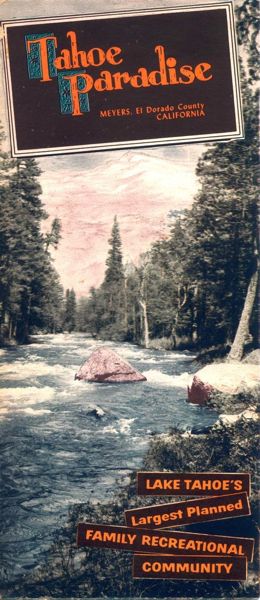
A brochure touting Tahoe Paradise. Photo/Theresa and Darrell Eymann

A brochure touting Tahoe Paradise. Photo/Theresa and Darrell Eymann

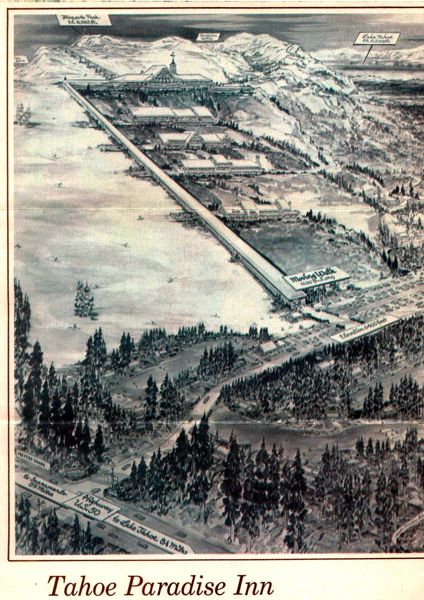
The proposed Tahoe Paradise Inn. Photo/Theresa and Darrell Eymann

The proposed Tahoe Paradise Inn. Photo/Theresa and Darrell Eymann

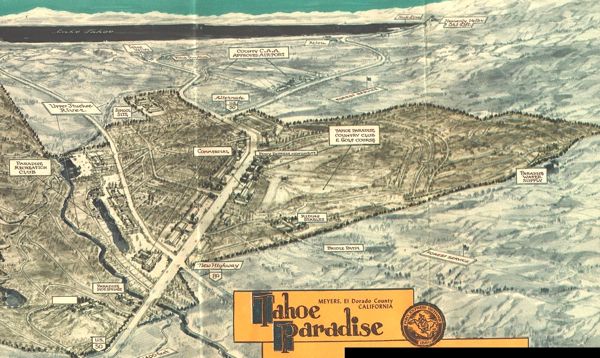
Tahoe Paradise proposed development. Photo/Theresa and Darrell Eymann

Tahoe Paradise proposed development. Photo/Theresa and Darrell Eymann

In the early 1960s, developers promoted a planned recreational community in Meyers which they named Tahoe Paradise.

A promotional brochure shows the plan included a long, covered moving walkway leading to a proposed Tahoe Paradise Inn, a riding stables, hot springs, water service, recreation club, and a new Highway 89 link toward Camp Richardson.

Today’s Pioneer Trail was proposed then as “Alternate U.S. 50” to Stateline.

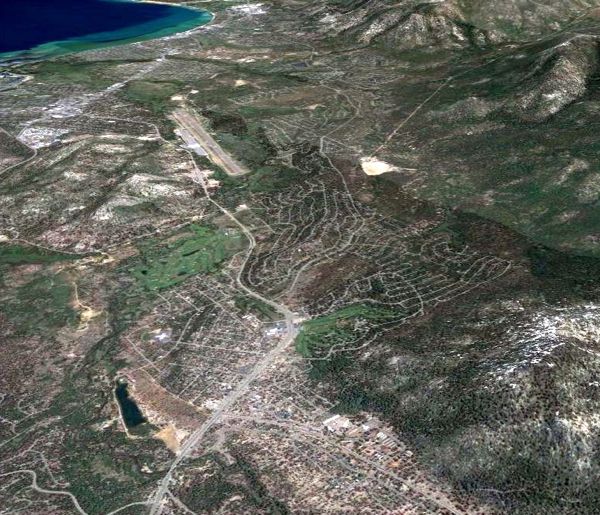
Tahoe Paradise and Meyers today. Photo/Google Earth

Tahoe Paradise and Meyers today. Photo/Google Earth

Remaining today includes Tahoe Paradise Golf Course and the divided four-lane stretch of Lake Tahoe Boulevard between the South Lake Tahoe city limits and Sawmill Pond and Tahoe Mountain Road, which was intended to serve what the developers hoped would be a large population in Tahoe Paradise.

— Bill Kingman


Trails lead everywhere except to destination

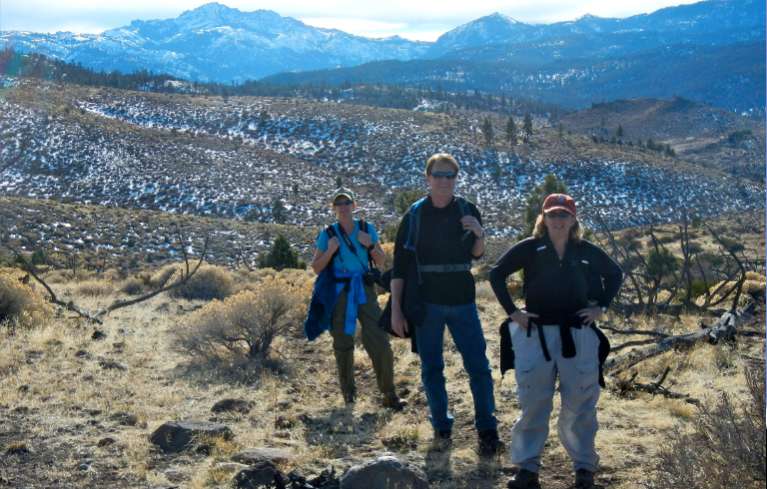
Pam Valentine, from left, Tom Ward and Sue Wood are having a hard time finding natural hot springs. Photos/Kathryn Reed

Pam Valentine, from left, Tom Ward and Sue Wood are having a hard time finding natural hot springs. Photos/Kathryn Reed

By Kathryn Reed

MARKLEEVILLE – Mystery hot springs between Markleeville and Gardnerville are still just that – a mystery.

I know they exist. I’ve seen pictures. I’ve heard stories. I’ve talked to someone who has been in the springs. I even had directions. But the four of us never found them.

I had been told about the springs from Linda who I volunteer with at Bread & Broth. These are part of the directions she gave me: “… continue for a couple of blocks along the fence, but you will eventually have to go cross country up to the ridge where you will find a trail. Follow it and it will eventually go downhill toward the river, which you’ll be able to see from the top. Two nice hot pools at the bottom of the road right on the river.”

The landscape, even at 5,500 feet, is much different than Tahoe.

The terrain, even at 5,500 feet, is much different than the Lake Tahoe Basin.

We hit many ridges. We saw three women on one who asked us if we knew where the hot springs were. This encouraged us. We might be in the right area – or we were all lost.

We never saw the trio again despite eventually heading in their direction.

Others have said getting to the springs from the Leviathan Mine side would be an option. Maybe we’ll try another day. Or maybe we’ll just hike along the river and skip the whole ridgetop thing. Someone else suggested a rafting trip would be a way to find the springs.

What we did find on the last Sunday of January was new territory to explore. While the trails are now covered in snow, on this particular day we were able to wear hiking boots to tromp through the sagebrush and chaparral for what was about a 5.5-mile hike.

I don’t know how distinct the trails are for snowshoeing.

There are no trail markers or signs to know where you are or where you are going. That’s why it is important to pay attention to your surroundings so you’ll be able to find your vehicle at the end of the day.

Trails are single-track and may see more cow traffic than human beings based on the amount of dung in the dirt.

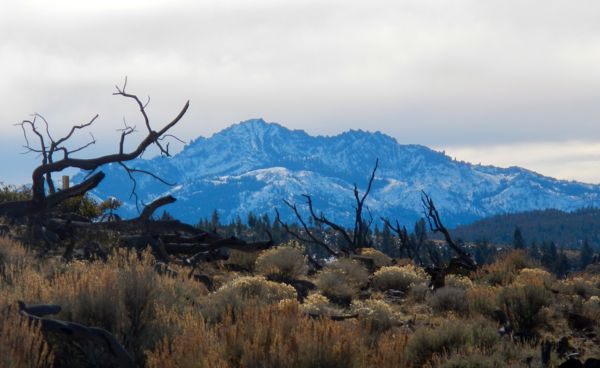
Snow covered mountains in the distance.

Snow covered mountains in the distance.

Sweeping views are visible from various high points. The contrast was stunning. At times the ruggedness of the Sierra penetrated the sky, while other times the parched Carson Valley unfolded below us.

It was an interesting trek to an area none of us had explored before. With its being lower in elevation than the Lake Tahoe Basin, the terrain was completely different. I could see how during summer this would be an unbearably hot place to hike because there would be little or no shade. Even two weeks ago Pam and I were in short-sleeves for part of the hike.

——–

Getting there:

From South Lake Tahoe go west on Highway 50. Turn left onto Highway 89 toward Hope Valley. At Picketts Junction, go left onto Highway 88. Turn right onto Highway 89 toward Markleeville. Turn left onto Diamond Valley Road. Cross the river and park on the left. Cross the road and enter through the cattle gate. Start exploring. (There are cattle gates on both sides of the road, but we only explored in one direction.)


Opinion: Inequality fine with conservatives

By Robert Reich

With polls showing that a majority of Americans now believe inequality has grown over the past decade, and favor tax increases on the wealthy to expand help to those in need, conservatives want to change the subject.

Those with presidential ambitions say we should focus on poverty rather than on inequality.

Sen. Marco Rubio of Florida points to the “lack of mobility” of the poor as the core problem. Rep. Paul Ryan of Wisconsin blames their isolation from mainstream America: “On every measure from education levels to marriage rates, poor families are drifting further away from the middle class.”
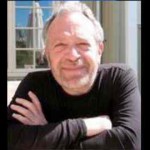
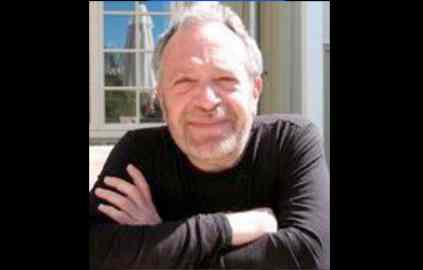
Robert Reich

Robert Reich

Conservative New York Times columnist David Brooks argues that the “interrelated social problems of the poor” have nothing to do with inequality.

Rubbish.

When almost all the gains from growth go to the top, as they have for the last 30 years, the vast middle class doesn’t have the purchasing power necessary to keep the economy growing and generate lots of jobs.

Once the middle class has exhausted all its coping mechanisms — wives and mothers surging into paid work (as they did in the 1970s and 1980s), longer working hours (which characterized the 1990s), and deep indebtedness (2002 to 2008) — the inevitable result is slower growth and fewer jobs.

Slow growth and few jobs hit the poor especially hard because they’re the first to be fired, last to be hired, and most likely to bear the brunt of declining wages and benefits.

A stressed middle class also has a harder time being generous to those in need. It’s no coincidence that the tax revolts that began thundering across America in the late 1970s occurred just when middle-class wages began stagnating.

Helping America’s poor presumably requires some money, but the fiscal cupboard is bare — and the only way to replenish it is through tax increases on the wealthy because the middle class is stretched to the limit.

The shrinking middle class also hobbles upward mobility. Not only is there less money for good schools, job training and social services, but the poor face a more difficult challenge moving upward because the income ladder is far longer and its middle rungs have disappeared.

Conservatives don’t want Americans to draw the connection between widening inequality and unequal political power. Brooks, for example, warns that any discussion of unequal political power will make it harder to reach political consensus over what to do for the poor.

But it’s precisely the concentration of power at the top — which flows largely from the concentration of income and wealth there — that has prevented Washington from dealing with the problems of the poor and the middle class.

As wealth has accumulated at the top, Washington has reduced taxes on the wealthy, expanded tax loopholes that disproportionately benefit the rich, deregulated Wall Street, and provided ever larger subsidies, bailouts and tax breaks for large corporations.

The only things that have trickled down to the middle and poor besides fewer jobs and smaller paychecks are public services that are increasingly inadequate because they’re starved for money.

Unequal political power is the endgame of widening inequality — its most noxious and nefarious consequence.

Big money has all but engulfed Washington and many state capitals — drowning out the voices of average Americans, filling the campaign chests of candidates who will do their bidding, financing attacks on organized labor, and bankrolling a vast empire of right-wing think tanks and publicists that fill the airwaves with half-truths and distortions.

Finally, conservatives would rather talk about poverty than about inequality because they can then characterize the poor as “them” — people who are different than most of us, who have brought their problems onto themselves, who lack self-discipline or adequate motivation. Accordingly, any attempt to alleviate poverty requires that “they” change their ways.

But inequality affects all of us, and dealing with it requires that we acknowledge how distorted our economy and our politics have become. When 95 percent of the economic gains since the start of the recovery go to the richest 1 percent, something is fundamentally wrong

America’s surging inequality requires that we address the growing misallocation of political and economic power in America. That’s exactly what conservatives don’t want us to do.

Robert Reich is chancellor’s professor of Public Policy at UC Berkeley and senior fellow at the Blum Center for Developing Economies. His new film, “Inequality for All,” is now out on iTunes, DVD and on demand.


Swath of North Shore without power

A large number of Liberty Utilities’ customers on the North Shore are without power Saturday night.

No cause has been located as of 10:10pm. Because of that, there is no estimated time when power will be restored.

The outage is affecting customers serviced by the Brockway substation. The number of customers without power has not been disclosed by Liberty.

— Lake Tahoe News staff report


Illegal massage businesses on the rise in Calif.

By Jeremy B. White, Sacramento Bee

The sign wasn’t the kind most businesses feel compelled to post.

“We Are Not A House Of Prostitution,” proclaimed the notice that Assemblyman Jimmy Gomez, D-Los Angeles, recalled seeing in the window of a Los Feliz massage parlor.

To Gomez, the message illustrated how a perennial concern about massage businesses has intensified over the last few years. Cities and counties have witnessed a boom in massage establishments even as they have ceded some authority to regulate those businesses, heightening the risk of violators selling sex under the guise of massage therapy.

Lawmakers will soon have an opportunity to change how California regulates massages. A 2008 law replaced local control with a state nonprofit, the California Massage Therapy Council, that certifies massage practitioners, requires background checks and oversees massage schools. The law creating the new framework will expire at the end of 2014.

Read the whole story


Letter: Agencies creating a Tahoe residents don’t want

To the community,

Why I went to the meeting Feb. 6:

After reading the Catalyst Project document, I was shocked. This wasn’t a catalyst for commercial growth, it was an immense planned development. I realized that this project could never happen because there wasn’t enough commercially zoned land for a new 4-acre project. Then a Lake Tahoe News’ story came out, magically, 5.78 acres of California Tahoe Conservancy lots are going to be sold, right in the general vicinity of this Catalyst.

So I went back and crunched some numbers, and saw that once again, this project could never get off the ground because of lack of commercial floor area (CFA). Since I have personal experience with this commodity, I understood that there was simply not enough CFA allotted to Meyers. That was until the new TRPA Regional Plan was explained to me. Goes something like this: CFAs, TAUs (tourist accommodation units), hard coverage (asphalt) and soft coverage (compacted dirt), are government commodities that control growth and create revenue. These commodities are very valuable. And if I were to make an analogy, it’s like how gold and silver are to the paper dollar, they fluctuate depending on demand. If the feds went out and printed a gazillion one-hundred dollar bills, it would upset the economy. Well, that’s kind of what the TRPA did.

They are supplying up to six times the commodities like CFAs or coverage for one commodity purchased, or a 1 to 6 ratio, or a 1 to 2 ratio, or a 1 to 3 ratio, depending on location. Also, this surprised me, transferring/converting stuff, residential stuff to commercial stuff? CFAs converting to TAUs? Meyers stuff being sold/traded with North Shore stuff? Really? Answer: Yes.

Yes, they are trading or selling commercial floor area and want to sell or trade more coverage across the lake and across the board. TRPA Code 50, 50.10.1

The TRPA has also changed our zoning title, our commercial area is now a “town center”, increasing density, which basically means, they could cram more stuff (see above) into a smaller space.

With these changes, the numbers work, this mega resort could actually fly. Wow! But wait, neighbors would still have to be notified if something like this was in the planning process, right? No, under the new plan, to add insult to injury, they don’t have to tell us anything.

Lastly, never underestimate the Meyers community. I was so proud to be among all those people who showed up [Thursday] night, reminded me of 20 years ago when we stood up and said, “We will not be the parking lot for Lake Tahoe!”

I was proud then and am proud now. By the way, this Catalyst calls for a 465-unit parking garage to “capture the gasoline vehicles and incentivize them into electric cars”.

Good grief.

Angela Olson, Meyers


Fishing ban expanded in California

By Aaron Kinney, Bay Area News Group

SACRAMENTO — Taking an even more aggressive approach to protecting drought-stricken fish, state wildlife officials on Wednesday tightened already unprecedented restrictions on recreational fishing in Northern California.

The California Fish and Game Commission voted unanimously to extend shutdowns along the northern coast until the spring to safeguard threatened steelhead and endangered coho salmon. The commission also expanded the prohibition to include most of the Russian River in the North Bay and key spawning habitat in the American River east of Sacramento.

Charlton Bonham, director of the state Department of Fish and Wildlife, acknowledged the bans will be difficult for anglers and rural towns whose livelihoods depend on steelhead fishing during the winter. But, he added, the fishing community is overwhelmingly supportive of the state’s intervention.

Read the whole story