LTUSD bond oversight committee members added

The Lake Tahoe Unified School District board on Tuesday appointed Casey Blann to the Citizens Bond Oversight Committee as the business representative and Kelly Lancellotti as the at-large member of the committee. Both are two-year terms.


Earthquake, tsunami lecture in Incline

Earthquake and Tsunami Hazard of the Tahoe Basin … and Other Geophysical Musings is the subject of a presentation by Graham Kent, director of hte Nevada Seismological Lab.

Click on lecture for details.


Tahoe Basin Science Conference

The 2010 Tahoe Basin Science Conference is March 16-17 at the Tahoe Center for Environmental Sciences, Sierra Nevada College Campus, Incline Village.

Click on conference for details.


Tahoe’s talk of Vancouver, Jan. 27 pm edition

Publisher’s note: This is the final installment of Tahoe’s talk of Vancouver.

By Kathryn Reed

WHISTLER, British Columbia — I’m a convert.

I’ve never been a fan of ski villages. They seem like a make believe, developer construed, concrete morass with little attention paid to the locals and dollar signs the end goal.

Much of this might be true for Whistler Village, but the feel is so much different.

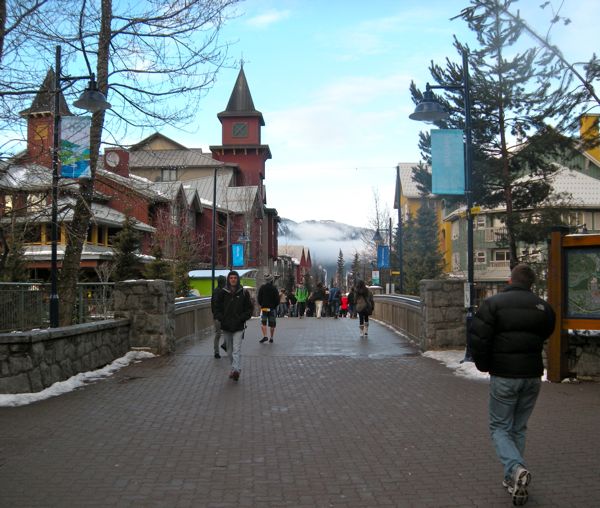
Whistler Village is all about pedestrians. Photos/Kathryn Reed

Whistler Village is all about pedestrians. Photos/Kathryn Reed

For starters, the size of the village is in proportion to the mountain that looms above. It’s huge by California standards. There are 134 restaurants and bars in Whistler Village, 164 hotels-condos-B&Bs and 218 retail shops.

All of these businesses rely on 9,877 full-time residents, 2,500 seasonal residents and 11,522 second home owners.

Whistler Village is a place to be — to walk. Yes, walk. It’s all about pedestrians. California villages are for walking, too, but the limited lodging at some of them make it easier to drive to the village, necessitate crossing a state highway, or the walk to the village is cumbersome in some other way.

At Whistler, skis and snowboards are sitting outside restaurants-bars that are slopeside as well at ones in the interior of the village.

This doesn’t happen at Mammoth because the village is a drive or bus ride from the resort.

It doesn’t happen at Heavenly because just the gondola empties into the village and there aren’t many places to eat-drink there. And that village has nothing lively like what’s going on at Whistler —  and its mid-week here.

Northstar with all of its single-family residences and focus on family isn’t that upbeat.

Squaw had eateries at the base long before the village went in. But the addition of the village hasn’t made it much of a happening place.

One can’t say Tahoe skiers are more serious and therefore less likely to indulge in apres ski fun. I saw more excellent skiers at Whistler-Blackcomb in the past few days than I ever do at any Tahoe resort in a season.

A major difference is locals frequent Whistler Village.

Many travelers like to go where the locals are. They want to be part of the scene, part of the in crowd, to live like a local if only for a short time.

Whistler Village has a combination of chain and independent stores and restaurants. Storefronts are of various sizes. It’s a mix of T-shirt shops (nice ones), souvenir shops, a grocery store, theater, ski shops, restaurants, clothing, ice cream, cigar and other specialty shops.

Street signs and lights are fun and easy to read.

An information booth has a real person in it.

Bear-proof garbage and recycling bins are everywhere.

All ages are out and about — though mostly adults. It’s couples, groups of friends — men and women.

Every Sunday night through March is a free event called Fire and Ice — where riders do tricks and then do them again through a ring of fire. Fireworks go off. It’s all on the lower part of the run. Hundreds are huddled outside. More are sitting outside or in nearby bars.

Apparently, non-weekend events are a draw for people in Whistler.

ngg_shortcode_0_placeholder


Lake Tahoe ski report, Jan. 27

curtisPartly cloudy with light winds today, and a slight chance of scattered showers—enjoy the break in the weather! Curtis Fong, the Guy from Tahoe, delivers his ski report.


Tahoe’s talk of Vancouver, Jan. 27 am edition

By Susan Wood

CALLAGHAN VALLEY, British Columbia — Free-heel skiers rejoice.

For the first time in history, there’s a place and time to see the best of the best compete in all four Nordic disciplines — cross
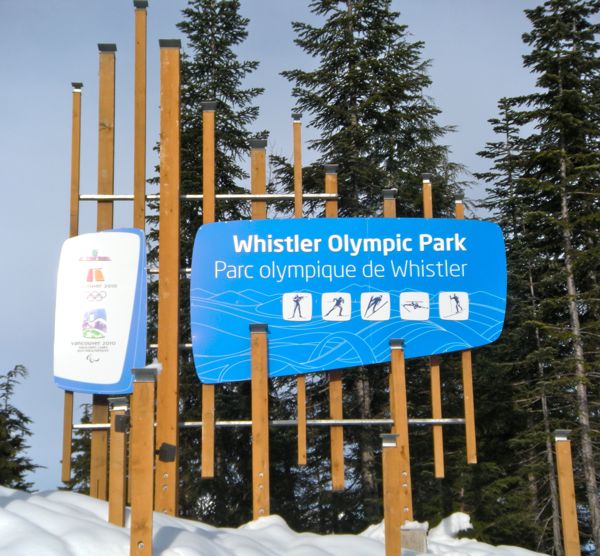
A venue was created for Vancouver's Nordic events.

A venue was created for Vancouver's Nordic events.

country, biathlon, ski jumping and Nordic combined — during the 2010 Vancouver Winter Games. The beauty and majesty of the Callaghan Valley, located 11 miles south of Whistler off the Sea to Sky Highway between the ski resort town and Vancouver, will become the backdrop for 28 medal events at Whistler Olympic Park.

The governments of Canada and British Columbia funded the $120 million investment to develop 5,000 acres of the once-sleepy backcountry area of Callaghan Country. It is anchored by Mount Callaghan to the north and Callaghan Creek to the south. Even as the world prepares to cast its eyes on the wilderness area, the place has not lost its charm. A six-mile drive up Callaghan Valley Road leads pre-Olympic visitors to a tiny, narrow bridge crossing with a funky cabin welcoming visitors.

With the Olympics fast approaching, construction crews are putting the finishing touches on the ski jumping venue, and the sign identifying this multi-sport complex has been erected. Athletes have gone out to test some of the grounds — 100km of groomed trails. Another 15km of snowshoeing trails are open. Two-thirds of the whole area is open to the public. All of it will be when the Games are over.

The place is a popular option for cross country skiers such as Walter and Sheila Frith who split their time between Whistler and Vancouver. The local residents have explored the area during the last decade.
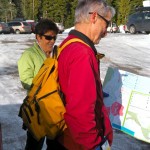
Sheila and Walter Frith talk about cross country trails. Photos/Kathryn Reed

Sheila and Walter Frith talk about cross country trails. Photos/Kathryn Reed

“We love cross country skiing, so this is indeed the jewel of the Olympics,” he told Lake Tahoe News on the couple’s return to their vehicle from the trail. He explained how few trails existed before Vancouver’s Organizing Committee won the bid to host the Winter Games.

The Friths enjoyed taking the entry to Inside Passage run to the appropriately named Around the World run, a 1-1/4-mile route which encircles the Top of the World climb to what the facility’s brochure labels as the place for “fantastic views in all directions.”

These runs lie outside the Olympic venue, so they’re open to the public.

The Friths said they appreciated more trails developed than what Olympic officials intend to use. Being residents, they have seen a “hot and cold” reaction to an event of such magnitude enveloping their two towns.

“We knew enough about the Olympics that you don’t like all of it, and certainly there’s a reluctance to hosting it, but we expect all to come on board. And I think they’ve tried for a green Olympics,” he said, illustrating an approval for the sustainability measures taken this year with the Games. (Read about some of these measures in upcoming Olympic coverage in Lake Tahoe News.)

Here at Callaghan Valley, Vanoc officials chose a site to develop where trees were previously harvested and cut their construction footprint in half from the initial design. An environmental assessment team reviewed the impact of wildlife, plants, wetlands, waterways and archaeological sites during building phases that started five years ago.

The organizing committee hopes to fill three stadiums with 12,000 spectators witnessing the spectacle of these lesser-known, yet equally thrilling sports.

Just a few notes on the subject:

Athletes competing in the 31 mile cross country race are expected in two hours to climb 2,000 vertical feet. That’s more than double the vertical drop the men’s downhill racers will cover at Whistler Creekside.

Ski jumpers reach a speed of more than 60mph before hurling their bodies into the air.

Chamonix, France, was the first Olympic city to host ski jumping and cross country skiing in 1924. The French city at the base of Mount Blanc touts a proud heritage of its glory days of the Winter Games.

The men’s biathlon was first held as an Olympic event at the 1960 Winter Games in Squaw Valley. The Lake Tahoe-area resort hosted a slew of events marking its 50-year anniversary earlier this month, including a Nordic Legends dinner at Granlibakken Resort a little over a week ago. (Read all about it in the Lake Tahoe News archive.)

Squaw’s neighboring ski resort, Northstar-at-Tahoe, did its part in commemorating the history of biathlon and Tahoe Olympic roots by installing the West Coast’s one official course this year.


Guide to snowboarding competition

vanolyBy Ron Judd, Seattle Times

Because of its fast-paced action, soaring jumps, and spectacular wipeouts, snowboarding has quickly grown from a stepchild Olympic sport to a true fan favorite.

Snowboarding is contested on slopes with heavy degrees of human shaping. The halfpipe, where freestyle snowboarding takes place, is a carved snow trough, about 110 meters (360 feet) long and 13 to 17 meters (42 to 56 feet) wide, with walls about 3.5 meters (11.5 feet) high. The parallel giant slalom course is much like those used in alpine skiing for a giant slalom: A set of gates set 7 to 15 meters (23 to 50 feet) apart over a vertical drop of 120 to 250 meters (394 to 800 feet) so racers can compete side to side, making turns all the way down the course. Snowboard cross courses are long, undulating trails—just barely wide enough if all four competitors were to run side by side—with a series of whoop-de-do jumps.

Read the whole story


Sierra Nevada specialty plate not selling well

By Paul Rogers, Mercury News

Maybe it’s the bad economy, or the dinky designs. But two state campaigns aimed at raising money to expand parks, restore creeks and build hiking trails in the Bay Area and the Sierra Nevada through the sale of new specialized license plates are failing to gain traction with motorists.

Under state law, sponsors of commemorative license plates must sign up 7,500 prepaid orders in one year or the DMV won’t produce the plates. The plates cost $50 a year.

But a proposed plate that would feature a small image of the Golden Gate Bridge and whose proceeds would help Bay Area open space projects has sold only 455 copies, and faces a deadline of mid-July. A second proposed plate, which features a bear and a mountain, would fund projects of the Sierra Nevada Conservancy, a state agency. It has sold only 256 copies, and faces a September deadline.

Read the whole story


Reno-Tahoe 2022 Winter Olympic Games?

ringsBy Susan Wood

The Winter Olympics is a hot ticket for those who are enthusiastic about cold weather sports. That’s why the Reno-Tahoe Winter Games Coalition has not given up hope on hosting the world-renowned event again.

The group led by Chief Executive Officer Jon Killoran is so motivated to bring the Games back decades after Squaw Valley hosted them in 1960 that the board has agreed to engage in a game of chess in determining what year to bid for.

As it stands, the 2014 prospect once dreamed about by the late Reno Sports Commission Chairman Jim Vanden Heuvel moved to 2018. It was more recently bumped to 2022 once Chicago lost its bid for the Summer Games in 2016.

Killoran is still hopeful — especially since patience is the name of the game.

“I don’t think there’s a better North American region to host them than us. Mother Nature brings us this great skiing in close proximity to the Reno and Sacramento airports,” Killoran told Lake Tahoe News shortly after Chicago lost its bid.

He further explained how the International and U.S. Olympic committees evaluate the strength of the bid based on the prospect of mass ticket sales. The population bases of the San Francisco Bay Area, Sacramento and Reno provides that potential.

“We feel we stack very well against any other region with this,” he said.

And now, the USOC has a new chief executive officer, Scott Blackmun, who has expressed more interest in getting the Winter Games back in the United States in 2022.

The local coalition has been using the Winter Games in Salt Lake City in 2002 as a model for calculating the bottom line. Its budget came in at $3 billion with a $76 million profit. This was also just five months after 9/11, so people were not traveling.

Venues built for the Games are recognized for bringing in revenue long after the athletes and organizers have packed up. The budget for the Games scheduled in Vancouver in February is set at $1.6 billion.

Killoran said enthusiasts shouldn’t lose hope since the region has had them before.

“In the modern Olympics, 50 years is a long time,” he said. “They don’t tend to return to a region too quickly.”

He could have a point. The United States hosted them twice at Lake Placid, N.Y., in 1932 and 1980. Innsbruck, Austria, is another two-time location.

Whatever the case, the bid would represent a far-reaching effort — with organizers acknowledging widespread support would be necessary from the ski resorts and local government groups.

Transportation and environmental issues represent the top concerns for hosting the Games here. Most agree a mass transit system would need to be put into place and environmental watchdog groups would need to be behind it. As former South Lake Tahoe Mayor Tom Davis put it when the idea circulated in 2001: “That’s going to be our biggest hurdle.”

In the meantime, the coalition will focus on more short-term goals such as the West Coast AAU Junior Olympic Games. This event received joint support from the Nevada Youth Sports Commission and Reno-Sparks Convention and Visitors Authority.

For now, the latter has developed no economic impact report for hosting the 2022 Winter Games but pledges marketing support, according to RSCVA officials.

“We’re more involved on the periphery for now,” spokeswoman Jill Stockton said.

Truckee Mayor Carolyn Dee, also Squaw’s director of business administration, summed up the quest with a familiar Olympic theme: “Time will tell.”

Other attempts have been made to bring the Games back to the Tahoe area. A group from Squaw tried for the 1976 games and a South Shore chamber of commerce had talked of going after the 1996 Games.


EDC answers ‘Call of the Wild’

The El Dorado Arts Council, Libraries and County Office of Education will launch The Big Read in celebration of “The Call of the Wild” with a proclamation by the county Board of Supervisors followed by a reception at the Main Library in Placerville on Feb. 2.

The kick-off event will feature the Board of Supervisors reading a proclamation announcing the start of The Big Read:WILD in El Dorado County. Become enchanted with the words of Jack London by listening to dramatic readings from the book. Then, cross the street to the Main Library for a program on wolves, featuring live wolves, book giveaways and snacks.

The Big Read is an initiative of the National Endowment for the Arts designed to restore reading to the center of American culture.

El Dorado County is one of 268 communities nationwide participating in The Big Read through June.

During February and March the county will celebrate “The Call of the Wild” with a full calendar of events including “Jack London’s Alive and Well and Visiting El Dorado County,” dynamic portrayals by actor/scholar Michael Oakes in El Dorado Hills, Placerville, and South Lake Tahoe; Iditarod racer Jeanne Ashcraft; and The Battle of the Gold Rushes at the El Dorado County Museum.

For more information on this event, contact El Dorado Arts Council at edac@eldoradartscouncil.org or  go to www.eldoradocountybigread.org.