Bereavement Group meeting
Barton’s Hospice “Memory Dish Bereavement Group†is Feb. 17 from 3:30-5pm in the Carson Valley Medical Center Administration Building, Gardnerville.
Free, but call for reservations — (775) 782.1510.
Barton’s Hospice “Memory Dish Bereavement Group†is Feb. 17 from 3:30-5pm in the Carson Valley Medical Center Administration Building, Gardnerville.
Free, but call for reservations — (775) 782.1510.
Renew your love and commitment in a ceremony performed by Hillary & Stew, tailored to your relationship.
Just a few half hour time slots still available in South Lake Tahoe.
A $50 suggested love offering includes flowers and a photo. Call the office for reservations, (530) 544.2266.
 By Cheryl Millham
The two cubs rescued by the BEAR League after the mother was illegally shot and killed in Carnelian Bay were brought to Lake Tahoe Wildlife Care. They came in weighing 13 and 16 pounds, respectively. There, they joined three cubs already at LTWC from Yosemite.
All five cubs became friends fast, chasing each other, playing in their pool, rolling and tumbling and swinging on their two swings.
The cubs were on LTWC’s webcam all summer and into December and gave people all over the world enjoyment just being able to watch them play and grow.
This next spring, if we receive any cubs, they will also be on our webcam. Just log on to www.ltwc.org and click on “Bear Cam.”
Since the cubs had no mother to teach them how to find food or even what foods to eat, it is up to us to introduce these foods to them. An example of the types of foods we offer them is fish, (whole fish) which was placed in their swimming pool, so they learned that if they wanted fish, they needed to get wet. They learned about honey and honeycomb, carrion (dead animals) and fruits and nuts, which they will find where they are released.
As the bears grew, their volume of food had to increase. When they first arrived, they were all put on bear formula along with other foods, mostly fruit. By the end of summer, they were eating about 40 pounds of food put into their cage twice a day.
That equates to 16 pounds of food for each cub per day. No wonder they gained 70 to 90 pounds in six months.
The volunteers who feed and clean the cubs are never in the same area with them. There is never any communication with them. The cubs are totally wild and not habituated with humans.
To put the bears into hibernation, we always wait until the wild bears are going under. Then we start pulling back on the quantity of food they receive. We do this slowly. This process takes about two to three weeks. Bears don’t go into hibernation when it gets cold. They go into hibernation when there is no food. That is why some of our wild bears don’t hibernate, because they can find food in the form of garbage all winter.
About two weeks of cutting back on their food, we put in tree branches along with six to eight bags of pine needles so they can arrange them into a huge nest. When the food is stopped, they have already made their winter den — or nest. Then, it is sleepy time for about two more months, until Fish & Game (or the biologists from Yosemite) can make their plans to come and take the cubs to their release point.
At this time, we have had the bears for more than seven months.
It is a happy day when we send the cubs back home to the wild, which is where they belong. They all learned their lessons well and we have no doubt they will have a great life being free, wild bears.
Cheryl Millham is executive director of Lake Tahoe Wildlife Care.
HiN1 vaccine clinics scheduled for Kings Beach at 8665 Salmon Ave. on Feb. 11 and Feb. 25 from 9am-3:30pm, except for the lunch hour.
Publisher’s note: According to the Canadian press, tubes filled with a solid form of carbon dioxide have been placed in moguls and on the aerials course to create a dry ice-like compound to keep snow from breaking down. Cypress is 90-minutes south of Whistler.
By Philip Hersh, Chicago Tribune
VANCOUVER — There was only one subject on everybody’s mind when the U.S. freestyle moguls ski team met the press Monday.
Whether the snow conditions at Cypress Mountain would spoil and/or affect their competition, which is Saturday (women) and Sunday (men).
The answer was a resounding — and unanimous — “no” from the eight U.S. moguls athletes.
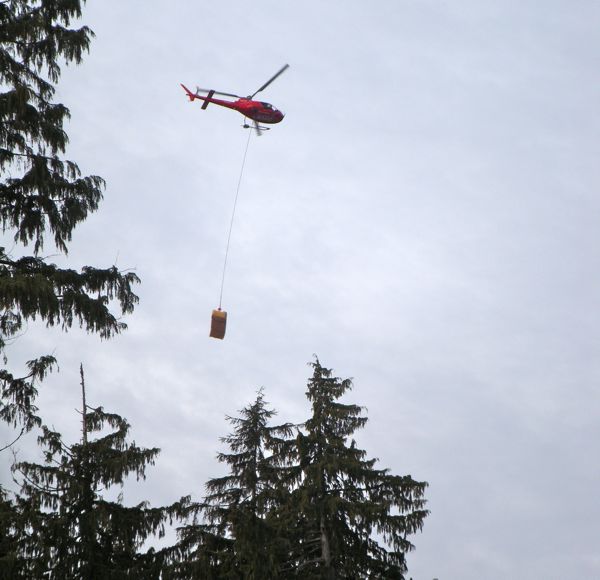
A helicopter lifts a hay bale to the slopes of Cypress Mountain near Vancouver on Jan. 27. Photo/Kathryn Reed
“We’ve skied in hot weather, cold weather, rain, we’re used to anything,” said Heather McPhie of Bozeman, Montana.
 More snow is in the forecast for today. Here is the ski report from Curtis Fong, the Guy from Tahoe.
James Crawford & Friends presents Hands and Hearts for Haiti a benefit concert for disaster relief in Haiti.
Date: Feb. 27
Time: 11am-6pm
Where: Horizon Convention Center, Stateline
What: More than a half dozen bands will play all day
Cost: $10, tickets at the door or contact James Crawford at (530) 543.3342 or Paige Rice at (530) 543.1903
All proceeds go to The Salvation Army — Haiti Earthquake Fund.
Bowling Party to raise money for Unity at the Lake’s building fund.
When: Feb. 13
Time: 6-8pm
Where: Tahoe Bowl, Freemont Street, South Lake Tahoe
Cost: $15 or $20 at the door ($10 for kids under 12)
What you get: Fun, laughs, bowling shoes, pizza and two games of bowling
RSVP: paigerice@gmail.com or (530) 543.1903
By USSA
LOUISVILLE, Colo. — Olympic medalist Jimmie Heuga, a star of the 1964 Olympic Winter Games and one of the U.S. Ski Team’s greatest ski racers, died Feb. 8.
His death came on the eve of the Olympics in Vancouver and 46 years to the day after his medal. Heuga, who was bronze behind Billy Kidd’s silver in the 1964 Olympic slalom, was 66.
“Jimmie Heuga was a champion in every sense of the word,” said U.S. Ski Team President and CEO Bill Marolt, who skied with Heuga on the 1964 Olympic Team. “He was a champion as an athlete, as a person and any way you want to measure him.
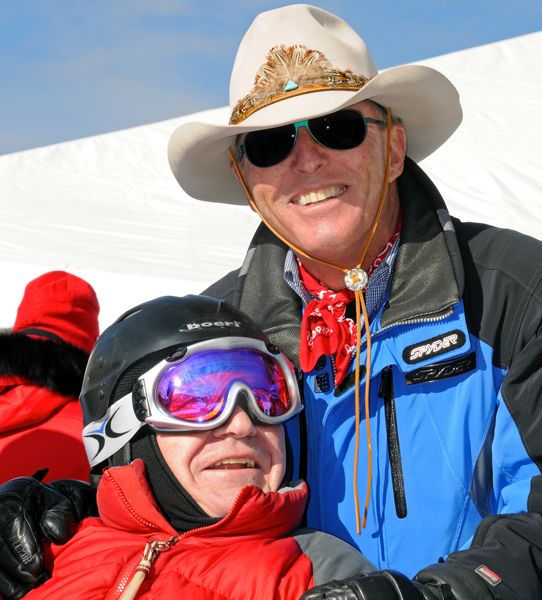
Billy Kidd with teammate and bronze medalist Jimmy Heuga. Photo/U.S. Ski Team/Tom Kelly
“We always talk about toughness — you heard about it in the Super Bowl this weekend,” added Marolt. “When I look back at all the athletes I’ve known, pound for pound, Jimmie Heuga was the toughest I’ve ever met. He was a 5-foot-6, 140 pound guy who didn’t back down from anybody. That’s the kind of toughness you need to be a champion.”
Heuga gained worldwide acclaim for his 1964 Olympic medal. But his real mark on society came after he was diagnosed with Multiple Sclerosis and dedicated his life to research and innovative treatment of the disease.
“Jimmie Heuga was one of our greatest Olympians and one of our greatest Americans,” said U.S. Olympic Committee CEO Scott Blackmun from Vancouver. “As a skier he was among the best in the world. But, as a human being later in his life, he made a difference for those suffering from a terrible disease. He will be sorely missed by our Olympic family and by everyone he touched in his life.”
Heuga grew up skiing in Squaw Valley and became a U.S. champion in 1960 at the age of 16. He came in the 1964 Games as one of the favorites at just 20 years old.
As a 13-year old, Heuga moved to Colorado to train in the Aspen Ski Club program. He later became a star at the University of Colorado under Coach Bob Beattie, winning an NCAA title in 1963. Heading into the 1964 Games, Heuga was part of a powerhouse team that included Kidd, Bill Marolt, Chuck Ferries, Buddy Werner and more with hopes of the first U.S. men’s alpine skiing medal in history.
Going into the final event, the slalom, the men were still without a medal. Heuga and Kidd combined to make history, with Heuga taking bronze and Kidd silver. The two became lifelong friends.
After a pair of top-six finishes at the 1966 World Championships in Portillo, Chile, Heuga went on to become the first American to win the prestigious Arlberg-Kandahar in 1967 in Garmisch-Partenkirchen, Germany. That same year he began to notice symptoms of what would later be diagnosed as MS. A year later he was named to his second Olympic Team, gracing the cover of Sports Illustrated together with Kidd.
At only 26, at the peak of his ski racing career, Heuga’s MS diagnosis was confirmed. While the conventional medical wisdom of the time was for MS victims to avoid physical or emotional stress, Heuga went about his life differently. He found that his physical health greatly improve with his own program of exercise, nutrition and mental motivation.
In 1984, the Olympic medalist took what he had learned personally to the world, founding The Heuga Center in Edwards, Colo. For over a quarter century, Heuga spread his “can do” philosophy with others. Today the Center, renamed Can Do Multiple Sclerosis, continues the legacy he established as a passionate advocate for other MS patients and for new treatment therapies which are now the medical standard for MS care.
“He was the personification of determination and never giving up — he inspired so many people,” said Kidd. “Jimmie’s accomplishments on the race course will forever be remembered. But it’s his accomplishments and drive in the fight against MS that will continue to help so many people live their lives. His life is an inspiration.”
Born to Lucille and Pascal Heuga, a Basque immigrant who ran the cable car at Squaw Valley, Heuga began skiing at 2 and three years later, he was competing on the junior circuit. He appeared in a Warren Miller film at age 9. In 1958, at 15, he was named to the U.S. Ski Team. He remains the youngest man ever on its roster.
He has been honored by the National Multiple Sclerosis Society, and is an awardee of the U.S. Ski Team’s Texaco Star Award. He has been on the President’s Council on Physical Fitness, and was inducted into the World Sports Humanitarian Hall of Fame two years ago. He is an honored member of the U.S. Ski and Snowboard Hall of Fame, inducted in1976, and the Colorado Ski and Snowboard Hall of Fame in 1987. He was named to the Colorado Athletic Hall of Fame in 2000.
In lieu of flowers, contributions may be made to the Jimmie Heuga Endowment Fund, 27 Main Street East, Suite 303, Edwards, CO 81632. Details on services are pending.
By Cathy Locke, Sacramento Bee
A new registry is aiding law enforcement and providing some peace of mind to families of autistic children and adults in El Dorado County.
The registry through the Sheriff’s Office “is unique in Northern California and maybe in the state,” said Ron Huff, director of clinical and intake services for Sacramento-based Alta California Regional Center.
The center helps secure services for children and adults with developmental disabilities.