Series of art exhibits at LTCC

Lake Tahoe Community College has a slew of art exhibits going on.

Through March 14 is the UNR MFA Student Exhibit in the Haldan Art Gallery. Ginny Schankerman’s “Seeking the Elephant” is in the Foyer Gallery through March 22. Tahoe Area High School Art Exhibit is in the Student Gallery until March 22.

The college’s Art Department Faculty and Staff Show will take over the Haldan Art Gallery from April 17-June 20. There will be a reception April 17 form 5-7pm.

Shiloh Flood’s “???” will be in the Foyer Gallery from April 12-June 21. An artist’s reception will be April 17 from 5-7pm.

The annual Student Art Exhibition in the Student Gallery is May 18-June 14. The reception and awards ceremony is May 18 from 2-5pm.


Warm weather makes for slushy Olympics

By John Branch and Sam Dolnickfeb, New York Times

KRASNAYA POLYANA, Russia — Warm weather is threatening the outdoor events at the Winter Olympics, forcing organizers to shuffle schedules, tap into reserve stockpiles of snow and scramble workers into action.

Afternoon temperatures at the ski jumping venue on Thursday reached 63 degrees. A practice session for the men’s aerials competition scheduled for Thursday night was canceled, and the men’s super combined ski race on Friday was moved to 10am local time from 11am to avoid midday temperatures expected to approach the mid-50s. Crews have begun adding snow, some of which was stockpiled from last year, to portions of the course.

For most of the mountain venues, the issue is not the amount of snow, but its condition. Workers at the Laura Biathlon & Ski Complex spread more than a ton of a salt mixture across the cross-country skiing courses on Thursday to help improve the slushy areas, a strategy also employed at the site of Alpine skiing across the valley where all the outdoor events are held.

Read the whole story


Bacon becoming a staple in the food world

By Charles Passy, MarketWatch

How far can the bacon boom go?

It’s a question that veteran “As Seen on TV” marketer Scott Boilen asked when he was given the opportunity to introduce yet another bacon product to an already crowded marketplace. But Boilen couldn’t resist the invention, a simple gizmo that turns a few strips of bacon into an edible shell. And so the Bacon Bowl was launched by Boilen’s Allstar Products Group via a series of infomercials in late 2013.

In a brief period, Boilen’s New York-based company has sold more than 2 million units of the $10.99 bacon cooker, making the Bowl a success story potentially on par with the Snuggie, to name Boilen’s biggest “As Seen on TV” hit.

The lesson? Never underestimate the power of bacon, says Boilen: “It’s almost become a cult-like food.”

Read the whole story


Free microchips for pets in Washoe County

Washoe County Regional Animal Services has extended its free microchipping campaign for an additional two years. Washoe County pet owners may microchip their pets for free at animal services through January 2016.

Because microchips have proven themselves as invaluable to their mission, Regional Animal Services initiated a yearlong free microchipping campaign in January 2013. The campaign’s goal was to microchip 5,000 pets by the end of January 2014.

The goal was exceeded by well more than 2,000 pets.

A microchip is a small, electronic chip enclosed in a glass cylinder about the size of a grain of rice. The microchip is activated by a scanner that receives an identification number which is linked to the pet owner’s contact information stored in the Animal Services’ database.

For more information, go online.


Mental health takes its time leaving sr. center

By Kathryn Reed

“Frankly, I feel that by remaining we are subjecting the clients of our wellness center to unjustified and disrespectful mistreatment.”

That is what Terri Daly, chief administrative officer for El Dorado County, wrote in a letter to South Lake Tahoe officials on May 15, 2013. It was in reference to mental health clients being seen at the senior center in the city.

senior centerDespite those sentiments, mental health is still seeing clients at the senior center. A deal was signed in 2012 allowing for the joint use. It has been an unsuccessful blending of populations.

“We are working together on a solution so they can leave as soon as possible,” City Manager Nancy Kerry said. But she said the move could still be several months from now.

The problem is the county took over some of the space the seniors had been using. The mental health clients can be disruptive. Seniors don’t feel safe.

Ross Branch, policy analyst with the CAO’s office, said, “The senior center was never intended to be a long-term solution. The reason we moved there was to help defray maintenance costs with the city.”

That’s great in theory. But the county hasn’t paid its share of utility bills that was originally agreed upon. After months of no payments, the county agreed to a lower amount and has paid that. The fees were based on the percentage of space used.

“The cost sharing for ‘maintenance costs’ was the sharing of the facility expenses. However, as soon as we submitted an invoice, the county disputed the cost sharing,” Kerry told Lake Tahoe News.

The county doesn’t have a date for when it will be out of the senior center, but it has found a place it would like to move into. An employee told Lake Tahoe News it’s the Tata Lane building the city used to lease.

“We are finalizing details on a new lease agreement,” Branch said. But he didn’t know where the building is and said he could not give a time frame for when the move would occur.


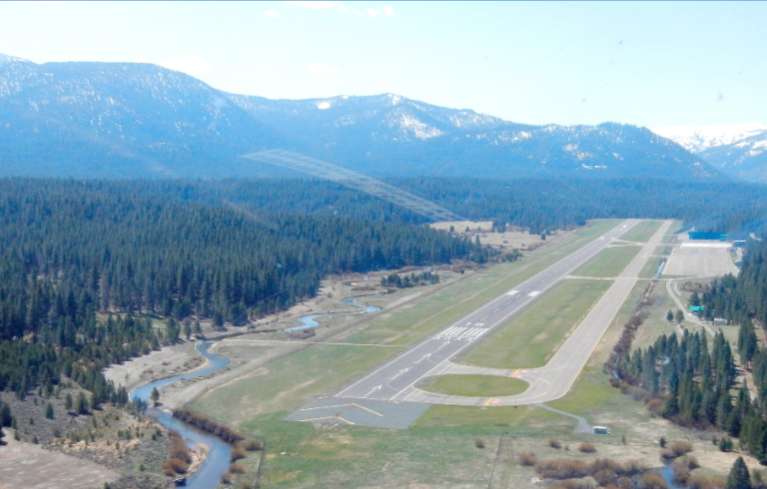
Lake Tahoe Airport master plan taking off

Lake Tahoe Airport's future is being studied. Photo/Kathryn Reed

A master plan is being put together to guide Lake Tahoe Airport for the next 20 years. Photo/Kathryn Reed

By Kathryn Reed

It’s not a noise study. It’s not a comprehensive economic study. It’s not a study to do away with the airport. It’s not a study to bring back commercial air service.

The master plan for Lake Tahoe Airport is a vision for the South Lake Tahoe airfield for the next 20 years.

As Councilman Tom Davis said at the start of the Feb. 13 meeting about the master plan, the airport has a “checkered history”.

The 1992 airport agreement that was the result of multiple lawsuits that involved the California Attorney Generals Office, League to Save Lake Tahoe and Tahoe Regional Planning Agency expired in October 2012. Because the environmental, economic and social fabric of the South Shore is not the same as 1992, the city opted to go forward with a comprehensive master plan for the airport. Plus, the FAA requires a master plan.

The FAA is funding 90 percent of the master plan at a cost of $315,000, with the city picking up 10 percent or $35,000. C&S Companies out of San Diego is the consulting firm doing the work.

Safety is the FAA’s No. 1 priority for all airports. And because it is footing the bulk of the bill, it has the most say in what is studied.

The Tahoe Regional Planning Agency has rules about noise in the Regional Plan, but they remain much the same as when the 1980 RP was adopted. There was talk when the latest RP was adopted in 2012 that noise would be addressed at a later date. That still hasn’t happened. And it won’t be looked at in the master plan.

While the economics of the airport will be considered, it is done on a limited basis. It won’t delve into who regionally is benefiting or being hurt financially by the airport. Nor will it study the feasibility of having festivals or other events there. It’s about the finances of the airport itself.

This was a bone of contention for some of the more than 100 people who attended the Thursday night meeting. Some people want a comprehensive economic study done. The city always has the option to do that at another time, for more money.

Several in the room advocated for closing the airport or keep it just for helicopter service.

To close the airport would require Federal Aviation Approval. It would also mean the city would have to pay back the $27,462,036 the FAA has provided for improvements to the facility since 1999.

The city obtained the 55-year-old from El Dorado County in 1983 for $1. The city’s general fund has been subsidizing the airport at a cost of about $400,000 a year. Half of that expense will go away after this fiscal year when the hangar debt is paid off.

Most South Lake Tahoe city offices are at the airport. This is saving the city roughly $100,000 a year in rent; what it was paying when offices were on Tata Lane.

On the flip side, if commercial air service were to return, those city offices would have to relocate.

City staff and councils have for years said they want commercial service to return. It hasn’t happened since 2000. The peak passenger count was in 1978 at 294,000.

While there was a vocal contingent of people against the airport as it is today and adamant against expansion, many in attendance want a viable, thriving airport.

The FAA will have final say over the Forecast of Demand and the Airport Layout Plan. These are two documents that are part of the master plan.

The Forecast of Demand predicts future levels of service (operations) and the type(s) of aircraft providing that service.

Michael Hotaling with the consulting firm was repeatedly asked where the information was coming from to predict those outcomes. He didn’t have a concise answer, instead differed to the company doing that report. But no one from that firm was in attendance.

The Airport Layout Plan is the other document the FAA must approve. It will show existing airport facilities and provide a blueprint for future airport development. It also goes into safety issues and land use outside the airport.

Hotaling had mentioned the airport’s being an environmental asset. When pressed to explain in what way, Hotaling said only in regards to providing a tarmac and fuel for planes fighting the 2007 Angora Fire and then as a staging area for planes working on slope stabilization post-fire.

Vehicle miles traveled to get to the airport or to the destination after landing will not be studied.

At least two more community meetings are planned regarding the master plan. Public comment would be taken at the City Council and TRPA meetings when approval for the document is sought, but by that time it’s essentially a done deal. The final report is expected to be completed in January 2015, with it going for agency approval the next month.

Notes:

Lake Tahoe News did a three-part series on Lake Tahoe Airport in July 2012. Here are the articles – story No. 1, story No. 2 , story No. 3.

• Information about the master plan process will be on the city’s website.


Opinion: Budget surplus should not be wasted

By George Runner

We’ve all heard dramatic stories of lottery winners acquiring hundreds of millions of dollars only to declare bankruptcy a few years later.

In fact, studies show 70 percent of all individuals who suddenly receive large amounts of money will lose it in a short period of time.

The cause of this problem is impulse spending by people who incorrectly assume they will never have to worry about money again. They spend as much as they want on whatever they want, making permanent financial decisions with their one time earnings.

George Runner

George Runner

This year, California essentially won the lottery when it comes to the budget. The governor’s budget proposal shows nearly $20 billion more in revenues will be generated during the next fiscal year than was collected three years ago.

Years ago, during the Davis administration, California found itself in a similar situation. As vice chair of the Assembly Budget Committee at the time, I remember sitting in Gov. [Gray] Davis’s office as he personally promised to show fiscal restraint with the state’s large revenue windfall.

Unfortunately, Gov. Davis ultimately caved to pressure from legislative Democrats and authorized ongoing spending with those temporary revenue dollars. Gov. Davis said all the right things, but his actions spoke louder than his words.

Despite Gov. [Jerry] Brown’s assurances, the messages we are hearing from the majority party indicate we may be on track to repeat these fiscal mistakes. Much like an irresponsible lottery winner, legislators can’t seem to fight the impulse to spend extra money as soon as it’s in the bank.

Our increased revenues are primarily the result of temporary tax increases that will soon expire and volatile capital gains that can disappear at any time. California cannot solve its long-term budget problems by relying on these temporary and unreliable solutions.

However, to go along with this new revenue, we’ve already seen proposals for increased spending. For example, Democrats in both houses of the Legislature have already thrown their support behind SB837 (Steinberg), a bill that will create a completely new school grade. By establishing a “transitional kindergarten” program available to every 4-year-old child in California, SB837 will rack up a price tag of nearly $1 billion by the year 2020.

These kinds of new, permanent spending proposals expand government, but do nothing to invest in the private sector.

Recently, a prominent Democratic elected official even called for the extension of Proposition 30, the temporary tax increases Californians imposed on themselves to get out of the fiscal hole of overspending.

The majority party is already planning on making this latest round of “temporary” tax increases permanent before they expire. Job creation and economic growth is the pathway to preventing future financial trouble for California.

Our long term problems will only be solved if Gov. Brown resists the impulse to spend our new surplus. We need to learn from the budget mistakes of the past, before it’s too late.

George Runner represents more than nine million Californians as a taxpayer advocate and elected member of the state Board of Equalization.


Youngsters consuming coffee in greater numbers

By Allison Aubrey, NPR

Energy drinks tend to get a bad rap. The Food and Drug Administration has investigated reports of deaths and sickness linked to them. Hospitals have reported increased ER visits. And on Capitol Hill last summer, senators grilled energy maker execs about marketing to kids.

But when it comes to caffeine intake, teenagers seem to be getting far more caffeine from coffee drinks.

A new report, published in the journal Pediatrics, finds that 17- and 18-year-olds are consuming almost double the amount of caffeine from coffee compared with a decade earlier. And increasingly, younger tweens and teens, ages 12-16, are getting more caffeine from coffee, too.

Read the whole story


El Dorado, Placer income levels among best in state

By Claudia Buck, Sacramento Bee

When it comes to income, the Bay Area rocks. In the Central Valley and Inland Empire, not so much.

Overall, in another sign that California’s economy is shaking off the recession, state tax officials reported Tuesday that the statewide median income – for 2012 – was $70,938, up 4.1 percent over the previous year. That’s for those filing joint tax returns. For individual returns, the 2012 median income was $35,910, an increase of 3.5 percent, according to the state Franchise Tax Board.

Locally, Placer and El Dorado counties ranked in the top 10, at seventh and eighth, respectively.

Read the whole story


Terrain-based ski lessons speed learning process

By Holly Ramer

NORTH CONWAY, N.H. — Allison Willette’s first few skiing lessons left her with a sore butt and aching knees but not a lot of skills. But one day’s worth of terrain-based learning made all the difference.

“Yesterday was probably the first day that I enjoyed it,” she said.

The instruction Willette got at Cranmore Mountain Resort is a new approach that uses sculpted zones to control students’ speed and reduce fears and falls. Without worrying about sliding down the mountain out of control, students can focus on building skills because the banks, berms and bumps naturally slow them down.

That means less emphasis on “snowplowing,” or pointing the skis into a wedge shape to slow down. Less time learning to stop, more time learning to go.

“Back in the good old days, we used to get people into a wedge right off the jump, but the wedge was more of a defensive posture, something to slow down and stop with,” said instructor Dave Bartlett. “But we were kind of resisting the forces we’re working with.”

The new method puts the emphasis on shaping those forces, Bartlett said, getting students more comfortable more quickly.

Willette, of Hadley, Mass., tried it out last month with her 8-year-old son. He had never been on skis; the few times she had she’d always felt intimidated. Both made quick progress.

“It allowed you to physically feel what the turn should feel like, and then you just naturally push in the right direction. So you kind of disengage your brain, and you can do it,” she said. “I learned quickly how to make turns there, and I was able to apply that to the flatter field.”

Students start out on flat snow, getting a feel for their skis. The next zone is a mini-pipe, where they slide down one side of a gentle, U-shaped slope and part way up the other. The slope is a bit steeper in the “roller” zone, which is followed by a short section of trail with banks and berms that guide students through three turns. The “traverse trax” zone includes eight turns and is the last stop before students head to the chairlift to try out a beginner trail.

Cranmore, along with Vermont’s Bromley Mountain and Jiminy Peak in Massachusetts, is one of three New England resorts that partnered with the consulting firm Snow Operating LLC to start terrain-based learning this year. Others that have adopted the approach in recent years include Breckenridge and Vail in Colorado, Northstar in California and Mountain Creek in New Jersey.

Kelly Coffey, training manager for the Breckenridge Ski and Ride School, said he has seen a marked improvement in his students, sometimes even before they actually try out the course. A family of four who took a lesson around Christmas were visibly nervous when they put on their skis, but by the time he finished explaining the zones, they were more relaxed.

“I could just see the tension in their bodies just flow out,” said Coffey, who also is a freestyle specialist for the Professional Ski Instructors of America. “From then on, I was able to get them to move a lot easier, and more gracefully, and we could progress more quickly. There were times I wanted them to turn, and they didn’t accomplish it, but they didn’t panic.”

Karen Dolan, director of Cranmore’s snowsports school, said she has seen many trends come and go during her 40 years in the industry, but she believes terrain-based learning has sticking power because it makes learning more fun. And boosting the fun factor makes it more likely that students will return — a key motivator for Cranmore and other resorts given that nationally, 85 percent of skiers never try it again after their first outing.

Mountain Creek saw its so-called conversion rate rise from 17 percent to 65 percent after implementing terrain-based learning. It remains to be seen whether Cranmore will see a similar increase, but Dolan said that kind of improvement would more than justify the $37,500 expense of building and maintaining the new terrain zones. In the meantime, the entire resort, including groomers, snow-makers, instructors and managers, is getting used to the new program.

“They all have to be part of this culture change and understand why we’re doing it. It’s everybody’s job to convert skiers and riders,” she said. “They’re here, marketing spent a lot of time getting them here, so let’s make sure that they’re having fun.”

First-time skiers and snowboarders can try terrain-based learning for free on March 9 at the three New England resorts if they register in advance. The promotion, limited to 150 people at each resort, includes equipment rental, helmet rental, a lesson and a beginner’s lift ticket.