Reno’s Wise captures gold in freeski halfpipe

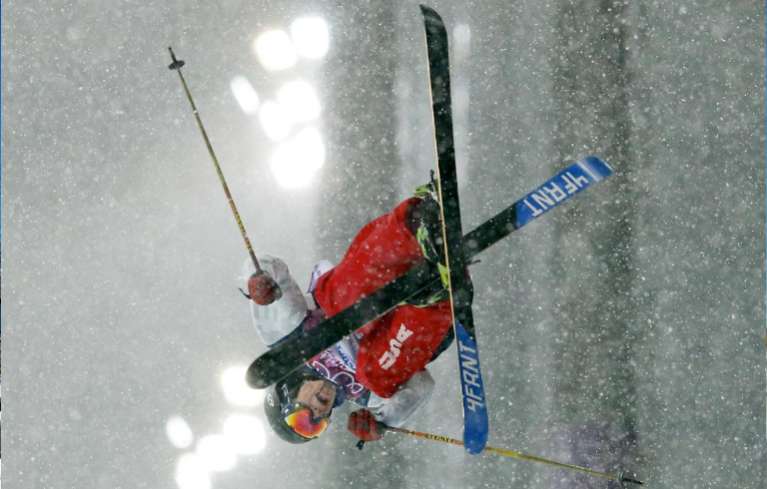
 David Wise of the United States gets air during the men's ski halfpipe final at the Rosa Khutor Extreme Park, at the 2014 Winter Olympics, Tuesday, Feb. 18, 2014, in Krasnaya Polyana, Russia. (AP Photo/Sergei Grits)

David Wise gets air during the ski halfpipe final at the Winter Olympics on Feb. 18 in Krasnaya Polyana, Russia. Photo/Sergei Grits/AP

Reno’s David Wise on Tuesday made history in multiple ways.

The 23-year-old earned a gold medal Feb. 18 in the inaugural freeski halfpipe competition. He is also the first gold medalist from Reno.

Out of an initial field of 35, he made it to the final round of 12 earlier in the day. His first run in the finals was all he needed. He scored a 92. Wise fell on the second run.

Conditions turned a bit more winter-like on Tuesday. Even though it was snowing, the pipe was slushy.

Wise had a small army of family in the crowd for support. His wife, Alexandra, even had a near life-size photo of their 2-year-old daughter. The little one didn’t make the trip to Russia.

Wise, who rides for Northstar, is well decorated in the sport of freeski halfpipe, having won three consecutive X Games gold medals.

Mike Riddle of Canada earned the silver with 90.60 points and France’s Kevin Rolland the bronze with a score of 88.60.

Aaron Blunck was the other American to make it to the finals. He finished seventh with a score to 79.40.

— Lake Tahoe News staff report


Library looking at its role today and in the future

On March 25 at 5:30pm, the Friends of the Library will be hosting a special presentation — the 21st Century Library: So Much More than a Building of Books.

Jeanne Amos, director of El Dorado County’s library system, will describe how this information center has advanced with the information age.

Afterward, specially-invited stakeholders and other library-lovers will discuss how the library can stay a vital information center into the future.


Kit Carson left legacy throughout Nevada

By AP

CARSON CITY — When you live in or near the state’s capital city, it’s hard to miss Kit Carson’s influence.

There’s Carson City, the Carson Valley, the Carson Pass and the Carson River. He also merits not just a mountain but the entire Carson Range, west of Reno and Carson City.

A life-size bronze statue of the pathfinder atop his horse stands in the mall between the Legislative Building and the Capitol, and the local library is full of juvenile books about the man who guided John C. Fremont’s expedition when it passed through the largely unknown Great Basin from 1843 to 1844. Kit Carson is our hero.

A life-size bronze statue of Kit Carson atop his horse stands in the mall between the Legislative Building and the Capitol in Carson City. Photo/ Cathleen Allison/AP

A life-size bronze statue of Kit Carson atop his horse stands in the mall between the Legislative Building and the Capitol in Carson City. Photo/Cathleen Allison/AP

Dime novels romanticizing Carson appeared as early as 1849. Author Herman Melville even mentioned him in his classic “Moby Dick.”

It is said that star-struck tourists would visit Carson at his home in Taos, N.M., before his death. Some would walk away disappointed because the 5-foot-5-inch Carson was not the giant they imagined after reading of his exploits.

State archivist Jeff Kintop acknowledged the pride he felt when he first got a job in Carson City.

“There was something cool about being in Carson City,” he told the Las Vegas Review-Journal. “We were brought up on Kit Carson and Davy Crockett. They were the heroes of the West.”

Opening the West

Born in Kentucky in 1809 and raised on the Missouri frontier, Christopher Houston “Kit” Carson gave up any thought of an education at age 9 when his father died. He was forced to help his mother, who had 10 children. He would hide his inability to read throughout adulthood, but he did learn to write his name and speak five Indian languages. Signatures of Carson sell today for $14,700.

At 14, Carson became an apprentice to a saddle maker. He hated the work and fled at 16 with merchants heading down the Santa Fe Trail. He became a trapper and a mountain man with Jim Bridger and over the years became as acquainted as anyone with lands in the unknown West.

In 1842, he met Lt. John C. Fremont by chance when the two were on a steamboat going down the Missouri River. They became lifelong friends after Fremont hired him to be his scout for expeditions into the Mexican-owned West.

Besides Nevada, those expeditions included battles in 1846 in which Fremont took Los Angeles from the Mexicans. Carson also brought 200 fresh personnel through Mexican lines to rescue Gen. Stephen Kearny and his troops in San Diego. That act helped the Americans complete their conquest and contributed to Carson’s legend.

When the United States subdued the “Californios” in the Bear Flag rebellion, Carson rode east to Washington, D.C., to inform President James Polk that the nation stretched from the Atlantic to the Pacific.

After his expeditions with Fremont, Carson decided to settle down as a rancher with wife, Josefa, in Taos.

Around this time, he came across a burned camp where Apache had killed settlers. There he saw for the first time a book on the life of Kit Carson. “Burn the … thing,” was his response.

In 1853, he and a partner herded thousands of sheep through Nevada and across the Sierra Nevada to Sacramento, Calif. He would never see “Carson City,” which received its name five years later. The sale of the sheep in gold rush California made him rich.

Carson became the Indian agent in northern New Mexico and held that job until the beginning of the Civil War in 1861. He led the advance at Valverde, near present day Socorro, N.M., with a group of New Mexican volunteers who subdued the Confederates. But then the Army chose Carson to lead the battle against a new foe: the Navajo.

The Long Walk

This year not only marks Nevada’s 150th anniversary but the 150th anniversary of “The Long Walk of 1864,” when Civil War brevet Gen. Kit Carson on government orders conducted a scorched earth policy of burning cornfields, killing sheep and taking over water holes to force the Navajo to surrender to Army control.

The Army then forced 8,000 American Indians to walk more than 300 miles from northeastern Arizona to Fort Sumner, N.M., or the Bosque Redondo. Three hundred died along the way.

The Navajo today contend that the United States wanted them out of northeastern Arizona to open the area to mining. They also say that Carson paid Ute and other American Indians who were their traditional enemies to burn their hogans, steal their livestock and capture them for slavery.

Starving and without water, the Navajo surrendered to Carson and his troops at Canyon de Chelly in January 1864.

After the Civil War, Carson returned to Taos and tried to expand his ranch into Colorado. When he died in 1868, legend has it, his last words were “Wish I had time for one more bowl of chili.”

Myth of the West

Some historians see Carson as an American Indian killer, a victim of American expansionism and a racist. He may have been all of those things, but he also was a man who shared the views of most white people of his time.

He remains a villain to the Navajo Nation.

“We hold him responsible for the suffering the Navajo people experienced,” said Clarenda Begay, curator at the Navajo Nation Museum in Window Rock, Ariz.

“A lot of people don’t know about the Long Walk. We haven’t changed in our views of him.”

In published works, Carson contended he only killed bad tribesmen, never “a squaw or a papoose,” and despised those who did.

His apologists blame his commanding officer, Gen. James Carleton, for orders to kill all who would not surrender and yield to reservation life.

But as early as 1857, Carson had adopted Carleton’s philosophy that the only way to tame the Navajo was by confining them to a reservation, teaching them agricultural skills and stationing troops nearby to prevent them from leaving.

“As long as these mountain Indians are permitted to run at large, this country will always remain in its impoverished state, and the only remedy is to compel them to live in settlements, cultivate the soil and learn to gain their maintenance independent of the general government,” Carson said.

Sheryln Hayes-Zorn, acting director of the Nevada Historical Society in Reno, says Carson remains in the national consciousness largely because of the 19th century dime novel and the television shows and movies that romanticized him.

Without much accuracy, they created a hero for generations of children who grew up playing cowboys and Indians.

“I think that kept his legend going,” she said.

During a recent public television documentary on Carson, author Dayton Duncan called him the “greatest living symbol of the desire Americans had to mythologize the West and take real things and turn them into something else. He just was who he was and other people projected onto him their own beliefs, their own myths.”


Talent show looking for student participants

The Kiwanis Club of Lake Tahoe presents the 8th annual Stars of Tomorrow talent show in March.

This is an opportunity for performing arts South Lake Tahoe students in grades 9-12 to express themselves in public for their families, friends, and the community. Scholarship awards will be given for first place ($1,000), second place ($750), third place ($500), and audience favorite ($250).

Applications and contest rules are available from performing arts instructors and administrative offices, or contact Dick VanBuskirk at (530) 541.0891. Applications must be submitted by Feb. 28.

The event takes place March 7 from 7-10pm at South Tahoe Middle School. Tryouts-rehearsal takes place March 6 from 6-9pm at STMS.

Tickets may be purchased at the door: adults $5, students $2, families (two adults, two children) $10. All proceeds from the event go toward the scholarships.


U.S. women miss podium in giant slalom

By Rob Hodgetts, BBC Sport

Slovenia’s Tina Maze won her second Sochi Olympic title with a victory in the women’s giant slalom.

Maze, 30, who shared downhill gold with Dominique Gisin earlier in the program, led by 0.52 seconds after the first run.

She was as solid in the second run, winning by 0.07 seconds in 2:36.87.

Super-G champion Anna Fenninger of Austria claimed her second medal with silver, while German defending champion Viktoria Rebensburg won bronze.

Julia Mancuso of Squaw Valley, who won bronze in the combined event, crashed out on the first run, while Germany’s double Sochi medalist Maria Hoefl-Riesch pulled out ahead of racing with a sore throat.

Mikaela Shiffrin of Vail-Eagle placed fifth in her Olympic debut.

Read the whole story


Meyers youngsters learn to snowboard — indoors

By Kathryn Reed

MEYERS – Dry slopes work for British Olympians to learn to ski and ride, so why not indoor snowboarding for Meyers kids?

That is exactly what took place two days last week at the magnet school. Four stations were set up in the multipurpose room, which doubles at the gymnasium, so K-2 students could get a feel for what it is like to be on a snowboard.

And while this isn’t how hometown gold medalist Jamie Anderson learned, the youngsters were thrilled to be possibly following in her footsteps. One kindergartner said he had been snowboarding his whole life.

With how well some of the students were able to balance, it was obvious they had either been on a board before or they are naturally gifted.

A handful of Sierra-at-Tahoe employees brought the Burton-certified learning tools to the school as an introduction to snowboarding. But it’s more than that for teacher Kristi Jouett. What was being taught also fits into the state standards for physical education.

“It teaches them balance, changing directions, and moving through space without crashing into each other,” Jouett said of the interactive Burton program. These are all things she teaches in PE.

Sierra would like this to become a permanent component of Lake Tahoe Unified School District’s physical education curriculum at all of its elementary schools. The tools Sierra uses are supplied by Burton. All the equipment is scaled to this age group.

One station had kids on a mini plastic snowboard that was then pulled by one or two classmates who held a handle that looks like it would be used for water skiing.

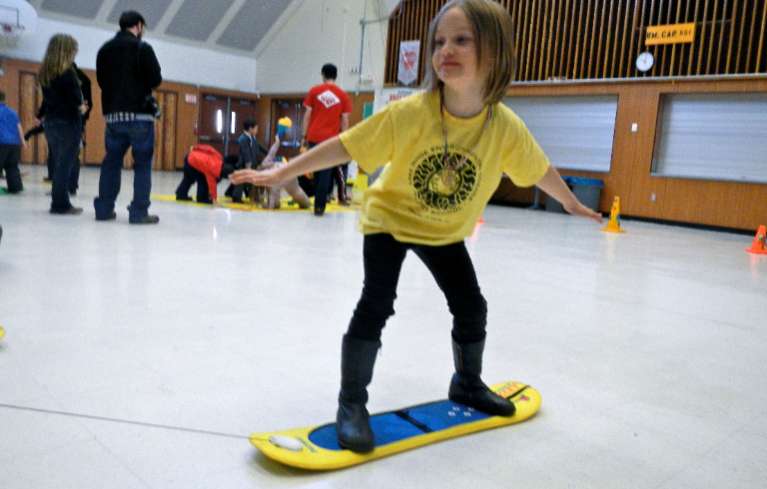
Kindergartner Avalon Newberry is pulled on a snowboard by classmates at the magnet school in Meyers. Photo/Kathryn Reed

Kindergartner Avalon Newberry is pulled on a snowboard by classmates. Photo/Kathryn Reed

Avalon Newberry was “riding” through the gym as one of the instructors told her: hands out, stay low and spirits high.

A sense of seriousness then came over her, followed by a big smile as she did what she was told to do.

Those on the stage were on a springy mini snowboard that allowed them to get the feel of rocking back and forth as well as side to side. Once the balance part was mastered then they tossed a ball to each to further test their skills.

Like what the pros have been showing off for the judges, the youngsters were grabbing the tail for points.

At the end of the special PE class they were all awarded “Olympic” medals.


Opinion: Local publications prove their relevance

By David Carr, New York Times

A lot of important journalism begins with a simple, seemingly obvious question, like why traffic is snarled in New Jersey on the way into New York.

Traffic coverage may be the lowest species in the dog-bites-man pantheon of news, except when it is not.

David Carr

David Carr

John Cichowski writes the “Road Warrior” commuter column for the Record, a daily newspaper in northern New Jersey that covers Bergen County. In September, the editor of the newspaper, Martin Gottlieb, received a tip from the publisher that navigating onto the George Washington Bridge from Fort Lee was taking hours. Gottlieb told Cichowski, who called the police in Fort Lee and was informed that the problem went far beyond a routine traffic tie-uup.

Shawn Boburg, who reports on the Port Authority of New York and New Jersey for the Record, was in the middle of a big investigative story at the time, but in December, he dug in and tried to find out what was behind the lane closings. After a number of articles, on Dec. 28, he wrote that emails showed that officials at the Port Authority, in spite of their earlier claims, knew about the closing and the resulting mayhem, some of it potentially life-threatening. On Jan. 8, he was first with an article linking the closings directly to the staff of Gov. Chris Christie.

Read the whole story


U.S. medals in men’s snowboarder cross

After fog delayed the men’s snowboarder cross by a day, a series of heats culminated with six riders in the final on Feb. 18. Alex Deibold of Vermont represented the United States.

A bronze medal was Deibold’s reward. This means an American has been on the podium since boarder cross became an Olympic sport in 2006.

Pierre Vaultier of France took gold. Russian Nikolay of Russia took silver.

Mammoth’s Trevor Jacob finished ninth.

Seven-time X Games gold medalist Nate Holland came up short in his third Olympics. The Truckee resident did not make into the semis on Tuesday.

— Lake Tahoe News staff report


Snippets about Lake Tahoe

kirkwood• The Freeride World Tour is moving its fourth stop from Kirkwood to Snowbird, Utah, for better snow conditions.

• Lakeshore Realty in Incline Village is celebrating its 20th anniversary this year.

• There will be a free Deferred Action for Childhood Arrivals clinic on March 21 from 1-4pm in the Aspen Room at Lake Tahoe Community College in South Lake Tahoe. Make an appointment and find out more about the clinic by calling (530) 542.0740.

• Elephant Revival will be at the Crystal Bay Club on March 8 at 10pm. Tickets are $15 advance, $18 door. For more info, call (775) 833.6333.

• This year’s St. Baldrick’s event, which raises money to fight juvenile cancer and to fund research, is March 1 from 3-6pm at the South Lake Tahoe Ice Arena. Those who want to volunteer or have their locks shaved off may sign up online.


Tahoe Humane Society celebrating World Spay Day

The 20th World Spay Day is Feb. 25.

In addition to offering spay/neuter vouchers during the month of February, the Lake Tahoe Humane Society is having an open house that day from 2-7pm. The office is at 870 Emerald Bay Road, Suite 104, South Lake Tahoe.

This is an opportunity to learn about the agency’s services and programs.

The society is accepting unopened bags and cans of dog and cat food for the emergency pet food bank.

For more information, contact Liz Maul at (530) 542.2857 or info@laketahoehumaneandspca.org.