‘Documentary Papers, Stories of Undocumented Youth’

As part of Global Youth Service Day, Lake Tahoe Community College’s H.O.P.E. club, in association with the Boys and Girls Club of South Lake Tahoe, is screening “Documentary Papers, Stories of Undocumented Youth” on April 24 at 6pm in the Duke Theatre at LTCC.

“Papers” is the story of undocumented young adults and the educational challenges they face, for there is no form of state and/or federal financial aid they can count on to continue with their dream of higher education.


Old Man Winter about to unleash his fury again

A winter weather advisory for snow remains in effect from 5pm this afternoon to 9am Monday.

Snow will develop this afternoon, then become heavy at times tonight with snowfall from 1 to 2 inches per hour. Numerous snow showers will continue through Monday.

Snow accumulations through Monday morning of 8 to 14 inches will affect areas above 7,000 feet, with 4 to 8 inches at lake level.

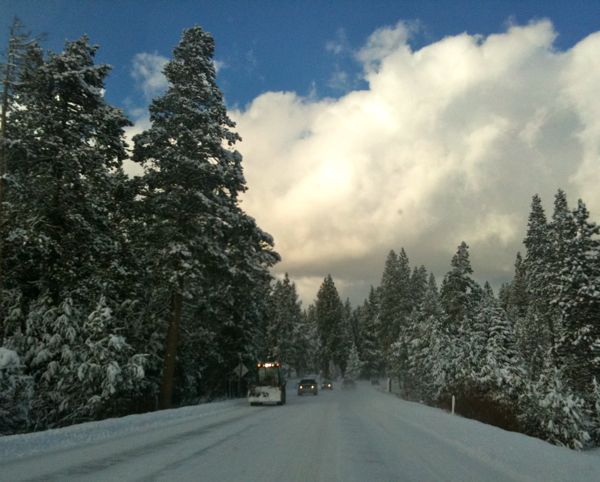
Roads in Tahoe are about to be covered in white again. Photo/Kathryn Reed

Roads in Tahoe are about to be covered in white again. Photo/Kathryn Reed

Expect south to southwest winds of 15 to 30mph, with gusts up to 40 mph today. Sierra ridge gusts may reach 100 mph this evening.

Snow covered roads and visibility below one half mile at times will cause difficult travel conditions this afternoon through Monday morning.

Snow is expected to pose an inconvenience to travelers. Roads will become slick and hazardous, with snow and ice first developing on bridges and overpasses. Motorists should slow down and use caution.

Check the road icons on the home page of Lake Tahoe News to know about restrictions and closures.


Lake Tahoe ski report, April 11

curtisWinter is going to return to Tahoe later today. Here is the ski report from Curtis Fong, the Guy from Tahoe.


Poetry comes in many forms at SNC

National Poetry Month has always been celebrated at Sierra Nevada College in Incline in a big way, and this year is no exception, with several high-caliber poet-performers gracing the campus—and one even joining the SNC English faculty.

On April 22 from 7-9pm in the Tahoe Center for Environmental Sciences, the community is invited to a poetry reading by Nathalie Handal, an award-winning Palestinian-American poet, playwright, and writer who has authored multiple poetry collections and has been involved either as a writer, director, or producer in more than 20 theatrical and/or film productions worldwide.

She served as editor of “The Poetry of Arab Women: A Contemporary Anthology” and “Language of a New Century: Poetry of the Middle East”, was a finalist for the 2009 A Room of Her Own’s Freedom Award, and is the author of “The Lives of Rain”, as well as a forthcoming poetry book, “Love and Strange Horses”, which will be published by the University of Pittsburgh Press.

Copies of her books will be available for sale at the SNC Bookstore.

Local poets will stand and deliver for a chance to take home the title of Tahoe Slam Poet of the Year at SNC’s Annual Tahoe Slam Competition on April 30 from 7-10pm in Patterson Hall.

This year the festivities will be hosted by a trio of MCs known collectively as the Aerosol Love Letter Campaign: Matt Blesse, Terry Taplin, and Abe Becker, former members of the UC Berkeley National Slam Team. Competitors will be limited to the first 10 people to sign up, so hopeful contestants should plan on arriving a minimum of 20 minutes before the event to sign up for a chance to compete.

Judges will be chosen at random from the audience, and audience members are encouraged to participate (Note: booing or cheering the judges is acceptable; heckling the poets is not).

Poets will be limited to a maximum of three minutes for their first utterance (just the poem, please; no long preambles). First-, second-, and third-place winners will receive cash prizes.

And in the fall, Iraq veteran soldier/award-winning writer Brian Turner will be joining SNC’s English faculty on a full-time basis. Turner is currently promoting his latest work, “Phantom Noise” (Alice James Books), which is being launched—coincidentally or not—during National Poetry Month, and which will be available in the SNC Bookstore.

Turner’s “Here, Bullet”, a collection of poetry about a year he spent deployed in Iraq, has garnered a number of literary awards, including the 2006 PEN Center USA Best in the West Literary Award in Poetry, the 2007 Poets’ Prize, and selection in the New York Times Editor’s Choice.

For more information on any of the events, contact English Program Chair June Saraceno at jsaraceno@sierranevada.edu or at (775) 881.7514.


Officials: Muck on roadways not from change in de-icing

By Kathryn Reed

Every spring the sides of the roads in the basin and on the highways leading to Lake Tahoe are black and not the pristine white of fresh snow. The difference this year is locals have noticed the black has been more prominent throughout the winter.

However, snow removal officials on both sides of the state line say nothing new is going on.

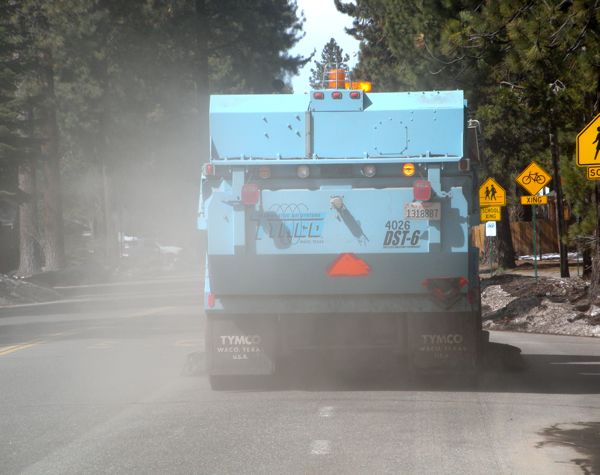
A South Lake Tahoe street sweeper creates dust. Photos/Kathryn Reed

A South Lake Tahoe street sweeper creates dust. Photos/Kathryn Reed

Caltrans is responsible for the highways throughout Lake Tahoe in California, while the Nevada Department of Transportation handles them in the Silver State. On city streets and in the county it is those jurisdictions that take care of the side streets.

The Tahoe Regional Planning Agency does not oversee what is put on the roads each season, but it does take a look at the reports the various jurisdictions compile. On the California side, the Lahontan Regional Water Control Board looks at what was put on the roads and what the sweepers took off.

“We don’t regulate public safety,” TRPA spokesman Jeff Cowen said.

Public safety is the main focus of snow removal policy.

“You have to find that fine line to provide for public safety and be environmentally conscious,” said Tom Celio with the El Dorado County Department of Transportation. “Our primary skid resistance material we use for ice control are cinders, volcanic cinders. We’ve been using them for 20 years. There’s been no change.”

Those cinders are also what are used in South Lake Tahoe. In the city it’s a mix of two-thirds cinders and one-third salt.

John Greenhut, public works director for South Lake Tahoe, said his department believes cinders create less fine sediment. It’s the fine sediment that people charged with protecting the clarity of Lake Tahoe want to keep from reaching the water.

Caltrans uses a mix of sand and salt. Years ago the agency was blamed for the dying trees along state highways because of the amount of salt being used. Part of the problem was blowers spraying the salt into the foliage and then the conifers turning a rust color.

“If the sand is wet, it may appear black in color. It’s gray or brown in color when it’s dry,” Deanna Shoopman, Caltrans spokeswoman said. “We use the purest sand we can get for Tahoe.”

The state and an independent environmental agency tests each delivery of sand and salt to make sure it meets appropriate standards, Shoopman said. The same components used in the basin are used on the highways on the outskirts of Tahoe.

NDOT uses three parts sand to one part salt on the 150 lane miles it services in Lake Tahoe.

“This ratio, with a relatively smaller amount of sand than used in some other situations, helps reduce sand particulates form being blown into the air,” said Meg Ragonese, NDOT spokeswoman. “When spread on the roads, salt and sand is wetted with brine (a water-salt solution) to create heavier sand that keep roads ice-free at lower temperatures and will not as easily bounce off roadway surfaces. Brine is also sprayed on wet road surfaces prior to snowfall to delay ice pack build up.”

NDOT has reduced the amount of sand it uses from about 4,300 cubic yards in 1990 to a little more than 800 cubic yards in recent years.

Celio said one of the benefits of the cinder is they are easier to pick up with a sweeper because they are coarser than sand.

“We sweep it up as soon as it is practical, as soon as we get dust,” Celio said.

Lahontan requires the county and city to keep a log of the material put on the road, what is swept off and what is collected in sediment traps the in various detention basins.

Russ Wigart, an engineer with the county DOT, along with others in the basin keep researching the best methods to melt snow and ice. Crushed walnuts have been used other places, but it’s cost prohibitive at $300/ton. Cinders cost about $20/ton.

ngg_shortcode_0_placeholder


Coordinating service projects in South Tahoe

To the community,

I am compiling a list of service projects that South Lake Tahoe area nonprofits and other groups would like to see done this summer.

Is there a lot that needs weeding? A building that needs painting? Seniors in need of some assistance in their homes? Low-income families in need of their house painted or defensible space incorporated? A fence fixed? What do you need done?

Once this list is accumulated I’ll be contacting local clubs and the community in general to try and have a community-wide service day, called “Tahoe Cares.” Please call me your list(s) with location and contact person’s name and phone number. Please also mention if you have some supplies already to get the job done. Also, if you’d like to help organize this day, please let me know.

Thank you,

Paula Peterson, Tahoe Douglas Rotary and Tahoe Youth &Family Services BOD

(530) 542.2262


Incline toddler, agency to receive $500 from Hyatt

Incline Village resident Lexie Mae Hidalgo and The Children’s Cabinet will split $1,000 donated by Hyatt Regency Lake Tahoe in Incline Village.

Hyatt’s staff and community members will gather in front of Cutthroat’s Saloon for a special celebration April 15 as General Manager Mark Pardue and Director of Food & Beverage David Lockard give Lexie May, 2,, and the Incline Village nonprofit their checks.

A tradition since opening in 2000, local residents and resort guests continue to decorate the walls of Cutthroat’s Saloon with embellished dollar bills, with 1,000 bills collected since early 2009.

Lexie Mae has Coats’ Disease, a rare condition causing abnormal development in the blood vessels behind the retina.

The Children’s Cabinet offers services and resources to address unmet needs of children and families in need in the region.


Feminism unable to bring about total equality

By Jessica Bennett, Jesse Ellison and Sarah Ball, Newsweek

They were an archetype: independent, determined young graduates of Seven Sisters colleges, fresh-faced, new to the big city, full of aspiration. Privately, they burned with the kind of ambition that New York encourages so well. Yet they were told in job interviews that women could never get to the top, or even the middle. They accepted positions anyway—sorting mail, collecting newspaper clippings, delivering coffee. Clad in short skirts and dark-rimmed glasses, they’d click around in heels, currying favor with the all-male management, smiling softly when the bosses called them “dollies.” That’s just the way the world worked then. Though each quietly believed she’d be the one to break through, ambition, in any real sense, wasn’t something a woman could talk about out loud. But by 1969, as the women’s movement gathered force around them, the dollies got restless. They began meeting in secret, whispering in the ladies’ room or huddling around a colleague’s desk. To talk freely they’d head to the Women’s Exchange, a 19th-century relic where they could chat discreetly on their lunch break. At first there were just three, then nine, then ultimately 46—women who would become the first group of media professionals to sue for employment discrimination based on gender under Title VII of the Civil Rights Act. Their employer was NEWSWEEK magazine.

Until six months ago, when sex- and gender-discrimination scandals hit ESPN, David Letterman’s Late Show, and the New York Post, the three of us—all young NEWSWEEK writers—knew virtually nothing of these women’s struggle. Over time, it seemed, their story had faded from the collective conversation. Eventually we got our hands on a worn copy of In Our Time, a memoir written by a former NEWSWEEK researcher, Susan Brownmiller, which had a chapter on the uprising. With a crumpled Post-it marking the page, we passed it around, mesmerized by descriptions that showed just how much has changed, and how much hasn’t.

Read the whole story


Green building movement attracting tenants

By Jim Wasserman, Sacramento Bee

Sacramento has for years outperformed much larger cities when it comes to green building construction, thanks mainly to the eco-conscious policies of state government.

Now the green trend has engulfed the private office market as well. Developers in Sacramento – and nationwide – are using sustainability as a key marketing tool in their effort to attract tenants. It’s one more selling point in a real estate climate with vacancy rates well into the double digits.

Altogether, nearly 100 commercial and institutional buildings in Sacramento, Placer, El Dorado and Yolo counties now meet either the “Energy Star” standards established by the U.S. Environmental Protection Agency or the LEED (Leadership in Energy and Environmental Design) standards of the U.S. Green Building Council, which designates buildings “silver,” “gold” or “platinum.”

Read the whole story


Kings Beach, Meeks Bay controlled burns

USFSPending favorable conditions, Forest Service fuels management crews expect to conduct prescribed fire operations in Kings Beach and Meeks Bay this coming week.

Operations in Kings Beach are scheduled to begin April 11 and continue for two to three days. Operations in Meeks are expected to begin April 12 and continue throughout the week.

Other state and local agencies may also be conducting prescribed fire work during this time. Residents and travelers can expect to see smoke from prescribed fire project areas.

This and other prescribed fire projects are designed to reduce wildfire risks to communities and critical resources. Smoke management is part of every prescribed fire burn plan, and efforts will be taken to reduce actual or potential smoke impacts on community areas.