Talk to focus on bacteria in Lake Tahoe’s water

Lauri Kemper, assistant executive officer of the Lahontan Regional Water Quality Board, will present information on current bacteria standards in the region, recent EPA standards and potential updates planned by the state Water Board on March 5.

She will delve into how this affect surface waters for fishing, swimming and drinking.

She will also describe opportunities for public involvement.

The Sierra Club meeting is at 7pm at Unity at the Lake Center, 1195 Rufus Allen Blvd., South Lake Tahoe.


Helicopter rescues hiker from Mt. Rose

A 27-year-old hiker on Mount Rose had to be rescued by helicopter on Sunday.

He was with a group that slept on the mountain the night before. Their plan was to go the summit Sunday morning.

Washoe County sheriff’s deputies, who have not released the man’s name, said he slid about 100 yards off the trail early Feb. 23. The department’s helicopter plucked him off the mountain about 9:45am and then he was taken by ambulance to Renown Medical Center in Reno. His condition is not known

— Lake Tahoe News staff report


Snippets about Lake Tahoe

 • Sierra-at-Tahoe is having a party March 15 at the resort’s plaza to celebrate its Olympians – Maddie Bowman, Jamie Anderson and Hannah Teter. Details will be coming later.

• More than 300 search and rescue team members from around the state will be in the American River Canyon near Auburn for a mountain rescue team testing on March 1.

• Placer County’s Department of Child Support Services continues to offer free monthly information sessions for those interested in learning more about the Department’s programs and services. More info is online.

• Carson Tahoe Health and Prestige Care are partnering to provide a residential facility for patients with Alzheimer’s or other forms of dementia.

• North Tahoe Arts is putting on Photographing Your Artwork workshop next weekend. Learn how best to photograph your work and how to manage digital files of your work. Contact Pam Sutton at (775) 830.8388.


West Tahoe fault overdue for major temblor

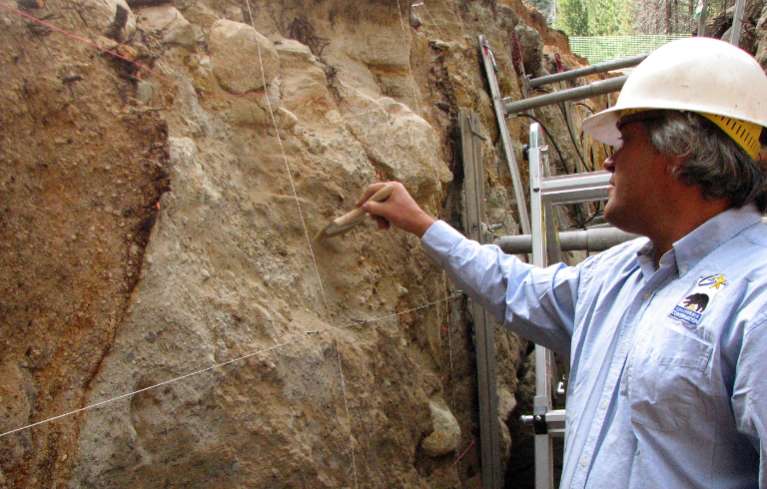
Gordon Seitz in the trench brushing dirt from the walls. The dark diagonal line or crack you see in the wall of the trench is the actual fault line. Photos/Provided

Gordon Seitz in the trench brushing dirt from the walls. The dark diagonal line or crack in the wall of the trench is the fault line. Photos/Provided

By Jessie Marchesseau

Anyone who has lived in Lake Tahoe for a while has heard stories of the impending tsunami if an earthquake occurs. In reality, those stories may not be too far off. And the earthquake may not be either.

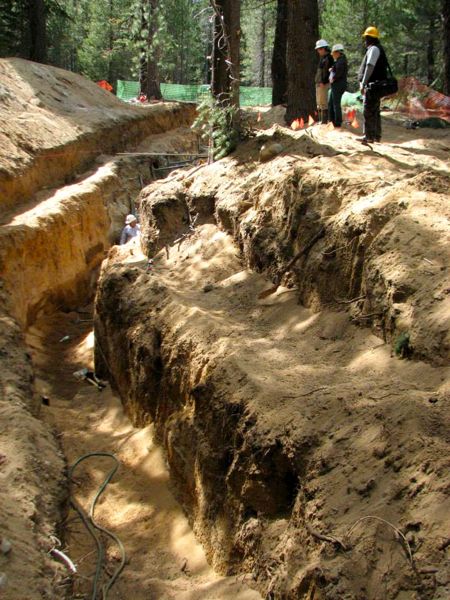
The California Geological Survey has been taking a closer look at the West Tahoe fault, the most active and most hazardous of the three faults in the Lake Tahoe Basin. Last October, the agency dug a trench approximately 15 feet deep and 15 feet wide across part of the fault near Meyers.

The project was years in the making, with the CGS working closely with the TRPA, USFS and Lahontan making sure the project was a low-impact as possible. The trench has already been filled in again and the land restored.

Gordon Seitz, engineering geologist with the CGS and lead on this project, said trenches are a relatively common way to study fault lines. By examining and sampling layers of sediment below the surface, geologists can determine frequency and magnitude of past earthquakes.

Seitz and his crew were able to learn quite a bit about what has happened at the fault since the last Ice Age (about 12,000 years ago). They found two earthquakes, each one shifting the earth on the west side of the fault higher than the east side resulting in a full 12-foot difference between the two sides.

“If we had an earthquake tomorrow, there would be a step, a vertical step on the fault,” Seitz told Lake Tahoe News. “It would be about 6-feet high.”
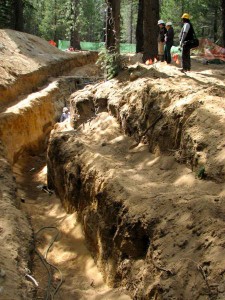
the trench itself before it was filled back in.

The trench before it was filled back in.

An earthquake tomorrow is not exactly out of the question, either. It will be a few more months before exact results are back from the lab, but so far it looks as if earthquakes happen on the West Tahoe fault about every 4,000 years. And how long has it been since the last one? About 4,000 years.

“If it happened tomorrow in Tahoe, I wouldn’t be surprised. But I’m not expecting it to either,” Seitz said.

The West Tahoe fault travels from just west of Meyers through Fallen Leaf Lake, down into the bottom of Lake Tahoe and back out again near Dollar Point. What Seitz said makes the Tahoe area so interesting is that in most places the biggest hazard during an earthquake is the shaking, but when the west side of the fault, 1,200 feet below the surface of Lake Tahoe, rises up 6, maybe even as much as 18-feet higher than the east side, a giant wave will ensue.

“If we have a shift like we see in the trench at the bottom of the lake, we will have a large wave, that’s a given,” Seitz said. “What we don’t know is how big the wave is or the impact.”

This is something else he is working on. Last July, Seitz was part of a team that took a remotely operated submarine-like vehicle 1,100 feet down into Lake Tahoe. What they saw was not a 12-foot step from the west to the east side of the fault like in Meyers, but a 36-foot step. This means there are either more earthquakes down there, or they are just bigger.

The team hopes to take the remote operated vehicle down again this summer for further investigation, and to hopefully determine which of those scenarios it really is.

Seitz expects to have solid data on the earthquakes of the West Tahoe fault within the next five years. However, he said the more difficult part of all of this is what to do with that data. The hope is to have reports, maps and computer models to explain where the fault is and how it and the waters of Lake Tahoe will behave in different scenarios. All this could be used for future planning in our communities, especially in the realm of emergency response plans.

“Overall, even though it sounds scary,” Seitz said, “it should make people feel better that we’re working on it.”



Tahoe Tails — Adoptable Pets in South Lake Tahoe

Domingo and Carrerras

Domingo and Carrerras

Domingo and Carrerras are beautiful black smoke-Tiffany mix brothers, about 9 months old.

Their fur is unusual; long and with many shades of black and gray. They are full of personality and are quite playful. They must be adopted together.

Domingo and Carrerras are neutered, microchipped, and vaccinated. They are at the El Dorado County Animal Services shelter in Meyers, along with many other dogs and cats who are waiting for their new homes.

Go online or the Tahoe animal shelter’s Facebook page to see photos and descriptions of all pets at the shelter.

Call (530) 573.7925 for directions, hours, and other information on adopting a pet.

For spay-neuter assistance for South Tahoe residents, go online.

— Karen Kuentz


Letter: Ski patrollers help at Bread & Broth

To the community,

On Feb. 17, Heavenly ski patrol members Rebecca Strmiska, Kris Morehead, Brook Linnell, Tom Burkart and Marissa Streck exchanged their skis for aprons at Bread & Broth’s evening dinner. B&B would like to thank the Heavenly ski patrol for the $250 sponsorship of an Adopt A Day of Nourishment and the great crew they sent to help the B&B volunteers serve the evening’s healthy, filling meal.

Bread and Broth is a nonprofit, all volunteer program that serves a full course dinner every Monday at St. Theresa Church’s Grace Hall and a soup and pasta meal every Friday at Lake Tahoe Presbyterian Church. The financial and time donation that our Adopt A Day sponsors provide, like the Heavenly ski patrol, guarantee B&B is able to sustain our support of those in our community who are experiencing difficult times.

“Bread & Broth is a great way to give back to the community!” said Burkhart. “As ski patrollers we are all about helping others and that is why we come to B&B. We want to help the South Lake Tahoe community.”

B&B salutes the ski patrol for their concern for the community and looks forward to their hosting another AAD on April 21s.

To help B&B as a donor or sponsor, contact me at (530) 542.2876 or carolsgerard@aol.com.

Carol Gerard, Bread & Broth


Olympic medal game is often mental one

By David Wharton, Los Angeles Times

SOCHI, Russia — Twelve hours wasn’t nearly long enough to ease their pain.

The morning after losing in overtime to rival Canada, the U.S. women’s hockey players talked about the anguish of walking away from the Sochi Olympics with silver medals around their necks.

“We didn’t train as hard as we did for second place,” forward Meghan Duggan said. “It’s one of those things we have to swallow.”

Contrast her words with the sigh of relief from Bode Miller a few days earlier. The ski racer acknowledged making a big mistake on the super-G course, saying he felt “really lucky” to hang on for bronze.

Finishing third might feel better than finishing second.

“With silver, you’re just one person away,” said skier Julia Mancuso of Squaw Valley, who has medals of every color from the last three Olympics. “But with bronze, it’s like, I could have been totally off the podium.”

Read the whole story


Food being distributed on North Shore

Project MANA, a hunger relief agency serving the North Lake Tahoe and Truckee communities, is trying to reduce the incidence of hunger for families and individuals in the region.

In order to do so, Project MANA has four weekly food distributions at the following times and locations:

MONDAYS

Tahoe City

Fairway Community Center

330 Fairway Drive

3-3:30pm
TUESDAYS

Truckee

Community Arts Center

10046 Church St.

3-3:30pm
WEDNESDAYS

Kings Beach

North Tahoe Family Resource Center

8321 Steelhead Ave.

3-3:30pm
THURSDAYS

Incline Village

DW Reynolds Nonprofit Center

948 Incline Way

3-3:30pm

In addition, Project MANA has a home delivery program called Food and Companionship Exchange for individuals restricted to their homes because of health, and who have limited access to food. Food is packed and delivered to their homes by Project MANA volunteers on a weekly basis.

Project MANA’s nutrition education program provides community members with tools to improve their health, wellness, and perspective through cooking demonstrations, food samples, and lessons on budgeting, smart shopping, food safety, and healthy eating.

Project MANA accepts food donations at 948 Incline Way, Incline Village Monday-Friday from 9am to 4pm.

For further information, call (775) 298.0008.


Obama proposes shift in wildfire funding

By Coral Davenport, New York Times

WASHINGTON — President Obama’s annual budget request to Congress will propose a significant change in how the government pays to fight wildfires, administration officials said, a move that they say reflects the ways in which climate change is increasing the risk for and cost of those fires.

The wildfire funding shift is one in a series of recent White House actions related to climate change as Obama tries to highlight the issue and build political support for his administration’s more muscular policies, like curbing carbon emissions from coal-fired power plants. On Monday, Mr. Obama plans to describe his proposal at a meeting in Washington with governors of Western states that have been ravaged recently by severe drought and wildfires.

The proposal will ask Congress to pay the costs of fighting extreme wildfires in the same way it finances the federal response to disasters like hurricanes and tornadoes, the officials said. When unpredictable events like Hurricane Sandy are destructive enough to be declared disasters by the president, the Federal Emergency Management Agency is authorized to exceed its annual budget and draw on a special disaster account. The account is adjusted each year to reflect the 10-year average cost of responding to such events.

Read the whole story


Yucca Mountain future being debated

By Conor Shine, Las Vegas Sun

Major progress is expected in the coming year toward resolving the outstanding questions and legal challenges surrounding Yucca Mountain’s potential as a repository for the country’s high-level nuclear waste, members of the state Legislature were told during an interim committee hearing Friday.

During a four-hour hearing, a range of experts and state officials laid out the road map for decisions in the upcoming year that will seriously affect Yucca Mountain’s future.

The hearing also laid bare the confusion and tension that still surround the project three decades and $15 billion after it was first considered, with a contingent of rural county officials and residents urging the state to reverse course and consider the potential economic impact the repository will have. Fully developing the Yucca Mountain site is projected to cost in excess of $100 billion.

Read the whole story