USFS wants input on off-highway grant

The U.S. Forest Service Lake Tahoe Basin Management Unit is accepting public comment on the Off-Highway Vehicle Cooperative Funds grant application.

The OHMVR grant provides staffing for OHV education and information, law enforcement patrols, resource and use monitoring, and protection for both natural and cultural resources in the Lake Tahoe Basin.

The 30-day comment period begins March 4 and ends April 7.

For more information about the grant and how to comment, go online or email Don Lane at dlane@fs.fed.us.


Zephyr Cove woman accused of killing husband

A Zephyr Cove woman is behind bars for allegedly shooting her husband.

Tatiana Leibel

Tatiana Leibel

Harry Leibel, 64, died of a single gunshot wound.

Douglas County sheriff’s deputies said at first Tatiana Leibel, 50, told them her husband shot himself.

“During the subsequent investigation, information was developed to implicate Tatiana as a suspect,” deputies said in a press release.

The incident occurred at their Kent Way home. No one else was home at the time of the Feb. 23 shooting.

Leibel is being held without bail.

— Lake Tahoe News staff report


LTCC inching closer to putting bond on ballot

By Kathryn Reed

Lake Tahoe taxpayers have not directly paid for any of the buildings at Lake Tahoe Community College. But that could soon change.

The college is contemplating going to the voters in November with a general obligation bond between $35 million and $55 million. This would be spent on facilities.

The board this month agreed to hire Fairbank, Maslin, Maullin, Metz & Associates to conduct a survey of 400 registered voters in the district to gauge their opinion of the proposed bond. The research firm will be paid $19,500. The board had budgeted $20,000 for this expense.
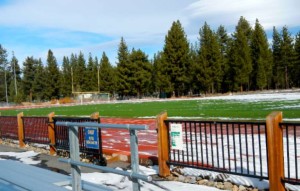
Lights at South Tahoe Middle School are a possibility. Photo/LTN

Lights at South Tahoe Middle School are a possibility. Photo/LTN

Different questions will be put to voters to find out what dollar amount, if any, they support. The survey will last about 19 minutes.

South Lake Tahoe will pay for a portion of the survey because it will have specific questions asked at the end. They will be multiple-choice questions, but the exact questions are not known.

Results of the survey will be presented to the board at the April 8 meeting.

The answers will help the board decide if it wants to go forward with the bond measure.

College President Kindred Murillo told Lake Tahoe News this would be the community’s opportunity to decide if it wants to help fund the college. The college would hope to leverage the taxpayer money like Lake Tahoe Unified School District did so there would be even more money available for improvements.

While the college has not definitively decided how it would spend the money, it has a list of ideas.

One idea is to put lights on the South Tahoe Middle School field so there are more opportunities to play football and soccer at night. With the college starting soccer programs in the fall, it will mean more demand for fields.

The college field is half on city property, half on college land. It is maintained by the city and governed by the recreation joint powers authority. The college, though, has priority over using it for classes and intercollegiate play.

Part of the bond money could go toward adding bleachers and dugouts at the college field.

“There’s a possibility of putting a bubble over it in the winter,” Murillo told Lake Tahoe News. “One major problem with artificial turf is snow.” She said snow is more damaging than something like a SnowGlobe music festival.

The expense of a bubble is being researched.

Three capital outlay projects have been submitted to the state. The first priority is a remodel for efficiency that would include an overhaul of the science labs, student services and technology. This will include a university center. This is needed as the college looks at offering four-year baccalaureate degrees.

The next project is for a regional public safety training facility. This could include having a city fire station on campus.

The third idea was for a sports medicine facility, but with South Tahoe High having just built one the college now sees this as being redundant. Instead, another project could be adaptive physical education or a sustainability center to go with environmental studies.

Safety improvements would be made throughout the campus, along with technology upgrades.

The college is also looking at improving the trails people use so they are clearly marked and in good condition.

Dorms are another project.

“They are essential to make a destination college real,” Murillo said.

Today students have to live at home or rent an apartment or house.

With improvements the city is making to Harrison Avenue and what the college could do in the future, Murillo foresees the area from Al Tahoe Boulevard to Lakeview Commons being a hub for college students.

Murillo also envisions creating an early childhood education center by taking the existing Child Development Center and perhaps moving the Tahoe Parents Nursery School to the campus.

Build-out of the projects is likely to take 10 years and the bond payments would last 20.

“We want to make the community feel like it’s theirs,” Murillo said of the college.



Letter: Tahoe airport needs to be accountable to all

To the community,

I was pleasantly surprised at the turnout for the city’s first workshop on updating the airport master plan last week on Feb. 13 at City Hall. I want to thank city officials for holding it. There was a large crowd present who came to the meeting with different views and perspectives about the airport. Several people voiced support for it, while others want it to be closed. Some people were there just to listen and find out more.

We were told that the city’s existing airport master plan expired in 2012 so the Federal Aviation Administration gave the city a 90 percent grant to pay for the $350,000 consultant study that is expected to take one year to complete. More public meetings will be held during the study period.

The South Tahoe Chamber of Commerce Board of Directors supports a viable airport and the board asked me to participate in the update process and keep them advised. I am also one who supports having a viable airport in town because I believe that it can be an alternative travel option for visitors to using their auto. I support commercial service as long as the planes are state-of-the-art technologies, noise standards are enforced, and the people of South Lake Tahoe do not have to subsidize commercial flights as they did in the past. The airport is a public safety resource in times of emergency as was demonstrated during the Angora Fire. The airport is one of a few locations in town where non-aviation lands can be used to grow environmentally friendly businesses and grow and diversify the local economy, something we desperately need if we are going to have more than minimum wage jobs. Finally, a viable airport may attract ecologically minded business men and women to live and work in South Tahoe who want easy access to other regions to do offsite work and can conduct business here via the Internet.

However, I recognize that a few community members want the airport closed down and the land restored to a natural condition, and they want to know the cost to close the airport. They point out that the airport built in 1959 took away valuable environmental lands. Some people want to know the specific benefit the airport provides to residents and businesses in South Lake Tahoe? To these requests, the consultant doing the study stated that master planning process did not cover the cost to answer these questions.

Although I am an airport supporter, a way must be found to answer the questions about the cost of airport closure, the impact of airport closure (good and bad), and the specific benefits South Lake Tahoe residents derive or can derive from it. In addition, I think the study needs to be examining how the airport master plan implementation can be coupled with needed environmental improvements in the community just as city government officials did a few years ago when the airport runways were rebuilt but narrowed and improvements were made to the Upper Truckee River adjacent to the runways to reduce sedimentation discharge into the Lake.

We need continued civic engagement on the airport master plan, involvement by supporters and critics, and answers to questions being posed by the public. I believe that we can find common ground between supporters and critics by the participation of all concerned parties and clear and concise answers to questions posed by the public.

Thank you for your assistance in regard to this matter.

David Jinkens, South Tahoe Chamber of Commerce Government Affairs liaison volunteer


Olympics are the closest to coverage parity female athletes get

By Sarah Laskow, Columbia Journalism Review

For every Olympics since 1994’s Lillehammer Games, Andy Billings has broken down how much time the primetime broadcast spends covering male athletes and female athletes. Usually, men get significantly more of the clock time. But this year, when Billings, who directs the University of Alabama’s sports communications program, and his collaborators ran an initial data-crunch on the first week of the Sochi Olympics, NBC’s coverage was looking more equitable. Through the Friday night of Valentine’s Day, NBC spent 47.6 percent its time covering men and 37.6 percent of its time covering women, with the remainder going to pair sports, like ice dancing.

That counts as an improvement. “It’s a 10-percent gap favoring male athletes, which is smaller than normal,” said Billings, late last week. (Researchers like Billings focus on NBC’s primetime coverage because it reaches the most people—averaging 22.5 million per night, according to the Washington Post.) At the last winter Olympics, in Vancouver, the gap was 20 percent. And, at that point in the Games, women’s figure skating hadn’t even started yet.

By the end of the two weeks, the gap had narrowed even further: Men got 45.4 percent of clock time, women 41.4 percent, and pairs 13.2 percent.

Read the whole story


Confession of a former FuelBand fanatic

By Lauren Steele, Outside

When Nike released the FuelBand in January 2012, my boyfriend at the time was certain it would make the perfect gift for me, raising the bar for my fitness-crazed inner athlete—a welcome development, right? On the fateful day he ordered my wrist-worn, nonhuman trainer, little did he know that he was effectively locking me into a handcuff of obsession. To be sure, there’s a good reason why I no longer have a FuelBand (or a boyfriend).

Like most gadgets born of the recent activity-tracker movement—think Fitbits, Jawbones UPs, Basis Watches—the FuelBand uses a traxial accelerometer to sense movement. (This magic tech trick is what makes an iPhone screen rotate when it’s tilted.) The smarts inside the FuelBand tracks time, steps taken, calories burned, and NikeFuel earned on a personal NikePlus account, where you can set goals to earn a certain amount of NikeFuel each day.

So, what’s NikeFuel? According to NikePlus, it’s a “universal way to measure movement for all kinds of activities.” What NikePlus should say is that it’s a “meaningless number, calculated by an algorithm using the laws of obligation and shame, for which a limit doesn’t exist.” In sum, NikeFuel points have no meaning beyond the boundaries of Nike World. The concept behind the points is that, unlike BMRs or calories, they’re supposed to represent whole-body movements—free from the variables of weight, gender, age, or height. They count every motion equally, from a fidget to a front squat.

Read the whole story


Study: U.S. exercise habits atrocious

By Dominique Mosbergen, Huffington Post

The exercise habits of the average American are appalling, according to a study recently published in Mayo Clinic Proceedings.

For the study, scientists tracked the activity of 2,600 people for two years. They found that obese women average a mere 11 seconds a day of vigorous exercise (that’s about an hour a year), while men and women of normal weight exercised vigorously — engaging in fat-burning activities such as jogging or jumping rope — for fewer than two minutes daily, the Los Angeles Times reported.

The Centers for Disease Control and Prevention (CDC) recommend that adults get at least 75 minutes of vigorous-intensity exercise or 150 minutes of moderate-intensity exercise every week, in addition to bi-weekly muscle-strengthening activities.

Read the whole story


Multiple injuries in Kingsbury Grade collision

A two-car crash Feb. 23 snarled traffic on Kingsbury Grade. Photo/Provided

A two-car crash Feb. 23 snarled traffic on Kingsbury Grade. Photo/Provided

Kingsbury Grade was closed for several hours Sunday when two drivers from the Bay Area were in a collision.

Kevin C. Wilhite, 19, of Castro Valley was driving a black 2003 GMC Yukon east on the grade near Terrace View Drive when he crossed the double yellow line and struck the front of a Toyota Sienna minivan, according to officers.

Kavitha Mannava, 38, of Fremont was west on the highway with four passengers when her vehicle was struck.

Nevada Highway Patrol officers said Wilhite was speeding and struck the front end of the Toyota head-on. He sustained minor injuries and was treated at the scene, while his female passenger was taken to Renown Medical Center in Reno by ground ambulance for non-life-threatening injuries.

Mannava and one of her passengers sustained minor injuries and both were taken by ground ambulance to Barton Memorial Hospital in South Lake Tahoe.

Wilhite was cited for failing to drive on the correct side of the highway.

— Lake Tahoe News staff report


Photographers rally to protect work in ‘fair use’ cases

By Patricia Cohen, New York Times

To many photographers, a federal appeals court ruling last spring that permitted Richard Prince to use someone else’s photographs in his art was akin to slapping a “Steal This” label on their work.

The U.S. Court of Appeals for the Second Circuit reasoned that as long as Prince’s work transformed the images into original art, he was not violating anyone’s copyright.

But photographers are pushing back against that interpretation. Several membership and trade organizations have banded together recently to press their cause in Congress and the courts.

Read the whole story


Concern for driving high grows

By NPR

The Lodo Wellness Center in Denver has been selling medical marijuana for several years. But since Jan. 1, when marijuana in Colorado officially moved from underground to behind-the-counter, they’ve also been selling legal, recreational pot.

A majority of Americans now say they support full legalization, and the trend is spreading: Legal weed is coming soon to Washington state.

Meanwhile, the public health community is warning of a potential safety problem: more people driving while stoned. But health officials and law enforcement don’t yet have the data or tools to address the concern.

Read the whole story