LTCC slow to decide how to replace departing president

By Kathryn Reed

What happens when Paul Killpatrick vacates the president’s office at Lake Tahoe Community College next month?

The answer to that question should come June 15 at 7am after the board of trustees’ special meeting.

Paul Killpatrick is leaving LTCC on July 16.

Paul Killpatrick is leaving LTCC July 16.

The board discussed before and after the regular session on June 8 how to proceed. No decision was made.

Michelle Risdon, Academic Senate president, reiterated her group’s issues: cost of having an interim president; consistency in leadership; and taking the time to think about what qualities everyone wants in the person to next occupy that seat.

She told the board that 31 of the 33 faculty who responded to a questionnaire did not want to hire an interim president.

At the June 2 board meeting the faculty presented the idea of having the two vice presidents share the role of president. One hasn’t even started his job.

Board member Fritz Wenck this Tuesday said, “There seem to be a number of people out there who would be good in the interim. Some people I think would be outstanding.”

Board President Kerry David doesn’t believe having the two VPs share the president’s job is the best idea because those jobs already require added work compared to a few years ago, the people in the positions are new, and the college has things like accreditation and a declining budget to deal with.


Compost Tahoe video looking for votes

compostTo friends of Compost Tahoe,

We finally have our video done on so we are now officially entered in the MYOO Create waste prevention contest. The winning entry will receive $15K in funding so please click on the link and vote for us.

In order to vote, you have to create a user name and password. It’s free and there are some very cool ideas to read about. Be sure to check out the Plastiki … a boat made entirely of plastic bottles which is sailing around the world to bring attention to the problem of plastics in our oceans.

Check it out, please vote for us and be sure to spread the word to your friends.

Thank you,

David Hansen, director of engineering at Embassy Suites Lake Tahoe Hotel & Ski Resort


Youth basketball signups at Kahle

Advantage Basketball Camps is accepting registrations for its June 28-July 1 ball handling and shooting camp at Kahle Community Center in Stateline

The four-day summer camp costs $125-$195. Sibling, group and team discounts available.

Camps are open to boys and girls ages 6-18 of all ability levels.

To register or for more information click here or call (310) 903.6473 or (425) 670.8877.

Advantage Basketball Camps are recognized as one of the top ball handling camps in the world since 1986.

Sports Illustrated for Kids recently picked Advantage Basketball as one of the top camps in the country.


Climate change through a photographer’s persepctive

When John Muir coined the phrase “Range of Light” in the late 1880s, few people had seen the spectacular Sierra Nevada. John Muir’s writings provided the world a window into this magnificent landscape. His writing and activism helped bring attention to the threats to the natural ecosystem of the Sierra Nevada. Due to the visionary actions of an earlier generation, many regions of the Sierra Nevada are now protected in National Parks and Wilderness Areas. The images of landscape photographer Ansel Adams also played an important role in the protection of important regions of the Sierra.

Photographers still gain inspiration and imagery from the beautiful landscapes of the Sierra Nevada. Elizabeth Carmel is a Truckee-based photographer who will present on her new book “The Changing Range of Light: Portraits of the Sierra Nevada”. The landscape photography book focuses on climate change issues in the Lake Tahoe and Sierra Nevada region of California.

Accompanying her presentation are prominent climate change scientists Geoff Schladow and Robert Coats. The scientists contributed insights in the book’s introduction and within the text that accompanies the photography, and will talk about the recent scientific results and ideas on climate change, particularly as it affects the Sierra Nevada.

Elizabeth Carmel

Elizabeth Carmel is a Sierra-based photographer specializing in unique, expressive landscapes and “waterscapes.” Her prints combine dramatic photography, vivid colors, and artistic touches to create new, captivating visions of the natural world. She has spent years exploring and photographing the diverse landscapes of the world, often traveling on foot or skis in wilderness terrain far from roads in order to capture her unique images. Her award winning images are in numerous galleries and private collections throughout the United States. Elizabeth and her husband, Olof Carmel, own and operate a photography gallery in Truckee.

Geoffrey Schladow

Geoff Schladow has a doctorate in civil and environmental engineering from the University of Western Australia. His research at Lake Tahoe focuses on the physical processes that control water quality and the lake ecosystems. A changing climate, and its impacts on both the watershed and the lake, is currently at the forefront of his research. Dr Schladow is the founding director of the UC Davis Tahoe Environmental Research Center.

Robert Coats

Bob Coats has a doctorate in Wildland Resource Science from Cal. His recent research in the Tahoe basin, concentrates on the effects of land disturbance on water quality and on the regional trends and impacts of climate change in the Basin. He lives and works in Berkeley where maintains the consulting firm of Hydroikos Ltd. Coat’s work outdoors sometimes provides inspiration for his poetry; which has been published in arrange of anthologies.

Program is presented by Squaw Valley Institute and UC Davis Tahoe Environmental Research Center. For additional information, visit www.squawvalleyinstitute.org or terc.ucdavis.edu.

Date: June 17

Time: 6:30pm no-host bar/door opens; 7pm program

Cost: $10. No-host bar

Location: Assembly Rooms 139 and 141 Tahoe Center for Environmental Sciences, 291 Country Club Drive, Incline Village.


Bodies exhibit — an education more than skin deep

bodiesBy Denise Sloan Smart

SACRAMENTO — One would think that roaming among more than a dozen dead bodies might be creepy, but at Bodies Revealed, it’s fascinating, even captivating.

Bodies Revealed is currently on display in Sacramento.

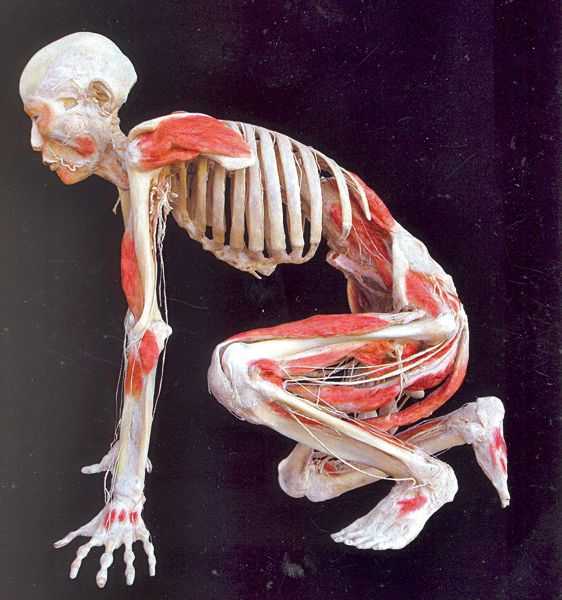
Bodies Revealed lets you explore deep within the human body in a way that is informative, but not frightening. As you move from gallery to gallery, the exhibition uses 14 full body human specimens and more than 200 human organs to tell the story of the miraculous systems at work within each of us every second of our existence.

The bodies are all small as they were, “Chinese men, all of whom died of natural causes,” according to the docent who was working the day we toured the exhibit.

The full-body specimens are complemented by presentation cases of related individual organs, both healthy and diseased, that provide a detailed look into the elements that comprise each system that makes us tick. One body is nothing but a nervous system. Another body is stripped of everything but the circulatory system.

Did you know you have 100,000 miles of vascular system in you? And that you were born with 300 bones that grew into 206 bones?

One tour of Bodies Revealed and you learn our bodies are intricately developed machines; more complex and wondrous than all the computers and gadgetry we surround ourselves with today.

Yet most of us do not know what makes us tick. We don’t know how we function, what we need to survive, what destroys us or what revives us.

Bodies Revealed is an attempt to remedy that lack of knowledge by presenting to the lay public material that was previously only available to the medical profession: A three-dimensional tour of the human body.

A tour of Bodies Revealed will give you a new connection to your own body because you will understand better how you work.

The Polymer Preservation process is a technique in which human tissue is permanently preserved using liquid silicone rubber. Polymer preservation provides a closer look at the skeletal, muscular, nervous, respiratory, digestive, urinary, reproductive, endocrine and circulatory systems. The end product of the preservation process is a dry, odorless specimen that resists decomposition. The “specimen,” as the bodies are referred to, are so “plasticized” that you forget they were once living, breathing humans until you see eyebrows or get close enough to see eyelashes, then you remind yourself, they were real people. But they are so interesting that you can’t stop staring, closely!

There is a fetal exhibit that is equally educational that has deceased fetuses at various stages of growth from 6 weeks to several months old. A sign explained that all had died “envitro” and of natural causes.

We skipped the $5 audio headset and didn’t feel like we missed a thing. The last date tickets are available is Oct. 24. The exhibit, at 2040 Alta Arden Expressway, opens at 10am seven days a week. Tickets range from $12 for students to $22 for adults, not counting TicketMaster fees and surcharges.

Our self-guided tour lasted 1 hour, 20 minutes. We read every sign, looked at every specimen and didn’t miss a thing.

Bodies Revealed is an exhibit that is not without controversy, but it is the most fascinating exhibit I’ve seen in many years. I’d go back again tomorrow.


Quest to increase Tahoe’s clarity begins with TMDL

By Kathryn Reed

KINGS BEACH — With fine sediment being the major pollutant clouding the pristine waters of Lake Tahoe, that load of dirt is going to be scrutinized even more in the coming years.

Today the Lahontan Regional Water Control Board expects to release its plan to increase clarity, goals for how far a Secchi disk should be seen, and a credit program for those responsible for the pollution.
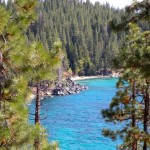
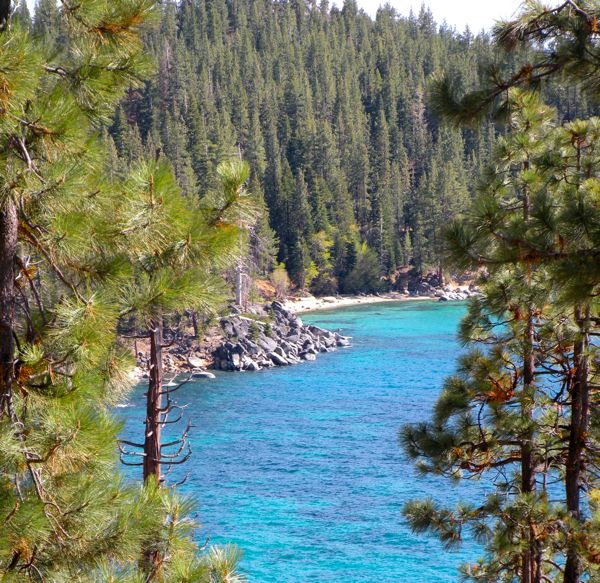
Increasing the clarity of Lake Tahoe is what theTMDL is all about. Photos/Kathryn Reed

Increasing the clarity of Lake Tahoe is what the TMDL is all about. Photos/Kathryn Reed

Called total maximum daily load, this is something agencies that oversee water bodies throughout the country must pay attention to under the Clean Water Act, which is regulated by the Environmental Protection Agency.

“A total maximum daily load, or TMDL, is a calculation of the maximum amount of a pollutant that a water body can receive and still safely meet water quality standards,” the EPA says.

Lahontan staff is proposing fine sediment particles be reduced by 32 percent in 15 years. This should allow the disk, which resembles a white dinner plate, to be seen 77 to 80 feet below the surface. (Right now it’s at 70 feet.) If the new level of clarity can be sustained for five years, scientists would consider the decline of Lake Tahoe’s clarity to be halted.

Robert Larsen, an environmental scientist with Lahontan, engaged the board in a nearly
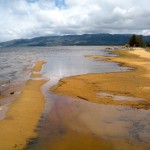
Near shore clarity is not addressed in the TMDL.

Near shore clarity is not addressed in the TMDL.

three-hour workshop on June 9 at the North Tahoe Event Center in Kings Beach. It was October 2008 that the board last had a thorough TMDL presentation.

“This TMDL is about deep water transparency. We’ve lost 30 feet of clarity in the last 40 years,” Larsen said.

Although aquatic invasive species and near shore degradation are concerns of Lahontan’s, they are not part of the TMDL. Larsen said addressing fine sediments would impact nutrients, which in turn affects near shore water quality.

Fine sediment is defined as particles less than 16 micrometers. Seventy-two percent comes from the urban upland – basically all the developed area of the basin; 15 percent from atmospheric deposition (the air), 9 percent non-urban upland (U.S. Forest Service and other undeveloped areas), 4 percent stream channels, and less than 1 percent from shoreline erosion.

The urban areas on both sides of the state line are being asked to cut the amount of fine sediment reaching the lake by 24.5 percent so the overall goal can be achieved. Larsen estimates it costing $1.5 billion to achieve this goal.

Where the money is going to come from was not discussed. It is one of those unfunded government mandates. The credit program will be the penalty part for non-compliance.

The counties, city, and both state departments of transportation are the primary players that must meet the criteria being set forth.

Robert Erlich, stormwater coordinator for South Lake Tahoe, was the only member of public to speak Wednesday. He has concerns about the costs involved as well as the continuing operation and maintenance dollars required.

The public will have 90 days to comment on the TMDL document. Click here for more information. If the report is not there, it will be by June 14.

The board will have a public hearing in September, with adoption likely in November. From there Nevada officials must approve it, as well as the California Office of Administrative Law and state Water Board. It could be implemented in 2011.

Luca thanks supporters, pledges support to next sheriff

Dear Friends,

Campaigning across El Dorado County has been an incredibly rewarding experience. Along the way, I have made many new friends and gained an even deeper appreciation for the lifestyle and values we share—from El Dorado Hills to Placerville to South Lake Tahoe.

In Tuesday’s election, we were close in a crowded race. We gave it our all, and I have no regrets or second thoughts. None.

I want to thank my wife, Diane, and my family, my team and the scores of additional volunteers who worked countless hours on the campaign trail with me. I cannot adequately say in words how grateful I am for their support.

Also, I want to congratulate Sheriff candidates John D’Agostini and Craig Therkildsen. I have enjoyed getting to know them better in recent months and wish them well in November’s runoff.

Finally, I want to thank the men and women of the Sheriff’s Department who keep our community safe day and night. They deserve our undivided attention and support, and I pledge to assist our next sheriff in any way possible to ensure their continued success.

Sincerely,

Bob Luca


Gardnerville man arrested in 2008 murder case

James Matlean, 23, of Gardnerville is being held without bail in the murder of Benjamin Oxley.

Oxley was found shot dead in his home in Minden on Feb. 21, 2008.

Matlean is in Douglas County Jail in Minden.

Anyone with with information about the case should contact Douglas County Sheriff’s Office Investigator Jon Storke at (775) 782.9909.


Alexandra Cousteau at SNC

International advocate for water quality and policy Alexandra Cousteau, granddaughter of renowned pioneer Jacques-Yves Cousteau, will be the featured speaker at the 2010 Siebens Binz—Tahoe Forum at Sierra Nevada College campus on Aug. 28 at 3pm.

Parents are encouraged to bring their kids to this free public event, which will feature an visual and audio presentation highlighting Cousteau’s worldwide journey to educate people about the water issues that affect us all — from Botswana to Lake Tahoe.

The 2010 Siebens Binz—Tahoe Forum continues SNC’s more than decade-long tradition of bringing high-profile speakers to the community. The event was created in 1997 in alignment with the mission of Sierra Nevada College, which emphasizes environmental, social, economic, and cultural responsibility and sustainability.

Tickets are free but required for entry; to RSVP or for more information, contact Michelle McFall at (775) 831.1314 or mmcfall@sierranevada.edu, or go to www.sierranevada.edu/forum.


Alternative Energy Home presentation

Alternative Energy Home presentation by Ben Solomon at Sierra Nevada College on Aug. 31.

Learn how to develop your own net energy producing, alternative energy home. The program consists of images and description of the development of the Alternative Energy Program at SNC from 1971 to the present, and the conversion of the Solomon house from a “tract” house to a net energy producer.

The material will include helpful information for home owners to reduce their energy consumption and thereby lower utility bills as well as improve home comfort.

Solomon is a professor of Alternative Energy at Sierra Nevada College. He has worked in the energy field since 1971, and has developed many devices and techniques for conserving and harnessing energy.

Time: 5:30pm No-Host Bar. Program begins promptly at 6pm.

Cost: $5 donation requested.

Location: Assembly Rooms 139 and 141, Tahoe Center for Environmental Sciences, 291 Country Club Drive, Incline Village.

For more information, contact Heather Segale at (775) 881. 7562 or email hmsegale@ucdavis.edu.