By Austin Fay
Alejandra Delgado’s journey began when she walked to this country.
She walked with her family, carrying only water in the blistering Sonora Desert sun for five days and nights when she was 12 years old.

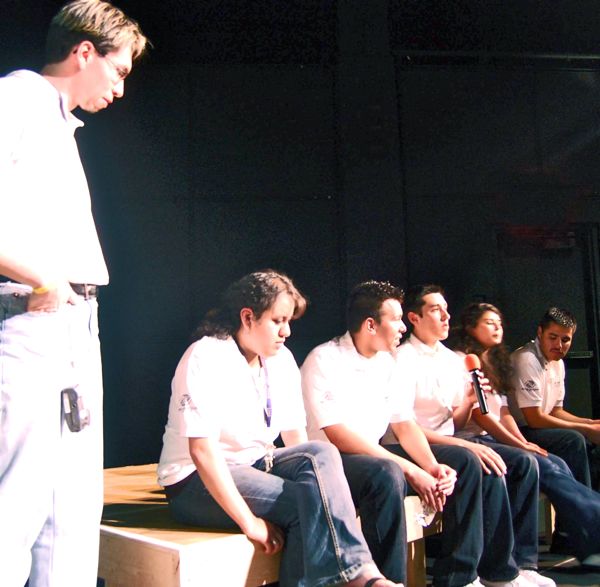
Arturo Rangel, LTCC's HOPE Club adviser, talks to members. Photo/Austin Fay
She and her three sisters, mother and father were on their long journey from a colonia called Golondrinas southwest of Mexico City into the United States to escape the slum they lived in. The 21-year-old’s journey continues at Lake Tahoe Community College where next year she will graduate with three associate’s degrees – Spanish, psychology, and liberal arts, with a concentration in social Sciences.
(The student’s name has been changed to protect the family.)
Delgado is the first person in her family to attend college.
However, any business she might apply to work after graduating cannot legally hire her because of her immigration status.
“I could either give up on my education or look for private scholarships for college. (I have received) a lot of support through teachers and friends pushing me to not give up,” Delgado said.
In addition to private scholarships to help pay her way through college, she works at Samurai restaurant on Highway 50 in South Lake Tahoe. That’s on top of taking anywhere from 12 to 20 credit hours and being the president of two collegiate clubs.
Her dream was to attend UC Berkeley next year, then pursue a graduate degree in psychology.
“I just found out it’s impossible without the DREAM Act. It’s just not a possibility right now, so I’m settling to go to San Francisco State,” Delgado said.
The difference in tuition between the UC and CSU system is the deciding factor. She doesn’t have the money or access to financial aid that people born in this country have.
For Delgado and thousands of other students across the nation, surviving on private scholarships keeps higher education out of reach because there isn’t enough of those dollars to pay the bills.
Delgado, along with 312 other students at LTCC are Assembly Bill 540 status students. This means they do not have documentation proving their citizenship. They are able to attend public universities with no state or federal financial aid. In California they pay in-state tuition. They are not eligible for federal financial aid like the Pell Grant or FAFSA.
AB540 students are not just undocumented residents. They are students who attended a California high school and moved out of state. They are allowed to go to colleges at in-state tuition rates because of AB540. LTCC has a large number of AB540 students because many have just moved to Nevada and come back to LTCC.
AB540 benefits less than 1 percent of students attending state universities in California. At LTCC in 2008-09, 313 students were AB540 eligible, which is 10.2 percent of 3,067 (732 full-time, 2,335 part-time) students. The state average is 1 percent. ngg_shortcode_0_placeholder (Click on graphic to see in full.)
Even with a two- or four-year degree, graduates cannot legally gain employment in the United States.
“Most of them came to this country through no fault of their own. They’ve gone through the educational system, they have American values, the only country they know is this country, the only country they respect is this country. It’s punishing students for something their parents did. They’re the future of the country,” Arturo Rangel said.
Rangel is the adviser of LTCC’s Hispanicos Orgullosos Preparándose para la Excellencia – Proud Hispanics Preparing for Excellence (HOPE) Club.
Delgado is a member of the HOPE Club. It consists of 17 LTCC students, with the mission of community service as well as providing financial and educational support to LTCC students. The group has raised about $1,000 since its inception a year ago.
The HOPE Club’s priority is passage of the 2009 Development, Relief and Education for Alien Minors (DREAM) Act, which would create a path to citizenship using secondary education as leverage. Members of the HOPE Club traveled to Sacramento in February to lobby, network and collaborate with students, legislators, and community leaders from around the state.
Because the DREAM Act will likely be considered along with a comprehensive immigration reform bill, AB540, as well as the federal and California DREAM Acts will dictate the future of undocumented students. Each year it’s estimated 65,000 undocumented students graduate from U.S. high schools, with 20,000 of them in California. About 5-10 percent go on to higher education.
The DREAM Act
The idea behind the DREAM Act is relatively simple, but for 10 years, the bill has hit a wall in the California Legislature and Congress.
A central tenet of the bill is granting students who came to the United States years ago the tools of a college degree and steady employment. Currently, the options for a college graduate who is here illegally are minimal. The DREAM Act will open the door to the American Dream for the undocumented college graduate. Through a six-year post-graduation process students will also have the opportunity for U.S. citizenship.
If the DREAM Act passes, criteria to be part of it includes a student must have entered the country before the age of 16, have been in the United States for five years prior to the passage of the bill, and the student must graduate from high school or obtain a GED. Also, the student must have good moral character, meaning no criminal record.
Rangel believes the passage of the DREAM Act will also lower rates of gang violence, teen pregnancy and delinquency in California communities “because people will have a hope, a sense of belonging, a sense of future.”
Last month, the latest congressional version of the bill was referred to the House Subcommittee on Higher Education, Lifelong Learning, and Competitiveness, according to OpenCongress. It is not known when the bill will come out of subcommittee. Democrats will reportedly take up larger immigration reform later this year.
According to a U.S. Census Bureau estimate, of the 309.5 million people in the country, 11.9 million are undocumented immigrants. Although most undocumented migrants are young adults, there is also a sizeable population of children. About one-sixth of the population — 1.7 million people — are under 18.
Looking forward
Students who have gone through the public higher education system in California fall through the cracks. They either continue on the employment path they’re on, are hired illegally or they go back to where they have residency.
Enrique Caro, a member of the HOPE Club, graduates with 64 of his classmates at LTCC tonight. Caro wants to be a clinical technologist and now has his associate’s degree in business.
Caro’s prospects look as good as any college graduate new to the job market. He is a U.S. citizen.
But still, as immigration reform fervor escalates, many students continue to fall into the opportunity gap.
“It seems like it’s getting harder and harder with what’s happening in Arizona. It seems like it’s going to get better, but before that I think it’s going to get a lot worse,” Caro said. “I sometimes think the U.S. has ‘cool-kid syndrome’ where the cool kids choose who can sit at their table and who can’t, we think we’re better than we actually are.”
While they attend school and work to make ends meet, Delgado and Karina Morales, another member of the HOPE Club, plan to live together in San Francisco in a year, envisioning a bachelor’s degree in their future.
Seeing her sister make sacrifices for her education, Delgado has inspired her younger sister to pursue higher education and will be attending LTCC this fall.