Equestrians left without water in payment dispute

By Cathy Locke, Sacramento Bee

Equestrians say their hot, thirsty horses are suffering because of a dispute between a state agency and an El Dorado County water district.

And while the dispute continues, the state has been trucking in water at a higher cost than what the water district is charging it in late fees, officials said.

Riders who frequent the Olmstead Loop, a popular trail in the Auburn State Recreation Area, recently discovered that water had been turned off at the trail’s staging area off Highway 49 in Cool.

Pilot Hill resident Pam Bailie said she had been riding a couple of weeks ago and stopped at the site expecting to water and hose off her horse.

Read the whole story


Opinion: Water conservation still a must-do

By Timothy Quinn, Sacramento Bee

Nine out of ten people believe that Californians need to conserve water, even with this year’s wet weather. This is according to a new survey conducted on behalf of the state’s public water agencies. The study also reported that four out of five are willing to reduce their household water use by 20 percent. They just need to learn how.

That’s good news for state and local water managers. For the past few years, we have been working hard on a comprehensive, long-term fix to our state’s aging water supply and delivery system. Last fall, the Legislature passed, and the governor signed into law, a historic water reform package that recognizes the need to invest in both conservation and 21st century water infrastructure. While that effort was a huge step forward, many of the fixes will not begin to affect our water supply for years, if not decades.

Read the whole story


Stateline lithium exploration company moving south

Stateline-based AmeriLithium Corp. is moving its headquarters to Southern Nevada.

The Henderson offices offer improved telecommunications, boardroom and staff facilities, along with the ability to grow with the company, according to officials

The new location also offers the added benefits of McCarran International Airport and the Henderson Executive Airport – reducing the time it takes employees to get to the lithium mining sites.

AmeriLithium is in the exploration stages of its three domestic locations Paymaster, Clayton Deep and Full Monty projects. In addition, AmeriLithium’s Nevada-based Paymaster Project is adjacent to proven lithium production in Clayton Valley, home to the only U.S.-based lithium producing plant, operated by neighboring Chemetall Foote Corporation, a subsidiary of Rockwood Holdings Inc.

Lithium is a lightweight metal used in a wide range of consumer products — the medical industry uses lithium as an anti-depressant; industrial uses include glass, ceramic and porcelain enamel manufacture; the aviation industry uses lithium in alloys. Of particular interest is the use of lithium for battery production, which has expanded significantly in recent years due to rechargeable lithium batteries being used increasingly in electrical tools and in the rapidly expanding portable electronics market. Furthermore, the next generation of hybrid and electric vehicles are being designed to use high-capacity lithium-ion batteries as environmentally-friendly fuel alternatives while the Obama administration has introduced $5 billion in funding and incentives for the development of a secure, domestic battery industry with special focus on lithium-ion batteries.


Zephyr Cove company plans forest project

John Seelmeyer, Northern Nevada Business Weekly

A Zephyr Cove company says it is studying possible locations in Nevada for creation of forests that can capture and store carbon dioxide.

Privately held Equinox Carbon Equities Inc. says it plans to plant 3,000 trees at a dairy farm in California’s Central Valley. The company didn’t provide details of the location.

Billy Barnwell, chief executive officer of Equinox Carbon Equities, said the company is managing the project for a unit of INET Global AG of Wil, Switzerland.

The trees would be hybrid of a North American hardwood with the fast-growing kiri species. Barnwell says the hybrid developed by Fresno-based Emerald Energy can grow 50 feet in three years.

Read the whole story


Tahoe City woman attempting to make swimming history

By Patricia Yollin

Karen Rogers is one of the few females in the world who covets the physique of a well-blubbered walrus. That’s because she’ll be in the ocean at least 15 hours, if all goes well, when she tries on Friday to become the first woman to swim from the Farallon Islands to San Francisco’s Aquatic Park — a distance of more than 30 miles in treacherous, bone-chilling water.

“This is something I’ve thought about for many, many years,” said the 43-year-old Rogers, who has lived in Tahoe City 20 years. “It’s just a feeling I get when I’m in the water. I don’t really believe I belong on land. I don’t feel very evolved.”
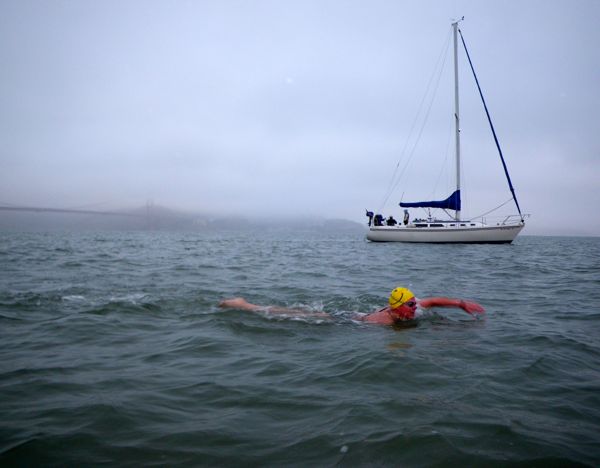
Karen Rogers of Tahoe City is going to swim to the Farallon Islands on July 2. Photos provided by Karen Rogers

Karen Rogers of Tahoe City is going to swim from the Farallon Islands to San Francisco on July 2. Photos provided by Karen Rogers

Over the decades, at least eight people have attempted to swim from the Farallones to the California mainland. Only Stuart Evans and Ted Erikson succeeded. A six-person relay ended on June 19 when one member of the Night Train Swimmers got hypothermia.

It took Evans 13 hours and 46 minutes to swim from the Farallon Islands to Bolinas Point in August 1967. The following month Erikson spent 14 hours and 38 minutes in the water, ending his swim below the center span of the Golden Gate Bridge. His two previous efforts had failed.

He said water temperatures dropped as he approached the bay during his first aborted attempt. He became disoriented and was pulled out of the water.

“The nurse on board could not find a pulse, so I was reported dead. I was deep into hypothermia and really not in contact with the world,” recalled Erikson, 82, of Chicago. “And we had two shark encounters, driven off or killed with a very serious .357 Magnum. My second attempt was halted by long, high swells that made me so seasick that I threw up feedings and became too weak to continue.”

Rogers said her coldest swim so far occurred in 41-degree Lake Tahoe water on Inauguration Day 2009. The duration of a later 21.5-mile effort traversing the length of the lake: 10 hours and 50 minutes.

“I decided it was time to wash away everything and start new, so I went down to the lake,” said Rogers, who has two sons, 16 and 18. She grew up in the Bay Area, in Orinda, and belongs to the South End Rowing Club in San Francisco. She is self-employed, specializing in restaurant accounting. Soon, she’d like to start a program to get teenage girls into the open water.

In May, Rogers swam 23 miles from the Golden Gate Bridge to the San Mateo Bridge in seven hours and 21 minutes. The Farallones swim, however, is the most ambitious she’s attempted. She’ll start around 2 or 3am, touch the island if the waves don’t knock her around — “it’s not really a great place to be bleeding” — and contend with water in the low 50s for much of her journey.

“This is probably the most challenging swim that’s ever been done,” said Chris “El Sharko” Blakeslee, 60, who crossed the English Channel in 2004 and, as Rogers’ team leader, is the only person authorized to end her attempt. “But she has a body type conducive to cold-water swimming, she’s older — you need to have that mental ability to gauge yourself — she has stamina, and she’s very focused. All those things together make her an ideal candidate.”

He conceded the undertaking would seem deranged to most people. Even at the South End Rowing Club, he said, some members consider it a little extreme.

“But I think it’s a noble goal,” said Blakeslee, who will keep a close eye on Rogers’ stroke count and look for sudden drops that could signal trouble.

The challenges, as Rogers sees it, include cold water, the sheer duration of the swim, strong winds, high waves, fog, tides, the seasickness that’s plagued her recently in the ocean and various forms of sea life.

“The great white sharks are still on vacation in Hawaii, or are on their way back,” she said. “But there may be a couple renegade ones. I’ve been rammed by sea lions before, and they’ve given me a pretty good charley horse. And if I were to swim into a jellyfish bloom, it wreaks havoc on your nervous system.”

But Rogers is ready. To get in shape physically, she has relied on running, mountain biking, Pilates, yoga, stretching and swimming in pools and San Francisco Bay. She also has tried to add an extra layer of insulation to her 5-foot-7 frame, eating everything from avocados to coconut ice cream with guava syrup. She currently weighs 172 pounds.

To prepare mentally, she uses visualization techniques. Once she stared at a painting of Bolinas Ridge all day. And she frequently gazes at a wall full of maps.

“Every day I sit next to the creek by my house,” Rogers said. “I just think about my swim and all the things that could happen and how I’m going to remedy those situations when I’m in the water. But my favorite part of marathon swimming, really, is not thinking about anything: the disassociation in the water for many hours. You just hear the water going past your head.”

Rogers compared the experience to a working meditation — and one that’s crucial in the ocean.

“You can get a lot of wind and chop in the bay, but you can always see land,” she said. “Out in the open ocean, you don’t have that. You have to work through it within yourself. I really like that. I just think sometimes I’m missing a dorsal fin to guide me a little bit.”

She’ll wear only a bathing suit, cap, goggles and earplugs, according to English Channel federation rules, and be accompanied by a large fishing boat, a 62-foot-sailboat and a crew of 17, including five kayakers — they’ll take turns navigating and providing liquid feedings every half-hour from the end of a line. She is paying for the $10,000 Farallones venture with her savings and private donations.

Bob Roper, the 71-year-old head of logistics for the team, has belonged to the South End Rowing Club for 42 years and still holds the record for the fastest swim from San Francisco to Marin County under the Golden Gate Bridge. He knows, better than most, what Rogers is facing.

“This is a huge, huge attempt,” he said. “It’s not going to be a walk in the park. It’s much better to go in warmer water a little later in the year, but by then the men in the gray flannel suits will be back. But even when the sharks return, it doesn’t mean a swimmer will be on their menu.”

Walt Schneebeli, 84-year-old historian of the Dolphin Club, the South End’s longtime rival, said, “It’s a very difficult thing to do. Our best swimmer has never tried to do this. The hardest part will be the last part. You get swept here and there.”

Frequently, Rogers is asked if she’s planning to tackle the English Channel. The answer is always no.

“I can’t quite get my head out of California,” she said. “I’m just a hometown girl who doesn’t really want to travel too far to have a challenging experience. There’s so much great open-water swimming right here. I really can’t even think past that.”

Patricia Yollin is a freelance writer based in the Bay Area.

ngg_shortcode_0_placeholder (Click on photo to enlarge)


Bijou Bash

Bijou Bash is an all-day event for the family — with activities, food booths, K-9 demonstrations, emergency equipment to roam in and more. It is at Bijou Community Park off Al Tahoe Boulevard in South Lake Tahoe.

Admission is free.

The date is Sept. 11 from 11am-4pm.


Charity bike ride to pass through South Tahoe

By Sam McManis, Sacraemento Bee

Summer is the season for charity cross-country bike rides, and one of the nation’s longest ones will be passing through Sacramento on Thursday.

The Texas 4000 for Cancer, a 4,687-mile journey that began on June 5 in Austin, Texas, and is scheduled to finish in August in Anchorage, Alaska, will stop at the state Capitol sometime Thursday afternoon after completing a 105-mile stage from South Lake Tahoe. The riders average 80 to 100 miles on their bikes daily.

The riders are all students from Texas who are raising money for cancer research. On their stops, the students meet with cancer patients and promote cancer awareness.

Read the whole story


Casino employees working harder for meager tips

By Ray Hagar, Reno Gazette-Journal

Minimum wage earners working in Northern Nevada’s gaming industry rely heavily on tips for income.

And they’d like to see more people called George come in to gamble, drink and eat in the casinos of Reno, Sparks and Lake Tahoe.

That’s because George is the nickname casino workers have traditionally bestowed on big tippers.

Yet there are fewer Georges in a region that continues to struggle with the recession, Nevada’s No. 1 ranking in national unemployment and the glut of tribal gaming in Reno’s top Northern California feeder markets.

Read the whole story


Weather delays whitewater rafting season

By Queenie Wong, Sacramento Bee

Rafting companies are counting on higher-than-normal snowmelt to rescue their season after a chilly spring kept customers on shore.

Gregg Armstrong, owner of the Lotus-based All-Outdoors California Whitewater Rafting, said his company’s spring reservations fell about 20 percent from last year, which was already slower than 2008, when he saw record sales.

Yet Armstrong is hopeful this year’s higher water flows will reverse his fortunes. His company does 80 percent of its business in the summer, when calmer waters attract a less extreme crowd than the rougher rapids of spring.

Read the whole story


Annual July 5 cleanup crew seeks volunteers

Ken Curtzwiler has been organizing a crew of volunteers via his business K&K Services for the last 10 years to clean up South Lake Tahoe beaches after Fourth of July.

Volunteers are always needed. Meet at the El Dorado Beach parking lot at 6am to volunteer.

Curtzwiler provides the gloves.

It will definitely give participants a different view of Fourth of July in Lake Tahoe.