South Tahoe responds to county’s redevelopment letter

cityPublisher’s note: This July 9, 2010, letter from South Lake Tahoe City Manager Dave Jinkens to Michael Applegarth, in El Dorado County’s administrative office, is reprinted with permission. It relates this story.

Michael:

As you requested, I am forwarding a copy of the attached letter from the Board of Supervisors to the City Council today.

I had the opportunity to discuss the letter this morning with the City Attorney/Agency Counsel, Mr. Enright and with the Director of Redevelopment and Housing, Mr. Palazzo. We will be carefully reviewing the County of Los Angeles v. Glendora Redevelopment Project decision. As you know, however, the City of South Lake Tahoe is in the California Court of Appeal, 3rd Appellate District, a different District than in the Glendora Case. Of course, the Glendora opinion is still important and significant, and it must be carefully evaluated. I know you know as well that South Lake Tahoe and Glendora are two very different cities in very differing environmental, social, and economic settings, and I suspect that the factual situation regarding their redevelopment proposal is different as well from the case in South Lake Tahoe.

The City Attorney needs some time to review the Glendora Case, and he will do so within the next few days along with your letter. We will then bring the matter to the City Council for review and direction. A few questions arise regarding your letter that would help us in our review and in any City response.

1. What specific parcels is the County proposing to be removed from the RDA Plan?

2. How does the County see the exemption of it from the Teeter Plan working in relationship to RDA Project No. 2? How broad are you looking at the hold harmless agreement?

I should also mention that on June 7, 2010 (referenced below) I directed a letter to the County Administrative Officer requesting further meetings. I received no response to my request and had we done so we could have been well on the way toward addressing outstanding issues. I note as well that on May 18, 2010 I directed an electronic mail communication to Supervisor Santiago in part requesting dialogue with her. Finally, on March 24, 2010 I directed to your Special Counsel Ms. Miller recounting our previous discussion at the Airport in our RDA Conference Room and suggesting more discussion on projects of mutual benefit we discussed such as a Green Business park at the Airport and Lakeview Commons Project. I received no reply to these communications as well.

Thank you for contacting me in regard to this important matter. I assure you that we will be responding within a reasonable period of time. I always appreciate hearing from you.

Sincerely,

Dave Jinkens, city manager and executive director South Tahoe Redevelopment Agency


Time to file for local elections

electionCandidates for South Lake Tahoe City Council may take out forms starting July 12.

Documents must be returned by Aug. 6. However, if an incumbent does not run, the deadline is extended to Aug. 11.

Three seats are up in November. Councilman Bill Crawford has said he does not intend to run, Councilman Jerry Birdwell wants to see who his competition might be, and Mayor Kathay Lovell wants a third term.

Interested candidates may pick up paperwork at 3368 Lake Tahoe Blvd., Ste. 8, South Lake Tahoe or at the city clerk’s office at Lake Tahoe Airport.

South Lake Tahoe voters will also be voting on a city treasurer. Suzie Alessi, city clerk, is up for re-election.

Other area races include: Placer County board of education, Tahoe Truckee Unified School District board, Lake Valley Fire Protection District board, and Tahoe City Public Utility District board.

Click on offices for more information about open seats on the California side of the lake.

Click on candidates to get information about Douglas County.

– Compiled by Kathryn Reed


Killing of wrong bear led to creation of advocacy group

By Jeff Delong, Reno Gazette-Journal

It started with paw prints that didn’t match a guilty party.

It was back in 1998 when a trapper hired by the California Department of Fish and Game shot and killed a mother bear and her cub after a bear tore through a cellar door on Lake Tahoe’s west shore in search of food.

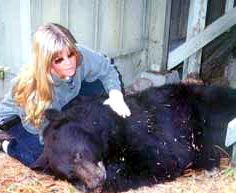
Ann Bryant founded the BEAR League. Photo/BEAR League

Ann Bryant founded the BEAR League. Photo/BEAR League

But the wrong bear was shot, residents of the Homewood area argued, insisting state wildlife officials were far too bloodthirsty when it came to policy concerning Tahoe’s bears.

“It was utter chaos. The local people were completely incensed,” said Ann Bryant, an area resident. “It was a crime against nature and we all took it that way.”

Read the whole story


DUI checkpoint in South Tahoe on July 12

The South Lake Tahoe Police Department will be conducting a DUI/driver’s License checkpoint on July 12 from 8pm to 1:30am along Lake Tahoe Boulevard and Pioneer Trail.

The department is continuing its efforts at lowering the number of people killed and injured in alcohol involved crashes locally and through the county’s Avoid DUI Task Force Campaign with this DUI/driver’s License checkpoint.

Personnel will be checking drivers to identify offenders and get them off the street, as well as heightening awareness to the dangers of impaired driving.

“We have already had an impact on traffic collisions with our extra enforcement efforts over the 4th of July weekend. Crashes were down in the city from seven injury collisions last year during the same tire period to just three this past weekend,” Sgt. Shannon Laney said.

In 2008, law enforcement statewide reported that 7,801 people were injured or killed during the three summer months of June, July and August.

A major component of the checkpoints, beyond taking dangerous drivers off the road, is to increase awareness of the consequences of impaired driving and to encourage using sober designated drivers. A DUI checkpoint is a proven effective method for achieving this goal, according to officers.

By publicizing these enforcement and education efforts, the South Lake Tahoe Police Department believes motorists are deterred from drinking and driving.


Alligator stories at Zephyr Cove library

The Douglas County Public Library in Zephyr Cove presents Alligator Stories and Crafts on July 16 at 1:30pm.

Miss Carol will read “Zack’s Alligator” by Shirley Mozelle. Children will sing songs, watch an alligator grow, go on a gator hunt, and make a craft to take home. For ages 3 and up; young children should be accompanied by an adult.

Sign up by July 15.

The Douglas County Public Library is located at 233 Warrior Way. For more information, call (775) 588.6411 or visit douglas.lib.nv.us.


Wondering why California is still in a drought

Publisher’s note: This editorial first ran June 26, 2010, in the Pasadena Star-News.

Hey, governor, it’s time you came clean and declared California’s drought to be over. Because it is. To do anything else would be dishonest.

See, the numbers don’t lie. From October through April, the state experienced above-average rainfall – 105percent, according to Sacramento’s own Department of Water Resources. This past season was different than the three previous seasons, when the state was experiencing lower-than-average rainfall: 76 percent, 72percent and 62percent for water years 2009, 2008 and 2007, respectively.

But we haven’t heard the governor, nor the Metropolitan Water District, nor its member agencies, say that the three-year drought is over, even though the numbers bear that out.

In fact, they’ve kept the pressure on in order to press for continued water conservation. We’re all for continued water conservation. We’re all for reducing the amount of water we waste running the tap or overwatering our lawns. But we think we can still save water even after a wet year.

Read the whole story


Fire summit sizzles with info, fizzles with attendance

By Austin Fay

STATELINE — Every tax paying homeowner in the Lake Tahoe Basin was sent a postcard notifying him or her of Friday’s fire symposium. From the approximately 40,000 postcards that were sent, about 10 homeowners showed up at Harveys.

The symposium of fire chiefs, decision-makers, land managers, and homeowners was part of the larger inaugural weeklong Living With Fire program.

The U.S. Bureau of Land Management, Nevada Association of Counties, Nevada Division of Forestry, Nevada Insurance Council, Nevada Fire Safe Council, Sierra Front Wildfire Cooperators, the University of Nevada Cooperative Extension, and U.S. Forest Service all sponsored the program.

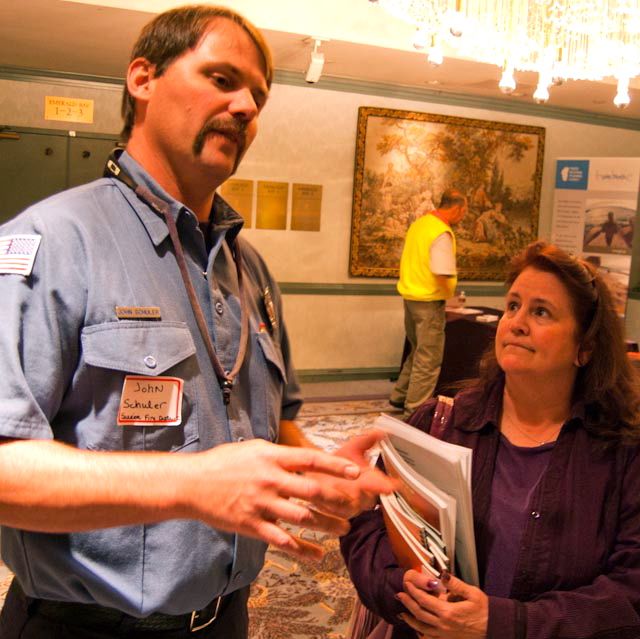
John Schuler, a defensible space inspector at the Sierra Fire Protection District in Washoe County, educates Petra Schuler, a South Shore homeowner. Photo/Austin Fay

John Schuler, a defensible space inspector at the Sierra Fire Protection District in Washoe County, educates Petra Schuler, a South Shore homeowner. Photo/Austin Fay

For a number of years Nevada has had a similar summit in May, but it has never been well attended by people in the basin. Having it this week in July was intended to draw second homeowners who may have been in town for the holiday week.

Speakers came from both sides of the state line. Kit Bailey, fire chief for the local Forest Service office, talked about wildland fires and how they affect homeowners in the Lake Tahoe Basin. Mike Vollmer of the Tahoe Regional Planning Agency gave an informative talk on what qualifies as defensible space as well as how to defend one’s home against fires.

A panel of homeowners — Paula Lambdin, Leona Allen, and Warren Berg — shared stories and told of the precautions they took during the 2007 Angora Fire, all of them emphasizing the effectiveness of having a defensible space. Lambdin and Allen lost their houses along with 252 other homeowners, but Berg’s was spared as he had protected his home by implementing defensible space recommendations.

There were also breakout sessions Friday where the few homeowners in attendance could meet with their division fire chief and learn details of the specific precautions their fire district has taken, as well as what homeowners can do to prepare in the event of a fire. Many fire districts hold smaller community events designed to educate the homeowners in their district, but this is the first time a basin-wide event has taken place.

Some of the measures included: creating a defensible space, replacing wooden roofs, joining a fire chapter, removing juniper bushes below windows, moving firewood stacks from structures, educating oneself and spreading knowledge throughout the community.

Things that homeowners could do were cited along with the reasons why homeowners don’t take steps to protect themselves. According to officials, the top six reasons why homeowners don’t implement defensible space are:

• Liking the trees and vegetation

• Cost

• Time

• Agency rules

• Loss of privacy

• Erosion concerns.

“We have a good fire department, but chances are any fire that comes through there, it will burn every lot,” Marilyn McDonald, a Fallen Leaf Lake resident, said.

The area where McDonald lives is currently being considered in the South Shore Fuel Reduction Project by the Forest Service. The review is expected to be published later this fall as to whether it is a priority for fuel reduction.

There is also a stewardship program for lots in the basin neighboring Forest Service land that allows for homeowners to remove brush, surface fuels and ladder fuels up to 100 feet from the house. The only precautionary measure not directly allowed is cutting trees. To a degree, and with a permit from the Forest Service, homeowners can maintain the tree growth around their homes.

Tahoe Regional Planning Agency changed its parameters for do-it-yourself defensible space preparation after the Angora Fire. Citizens can go in and do much of the defensible space preparation themselves. A tree 14 inches or less in diameter at breast height that is not in a stream area or has other restrictions can be cut by a resident without a permit.

South Lake Tahoe Fire Chief Lorenzo Gigliotti spoke about the Federal Emergency Management Agency grant the city is eligible for. Seven months ago, his department applied for a pre-hazard mitigation grant from FEMA to help pay for replacing the wooden roofs in South Lake Tahoe. After a screening of the nearly 9,500 single-family homes in South Lake Tahoe, 1,308 were found to have wooden roofs. The grant, if the district receives it, would pay for about 75 percent of the total replacement costs to go to a fire-resistant roof.

Tom Rosenberg, a full-time South Shore resident and homeowner, came because he was interested in fuel reduction initiatives.

“The turnout was disappointing to me,” Rosenberg said. “It’s up to us to do it ourselves. And at this point the regulations are very gentle.” Meaning there aren’t a lot of sticks, but there are a lot of carrots to create incentives for homeowners to educate and protect themselves against fire, he added.

Jessica Mencken of the Nevada Fire Safe Council had much to say about the low attendance.

“Getting people informed about events like this is the most frustrating part of my job,” Mencken said. “Nobody cares until, ‘oh no, it’s in my backyard’ and now, three years later, people don’t care. You get 10 people.”

But the publisher of Lake Tahoe News, a tax paying homeowner in the basin, never received one of the postcards that were supposedly sent. So the outreach is questionable.

Chief John Pang of Meeks Bay Fire Department said, “The first year you put on an event like this, you’re going to have a slow turnout, you’re asking people to come indoors for an entire day and for our second homeowners, it’s really difficult.”

In contrast, 1,100 people turned out for the Meeks Bay Fire Department’s 42nd pancake breakfast last weekend, where they had access to much of the information presented at the symposium.

“Unfortunately, if we had a fire last week, this place would be packed,” Pang said.



Assault on Asian clams in Tahoe under way

By Peter Hecht, Sacramento Bee

Scuba-diving scientists and a federal, state and regional battalion launched an aquatic assault Friday on alien invaders threatening to slime one of the world’s most pristine lakes.

In a $1.4 million experiment led by researchers from the University of California, Davis and the University of Nevada, the team set out to smother hundreds of thousands of the slovenly freeloaders – non-native Asian clams that spew algae-causing concentrates into Lake Tahoe.

Read the whole story


Golf fans must choose between celebs and pros

By Dan Hinxman, Reno Gazette Journal

The Reno-Tahoe Open and American Century Championship, the area’s two prominent golf tournaments, are the same week this year — July 12-18 — for the first time in the history of the two popular events.

“That’s unfortunate, isn’t it?” local golf enthusiast John Coats said.

The tournaments have been three to six weeks apart since the RTO, a PGA Tour event, began in 1999 at Montreux Golf & Country Club. That was the ninth year for the ACC, a celebrity tournament at Edgewood Tahoe Golf Course that annually draws celebrities including Michael Jordan, John Elway and Ray Romano.

Read the whole story


Dirty air may affect water quality, drought conditions

By Susanne Rust, California Watch

Dirty air may not just affect your lungs.

It could affect your tap, too.

Scientists at the Desert Research Institute, a division of the Nevada System of Higher Education, say polluted air can cut a storm’s snowfall in half.

Randy Borys, co-author of the study and director of the institute’s Storm Peak Laboratory in Steamboat Springs, Colo., said pollutants aren’t creating drought – they are just making it worse.

What’s happening is that pollutants, such as sulfate, nitrate or other compounds, attract tiny droplets of moisture in the atmosphere.

Read the whole story