Gritty reality of where food comes from depicted in movie

foodBy Kathryn Reed

After the bill signed by Gov. Arnold Schwarzenegger this month, a sequel to “Food, Inc.” may be necessary.

All eggs, no matter the origin, sold in California starting in 2015 must meet the standards set forth in the 2008 voter approved Proposition 2. This legislation says all hens must be able to freely lie down, stand up, extend their wings and turn around. 2015 is the year the proposition takes affect.

“Food, Inc.” is the 2008 documentary about where animal products in the United States come from well before consumers buy them at the grocery store.

It’s graphic. It’s raw – in several meanings of the word. It’s disturbing. It had Sue and I turning our heads several times, but the audio told us what was going on.

Why watch it?

For one, too many people think their food comes from a grocery store. There is no thought beyond that. No thought about who grew it or raised it. No thought about the chemicals involved or what the animals may have consumed. No thought about what conditions the animals lived in.

I was familiar with much of the commentary in the movie. I had not seen all the pictures. I hadn’t seen chickens unable to move because it was wall-to-wall chickens.

Suddenly, the fact that in my vegetarian diet I do consume eggs – and bake with them all the time – I was alarmed. I had heard stories, but to see the conditions and hear from the farmers made my stomach turn.

The unfortunate thing about the new California law is that it does not address processed foods. Just think about all the food products that contain eggs. Then think about if the bill would cover the hens laying those eggs.

But maybe, just maybe, this law will change how some hens are treated. That would be a movie sequel worth watching – how food production has improved in the United States.

Another alarming aspect the movie brought forward is how agricultural is dominated by a handful of companies. It’s right up there with big oil. It was pointed out how people in government who are there to regulate the industry came from the industry. Sound familiar?

It’s one of those movies that everyone should see so they have an understanding of where food comes from.

The movie does show a farmer who has no problem doing things in what would be labeled a more organic way – having cows eat grass instead of a corn product. Corn isn’t a natural food product for cows – it’s something people have found cheap and easy to feed them.

If you want to know more about where food comes from, I highly recommend the book “Fast Food Nation” by Eric Schlosser.
Plan circulating among convention center creditors

By Kathryn Reed

A plan for the long stalled convention center in South Lake Tahoe could be unveiled in August.

Owens Financial, the largest creditor involved in the bankruptcy, has taken the lead role in trying to come up with a resolution that everyone can live with. Several meetings have been conducted involving the various parties.

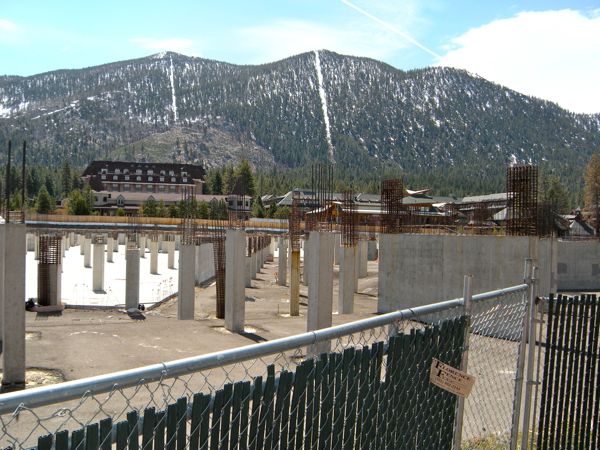
No work has occurred on the would-be convention center in years. Photo/Kathryn Reed

No work has occurred on the would-be convention center in years. Photo/Kathryn Reed

Lake Tahoe Development Company out of Zephyr Cove filed for bankruptcy last fall after it had put in the foundation and some rebar on the 11-plus acre site near Stateline.

Randy Lane, principal of LTDC, earlier this year thought he had lined up someone up to take over what was supposed to be a $410 million convention center-two hotel-retail complex.

“The last deal the company said they would offer X and they offered Y. They thought they could do whatever they wanted because no one else was out there,” Lane told Lake Tahoe News. “Maybe no one is out there who will step up to build today or tomorrow, but the dynamics have not changed and the location has not changed.”

Lane said Owens Financial has a plan that is being discussed among the creditors, but consensus is still needed. He expects a decision could come in a few weeks.

He doesn’t expect to go back to court until someone has a plan to present to the judge.

“I’m very grateful creditors say they are not going to take pennies on the dollar. They see value in this project,” Lane said.


Snippets about Lake Tahoe

black bear inn• For the sixth year in a row, Black Bear Inn in South Lake Tahoe has been given the distinction of Editor’s Choice by Fodor’s Travel Guide.

• Mike Laub, who bought Bill’s Casino to turn it into a strip club but isn’t able to do so because Douglas County put the kibosh on that plan, is not revealing what he might do now. He has not filed any plans with the county. A couple months ago he was calling owners of massage businesses on the South Shore to see if they would like to work there.

• The rumor that Blaise Carrig is staying in town and not going to Colorado to work higher up in the Vail Resorts corporation is false, according to Heavenly Mountain Resort officials. The general manager for the local resort should be named this summer.

• There will be a public hearing July 21 at 2pm at Lake Tahoe Airport before the zoning administrator regarding the Beachcomber Inn’s desire to operate a non-motorized boat rental concession on the beach adjacent to the inn at 999 Lakeview Ave. in South Lake Tahoe.

• Bike racks are available for businesses in South Lake Tahoe that have a high-use location for bicycle storage and are committed to being a bicycle friendly business. There is no charge for the racks, but there are terms and conditions for installation, maintenance, and promoting bicycle use among employees and customers. Contact Lake Tahoe Bicycle Coalition for an application at biketahoe@aol.com or (775) 586.9566.


STATA promotes change to bus/trolley

To the community,

As part of an ongoing effort to bring the BlueGo system to more efficient levels, STATA hired LSC Transportation Consultants to study the entire BlueGo system and create a Short Range Transit Plan that recommends improvements to the efficiency of BlueGo and bring the system back to levels that STATA could fiscally manage.

STATA recognized that there had been many changes to the routes in the last year, STATA worked diligently to ensure that any changes made would have a minimal impact on BlueGo riders and are pleased to announce changes that positively impact both locals and visitors as it is adding service to the widely utilized route 50. The Trolley will return to service on Highway 50 on July 18 with the first Trolley leaving the South Y Station at 10:15am and will run to the Stateline Transit Center. The last Trolley will leave the Y at 6:16pm. Trolleys leaving from Stateline begin at 10:40am, with its last departure at 6:40pm from the Stateline transit Center.

In addition to seeing the trolley again, riders can now enjoy 30-minute headways on Route 50 from 7:15am until the last trolley departs the Stateline Transit Center at 6:40pm.

After 6:40pm, service on Route 50 will return to 60-minute headways as they are currently.

We are thrilled to be adding service that so many locals and tourists will benefit from.

Additionally, South Lake Tahoe met July 13 to discuss other recommendations made by LSC in the Short Range Transit Plan. Specifically, the recommendations are to eliminate the Meyers service Route 40 and the Zephyr Cove service Route 22 due to extremely low ridership and high cost of operations.

The city approved the recommendations to eliminate the service. Therefore, effective July 18, Routes 40 and 22 will no longer be offered. Persons affected by the service change can utilize the demand response service of BlueGO on call by calling (530) 541.7149 24 hours per day at least 60 minutes prior to the time you wish to be picked up. Please note that for ADA Para transit ON CALL service, reservations must be made 24 hours in advance. Additional weekday ON CALL service will be instituted between the hours of 7:45-11am and 2-5pm to augment the existing demand response service.

In addition to the service changes, a new “transfer fare” will be established. The current on call fare is $6. The transfer fare will be $4 for on call service to the following transit centers (South Y Transit Station, Lake Tahoe Visitor Center, Stateline Transit Center, Lake Tahoe Community College and the Kingsbury Transit Center).

Call (530) 541.7149 for more information about schedules and fares.

Stacy Dingman, STATA spokeswoman and board member


Marriage, what is it good for?

By Jessica Bennett and Jesse Ellison, Newsweek

Every year around this time, the envelopes begin to arrive. Embossed curlicues on thick-stock, cream-colored paper ask for “the pleasure of our company” at “the union of,” “the celebration of,” or “the wedding of.” With every spring, our sighs get a little deeper as we anticipate another summer of rote ceremony, cocktail hour, and, finally, awkward dancing. Sure, some weddings are fun, but too often they’re a formulaic, overpriced, fraught rite of passage, marking entry into an institution that sociologists describe as “broken.”

Once upon a time, marriage made sense. It was how women ensured their financial security, got the fathers of their children to stick around, and gained access to a host of legal rights. But 40 years after the feminist movement established our rights in the workplace, a generation after the divorce rate peaked, and a decade after Sex and the City made singledom chic, marriage is—from a legal and practical standpoint, anyway—no longer necessary. The two of us are educated, young, urban professionals, committed to our careers, friendships, and, yes, our relationships. But we know that legally tying down those unions won’t make or break them. Women now constitute a majority of the workforce; we’re more educated, less religious, and living longer, with vacuum cleaners and washing machines to make domestic life easier. We’re also the breadwinners (or co-breadwinners) in two thirds of American families. In 2010, we know most spousal rights can be easily established outside of the law, and that Americans are cohabiting, happily, in record numbers. We have our own health care and 401(k)s and no longer need a marriage license to visit our partners in the hospital. For many of us, marriage doesn’t even mean a tax break.

Read the whole story


Tahoe ski resorts brag about second best season on record

The seven Ski Lake Tahoe resorts on Friday reported a 17 percent increase in skier visitation for the 2009-10 winter season, more than quadruple the national average reported this season by the National Ski Area Association.

The second busiest season on record, the 2009-10 winter season’s high snowfall totals and five-star Ritz-Carlton, coupled with the most affordable, quality ski packages, set the national standard for what a winter travel experience could be, according to Ski Lake Tahoe officials.

The seven resorts in Ski Lake Tahoe are Alpine Meadows, Heavenly, Kirkwood, Mt. Rose-Ski Tahoe, Northstar-at-Tahoe, Sierra-at-Tahoe and Squaw Valley.


Lahontan schedules TMDL public hearing

The California Regional Water Quality Control Board, Lahontan Region has scheduled a public hearing as part of the process for considering amendments to incorporate the Lake Tahoe TMDL into the Water Quality Control Plan for the Lahontan Region.

This action is being proposed to meet the requirements of federal Clean Water Act section 303(d). The Basin Plan amendment process is authorized under California Water Code section 13240. The Basin Plan amendment is a project subject to the California Environmental Quality Act and the Water Board is the lead agency. The Water Board wishes to obtain public input on the proposed Basin Plan amendment.

The Water Board has prepared draft Basin Plan amendments, a draft Lake Tahoe TMDL Technical Report, and a draft Lake Tahoe TMDL Report which includes an environmental checklist. The draft substitute environmental documents were prepared pursuant to Public Resources Code section 21080.5. These documents are accessible at the Water Board office in South Lake Tahoe or on the web page at http://www.waterboards.ca.gov/lahontan/water_issues/programs/tmdl/lake_tahoe/index.shtml.

There will be a public hear Sept. 7-8 at Lake Tahoe Community College in the board room at the South Lake Tahoe campus at One College Drive. The time has not been set.

The Water Board will not take action on the proposal until its regular meeting on Nov. 9-10.

Oral statements will be heard in September, but for accuracy and to the extent possible, testimony should be presented in writing. Submittal of written comments is encouraged. Written comments are requested no later than 5pm Sept. 10 to Douglas F. Smith at DFSmith@waterboards.ca.gov. For more information on this project, Smith at (530) 542.5453.


Building fees cut emissions on Fallen Leaf via electric boats

By Kathryn Reed

A distinct hum is usually associated with motor boating. Not anymore. Two boats cruising Fallen Leaf Lake are electric, creating a new boating experience for the user and others on or near the water.

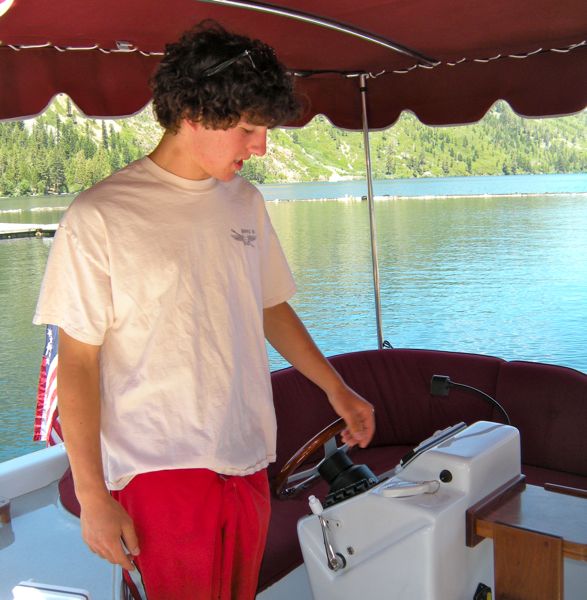
Self-described marina boy Joe Zanetell turns on the engine. Nothing seems to happen. No sound emerges from the engine. That’s one of the benefits of electric boats – no noise. But it also means the lake and air are not being polluted with fuel emissions.

Joe Zanetell fires up the electric boat at Fallen Leaf Lake. Photos/Kathryn Reed

Joe Zanetell fires up the electric boat at Fallen Leaf Lake. Photos/Kathryn Reed

This is the first season the South Shore lake has had electric boats. Rob and Sandy Wirth, who run the concessionaire, bought the boats for $35,000. After all, his background is in the electrical business.

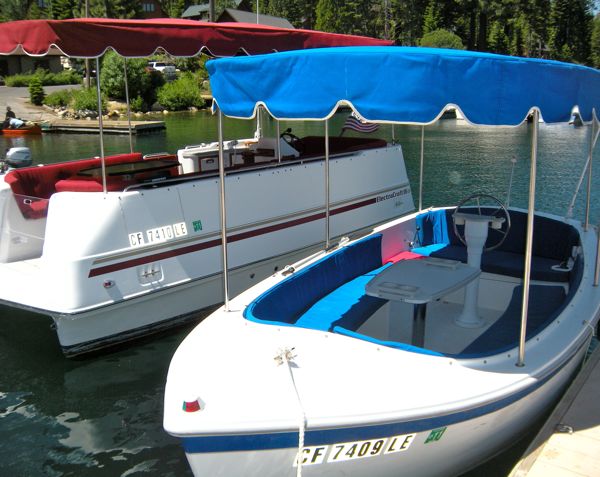
The pontoon boat holds nine people, while the V-hull can take seven. Both go about 6mph and have a charge lasting about four hours.

Most people cruise out a ways and then drift, according to Zanetell.

On today’s agenda, the Fallen Leaf Lake Community Services District board will consider becoming owners of one of the boats by using mitigation funds passed to it from El Dorado County via the Tahoe Regional Planning Agency.

The board will discuss and possibly vote on accepting $20,000 from TRPA. (Funds must be given to a public entity, thus the reason the CSD is involved and the money is not going directly to the Wirths.) The district and Wirths would then likely enter a six-year lease agreement.

The agenda says the district has received confirmation from its insurance carrier that liability will be covered under the concessionaire’s policy.

“People are really digging them,” interim CSD General Manager Tom Barnes said of the boats. “They are very stable. It’s a good way to poke around the lake.”

Fallen Leaf Lake has two electric boats for rent.

Fallen Leaf Lake has two electric boats for rent.

Last spring talks about electric boats began between Barnes and TRPA officials. Then Steve Kooyman, a civil engineer with the county’s transportation department, got involved, along with Supervisor Norma Santiago.

“Given that the electric boats have no emissions as well as address other thresholds such as noise, this is a very logical project to support with these funds,” Santiago said. She is also on the TRPA Governing Board. That agency will vote this month or in August to allocate the mitigation funds.

What are mitigation funds?

All new construction projects in the Lake Tahoe Basin pay air and water quality mitigation fees to TRPA. That check must be written before the final permits are signed by the bi-state regulatory agency.

Whichever jurisdiction the construction is occurring in has the funds deposited in a pot for that city or county. The government agency then can request money from the TRPA board for projects that have to do with air and water quality improvements.

“This is a restricted fund by law. The money is invested back into the community,” explained Julie Regan, TRPA legislative affairs analyst. “It can’t go to operations, the building or salaries.”

With so many state and federal grants requiring matching funds, the mitigation account is a source for local governments to point to as money in hand.

Air quality mitigation fees for single-family residences are based on the projected number of trips that will be made. On average, the fee is $3,300. (Remodels don’t pay this fee.)

For water quality mitigation fees, it’s $1.86 per square foot of land coverage. So, 3,000 square feet of coverage will cost the builder $5,580 in fees.

“The fees are tiered on actual impacts,” Regan said. “It’s really designed to off-set the impacts on the ground.”

Commercial construction also pays mitigation fees, as well as other fees, which are calculated on a different scale.

For the five counties and one city in the basin (and only basin projects can use the money), there is $7 million in the account. From 2007 to the end of June 2010, $4.19 million in mitigation funds have been spent.

Spending the money

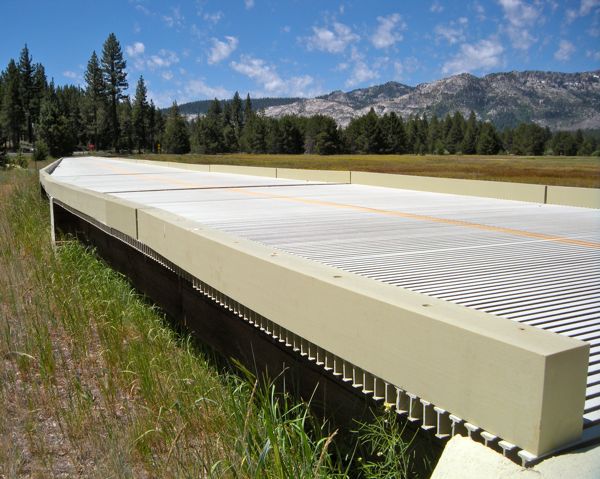
Mitigation funds helped pay for the Sawmill bike trail in El Dorado County.

Mitigation funds helped pay for the Sawmill bike trail in El Dorado County.

Local jurisdictions make requests to TRPA for the money. It’s up to the Governing Board to say yea or nay. The project must have some benefit to improving air or water quality to qualify.

About $200,000 in mitigation funds was used to help build the bike path in front of Lake Tahoe Golf Course in Meyers.

Several entities, including South Lake Tahoe, tapped the mitigation pot to purchase dustless street sweepers.

Placer County used these dollars to build bus shelters.

Regan said her agency is looking at whether mitigation funds could be used for a water taxi.

The electric boats are just one example of what mitigation fees can go toward. The idea is to see how well they work and what the public thinks of them so maybe they would be a staple at Lake Tahoe marinas.

“So much extensive research has been done to make sure these boats were eco-friendly, including the batteries that the boats use,” Santiago said. “This is a definite win-win for the community as it continues with its commitment to protecting Fallen Leaf Lake, while providing an eco-friendly boating experience to lake visitors.”


Wagner, Roenick share lead after Day 1 of ACC

Jack Wagner, 2006 winner of the American Century Celebrity Golf Championship, shares the lead after the first day of this year’s tournament with former NHL star Jeremy Roenick.

In the modified Stableford scoring format, the two have 26 points. Wagner is the only non-athlete to win the tournament that is now in its 21st year at Edgewood Tahoe Golf Course.

Edgewood Tahoe Golf Course

Edgewood Tahoe Golf Course

Trailing by one point to be among the leaders is former NFL quarterback Billy Joe Tolliver.

Not unique to the tournament, was the threat of thunder and lightning. Play was halted on Friday because of lightning strikes on the course. A little rain came down, too.

Click here to see Saturday’s pairings. Gates open at 7am, with the first group teeing off at 8:10am.

— Compiled by Kathryn Reed


Protesters lobby for smoke-free casinos

By Kathryn Reed

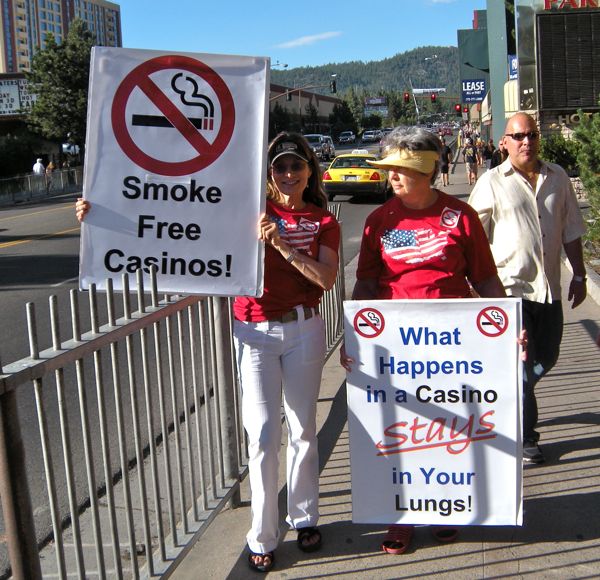
STATELINE — A group of non-smoking gamblers plans to spend two more days protesting in front of the Stateline casinos in an attempt to bring awareness that people would like go inside if it weren’t so smoky.

“Eighty percent of the people don’t smoke and they are shutting those people out,” Janet Kahler of Phoenix said.

Stephanie Steinberg, left, and Janet Kahler protest outside Harrah's on July 16.

Stephanie Steinberg, left, and Janet Kahler protest outside Harrah's on July 16.

She and Stephanie Steinberg, chairwoman of Smoke Free Gaming, were in front of Harrah’s Lake Tahoe early Friday night.

About a dozen people from the Denver-based organization started protesting Thursday and will continue through Sunday – trying to get national recognition while the American Century Celebrity Golf Tournament is in town. Protesters are from Nevada, Colorado and Arizona, with some local advocates.

Steinberg said casino security was out to speak with the pickets.

“We tell them we support Harrah’s,” Steinberg said. Gaming isn’t the issue; it’s the smoke-filled environment this group has an issue with.

She said the group also advocates for casino employees who are breathing secondhand smoke.

A few people were honking as they saw the signs reading, “Smoke free casinos” and “What happens in a casino stays in your lungs.”

Then there was the passenger who offered the women a cigarette. Later a guy appearing to be in his 20s walked by and said, “That would be nice,” after reading the signs.