Wild animals on stage tonight on South Shore

On Aug. 19 at 7pm, Barbie and Gabe of Wild Things bring native Sierra Nevada animals on stage at the U.S. Forest Service Taylor Creek Visitor Center.

This program gives people the opportunity to learn more about these fascinating animals, which could include a black bear yearling, bald eagle, beaver, great horned owl, turkey vulture or rattlesnake, depending on the health and general attitude of the animals that day. Most of these animals were taken in injured and can’t be released back to the wlld.

Do not bring pets to this program.

The local U.S. Forest Service’s nonprofit organization Tahoe Heritage Foundation accepts a $2 per person donation to help defray costs. This one-hour educational program, great for the whole family, takes place at the center’s Lake of the Sky Amphitheater, located on Highway 89 toward Emerald Bay.


DJ Tim at Brothers Bar

Reggae/HipHop/Dubstep with DJ Tim at Brothers Bar & Grill in South Lake Tahoe on Sept. 11 at 9pm.


Goldman illustrates climate change realities to Lake Tahoe

By Kathryn Reed

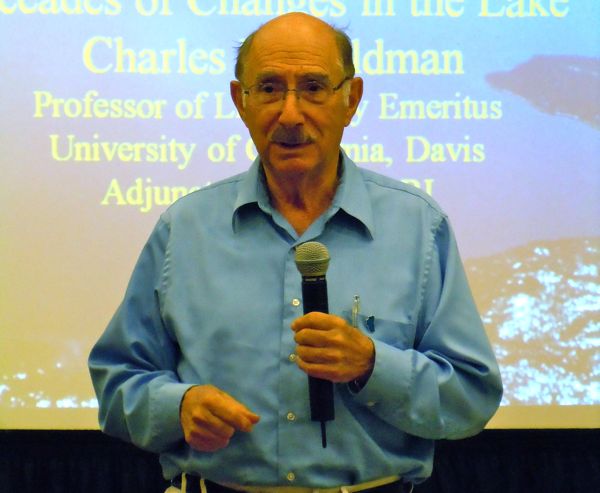
STATELINE — Proving scientists are not all nerds stuck in some cubicle plotting the future, Charles Goldman sprinkled his talk to a receptive group Wednesday with food tips – like the best way to dry bushels of lettuce is in a pillowcase on the spin cycle.

It all made sense at the time of his noon talk to Soroptimist International of South Lake Tahoe at Harrah’s Tahoe.

Charles Goldman gives a scientific lecture of sorts to Soroptimist on Aug. 18. Photo/Kathryn Reed

Charles Goldman gives a scientific lecture of sorts to Soroptimist on Aug. 18. Photo/Kathryn Reed

Goldman’s name is most often used with lake clarity and Secchi disk. The latter is the instrument that looks like a dinner plate for testing how clear Lake Tahoe is.

Limnology, the study of inland waters, is what Goldman is all about. He’s been doing so for more than a half century, with the bulk of his work at Lake Tahoe while employed by UC Davis until just retiring. Now he is an adjunct professor at UNR’s Desert Research Institute.

In those 50 years, the lake has lost about a third of its transparency. Although the rate of decline has been curbed, Goldman approaches the news with cautious optimism. The lake mixes its waters about every four years.

“If it doesn’t mix, transparency gets better,” Goldman explained.

After his recap of Tuesday’s annual environmental summit, Goldman delved into a variety of topics, most of which centered on the impacts of climate change to Tahoe and the far reaches of the globe.

“The Himalayan glaciers are retreating. You can’t imagine the impact when those go dry,” Goldman said. “Global warming is a very severe reality.”

People in the room nodded as he said fewer blankets are needed at night than years ago. This is because the daily minimum temperatures in the basin are rising.

The water temperature is also increasing. In the last 30 years the surface temp has increased by 4 degrees, Goldman said.

“Sea levels are going to come up. Florida at the current rate will be under water in the next 100 years,” Goldman predicted.

Plant and animal life are affected by the changes – even if the numbers sound minimal.

He said for 20 years he has been trying to get Harold Singer, executive director of Lahontan Water Quality Board, to put up a dam at Tahoe Keys to isolate the water so the invasive milfoil weed could be eradicated. As it is now, about $100,000 is spent on continual mowing. The duff washes into the main body of the lake and spreads.

Goldman said he gave Singer and others an earful again about his idea at the Aug. 17 summit and thinks he may be making progress.

“People didn’t used to slip-side on rocks (in Tahoe) and now they do,” Goldman said, illustrating how the lake is changing with the algal growth as the water warms.


Experts: Feds can help, but not save Nevada’s economy

By Erin Kelly, Gannett News Service

WASHINGTON – While U.S. Senate Majority Leader Harry Reid, D-Nev., and Republican U.S. Senate challenger Sharron Angle, a former assemblywoman, debate whether the federal government has helped or hurt Nevada, economists say there’s little doubt the state would be in even worse shape without aid from Washington.

Money from the feds — including about $3.2 billion in stimulus funds awarded to the state from the American Recovery and Reinvestment Act stimulus bill — has helped prevent layoffs of state workers and extend unemployment benefits for the jobless, experts say.

The role the federal government should play in boosting Nevada’s economy has been a constant source of friction between Reid and Angle. Reid has touted his efforts to bring more money to his home state, while Angle has denounced the spending as “reckless” and said it has not helped Nevada.

Nevada’s unemployment rate reached 14.2 percent in June, the highest in the nation. The state also suffered the highest home-foreclosure rates in the U.S. during the first half of this year.

“Without federal aid, we could be talking Great Depression levels of unemployment in Nevada,” said Elliott Parker, professor and chairman of the economics department at the University of Nevada, Reno. Unemployment rates reached as high as 25 percent at the peak of the Depression.

Read the whole story


Creating a cohesive cycling community

To the community,

The Lake Tahoe Bicycle Coalition is keeping its efforts rolling and producing results. And, we can accomplish more with your help. Here are a few ways you can help build our bicycle community: tell your favorite business about the free bike rack program and encourage them to get one; share your top 10 bike rides for a new bike website, help improve the bike trail map, get ready to participate in the Tahoe Bike & Trail Day Festival, and attend the mountain bike trails conference to learn and connect with others planning to build a world-class bicycle community and destination.

Now, no more whining about what isn’t happening. It is long time for all of us to recognize what is — how a dedicated group of bicyclists are working together with key stakeholders, agencies, organizations and businesses to help transform our region and become more livable, sustainable and bike friendly.

We can do more with your participation. Become a member of the Coalition. Volunteer to help out at our events. Voice your views and concerns at governmental meetings. Write letters to the editor and your representatives. Create events, programs, products or share your ideas with others to help build the future you see for Tahoe.

Working together, we can help create what is to be — now.

Enjoy the summer, be safe and friendly, and see you on the trails.

Ty Polastri, president Lake Tahoe Bicycle Coalition


St. Theresa test scores worth bragging about

By Mike Filce

While so much news about education these days highlights the negative, we need look no further than a small local school for the positive.

St. Theresa School, going strong since reopening in August 1994, approaches standardized testing differently from its counterparts. Students in grades 2-8 take the ITBS (Iowa Test of Basic Skills) in the third week of September, rather than in the spring when public schools conduct their standardized testing. The test has a mixture of questions covering key information from the prior school year, and introductory information from the current grade level expectations.

This year, grades 3-8 scored in the top third or higher nationally, and all grades performed above grade level. These most recent results show the third-grade class testing at a grade equivalent of 3.9, which is just short of fourth grade. That trend widens to 6.5 for fifth-graders, 10.1 for seventh, and 11.3 for eighth-graders.* (*Composite class scores rather than individual student scores.)

Each year, the school receives the results in early November, at which time the staff reviews both individual and grade-level results to plan and guide instruction for the rest of the year. This approach allows teachers to focus on each student’s weaknesses rather than teach to the test, according to third-grade teacher, Anne Filce.

Kelly Shanahan, parent of a sixth-grader, finds it “remarkable” that the teachers and administration “have the guts to test at the beginning of the year, before the students have been exposed to the material”; she appreciates how teachers then “take the testing information and tailor it to improve their curricula instead of spending time on state standards in which the students are already proficient.”

Principal Danette Winslow, clarifies, “the purpose of testing for grades 2-8 is diagnostic only … we are looking at what the students are bringing into their academic experience after having three months off of school. Teachers use the test scores as a barometer, to help guide them in their instruction.”

Matt Tillson, long-time middle school teacher at STS, expresses similar thoughts. He believess the “the test scores in the fall are a more true or accurate indication of the child’s memory and knowledge, versus in the spring when teachers have had the opportunity to teach to the test, which may not provide as true an indication of what they know.”

Mike Filce is a long-time educator on the South Shore.educator, involved parent, and school advisory commission member


Placer County may expand defensible space program

By Ed Fletcher, Sacramento Bee

Placer County is considering expanding a program that allows the county or local fire districts to step in for negligent property owners by clearing brush and reducing the risk of wildfires.

spaceThe county’s hazardous vegetation abatement program has been running as a pilot program for the fire districts north and west of Lake Tahoe since 2007.

Now there’s talk of expanding it to the remainder of the county.

Read the whole story


Tahoe water transit takes hit with latest boat cutting engine

By Stephen Ward

For those who anticipated “getting on Tahoe” and sailing the shores by means of the much touted Blue Warrior water shuttle this summer, start sending out SOS signals. The water shuttle service conducted by Get On Tahoe has come to an abrupt and erratic end, with the boat being sold Friday for just enough to cover the promissory note on the vessel after being in business for a little more than two months.

The enterprise boasted a 36-foot, 20-passenger boat dubbed the M/V Blue Warrior and was owned and operated by the Tahoe Divers Conservancy, a nonprofit partner to the Alpen Group that helps fight invasive species in Lake Tahoe. The shuttle offered pick-up and drop-off services from areas such as Carnelian Bay, Sand Harbor and Thunderbird Lodge, with tickets ranging from $35 for a round-trip adventure to $110 for a complete Lakeshore Water Tour.

The Blue Warrior water transit ceased proving service on Aug. 13. Photo/Provided

The Blue Warrior water transit ceased proving service on Aug. 13. Photo/Provided

Conservancy spokeswoman Mechele Duhamel cited two explanations for why the shuttle was unable to wade through the turbulent waters of challenges it encountered.

“The key reason we had to sell the boat is because we couldn’t land a dock or marina to station the boat,” Duhamel said. “We had to use a dinghy to bring the passengers to the boat.”

The dinghy crippled the venture. Besides serving as a constant indicator of the lack of support from the docks and marinas, it set limitations to who could board the Blue Warrior. The company’s website deterred young children and those with limited mobility from boarding the shuttle, saying the “process of getting in and out of any dinghy can be a sporty one.”

In addition to having trouble with the marinas, Duhamel also expressed her disdain with the money allocated to the Tahoe Regional Planning Agency, a purported $5 million, and the bi-state regulatory agency’s reluctance to provide funding for the shuttle.

According to TRPA spokesman Dennis Oliver, this is not the case.

“We don’t have a pile of money to hand to people,” Oliver said. “We are studying the feasibility of public water transport. If our studies show that waterborne transit would be a feasible venture, we would probably talk about starting a public water charter service … but we don’t have money to fund private water shuttle companies.”

TRPA put together a water transit study in June 2007.

The notion of moving people by boat beyond scenic tours has been tried unsuccessfully a number of times on Lake Tahoe. Ridership is inconsistent, destinations are changing and parking remains a problem.

Austin Sass, director of sales and marketing for Aramark at Lake Tahoe, believes a lot needs to be considered before rushing into this type of service. Sass runs the Tahoe Queen and M.S. Dixie II paddle-wheelers.

“One thing that needs to be looked at is parking,” Sass said. “If people are going from Heavenly Resort to Crystal Bay or Kings Beach, there needs to be a parking garage or ground shuttle that would be willing to take them to the dock. That’s a different issue in and of itself.”

Andy Chapman with the North Lake Tahoe Resort Association could not be reached for comment about how the demise of this shuttle service may impact tourists.

With ambivalence escalating and efforts dwindling, the future of waterborne transit being offered at Lake Tahoe is becoming increasingly murky.

In an Aug. 18 post on LTN by B Gorman, executive director of the Lake Tahoe South Shore Chamber of Commerce, she says, “I believe everyone is in agreement that we must find funds to improve bike trails, develop waterborne transit etc. etc.”

But no one has proved waterborne transit is logical or needed in Tahoe.

A March 22 Lake Tahoe News story says, “Another (Tahoe Transportation District) project involves South Lake Tahoe and Tahoe City — water transit. The goal is connecting the North and South shores via transit. By the end of the year the federal transit analysis should be finished. Out of that will come a recommendation if water transit is viable or not.”


Off-road racers set for Vegas to Reno competition

By Sean Collins, Reno Gazette-Journal

The 14th annual Vegas to Reno race, the longest off-road vehicle competition in the United States, will kick off Friday despite safety concerns after a crash at a similar event in California caused eight deaths last week, officials said.

“If you look at the videos of that race, it’s not a safe atmosphere,” said Casey Folks, director of Best in the Desert, which puts on the Nevada race. “If you wanted to go watch Vegas to Reno, we’re going to direct you to a controlled area. We don’t allow spectators out on the race course.”

The race is scheduled to begin at 5:45am Friday in Beatty, just north of Las Vegas, and finish in Dayton in Lyon County at the end of the day. The 535-mile course runs through federal property managed by the U.S. Bureau of Land Management, which was criticized for its inability to enforce safety measures after the California incident.

Read the whole story


CalTrout cycling event to raise awareness about its cause

The AIDS ride, Ride for the Cure, Ride for Kids … all across America people are getting outside, getting in shape, and getting the word out for the cause most meaningful to them.

These bicycle tours – ranging from 60 to 1,000s of miles – bring high visibility and raise money for these important issues. That’s why California Trout is launching the first Trout on Tour – a 1,400-mile bike ride to deliver an urgent message: Cold, clean water is the most important resource of the 21st century and fish are the best indicator of a healthy watershed.

CalTrout’s Outreach Manager Shannon Moon is cycling the state from Aug. 23-Sept. 29.

Along the way she’ll be hosting events, offering presentations, distributing information and highlighting top water and fisheries issues through CalTrout’s new blog, Twitter and Facebook. Visit www.caltrout.org/blog for more info.

The goal is to raise $10,000 to cover the costs of the education and awareness events and materials along the route.

For more information, email smoon@caltrout.org or call (415) 392.8887, ext. 107 or visit www.caltrout.org.

Route and date:

* August 19 – Event in San Francisco

* August 21 – Event in Mammoth Lakes

* August 22 – Spot the Trout riding around Mammoth Lakes

* August 23 – First day of the Ride: Mammoth to Bridgeport

* August 24 – Bridgeport to Topaz Lake

* August 25 – Topaz Lake to South Lake Tahoe – Event in Tahoe

* August 26 – Spot the Trout riding around South Lake Tahoe

* August 27 – Sierra Nevada Alliance Event – Tahoe to Sierraville

* August 28 – Sierraville to Quincy

* August 29 – Quincy to Lake Almanor

* August 30 – Lake Almanor to Lassen

* August 31 – Lassen to Fall River

* September 1 – Fall River to Mount Shasta

* September 2 – Event in Mount Shasta

* September 3 – Event in Mount Shasta

* September 4 – Mount Shasta to Cecilville

* September 5 – Cecilville to Orleans

* September 6 – Float to the Mouth of the Klamath with Yurok tribe

* September 7 – Float to the Mouth of the Klamath with Yurok tribe

* September 8 – Float to the Mouth of the Klamath with Yurok tribe

* September 9 – Requa to McKinleyville

* September 10 – Event in McKinleyville

* September 11 – McKinleyville to Weott

* September 12 – Weott to Legget

* September 13 – Legget to Mendocino

* September 14 – Mendocino to Gualala

* September 15 – Gualala to Jenner

* September 16 – Jenner to Calistoga

* September 17 – Calistoga to Napa – Event in Napa

* September 18 – Petaluma to San Francisco

* September 19 – Event in San Francisco

* September 20 – San Francisco to Big Basin

* September 21 – Big Basin to Pajaro

* September 22 – Pajaro to Monterey

* September 23 – Monterey to Limekiln

* September 24 – Limekiln to San Simeon

* September 25 – San Simeon to Pismo Beach

* September 26 – Pismo Beach to Santa Barbara

* September 27 – Santa Barbara to Ventura

* September 28 – Event in Ventura