Lecture: Life on other planets

What kinds of life inhabit extreme environments? What strategies do they use to survive? What significance does this research have for the history of life on Earth and future studies on other planets?

As an overview of Alison Murray’s current research, this program will provide a better understanding of the unseen life forms that dominate this planet and connect the study of life on earth and studies elsewhere in the Universe.

The discovery of a Martian meteorite in the Antarctic with evidence of microbial life resulted in a new field of science called Astrobiology. This field has grown rapidly in the last 10 years as evidence of water on Mars and the moon of Jupiter and other bodies in the solar system have been discovered.

Murray’s research in aquatic and ice-laden environments utilizes new approaches for exploring the diversity and complexity of microbial life in order to understand how life functions and adapts to its surroundings here on earth. The implications of this work have far-reaching significance for understanding the history of life on Earth.

Murray has led a research program at DRI since 2001 focused on studying free-living and symbiotic aquatic microorganisms and their ecology to understand their capabilities for survival in often extreme environments. Murray’s research utilizes molecular tools to examine diversity, activity, community composition and genomic structure. Her work is interdisciplinary in nature, drawing upon oceanography, geosciences, computational biology, and chemistry. She has also worked in Lake Tahoe to characterize the diversity of organisms throughout the water column.

Date: Sept. 9

Time: 6:30pm no-host bar/door opens; 7pm program

Cost: $10. No-host bar.

Location: Assembly Rooms 139 & 141 Tahoe Center for Environmental Sciences, 291 Country Club Drive, Incline Village. (On the campus of Sierra Nevada College.)


Tahoe Queen — beauty of Tahoe mixed with history

By Kathryn Reed

A look of awe comes across people’s faces as they glide across Lake Tahoe for the first time. Seeing why it’s called the Jewel of the Sierra, with it’s various shades of blue. Marveling that snow lingers in September on the higher peaks. Taken in by the other activity on the lake.

For 2.5 hours the Tahoe Queen churns across the water, which barely has a ripple on it from the gentle breeze. The sun beats down on us. Summer has returned to the basin – at least on Thursday and for this long weekend.

For my aunt Norma from Pennsylvania, this was her first time to Lake Tahoe. For my Mom, this was her first time on the renovated 27-year-old paddle-wheeler. For me, it was the first time in a few years to enjoy a scenic day cruise.

People relax and take in the views of Lake Tahoe from the Tahoe Queen. Photos/Kathryn Reed

People relax and take in the views from the Tahoe Queen. Photos/Kathryn Reed

None of us was disappointed.

Although Mark Twain, Joaquin Miller and Lillie Langtry were on board to dispense stories about Lake Tahoe from the 19th century, a bit of current day info was told. As the boat made its way out of the channel from Ski Run Marina it was pointed out how the shiny items in the water were clams – not the kind anyone wants to eat.

This invasive species turned up last week at Lake George in New York. They are destructive. Scientists are trying to eradicate them in Lake Tahoe.

Much of what Capt. Jerry Summers and the historical figures share dates to the 1800s when John Fremont and Kit Carson were the first white people to lay eyes on Lake Tahoe. Thousands of years before 1844, the lake had been home to the Washoe Indians. Though their presence is still at the lake, for the most part the white man did like he always did and ran the Indians off their land.

What makes this cruise more than just a ride across the lake into Emerald Bay is all the history that is given. It adds a depth that renting a boat for the day can’t deliver.

Back to current history, on the port side the scar from the 2007 Angora Fire is pointed out. Gardner Mountain and its charred trees are clearly visible. Though no one mentions it, the remains of the 2002 Gondola Fire are more glaring. People started both fires.

“That ridge was an inferno three summers ago,” Twain tells the guests. “It was an incredible site from the Tahoe Queen.”

Most of the boat activity is in Emerald Bay, including kayakers and a paddleboarder. Kids are jumping off the rocks at Fannette Island. People are visiting Vikingsholm. A few of the boat-in campsites are occupied.

The high water mark on the granite proves California and Nevada continue to be in a drought.

Before entering the bay, an osprey flies in front of the bow. They, along with bald eagles, have nests in this area.

To give an example of just how much water is in Tahoe, which has a maximum depth of 1,645 feet, Twain explains if the alpine lake were drained it would cover the two states it calls home with 4.5 inches of water.

Details:

• The Tahoe Queen has a variety of cruises that change seasonally.

Website

• Phone: (530) 543.6191

• Address: Ski Run Marina, 900 Ski Run Blvd., South Lake Tahoe

• Cost: $46 adults, $15 children

ngg_shortcode_0_placeholder (Click on photos to enlarge.)


Soroptimist looking for groups to give money to

Applications are currently available for Soroptimist International of South Lake Tahoe Foundation’s 2010-2011 community service grants program. Community organizations are encouraged to submit creative grant proposals that will create a lasting benefit for women and/or youth in the community.

Deadline for receipt of applications is 5pm Oct. 15.

The community service grants program began in 1997 as an equitable way for the club to award funding requests received from groups. By receiving and reviewing applications at one time each year, all applications compete on an equal footing. Special consideration is given to creative projects and programs that benefit a large number of women and/or children.

Instructions and applications may be found on Facebook, or completed and submitted online or downloaded and printed from the club website — click on “community grants application form”. Applications may also be picked up at and returned to Bank of the West on Third Street in South Lake Tahoe.

For more information, contact Kris Keesling at kris.keesling@hilton.com or Vicki McKenna at Vicki.mckenna@gmail.com.


Lawmakers could change rules to save counties with special elections

Publisher’s note: This editorial is from the Sept. 4, 2010, Sacramento Bee.

California’s legislators talk a good game about saving taxpayer money. But handed a common-sense chance to do just that, they have completely flubbed it.

The secretary of state’s office, the California Association of Counties and county officials could not find a single lawmaker – not one – willing to step forward and carry legislation to allow mail-only balloting for a Jan. 4 special election in the 1st Senate District.

With minimal impact on voters, that change could save the dozen cash-strapped counties in the district hundreds of thousands of dollars, including an estimated $250,000 in Sacramento County and $55,000 in El Dorado County.

Read the whole thing


SNC ties ‘must read’ book into film screening

“180 Degrees South: Conquerors of the Useless”, a true story of exploration and adventure directed by former pro surfer Chris Malloy, follows nomadic wanderer Jeff Johnson and a few of his friends as they attempt to duplicate the 1968 journey undertaken by his heroes Yvon Chouinard and Doug Tompkins from California to Chile’s Patagonia region.

The film, whose thesis might best be summed up by “It’s the journey that matters,” is being screened in Incline Village on Sept. 14th at Sierra Nevada College in the Tahoe Center for Environmental Sciences 139/141 at 6:30pm.

The film was chosen in part for the parallel themes it shares with the book “The Alchemist”, which was selected for SNC’s fall 2010 One Book, One Campus program. This free event is open to the public and will include door prizes donated by the Reno Patagonia store.

According to a review on Gear Junkie, Johnson “catches boat rides, surfs, mingles with locals and attempts to learn about the struggles of the area. … 180 Degrees South is not really a surf film, or a climbing film, or even an environmental film, yet it functions as all of these somehow. In a melancholy, yet beautiful and thoughful way, the film tells a story of true exploration and adventure.”

“The Alchemist” by Paulo Coelho is described as the magical story of Santiago, an Andalusian shepherd boy who yearns to travel in search of a worldly treasure as extravagant as any ever found. From his home in Spain he journeys to the markets of Tangiers and across the Egyptian desert to a fateful encounter with the alchemist. The story of the treasures Santiago finds along the way is a lesson about the essential wisdom of listening to our hearts, learning to read the omens strewn along life’s path, and, above all, following our dreams.

Sierra Nevada College continues the One Book, One Campus program begun in fall 2009, with all incoming fall 2010 students being asked to read “The Alchemist”. Inspired by the popularity of book clubs, a growing number of college campuses are adopting common reading programs. The idea of a common reading selection rests on a simple idea: that reading the same book brings people together as a community by creating a common ground for discussion.

For more information on the film screening or on the Common Reading Program, contact Betts Markle at (775) 881.7511 or emarkle@sierranevada.edu.


Property owners finding trees marked without their consent

By Kathryn Reed

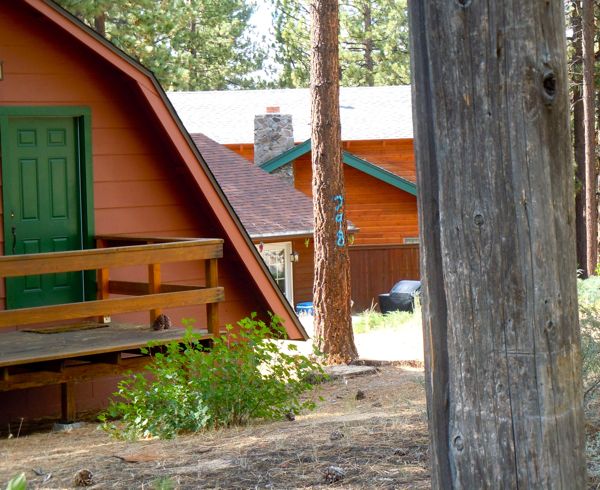
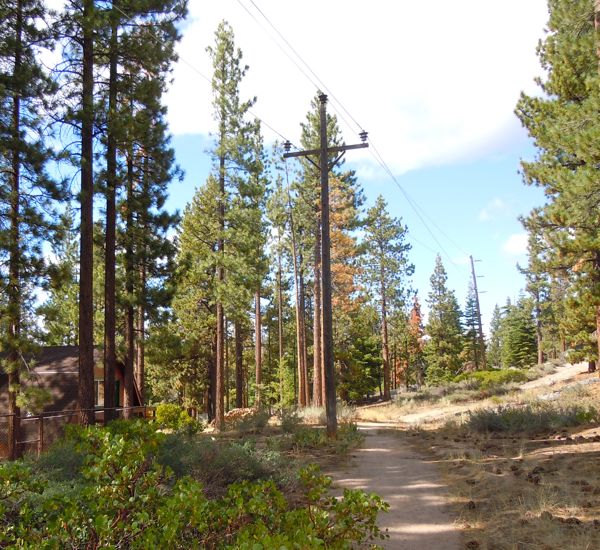
Blue numbers are mysteriously cropping up on trees along Powerline Trail. It’s not just Forest Service land being marked. And it’s not the feds with the spray paint.

It’s NV Energy out of Reno numbering the trees.

But no one is letting homeowners know what is going on.

NV Energy marked the tree, middle, being a threat to the power pole on the right. Photos/Kathryn Reed

NV Energy marked the tree, middle, being a threat to the power pole on the right. Photos/Kathryn Reed

For Janill Gilbert, whose house in South Lake Tahoe backs to the trail, it was a bit disconcerting to come back from a jog one day to find a tree in her yard with the number 798 on it.

If it falls one way, it goes into the power line, falls another it hits open dirt, falls the other two ways it could do some serious structural damage.

It’s not just dead trees or ones in the forest Gilbert has seen marked. All have been in the 700s.

Up the trail a bit is No. 800 – on land the Forest Service owns.

“We do work with the utilities. We have agreements and easements with them,” Cheva Heck, USFS spokeswoman, said. This parcel is one of the urban lots the agency owns.

But the Forest Service didn’t have any insider information over any other property owner. They found about the painted trees when Lake Tahoe News called.

An NV Energy official said the plan is to notify property owners their trees are going to be felled when all have been marked. The plan is for the work to be done this fall.

Not all rust colored pines have been tagged for removal.

Not all rust colored pines have been tagged for removal.

“We have a 60,000-volt line from Stateline to Meyers. An arborist is out there now going through the entire line. He is not done,” Fay Anderson, spokeswoman with the utility, told Lake Tahoe News.

Fay said it is the power company’s responsibility to make sure limbs and trees don’t threaten the lines. They have the authority to trim or remove trees in their right-of-way.

“Most properties have easements for utilities,” Fay said.

Dealing with NV Energy issues is not new to Gilbert.

The trail is a bit of an L-shape through the forest. Where it starts going uphill is where a pole caught fire in May. Gilbert said they heard a noise, saw flames and called the fire department. The decision was to let it burn out, which took about 24 hours, as embers fell onto the snow below. Soon after a new pole was erected.

Looking at the land behind Gilbert’s house and the others along the street, it’s hard to know what the arborist was thinking when he chose to tag certain trees. The one in her yard and up a short ways are dead. But other ones along the route that could conceivably fall onto the power line are dead, too.

Gilbert wonders if the power company will have to come back next year. Something is killing her trees. In the handful of years she’s lived in the house 15 of the 20 backyard trees have had to come down.

She speculates it is drought conditions. With being at the bottom of a hill, her vegetation is not well watered. Plus, she doesn’t have an irrigation system out back.

NV Energy might want to drive along her street. The seemingly healthy trees in front are swaying against the power lines.


AAUW potluck open to public

South Lake Tahoe AAUW welcomes members, guests, and the public to a potluck brunch on Sept. 11 at 10am at the Aspen Room at Lake Tahoe Community College.

The middle school girls AAUW sent to Tech Trek Math and Science Camp at Stanford this summer will share their adventures.

For more information and reservations, call (530) 541.1299.


Marketing grants available on North Shore

The North Lake Tahoe Resort Association, in collaboration with the North Lake Tahoe Chamber of Commerce, is accepting applications for its 2010-11 Community Marketing Grant Program. The deadline to apply is Oct. 8 at 5pm.

The majority of grants awarded will be in the $500 to $2,500 range, with possible $5,000 grants going to large-scale events.

The Community Marketing Grant Program provides marketing and promotional support to special events or projects and programs that bring visitors to the region; generate local and regional business revenue; provide local and regional media exposure; and opportunities for public relations. Grants cannot be used for capital investments, salaries, operational overhead, food and beverage, entertainment and supplies.

Because the funding for this grant program comes from Placer County transient occupancy tax through the North Lake Tahoe Resort Association the public revenue and other benefits generated must accrue principally to areas within Placer County.

The North Lake Tahoe Chamber of Commerce staff will review all Community Marketing Grant Program applications, followed by the Chamber of Commerce Advisory Committee during a regular public meeting. If approved by the Chamber of Commerce Advisory Committee, the North Lake Tahoe Resort Association board of directors will then consider the grant applications, typically as a Consent Calendar item on its regular board of directors meeting agenda.

For more information about the Community Marketing Grant Program and/or a Grant Funding Criteria and Application Form, call Kym Fabel at (530) 581.8764 or kym@puretahoenorth.com. An application form may also be downloaded off the North Lake Tahoe Chamber of Commerce website, click on Programs & Documents.


UNR QB throws under the radar despite his stats

By Adam Himmelsbach, New York Times

When Colin Kaepernick interned at a University of Nevada-themed sports apparel store this summer, he sold Wolf Pack clothing to people who often did not know that he plays for the football team. One customer even asked Kaepernick to help her find the jersey of the quarterback, unaware she was speaking to him.

“Colin goes, ‘I’m pretty sure it’s No. 10, and it’s right over here,’” said Shane Stuart, a manager at Silver and Blue Outfitters at Meadowood Mall in Reno. “He rang up her purchase and everything.”

Despite being the second player with consecutive seasons of 2,000 yards passing and 1,000 yards rushing in the N.C.A.A.’s Football Bowl Subdivision, Kaepernick enters his senior season in relative anonymity. He is overshadowed in the Western Athletic Conference by Boise State quarterback Kellen Moore, and he is overshadowed at the mall by the food court.

But it seems inevitable that his profile will rise with his yardage totals.

Read the whole story


Explaining what can be done about Tahoe’s clarity

By Harold Singer

In the late 1960s the average depth of clarity at Lake Tahoe was measured at more than 100 feet. Lake clarity, like a person’s temperature, is a sign of the health of the lake. A change in a person’s temperature signals a health problem, but it does not tell you what is causing the problem. Similarly, a decline in lake clarity is a sign of a problem, but does not tell us what is causing the problem.

Since that time in the late ’60s, lake clarity has declined about 30 feet. Also, in the last decade the amount of algae along the lake’s shoreline appears to have increased significantly – another sign of a problem.

Harold Singer

Harold Singer

During the previous few decades, scientists believed the primary cause of clarity loss was increasing algae growth in the lake. This algae growth was due to increased nitrogen and phosphorus entering the lake from stormwater runoff and atmospheric deposits into the lake. Phosphorus was primarily associated with soil particles. So, restoration and water quality improvement projects focused on controlling erosion, capturing and trapping stormwater runoff before it reaches streams or the lake, and reducing fertilizer use. These efforts appear to have contributed to the slowing of the loss of clarity that has occurred over the last few years.

However, more recent studies have determined that reductions in clarity are influenced more by the presence and persistence of very fine sediment particles remaining in suspension in the lake, rather than algae. More than two-thirds of these fine sediments are generated in the developed areas around the lake and mostly from the roads. The remainder comes from locally generated air pollution that is deposited onto the lake surface (16 percent), runoff from forested lands – specifically dirt roads and trails (10 percent), and from stream channel erosion (4 percent).

In order to make real strides in addressing lake clarity, we all must focus our efforts on significantly reducing the amount of these very fine sediment particles along with nitrogen and phosphorus that get into Lake Tahoe.

The California Lahontan Water Board and the Nevada Division of Environmental Protection have drafted a plan — The Lake Tahoe Total Maximum Daily Load for Sediment, Nitrogen and Phosphorus — to reduce fine sediment, nitrogen and phosphorus inputs to Lake Tahoe. This draft plan incorporates current efforts to reduce the amount of nutrients (nitrogen and phosphorus) reaching the lake while placing additional emphasis on reducing fine sediment generated from the developed areas (local and state roads and developed commercial and residential parcels). In California, this plan would require the city of South Lake Tahoe, El Dorado and Placer counties, and Caltrans to take actions to reduce their contribution of fine sediment by 32 percent over 15 years.

In Nevada, the Nevada Division of Environmental Protection will track similar reductions from Nevada road departments. Currently, these entities are required to treat all stormwater discharged to the kake to meet specified standards. The draft plan would give these entities flexibility to focus their efforts in areas that generate the greatest amount of pollutants, thereby providing cost-effective opportunities as compared to current requirements.

Now that we know what is causing the decline in kake clarity, we all have a role in helping the lake recover. All of us living and recreating in the Tahoe basin can do our part to assist state and local governments in this effort. Runoff from private parcels typically drains to roadways. Minimizing this runoff reduces the potential cost for the public agencies. Native soils provide natural infiltration; however, when soils are compacted due to frequent vehicle use or disturbance, more runoff is generated. Paving and providing infiltration systems for legal parking areas combined with restricting vehicle use on dirt surfaces also limits runoff to roadways or storm drainage systems.

The Lahontan Water Board will conduct a hearing Sept. 8 beginning at 9am at the Lake Tahoe Community College, with anticipation of an additional hearing on Nov. 10 where the Water Board will consider adoption of the plan. The Lahontan Water Board website (http://www.waterboards.ca.gov/lahontan/) contains a recently released film on the plan along with the proposed plan and supporting science.

Harold Singer is executive director of the Lahontan Regional Water Quality Control Board.