U.S. attorney, FBI agent singled out for work

By Kathryn Reed

It is never the work of one person to put a criminal behind bars; it often takes cooperation at many levels.

The efforts of Michelle Rodriguez, assistant U.S. attorney for the Eastern District of California, has helped get a number of South Lake Tahoe’s notorious criminals off the streets for years.

In her 20 years she has worked on the Jaycee Lee Dugard case, Operation Clean Sheets that involved fraud against the Redevelopment Agency, the Fedora bank robbery, multiple child exploitation cases, and more recently the case of disgraced South Lake Tahoe police Officer Johnny Poland, who in November started serving an 18-month sentence for obstruction of an official proceeding.
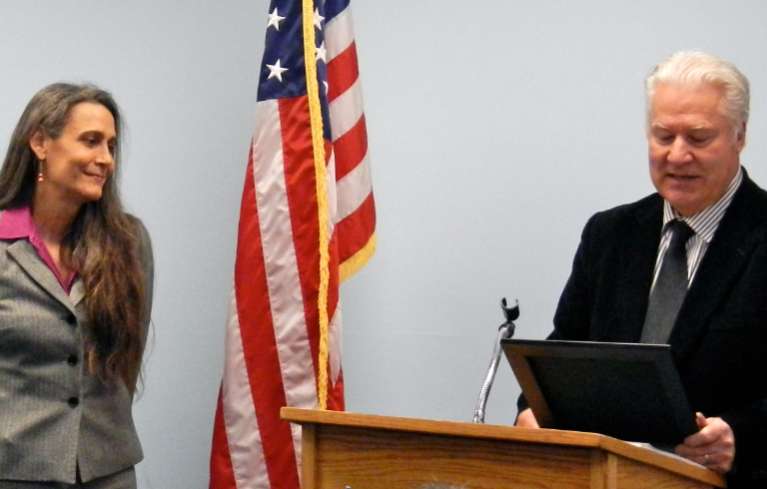
South Lake Tahoe Mayor Hal Cole reads a proclamation for Assistant U.S. Attorney Michelle Rodriguez. Photo/LTN

South Lake Tahoe Mayor Hal Cole reads a proclamation for Assistant U.S. Attorney Michelle Rodriguez. Photo/LTN

As Mayor Hal Cole read the list of her accomplishments, he added, “It sounds like we have a horrible city here.”

Rodriguez countered, “We’re working together to pull the weeds in the community.”

While the veteran prosecutor is not retiring, the South Lake Tahoe Police Department and local FBI office believed it was long overdue to recognize Rodriguez’s contributions to making the area a safer place by getting criminals locked up.

“What Michelle excels at is digging deeper, finding out what is really there,” local FBI Agent Chris Campion said at the ceremony last week.

Tom Osborne, assistant special agent in charge of the Sacramento FBI office, said Rodriguez “is a model for how to get things done.”

Rodriguez refused to take full credit for the accomplishments her peers spoke of.

“You guys make the cases and pound the pavement,” she said to the room full of officers.

Afterward Rodriguez told Lake Tahoe News, “What makes a difference is this community is interested in dealing squarely with the problems confronting it.”

She had high praise for Campion who was also honored for his years of service as the resident FBI agent in South Lake Tahoe. He admitted to the irony in everyone being able to keep the surprise from him.

“He can bring resources together and that makes a difference,” Rodriquez said.

While Campion is not retiring, his accomplishments were also noted. Both were given proclamations from the city.

“Mr. Campion goes out of his way. He juggles a lot of balls in the air at the same time and does so with aplomb and grace,” Rodriguez said.

Several South Tahoe officers praised the work of Campion.

“One reason I’m here now is this man shoots straight,” police Lt. Brian Williams said of Campion. They were involved in a shooting several years ago.

Also being presented was Poland’s badge. Campion returned it to Police Chief Brian Uhler. It was recovered during the investigation. Poland had given it to someone with close ties to gangs and violent people, Campion said.


Opinion: Defensible space incredibly important

By Jeff Meston

The vegetation surrounding a building or structure is fuel for a fire. Even the building or structure itself is considered fuel. Research and experience have shown that fuel reduction around a building or structure increases the probability of it surviving a wildfire.

Good defensible space allows firefighters to protect and save buildings or structures safely without facing unacceptable risk to their lives. Fuel reduction through vegetation management is the key to creating good defensible space.

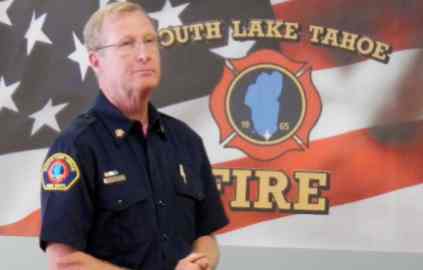
Jeff Meston

Jeff Meston

Terrain, climate conditions and vegetation interact to affect fire behavior and fuel reduction standards.

• Properties with greater fire hazards will require more clearing. Clearing requirements will be greater for those lands with steeper terrain, larger and denser fuels, fuels that are highly volatile, and in locations subject to frequent fires.

• Creation of defensible space through vegetation management usually means reducing the amount of fuel around the building or structure, providing separation between fuels, and or reshaping retained fuels by trimming. Defensible space can be created removing dead vegetation, separating fuels, and pruning lower limbs.

• In all cases, fuel reduction means arranging the tree, shrubs and other fuels sources in a way that makes it difficult for fire to transfer from one fuel source to another. It does not mean cutting down all trees and shrubs, or creating a bare ring of earth across the property.

• A homeowner’s clearing responsibility is limited to 100 feet away from his or her building or structure or to the property line, whichever is less, and limited to their land. While individual property owners are not required to clear beyond 100 feet, groups of property owners are encouraged to extend clearances beyond the 100 foot requirement in order to create communitywide defensible spaces.

• Homeowners who do fuel reduction activities that remove or dispose of vegetation are required to comply with all federal, state or local environmental protection laws and obtain permits when necessary. Environmental protection laws include, but are not limited to, threatened and endangered species, water quality, air quality, and cultural/archeological resources.

The methods used to manage fuel can be important in the safe creation of defensible space. Care should be taken with the use of equipment when creating your defensible space zone. Internal combustion engines must have an approved spark arresters and metal cutting blades (lawn mowers or weed trimmers) should be used with caution to prevent starting fires during periods of high fire danger. A metal blade striking a rock can create a spark and start a fire, a common cause of fires during summertime.

Vegetation removal can also cause soil disturbance, soil erosion, regrowth of new vegetation, and introduce non-native invasive plants. Always keep soil disturbance to a minimum, especially on steep slopes. Erosion control techniques such as minimizing use of heavy equipment, avoiding stream or gully crossings, using mobile equipment during dry conditions, and covering exposed disturbed soil areas will help reduce soil erosion and plant regrowth.

Areas near water (riparian areas), such as streams or ponds, are a particular concern for protection of water quality. To help protect water quality in riparian areas, avoid removing vegetation associated with water, avoid using heavy equipment, and do not clear vegetation to bare mineral soil.

General Guidelines:

1. Maintain a firebreak by removing and clearing away all flammable vegetation and other combustible growth within 30 feet of each building or structure. Single specimens of trees or other vegetation may be retained provided they are well-spaced, well-pruned, and create a condition that avoids spread of fire to other vegetation or to a building or structure.

2. Dead and dying woody surface fuels and aerial fuels within the Reduced Fuel Zone shall be removed. Loose surface litter, normally consisting of fallen leaves or needles, twigs, bark, cones, and small branches, shall be permitted to a depth of 3 inches. This guideline is primarily intended to eliminate trees, bushes, shrubs and surface debris that are completely dead or with substantial amounts of dead branches or leaves/needles that would readily burn.

3. Down logs or stumps anywhere within 100 feet from the building or structure, when embedded in the soil, may be retained when isolated from other vegetation. Occasional (approximately one per acre) standing dead trees (snags) that are well-spaced from other vegetation and which will not fall on buildings or structures or on roadways/driveways may be retained

Grass generally should not exceed 4 inches in height. However, homeowners may keep grass and other forbs less than 18 inches in height above the ground when these grasses are isolated from other fuels or where necessary to stabilize the soil and prevent erosion.

Jeff Meston is the fire chief for South Lake Tahoe.


Drought workshops available for Nev. farmers

With the 2014 drought looming, University of Nevada Cooperative Extension is offering workshops across the state this month and next to give Nevada agricultural producers, particularly alfalfa and grass hay producers, information to help them prepare for the drought.

Topics will include water availability, recommended irrigation practices, insurance options and an outlook on prices. The first workshop will be March 20.

The workshops are:

  • 6pm March 20 in Fallon at the Churchill County Cooperative Extension Office, 111 Sheckler Road; and in Caliente, via videoconference at the Lincoln County Cooperative Extension Office, 360 Lincoln St. This session can be made available to other communities via videoconference. Call 775.945.3444, ext.12.
  • 1pm April 1 in Eureka, in the Commissioners’ Chambers at the Eureka County Courthouse, 10 S. Main St.
  • 1pm April 14 in Schurz, in the Walker River Paiute Tribe Learning Center, Hospital Road, off of Highway 95.
  • 6pm April 14 in Yerington, at the Lyon County Cooperative Extension Office, 504 S. Main St.
  • 6pm April 29 in Minden, at the CVIC Hall, 1604 Esmeralda Ave. Note: This session will discuss irrigation practices only, and is part of the Agriculture Innovation Series Forum, where small-acreage equipment and services will also be discussed.

Those attending are encouraged to preregister by calling 775.945.3444, ext. 12 or emailing kintzj@unce.unr.edu.


Calif. lawmakers propose limits on gifts

By Laurel Rosenhall, Sacramento Bee

Following a spate of ethical problems at the Capitol, a group of California lawmakers Thursday proposed a set of bills they say will change the way they do business.

In recent months, two senators have taken leaves of absence to fight criminal charges, and two Sacramento lobbying firms paid record-setting fines for violating lobbying laws.

Senate Democrats, saying the events had prompted their action, unveiled proposals to ban campaign fundraising parties at the homes of registered lobbyists, cap gifts for legislators at $200 apiece and specifically prevent them from getting free tickets to concerts, sporting events and amusement parks.

Read the whole story


Run benefits Sugarloaf Station Foundation

The Sugarloaf Stampede is a run that benefits the Sugarloaf Station Foundation.

It’s on the El Dorado Trail at the Jacquier Road trailhead on March 29. It is an out and back course that is part-paved, part-dirt over what was once the Southern Pacific Railway line.

The run consists of three course lengths: a 5K run/walk, a 10K and 10-mile run. The run will be chip timed by J & J Sports Productions.

Registration is online.

In its 53rd year, Sugarloaf brings a unique camp experience to the students of El Dorado County. Sugarloaf is an overnight camp that runs Sunday to Saturday where campers are given the opportunity to expand their fine arts skills and to experiment with new ones.


El Niño could bring wet weather to Calif.

By Tony Barboza, Los Angeles Times

U.S. government forecasters say odds are increasing that El Niño, an ocean-warming pattern that alters weather across the globe, will develop later this year.

Conditions in the eastern tropical Pacific have shifted enough that the National Oceanic and Atmospheric Administration on Thursday activated its alert system to issue an official El Niño watch.

The alert means that meteorologists now believe El Niño, a natural cycle that occurs every two to seven years, has a more than a 50 percent chance of forming by the summer or fall.

Read the whole story


Phone scammers targeting Washoe County

The Washoe County Sheriff’s Office warns area residents about an emerging phone scam in which people are posing as local law enforcement personnel to  money from innocent victims.

“Our Office has received a number of calls in the last couple of days about scammers, using names of legitimate law enforcement personnel, who use the threat of imprisonment unless the victim pays,” Undersheriff Tim Kuzanek said in a statement.

Kuzanek said that scammers tend to target vulnerable people such as the elderly and those who are new to the country. Scammers telephone potential victims and identify themselves as a representative from a local law enforcement agency such as the Washoe County Sheriff’s Office. They may represent themselves as being with other local law enforcement agencies as well. The scammer tells the person there is a warrant out for their arrest for a certain amount of fine. The reason for the warrant is represented as being anything from a traffic violation to failure to pay full income tax requirements to the Internal Revenue Servic

“Although the Washoe County Sheriff’s Office will sometimes make calls to inform someone about a warrant, we never ask for payment over the phone or negotiate for payment in lieu of arrest,” Kuzanek said.

Anyone who has been a victim of this scam, or who receives such a call, is encouraged to take down as much information as possible, such as a name and call back number, without giving any information away. Then contact the Washoe County Sheriff’s Office at 775.785.9276.


Silicon Valley mogul to speak at Squaw

Hector Ruiz, a 20-year Silicon Valley mogul in microchip technology, will speak at the Olympic Village Lodge on April 19.

Ruiz will focus on life, leadership, innovation, and fair competition. Ruiz’s recent book “Slingshot: AMD’s Fight to Free An Industry From the Ruthless Grip of Intel” focuses on the $1.25 billion settlement that Intel paid to AMD regarding Intel’s predatory business practices while elaborating on his humble upbringing as well as advice and lessons learned from his relatives and teachers. Ruiz has also worked for Texas Instruments and Motorola.

Doors at 5:30pm, event starts at 6:30pm.

After the event, Squaw Valley Institute will be offering an all inclusive, three-course dinner with Ruiz at Graham’s. Event tickets are $15. Dinner and event is $75. Go online to purchase tickets.


Talk to feature Tahoe Rim Trail

Shannon Skarritt, director of membership and outreach with the Tahoe Rim Trail Association, will give a presentation in South Lake Tahoe on April 22.

She will introduce people to a snippet of TRTA’s 33-year history as well as its many programs, volunteer projects and all eight segments via a slideshow.

The evening will provide the public with the knowledge to be ready for the upcoming hiking season.

The free event is at 5:30pm at the South Lake Tahoe Library, 1000 Rufus Allen Blvd.


Poll: Nevada obesity rate among lowest in U.S.

By Kira Terry, Las Vegas Review-Journal

A Gallup Well-Being poll released last week shows Nevada among the top three states with the lowest obesity rates with an average of 21.1 percent obesity.

Nevada comes in as the third lowest in the nation, falling just behind Colorado at 20.4 percent and Montana at 19.6 percent.

Gallup used information gathered from telephone interviews that took place through much of 2013 as part of the Gallup-Healthways Well-Being Index survey.

The poll highlights that Nevadans and other top states with the lowest obesity rates have less of a possibility of being diagnosed with chronic diseases during their lifetime, such as high blood pressure, high cholesterol, depression, diabetes, cancer and heart attack.

Read the whole story