Donation to Dangberg Ranch fortifies collection

A significant collection of historic artifacts, documents and photographs has been donated to the Dangberg Home Ranch Historic Park by Dangberg family member C. Stephen Achard Jr.

The items help tell the story of the Dangberg family and the history of Carson Valley’s schools, businesses, events and families. Also new to the collection are several items recently found in a hidden dresser drawer just discovered at the park. Selections from both these acquisitions are now on display as part of guided tours of the Dangberg family home.

“Mr. Achard’s donation of family heirlooms and personal memorabilia makes an important contribution to fulfilling the park’s mission,” park interpreter Mark Jensen said in a press release. “The hundreds of items from the 19th and 20th centuries will help the park present the history of Carson Valley and Nevada ranching. There are some real treasures and we thank Mr. Achard for his generosity.”

Several items were recently discovered in a “hidden” drawer located at the bottom of a 19th century dressing table, including prints of skiing photographs shot and signed by Antoinette “Toni” Hiller, a noted sports and fashion photographer in the 1950s, and an herbarium of pressed flowers from the late 19th century.

Tours of the park continue Wednesday through Sunday at 10am and Saturday and Sunday at 2pm. Tours run through Dec. 12.

Tours are open to the public and cost $3 for adults, and free for children 12 and younger.


Applications being accepted for Youth Science Institute

Are you a high school student interested in learning more about science? Would you like to add a great experience onto your college resume while also having a great time and making new friends?

High school students interested in science may apply for the Youth Science Institute (YSI) program by Dec. 17. This afterschool program is offered on Wednesdays from 4 to 6pm at the Tahoe Center for Environmental Sciences in Incline Village beginning Jan. 26 and running through May 25, 2011.

UC Davis Tahoe Environmental Research Center (TERC) and Space Science for Schools will be hosting the fourth annual Youth Science Institute. This 15-week program is for high school students in grades 9 through 11 who have an interest in exploring different scientific disciplines. Students will conduct different science experiments and activities including stream monitoring, fish dissection, earth science geology hikes, astrobiology, biochemistry, green building demonstrations, lake science on the UC Davis Research Vessel John Le Conte and more. The students will not only gain knowledge and skills in various scientific fields and work with scientists, but will receive opportunities for paid internships, fulfill community service hours, and receive letters of recommendation.

Send applications or any questions to Martin Frye, UC Davis Tahoe Environmental Research Center AmeriCorps Member at mfrye@ucdavis.edu or (775) 881.7560, ext. 7483.

Additional details and the application are available online.


Pumpkin festival in Stateline

Lake Tahoe Community Pumpkin Festival is Oct. 22 from 5:30-8:30pm at 143 Michelle Drive, Stateline.

There will be a bounce house, face painting, mad science lab, raffles, games, bake sale and costume contest.

The event is free.

For more information, call (775) 588.5437.


Lecture about cloud seeding in Sierra at SNC

Arlen Huggins will discuss cloud seeding to enhance snowfall at Sierra Nevada College on Oct. 20.

Cloud seeding has been conducted in the Sierra Nevada since the 1950s and in the Lake Tahoe area since the 1960s. As a form of weather modification, wintertime cloud seeding is aimed at enhancing snowfall in mountainous regions to increase the snowpack, resulting in more spring runoff and water supplies to the surrounding areas.

Cloud seeding research is still being conducted, but the scientific basis for wintertime cloud seeding evolved mainly from detailed investigations of clouds and their response to various seeding materials in the 1980s and 1990s. Significant results from several of these research efforts will be presented to explain how the conceptual model for seeding winter storms came about, and how it is being applied today in areas like the Tahoe basin.

DRI scientists have played a major role in cloud seeding research and a specific DRI evaluation method using ultra trace chemical analysis of snow samples continues to be applied in ongoing research and operational seeding projects. Some examples of this unique evaluation method will also be presented.

Huggins, with the Desert Research Institute, has an active interest in applied research in summer convective storms and wintertime storms. He has studied the evolution of winter storms over mountainous terrain, including field projects in the Sierra Nevada of California and Nevada, the Wasatch Mountains of Utah and the Victorian Alps and Snowy Mountains of Australia. As a researcher Huggins has studied the physical effects of both airborne and ground-based cloud seeding on winter storm clouds, and produced several publications documenting the effects of seeding from cloud to ground. He manages the Cloud Seeding Program at DRI, which is designed to augment snowfall in selected mountainous regions of Nevada, California and Colorado.

Date: Oct. 20

Time: 5:30pm no-host bar/door opens; 6pm program

Cost: $5. Students free.

Location: Assembly Rooms 139 & 141 Tahoe Center for Environmental Sciences, 291 Country Club Drive, Incline Village, on the campus of Sierra Nevada College.


Google pilots self-driving car around Lake Tahoe

By Sharon Gaudin, Computerworld

Picture sitting in your car, maneuvering through busy downtown traffic while talking on your phone or sending a few texts.

This isn’t a scene of illegal texting or phone use. Why not? Because the car in this scenario is driving itself, leaving the passengers inside free to use their mobile phones. (In Google’s ideal scenario, you’d be talking on an Android phone.)

This is Google’s image of the future. The company known best for its search engine announced this past weekend that its engineers are working on developing technology for cars that can drive themselves. Autonomous cars may be a bit far afield from Google’s normal work in search, browsers, operating systems and maps, but the company is looking to head down a new road.

“Our automated cars, manned by trained operators, just drove from our Mountain View campus to our Santa Monica office and on to Hollywood Boulevard,” wrote Sebastian Thrun, a distinguished software engineer at Google, in a Saturday blog post. “They’ve driven down Lombard Street, crossed the Golden Gate bridge, navigated the Pacific Coast Highway, and even made it all the way around Lake Tahoe. All in all, our self-driving cars have logged over 140,000 miles. We think this is a first in robotics research.”

Read the whole story


Lights on South Tahoe High football field to be permanent

By Kathryn Reed

Sam Borges won’t be at the dedication of Viking Bowl next year when the South Tahoe High School football team takes the field on its lighted artificial turf field. But his three sons – Don, Dave and Dwight — likely will be, along with his widow, Rosie.

Sam and Rosie Borges talked for a decade about putting lights on the gridiron. Unfortunately, Sam Borges died earlier this year before the dream was realized.

Speaking to the Lake Tahoe Unified School District board of trustees on Tuesday, Don Borges became choked up talking about his parents’ dream. As athletic director of the school, he will be instrumental in pulling off this endeavor.
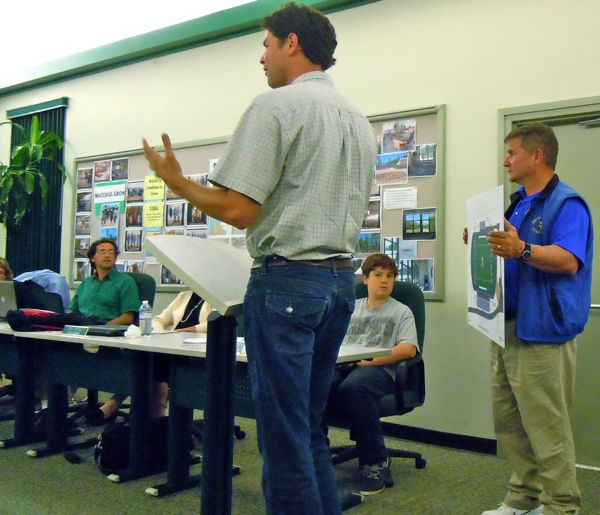
Don Borges, right, holds a rendering of the football while architect Brett Long talks about it. Photo/Kathryn Reed

Don Borges, right, holds a rendering of the football field while architect Brett Long talks about it. Photo/Kathryn Reed

On Oct. 12, the board voted 5-0 to go forward with the nearly $1 million project that could be completed by the 2011 season.

Temporary lights have been brought in twice this season. The inaugural event drew out about 1,000 people, and last week’s romp over Sparks saw about 800 in the stands.

Principal Ivone Larson read an almost poetic account of how those two games have brought the school and community together, and then delved into what a renovated, permanently lighted facility would mean to the school and town.

Besides being a moneymaker at $6 a ticket, the vision is the field could be rented to outside interests.

Chuck Leonard, president of the local Pop Warner association, said he has had calls from semi-pro leagues wanting to have games in South Lake Tahoe. Today, no field can accommodate them.

What the board approved Tuesday will allow Leonard to say “yes” in the future when people call.

Leonard spouted figures of 22 weekends a year being available to athletic teams wanting to use this as a football or soccer field that could infuse $150 million to $175 million into the economy.

The turf and lighting are expected to cost about $1.057 million. The district has a donor lined up to contribute $120,000, and will work on a match of $120,000 from the community. Until the agreement is signed, the donor’s name is not being released. This brings the cost to the district for phase one to $817,000.

The plan is to do phase one and two simultaneously. Phase two includes a concession stand that is likely to be LEED certified with ADA compliant restrooms. Spectators now use bathrooms at Mount Tallac High or the new building on STHS’ campus. But the American with Disabilities Act compliant facilities were going to need to be built sooner rather than later, which is why the district wants to expedite that aspect of the plans.

The anonymous donor has pledged $180,000 toward phase two.

Total for the district for the two phases would be $988,050. The money would come from developer fees. Those dollars can only be spent on construction projects. Less than $1.5 million is in that account now.

The third phase, which does not have a timeline, would get rid of the current bleachers. It would provide 1,000 seats on the home side, and 500 for visitors at a cost of $407,000.

Brett Long of Brett T. Long Landscape Architecture had a rendering of what the field could look like – including the Viking logo in midfield.

The footprint would encompass about 95,000 square feet. The oval would not be a regulation size track, but could be used for training – not meets.

School officials envision the artificial turf providing more opportunities for physical education classes because the field could be plowed in early spring. Plus, spring sports would now have a place to practice instead of going to the Carson Valley.

When it comes to raising money from the community, the plan is to sell blue and gold bricks (school colors) for $100 and $200, respectively, that will have the donor’s name on it. They will be incorporated into the design of the revamped stadium.

When the track and field at South Tahoe Middle School was constructed a few years ago about $700,000 in cash was raised and roughly $400,000 in in-kind services provided. District officials realize that kind of giving isn’t likely to happen in these economic times, but they are confident the town will come through with $120,000 to seal the deal.

To donate, call Angie Keil at (530) 541.2850, ext. 225.


Author of French bulldog puppy book in Reno Oct. 23

Michele Copen, author of “The Heart Thieves: Enchanting French Bulldog Puppies”, will be signing her new release at Scraps Dog Company, 6120 Mae Anne Store at Robb Drive in Reno on Oct. 23 from 12:30-3:30pm.

Along with the book signing event, there will be a French bulldog costume contest with prizes.

The book is a full-color, limited printing, collector’s book.

The book has been created by the author and photographer of the multi-award-winning book, A French Bulldog for Every Season.

“My goal with this book was to take my artistic experience and style expertise and blend them with the love I have for animals in general and my passion for the French Bulldog breed in particular. I worked on the book part-time for three years. The result is my contribution to the world of French Bulldogs,” Copen said in a release.


Rim to Reno trail about to break ground

Construction of the long-awaited Rim to Reno Trail System gets under way at 9am Oct. 16 at the Mt. Rose Trailhead near the summit of the Mt. Rose Highway.

Representatives from the Tahoe Rim Trail Association, United States Forest Service-Carson Ranger District, Great Basin Institute and Washoe County Regional Parks and Open Space will join volunteers in breaking ground on the new trail that connects the existing Tahoe Rim Trail to Reno.

The Tahoe Rim Trail circles the mountain ridges above Lake Tahoe, through the Humboldt-Toiyabe National Forest’s Mount Rose Wilderness. The Rim to Reno project will build new trail segments connecting the existing trails and creating a new system that includes loop trails along with the connector trail to Reno.

The Mt. Rose Summit Trail and the Tahoe Rim Trail have seen a dramatic increase in popularity since the trailhead at the Mount Rose Welcome Plaza, was completed in 2004. One of the goals of the new trail system is to provide quality recreation opportunities while minimizing impacts and reducing the potential for wilderness use conflicts.

The new trail system will be accessible through the Mt. Rose Summit Trailhead, U.S. Forest Service’s Thomas Creek and White’s Creek Trailheads, and Washoe County’s Galena Creek Regional Park, Lower White’s Creek and Lower Thomas Creek Trailheads. Ultimately, the trail system will be accessible from other Washoe County Trailheads, including the new Ballardini Trailhead, which is scheduled for completion in 2011.


Cycling in burn area a constant reminder of June 2007

By Kathryn Reed

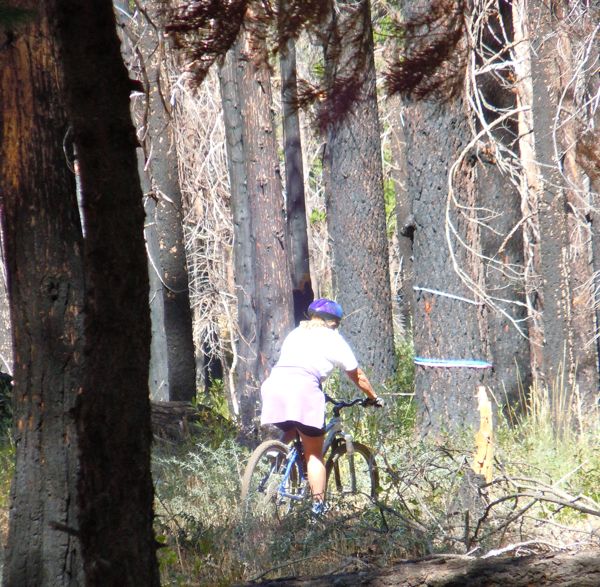
In every burned forest a line clearly marks where the fire was put out. That contrast of charred wood and lush green gets me every time.

I know for the people who call Gardner Mountain home and who re-create there regularly, the Angora Fire of 2007 has forever changed this little part of the South Shore. Maybe I need to ride there more often to get used to it. Or maybe that’s just not possible.

Sue Wood rides through the burned forest of Gardner Mountain. Photos/Kathryn Reed

Sue Wood rides through burned Gardner Mountain. Photos/Kathryn Reed

Sadness fills me every time I go there. Maybe it’s being immersed in dead, black trees. This same reaction does not befall me when I see the scar every day I drive in town or even when I go where those 254 houses were destroyed. It’s being outside, among the trees. It’s a feeling so hard to describe.

Mountain biking behind South Tahoe High School will continue to be one of my favorite places to pedal – no matter what it looks like. With so many offshoots, it seems I never take the same route.

Sometimes I start at the end of the football field near Mount Tallac High, other times I ride in from the side of St. Francis of the Woods condos.

I would say it’s impossible to get lost. Just keep heading north and the route always lets me out on Fallen Leaf Lake Road.

It’s not a technical route and it’s not all that long – perfect for me. But it’s fun. And it’s scenic.

As gut wrenching as it can be to see so many charred trees, it’s been interesting to watch Mother Nature heal herself in these three-plus years. Some vegetation has come back. Lake Tahoe is visible in the distance – one of the byproducts of the fire.

It’s not a route to fly over because it’s so popular with runners, walkers and dogs. But it will give you a bit of a workout depending on if you choose one of the uphill routes or stick to some of the flatter terrain.

At times it’s wide enough for the two us to ride side-by-side. This is the area where U.S. Forest Service contractors came in to rid the area of dangerous trees.

Carrying forward the black turns to green. It’s almost like another world. Soon a gate is in front of me, with Fallen Leaf Lake Road close by.

It’s decision time – ride through the campground to the lake and then on trails in that area, or head down the road and catch the paved trail that leads to Camp Richardson. This time it’s the latter.

ngg_shortcode_0_placeholder (Click on photos to enlarge.)


2-day closure of Ebbett’s Pass to remove wreckage

By Carlos Alcalá, Sacramento Bee

Crews will close a section of Highway 4 in Alpine County this week to recover a wrecked tractor-trailer.

The truck went over the embankment at Cadillac Curve. Crews from South Tahoe Towing and the U.S. Forest Service will attempt the salvage.

Highway 4 will be closed in both directions from Ebbett’s Pass to the intersection with Highway 89.

Read the whole story