Ski report: It’s a powder day
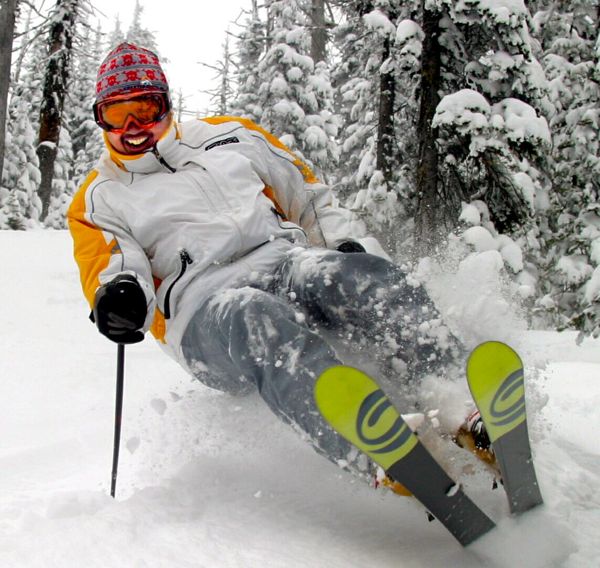 All resorts around Lake Tahoe are reporting several inches of fresh powder. At lake level on the South Shore about 3 inches of snow fell overnight.
Here is the ski report from Curtis Fong, the Guy from Tahoe.
All resorts around Lake Tahoe are reporting several inches of fresh powder. At lake level on the South Shore about 3 inches of snow fell overnight.
Here is the ski report from Curtis Fong, the Guy from Tahoe.
Looking for something different for lunch, something homemade, fresh and affordable? Look no further than the casual and friendly dining centers of the El Dorado County Senior Nutrition Program. Adults 60 years or older will find fresh homemade entrees that change daily Monday through Friday, and served between noon–12:30pm for the suggested donation of $3 per meal.
Enjoy a variety of tasty entrees carefully planned by a registered dietitian to meet one-third of an adult’s recommended dietary intake.
Dining centers are located in South Lake Tahoe, Placerville, Diamond Springs, Pollock Pines, Greenwood, Somerset and El Dorado Hills.
For more information, call the Senior Nutrition Program at (530) 621.6160. To learn more about other senior programs and services call Senior Information and Assistance at (530) 621.6369.
By Jim Sanders, Sacramento Bee
Smile at the windshield – and say cheese?
California is giving the green light to allowing video cameras to be mounted onto vehicle windshields in an attempt to improve road safety.
The goal is to make participants aware of bad habits by recording their behavior seconds before and after a crash or erratic driving maneuver.
“It seemed like a common-sense approach,” Assemblyman Nathan Fletcher said of permitting but not requiring the use of video recorders.
Parents could buy such cameras to place in their teenager’s car, but the prime market is expected to be truck, bus or other transportation companies with large fleets.
Critics question whether expanding workplace recording intrudes upon privacy in a society where cameras already are used for purposes ranging from monitoring department store aisles to detecting red-light violations.
By Jonathan Alter, Newsweek
Bill Gates is raising his arm, bent at the elbow, in the direction of the ceiling. The point he’s making is so important that he wants me and the pair of Gates Foundation staffers sitting in the hotel conference room in Louisville, Ky., to recognize the space between this thought and every lower-ranking argument. “If there’s one thing that can be done for the country, one thing,” Gates says, his normally modulated voice rising, “improving education rises so far above everything else!” He doesn’t say what the “else” is—deficit reduction? containing Iran? free trade?—but they’re way down toward the floor compared with the arm above that multibillion-dollar head. With the U.S. tumbling since 1995 from second in the world to 16th in college-graduation rates and to 24th place in math (for 15-year-olds), it was hard to argue the point. Our economic destiny is at stake.
Gates had just finished giving a speech to the Council of Chief State School Officers in which he tried to explain how administrators could hope to raise student achievement in the face of tight budgets. The Microsoft founder went through what he sees as false solutions—furloughs, sharing textbooks—before focusing on the true “cost drivers”: seniority-based pay and benefits for teachers rising faster than state revenues.
Seniority is the two-headed monster of education—it’s expensive and harmful. Like master’s degrees for teachers and smaller class sizes, seniority pay, Gates says, has “little correlation to student achievement.” After exhaustive study, the Gates Foundation and other experts have learned that the only in-school factor that fully correlates is quality teaching, which seniority hardly guarantees. It’s a moral issue. Who can defend a system where top teachers are laid off in a budget crunch for no other reason than that they’re young?
By Sharon Begley, Newsweek
If it were just kids, we could blame obesity on the cutbacks in phys-ed classes, school vending machines that sell high-calorie junk, and the substitution of videogames for kickball. If it were just adults, we could blame obesity on supersizing, fast-food meals, and pedestrian-unfriendly towns that force everyone into a car. But while 68 percent of American adults qualify as overweight or obese, and 17 percent of children do (compared with 5 percent in 1971), there are other increasingly pudgy populations. Meet some overweight pets, lab animals, and even urban rats.
David Allison, an obesity researcher at the University of Alabama at Birmingham, has long criticized the Big Two explanation for America’s thundering thighs: dwindling physical activity as a result of social changes like fewer sidewalks, and increasing calorie intake as a result of nefarious food-industry marketing. By chance, he came upon a record of marmosets in a Wisconsin research colony: the little primates’ weight had soared over the previous 15 or so years, even though they had not been bred for larger size, switched chow supplier, or undergone any other change that would obviously explain their extra heft. That set Allison looking for weight records of other animals.
With colleagues, he scrutinized the weight histories of 24 populations, from alley rats in Baltimore to lab macaques in California and even control groups of mice in federal toxicology studies. In a paper to be published in Proceedings of the Royal Society B (for biology), they report that in 23 of the 24—eight species, 20,000-plus animals—the percentage of obese individuals has risen since the 1940s (or since the oldest records they found). The odds of that happening by chance are 8 million to 1. And since neither feral rats nor lab chimps nor any of the others have cut back on phys ed or patronized vending machines more, says Allison, we need to look for explanations beyond the Big Two.
By Cheryl Katz, Environmental Health News
In a cluttered workroom at the back of the Berkeley shop, technician Bobby Panighetti readies a pair of skis for their first tracks, infusing the bottoms with hot wax. This essential ritual is being performed at winter sports centers around the world as the ski season gets under way.
 But new scientific research suggests that ski wax can expose users to potentially dangerous chemicals that can build up in bodies and may carry serious health risks, including cardiovascular disease, liver damage, hormone disruption and cancer.
Racers in particular use waxes with high amounts of fluorine-containing compounds, which can include substances known as perfluorochemicals. These so-called high-fluoro waxes make the skis go faster, but that speed could come at a cost – especially for parents who may layer on race wax week after week without knowing how to handle it safely.
By Ken Salazar and David J. Hayes
California’s water hub – the San Francisco Bay-Delta – can no longer do it all. Years of drought, worsening water pollution, rising water demands and the disappearance of wildlife and habitat have left the Bay-Delta in a state of environmental collapse. As a result, a multibillion-dollar agricultural economy, coastal fishing fleets and the 25 million Californians who rely on the Delta for clean drinking water are at severe risk.
This is the deciding moment for California’s water future. We can either complete the much-needed long-term California Bay-Delta Conservation Plan on which the Obama administration, Gov. Arnold Schwarzenegger, water users and other partners have made significant progress, or fall back into an endless cycle of conflict, litigation and paralysis.
While the conservation plan is still a work in progress, its essential elements are simple.
First, scientists and policymakers alike have concluded that California’s economic and environmental health can no longer tolerate exclusive reliance on a 50-year-old system of pumping water directly through the Delta – a system that reverses river flows, causes direct harm to fisheries, leads to unreliable water supplies and leaves many Californians at risk of losing clean water supplies if there were an earthquake.
Therefore, rather than simply pumping water from north to south through the Sacramento-San Joaquin Delta, there is an emerging consensus that we should reduce pressure on the system by also moving water around the Delta through a water conveyance system, such as a canal or a tunnel.
Ken Salazar is the secretary of the U.S. Department of the Interior. David J. Hayes is the deputy secretary of the Department of the Interior.
By Kathryn Reed
TWIN BRIDGES — Sometimes the best celebrations are spent with thousands of other people. Such was the case for the skiers and boarders schussing down the slopes of Sierra-at-Tahoe on Christmas.
One rider started taking her clothes off in the early afternoon at West Bowl saying how hot she was after starting the day at 9am. Another woman was in spaghetti straps. It was warm to start with, but the wind began to cool things down as the sun disappeared behind the clouds when the storm started to blow into the region.
Karina Kauffman, 13, didn’t mind the bulk of her gifts were not going to be opened until Christmas night.

Sierra-at-Tahoe employees in the Christmas spirit. Photos/Kathryn Reed
“This is the best time ever,” the Placerville teen said. Fewer people on the runs made her feel safer than a typical Saturday on the slopes.
Kauffman was on the mountain with her brother, dad and grandpa.
Tons of families spent the day at Sierra. Plenty of people were milling about the base lodge – seeming to be there to watch their loved ones enjoy the snow. Holiday tunes echoed through the sound system. Several people with Santa hats whizzed down the slopes, while at least one fully dressed Santa flew down on skis.
Plenty of snow covers all the slopes in and around Lake Tahoe. Sierra as of Christmas Day had received 71 inches in the last week and 240 inches since Thanksgiving.
Crews are still working on what will be the South Shore’s only super pipe.
With snow in the forecast for the better part of the week, powder days will be the norm.
Jaideep Neboori, 25, found a stash of powder under the West Bowl lift on Saturday. So much so that he got stuck for a bit, which meant his family kept on going.
He tries to get in a few days of boarding each season, but that’s more difficult now that he lives in New Jersey instead of Pleasanton, where he grew up.
For Tom Matteson, 28, and his buddy they thought visiting friends in South Lake Tahoe would be the best bet for the holidays. His family is spread out across the country so the Santa Barbara resident decided to make a shorter road trip.
“It’s always good to have fun on Christmas,” Matteson said.
Yun Mou and her husband brought their 4-year-old daughter to Sierra for her first time on skis. The San Jose couple has not been on skis for years, but said they were having fun. With limited time off from work, they said this time of year is when they can make it to the mountains.
Being from China, they said Christmas isn’t that big of a deal so it was just another ski day.
Many would say the best present was it being a Saturday without the usual crowds.
ngg_shortcode_0_placeholder (Click photos to enlarge.)
Dawn Patrol, Squaw Valley’s newest program, allows skiers and riders to experience the mountain in an entirely new way Dec. 26-31 and weekends throughout the season.
Dawn Patrol is an exclusive early morning mountain experience that includes a five-star breakfast buffet at High Camp and exclusive access to the 200 acres of tree runs, untouched corduroy and exhilarating chutes of Shirley Lake. Dawn Patrol is $49 (non-pass holders also much purchase a lift ticket).
Meet at 7:15am in the Cable Car building. Participants will ride the 7:40am Cable Car to High Camp where they have the option to enjoy a five-star breakfast or hit the slopes starting at 8am sharp for up to an hour and a half of pre-public skiing and riding on Shirley Lake. Breakfast runs from 8am to 10am. Once the mountain opens at 9am, skiers and riders will be able to access all of Squaw Valley’s 4,000 acres.
Dawn Patrol is limited to 150 people. Tickets are available for pre-purchase online at or at any ticket window prior to 3pm on the day before the Dawn Patrol date. Pending availability, tickets can also be purchased the morning-of, inside the Cable Car building. Check out the information page.
By Mike Danko, Aviation Law Monitor
We’ve filed suit against Los Gatos real estate broker Karen Trolan, her husband Steve Trolan, and their company, Trolan Enterprises, as a result of the September 2009 plane crash that left the Trolans’ passenger, 14 year-old Marilyn Mitchell, seriously injured.
The Trolans were headed from Truckee Tahoe airport to San Jose. They needed very littlKaren Trolane fuel for the short flight. But fuel was a few pennies per gallon cheaper in Truckee than in San Jose. The Trolans decided to fill the tanks of their single-engine Cessna 206 to the tops.