Vail Renaissance allows area to compete on world stage
Publisher’s note: This is the first of four days of stories about issues pertaining to Vail. Lake Tahoe News reporters spent the first week of January in Vail – skiing, eating, walking, talking, and observing. Today through Jan. 23 we share some of those experiences and insights with readers of Lake Tahoe News. The point is not to say Lake Tahoe should be Vail, but to point out what another ski town is doing. And with Vail Resorts now owning two ski resorts in Lake Tahoe and at one time wanting to be a player in the would-be convention center project in South Lake Tahoe, what Vail is doing very much pertains to Lake Tahoe.
By Kathryn Reed
VAIL – Lots of money exchanges hands each year among people who like to travel and those with a place to stay the night. The vacation rental market is a $24 billion a year business in the United States.
The town of Vail, Vail Resorts and people in the Vail Valley want their share and then some of that chunk of change.
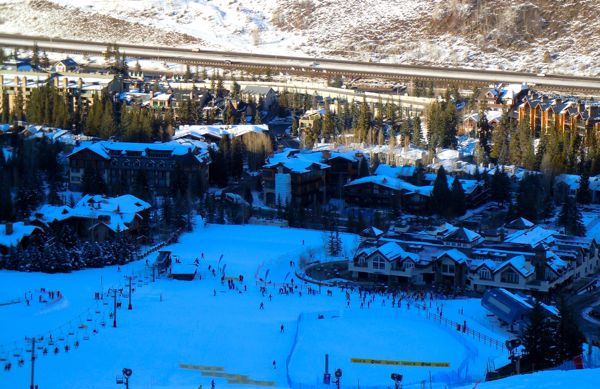
The mountain and the town of Vail blend together. Photos/Kathryn Reed
With travelers having more options these days because every town seemingly is able to capture a bit of the tourist dollar, the status quo doesn’t work. Vail looked around about a decade ago and realized it wasn’t top dog in the ski destination market. The Deer Valleys and Whistlers of the world were cutting into their profitability. (Lake Tahoe is not a threat – never has been, according to Vail officials.)
“We saw other resorts, specifically Beaver Creek and our competition in Aspen and other places that were doing new and interesting things. The traveling public is pretty sophisticated and they like new, shiny things and up-to-date accommodations. Things we had, but not enough quantity,” said Ludwig Kurz, who has been in Vail since 1966 and was on the town council from 1998-2003.
To get back in the game Vail underwent what it calls the Renaissance over the course of about 10 years. With the Four Seasons opening a month ago, and the Ritz-Carlton Residences coming online in 2010, the Renaissance is complete.
The meandering Arrabelle opened three years ago this month. It’s so monstrous it seems to take over the entire Lionshead area. The Solaris Residences in Vail proper is also hard to miss, though it is a mixed use complex. It had owners moving in last May.
The Renaissance amounted to about $250 billion in redevelopment, according to the town manager.
Kurz said intellectually people understood the need for change, but emotionally it was a harder sell to get rid of the old and build something new.
“We are lucky we didn’t have half completed buildings or holes in the ground,” Stan Zemler, Vail town manager, told Lake Tahoe News. “A lot of stuff here was controversial. One went to the public for a vote.”
Height and density concerns were some of the biggest hurdles.
The Vail Homeowners Association, a group of mostly second homeowners who united in the early 1990s to be proactive in how the surrounding neighborhoods would be impacted by development, had major reservations about the various aspects of the Renaissance.
“Most of it dealt with planning and zoning, master planning,” Jim Lamont, director of the homeowners group said of the numerous meetings. “Redevelopment was again a bitter pill for a lot of these people to swallow. But what we did was wed solving the community’s original sins with swallowing the bitter pill of more density.”
He added, “Vail was so crappily built in the first place.” (The ski resort came first, then the town.)
It took a couple years for the Lionshead master plan to come together.
“To me, master planning takes time. It’s painful, hard, (and involves) a lot of debate. But it sets the table for what you want. It creates a path for what you want and people go down that path,” Zemler said.
Lamont said his group was able to get heated streets, which he said is a must for an aging population. The VHA also was instrumental in how truck-loading docks functioned. Parking and transportation were issues they raised, too.
These urban renewal areas create tax increment that in turn pays for public improvements like streetscapes, lighting and transit.
“We raised enough issues about each new redevelopment project that things were pretty well vetted before they went under construction,” Lamont said. “The emphasis was put on rebuilding.”
Kurz believes the area was successful with the Renaissance because “we were somewhat tenacious and kept after it.” He also points to a sophisticated town staff who could handle the work involved in dealing with the public-private dealings.
“The risk comes in my mind when a developer who is an out of town person and wants to develop and doesn’t understand the community,” said Rod Slifer, with Slifer Smith & Frampton Real Estate. He’s seen it all. In 1962, the year Vail ski resort opened, Slifer was the town’s first and only real estate agent.
He is not a believer in hiring consultants to make recommendations about development or redevelopment projects.
“At least in Vail and most other ski areas I’m familiar with, the local real estate community and local government know what is needed and what would work,” Slifer said.
Sampling of properties
Vail Resorts has several subsidiaries, all with large bank accounts. This helps when it comes to remaking the town. RockResorts and Vail Resorts Management Company are two major players in the area. Much can be self-financed so bankruptcy isn’t likely.
The Arrabelle, the lodging property owned by RockResorts, is huge. It has walkways that lead from one area to the next. It’s hard to know where it ends or begins. Some people think it’s too tall because it casts a shadow on businesses that before were bathed in sunlight.
The Ritz Residences had its grand opening in November.
Kyle Denton, broker with Sotheby’s International, told Lake Tahoe News while on a tour of the property two weeks ago 18 of the 71 whole ownership units are under contract. They range in price from $1.75 million to nearly $9.2 million. The square footage is 1,500 feet to 4,500 feet.
Pre-sales were brisk in 2007 on the $111 million property, Denton said, with 2008 and 2009 being dead, and now things picking up.
Wendy Mallas, homeowner association manager for Vail Resorts Hospitality at the Ritz Residences, said more international buyers have been inquiring about the property – predominately South Americans and Mexicans. New Yorkers and Californians are the biggest domestic markets, along with Texans and people from Chicago. (These demographics parallel where skiers come from.)
The Ritz Destination Club has 45 units, with Marriott International handling the resale. (A Marriott is next door.) It is managed by RockResorts.
When the Four Seasons opened its third mountain locale at Vail in December (the others are Whistler and Jackson Hole), it was able to boast of having the largest suites in the Vail Valley. The 121 rooms are not ski-in, ski-out, but the heated ski area is next to the Vista Bahn lift for convenience.
In the first three weeks the 49-unit Ascent condo project was on the market 26 contracts had been written – this as of Jan. 7. The project is in the town of Avon at the entrance of Beaver Creek.
Prices range from $350,000 to $1.1 million. Even though they are moving, the original asking price in 2008 was more than 50 percent higher.
Inspirato is a company launched by Brent Handler, co-founder of Exclusive Resorts. Members have access to 40 luxury residence in ski destinations like Vail, Beaver Creek, Aspen, Snowmass and Dear Valley.
He has found a niche market for those who can pay a $9,500 initiation fee, $2,500 renewal fee and market prices each night. People want luxury accommodations, the amenities that go with them and flexibility in where and when they travel.
What’s next?
Ever Vail, a Vail Resorts proposed development, is wending its way through the regulatory process, with the possibility of being permitted this year. At $1 billion it is the single largest development ever proposed for Vail.
The multi-faceted project would cover about 12 acres – about the same size as the hole in South Lake Tahoe where the convention center project sits in foreclosure. This also compares to Lionshead and Vail Village that are each about 55 acres.
Literature from the company says, “Our fiscal analysis estimates Ever Vail will generate one time revenue of more than $30 million for the town of Vail, as well as $7.6 million at build-out in ongoing annual revenue that includes nearly $5 million from tax increment financing.”
Kristin Kenney Williams, spokeswoman with Vail Resorts Management Company, acknowledges the large amount of inventory in the Vail Valley that is not sold and how some believe the area is overdeveloped.
“We can’t rest on our laurels,” she said sitting in the members’-only bar at the Ritz Residences. She said the company is putting itself in a position to be ready for when the market fully turns around.
“We don’t want to cannibalize Vail Resorts or others that are here,” Williams said.
She says it will be like creating a new neighborhood.
She anticipates the soonest construction would start on buildings would be three years. Moving the frontage road that splits the property and cleaning up the toxics from the former gas station need to be handled first.
The plan is for a 102-room RockResorts hotel to be part of the mix. A gondola to service this area is also on the books. More than 400 residential units will also be part of it.
Williams estimates Ever Vail will bring about 2,000 new visitors a day to the area, with about half of them being skiers.
“That will in no way encroach on the mountain,” Williams said.
(One reason Vail does not have six-pack chairlifts is so fewer people at once are disembarking from a lift, so it keeps the flow on the mountain more manageable.)
How Ever Vail will impact travel on Interstate 70, the main artery to Denver, remains to be seen. Williams said it is a concern all parties are looking into.
Other things about Vail
Like South Lake Tahoe, about 70 percent of the homes in Vail are not occupied by the owners. They are second homeowners.
Eagle County unemployment was at 9.55 percent in October. Vail does not keep those stats. South Lake Tahoe’s unemployment topped 17 percent in November.
Vail’s population is about 5,000 people. South Lake Tahoe’s is close to 25,000.
The Vail Valley is about 35 miles long. The closer the property is to the slopes, the more expensive it is. People commute from the outer reaches, much like driving from the Carson Valley or Carson City to Tahoe.
Beaver Creek, a Vail Resorts ski mountain, expects to have the draft environmental impact statement of its improvement plan released in the first half of this year. The mountain needs beefing up before it hosts the World Championships in 2015.
The ski resort owned much of the land in Vail. Land for the hospital was donated by the resort, with a deed restriction so it remains a medical facility.
The focus of Vail Resorts is on the destination visitor, ideally who flies into the Eagle County airport and never needs a car. The Vail Homeowners Association is pushing for an international terminal at Vail Eagle airport.
Vail ski resort is in Eagle County, not the town of Vail. But all the development is in the town.
Parking is an issue in town. Since 1973, the town has spent $21 million on garages with 2,400 spaces. About 6,000 vehicles use the garages each day, according to Transportation Manager Mike Rose. The town is responsible for another 400 free spaces in the area.
Parking is free after 3pm, with other incentives.
One issue is people must use the garages at $25 day when there is vacancy or else face a $60 ticket for parking on the free frontage road.
Vail Resorts is responsible for about 90 percent of marketing in the winter. The town through a dedicated lodging tax has about $1 million to spend on summer special events. The town of Vail has a Special Events Commission to handle that. Events are geared toward locals and tourists.
ngg_shortcode_0_placeholder (Click on photos to enlarge.)