Ski report: Dress in layers
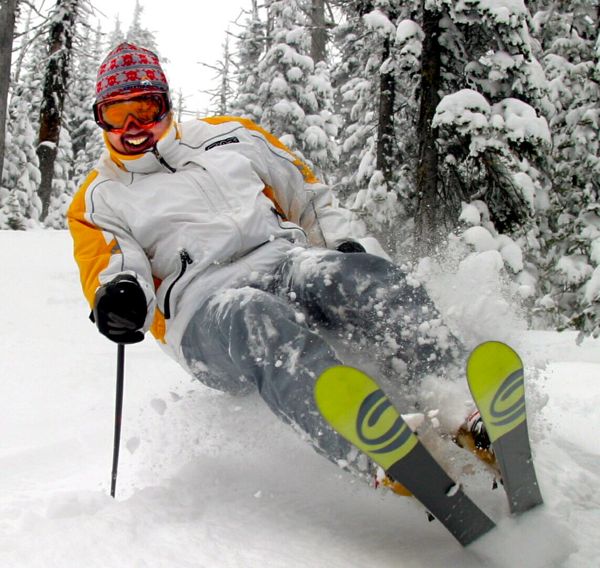 Blue skies and light winds on the slopes of Lake Tahoe today.
Here is the ski report from Curtis Fong, the Guy from Tahoe.
Blue skies and light winds on the slopes of Lake Tahoe today.
Here is the ski report from Curtis Fong, the Guy from Tahoe.
By Ski Racing Magazine News Service
CORTINA d’AMPEZZO, Italy — At the site of her first World Cup podium, American Lindsey Vonn tallied her 38th career win today in super G.
Vonn, who hasn’t finished lower than second in a speed race all season, earned her fifth victory of the season and second in a super G with a smooth run down the 1,745-meter Olympia Delle Tofane course. The 20th racer out of the start, Vonn led at every split and crossed the finish line with a time of 1 minute, 11.66 seconds to beat second-place finisher Anja Paerson of Sweden by 0.43 seconds. Vonn also climbed 71 points closer to overall leader Maria Riesch of Germany (ninth today), who currently owns a 1,052 to 927 advantage.
“I’ve been making a lot of mistakes in the last few races so today I just tried to have a clean and solid run and I’m really happy with it,” said Vonn who has become a high-speed recovery expert this season. “This gives me a lot of confidence for the next two races this weekend.”
Paerson secured her 93rd career World Cup podium and eighth in Cortina ahead of Austrian Anna Fenninger, who was only seven hundredths of a second behind Paerson in third place today.
Vonn’s winning time bumped her teammate Julia Mancuso off the podium by 0.13 seconds into fourth place with a time of 1:12.26. It was Mancuso’s fourth top-five finish of the season.
Gone were the snow-deteriorating high temperatures that canceled last weekend’s GS and slalom races in Maribor, Slovenia. The cloud cover that dimmed both this week’s downhill training days broke today and the famous Cortina sun was out for race day as the Dolomites were shimmering in all their glory while temperatures stayed in the high teens.
Women’s World Cup racing continues in Cortina on Saturday with a downhill. A second super G is scheduled for Jan. 23.
Publisher’s note: This is the second of four days of stories about issues pertaining to Vail.
By Kathryn Reed
VAIL — After spending the first week of the year in Vail, I was left wondering what would be so bad if Lake Tahoe became the Vail of the Sierra?
It’s not a simple answer because of some basic realities.
First, Lake Tahoe doesn’t have comparable ski terrain to Vail. Squaw comes the closest, but it’s no Vail.
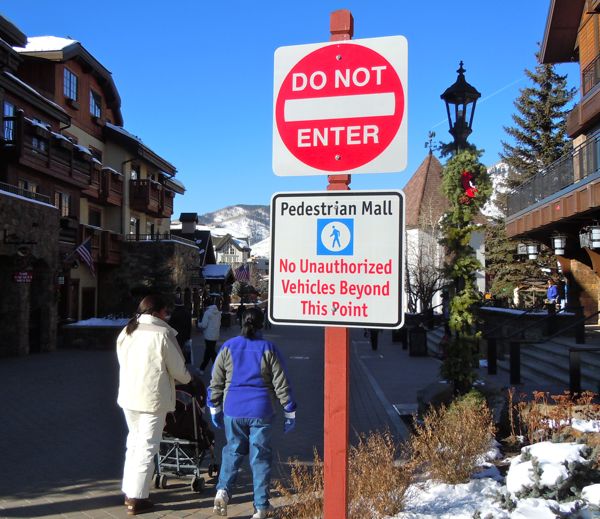
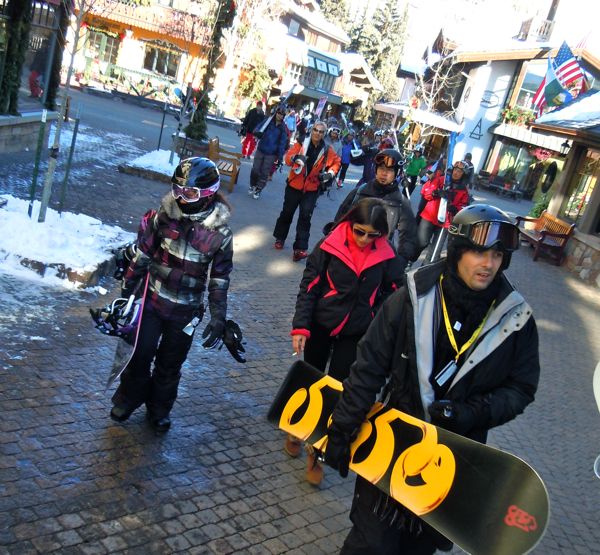
Vail makes it easy to be a pedestrian. Photo/Kathryn Reed
Second, the Lake Tahoe region is so much larger, diverse and spread out than the Vail Valley.
Third, Vail the mountain was developed and then the town at the base of it. In Tahoe, most resorts sprang up after the communities were developed. This makes the village of Vail seem real. No village in Lake Tahoe seems real. They were created for tourists as some bizarre brainchild of a developer to make money, not to create a community or true experience for the guest. Go to the villages at Heavenly, Northstar, Squaw (and Mammoth for that matter) and tell me why any local would go there. Then go to Vail or Whistler to see the difference between the world of make believe in the Sierra and world of functionality at those places.
Fourth, Vail is a company town with much of the commercial entities owned by Vail Resorts or a subsidiary of the company. Tahoe is more diverse with corporate ownership.
Vail has gone through what it calls a renaissance in the last decade. And it’s not done if Ever Vail, the $1 billion proposed development by Vail Resorts goes through.
In Lake Tahoe development is stalled – the convention center and Sierra Colina on the South Shore, Homewood on the West Shore, the Biltmore on the North Shore.
Regulations have something to do with all of that. The Vail Valley doesn’t have anything like a Tahoe Regional Planning Agency.
Better planning also led to completion of projects in Vail, including a Four Seasons opening last month. They got the players in a room, made decisions, hashed out compromises, created consensus and moved forward. It wasn’t easy. Nothing worth doing ever is.
In Tahoe, decisions are made and then lawsuits are filed – and then nothing happens. In Tahoe, personal agendas take priority over what is good for the majority. Lake Tahoe recycles people who aren’t professionals or the best in their field, which leaves the area mired in mediocrity.
Why would Tahoe want to be Vail?
• Vail has free bus service. It always has been. It was so incredibly convenient to use. They even have bus symbols at the stops so people know what it is, unlike the South Shore, which has BlueGo on the signs and no symbol. What is a BlueGo?
According to Mike Rose, transportation manager for Vail, “The bus system carries 3.2 million riders per year at a cost of about $3.2 million. The operating costs are covered by a 4 percent lift ticket tax paid to the town by Vail Associates. Capital replacement is paid for by the town general fund and a small amount of federal grants through the 5309 program.
“The bus service provides 76,000 hours of service per year within the incorporated city limits. There are six routes on the outlying and one in town shuttle. Service is every seven to 30 minutes depending on the route, time of day and season. Our longest route is East Vail at 12 miles round trip, West Vail is 10 miles, all others are in the four to five mile roundtrip range.”
• Vail excels in customer service. Walking into Two Elk, the mid-mountain lodge at Vail, people hand everyone a tissue, asking them how their day is.
People say “please,” “thank you,” “May I help you?” “Please come back.” This is the same level of service I remember from five years ago.
The bar where ski instructors hang out was every bit as friendly as Beano’s Cabin, the high-end dinner restaurant at Beaver Creek. It’s a level of service that is rare in Lake Tahoe.
As someone once said, “You only have one chance to make a first impression.”
Good service should not be reserved for tourists. I want it as a local.
• It’s walkable. Some in Vail don’t like the heated sidewalks, saying a ski town should have some snow on the walkways in winter. Maybe for ambiance that’s true, but I’ll take their walkways over our ice slicks any day.
• The Vail Valley dining options continue to grow, with Edwards on the far side, about 12 miles away, becoming a hot spot. Choices run the gamut from reasonable to outrageous. The diversity is astonishing.
The town of Vail has a population of about 5,000 people. South Lake Tahoe is about five times as large. But Vail’s town manager, Stan Zemler , says, “The budget is equivalent to (a city the with) 25,000 to 30,000 and the staffing because it swells on any given day to those numbers.”
At the end of the day, though, I don’t want any part of Lake Tahoe to totally recreate itself as Vail. Lake Tahoe is special. It’s one of a kind in its own way. The problem is that it is not functioning on all cylinders.
Tahoe’s economy is tourism. People who say we need a second economy are blowing hot air. Tourism, people, that’s our economic base. It’s not going to change. Cottage industries may crop up, but they will be a distant second to tourism.
But tourist areas run the gamut. What does Tahoe want to be? What does it want to look like? Who is going to live here full time? Who is going to visit? Will they return – why or why not? Maybe we need to ask what it is we are striving for? When will enough be enough? Will we ever have enough in the bank? Is there a magic number for when we have attracted the right number of tourists?
If money is the driving force and the end goal, then becoming a destination resort with high-end lodging is a must, along with complementary restaurants and retail. If we just concentrate on the drive-up market, it is going to strain our resources with overcrowding. Vail calls them brown baggers.
If recreation is the driving force and end goal, then someone ought to ask the U.S. Forest Service as land owner of much of the playground in the basin just how much more human traffic the terrain can handle. USFS officials have told me they are at capacity, especially in the summer. If we want more people on the lake, what does that do to the eco-system?
If a pristine lake is the goal, it’s bound to bankrupt all the jurisdictions and reward the wealthy developers who can afford to implement the environmental regulations. The elephant in the room no one acknowledges is the EIP – environmental improvement program. Billions of dollars are being spent on it. For what? Lake clarity is great, but restoring the basin to pre-settlement conditions is a farce and inane goal of the powers that be. People live here. Accept it.
Vail isn’t perfect, but it knows what it is and whom it wants to attract. At the end of the day, I guess I would like Lake Tahoe to be a bit more like Vail if it means knowing who we are and who we want as our customers.
ngg_shortcode_0_placeholder (Click on photos to enlarge.)
Parenting expert Tyler Durman will speak at South Tahoe Middle School on Feb. 8 from 7-8:15pm.
The talk is entitled “Bite-Sized Wisdom for Parent of Teenagers.”
The event is free.
By Jeff Delong, Reno Gazette-Journal
Safety standards at Sierra ski resorts are inconsistent and skiers and snowboarders should take note of the situation at their favorite resorts, a report released Tuesday by a nonprofit group suggests.
The California Mountain Resort Safety Report, prepared by the SnowSport Safety Foundation, found mixed results when it surveyed safety conditions at 25 different resorts.
Representatives of the California Ski Industry Association said safety remains a high priority for a sport with inherent risks. They said the report is likely linked to recent efforts to enact safety regulations at ski resorts by the father of a woman killed in a snowboarding accident in 2006, a position denied by the report’s lead author.
Dick Penniman, chief research officer for the SnowSport Safety Foundation, said the report is only meant as an information resource and that his group is not pushing for new laws or regulations at California ski resorts.
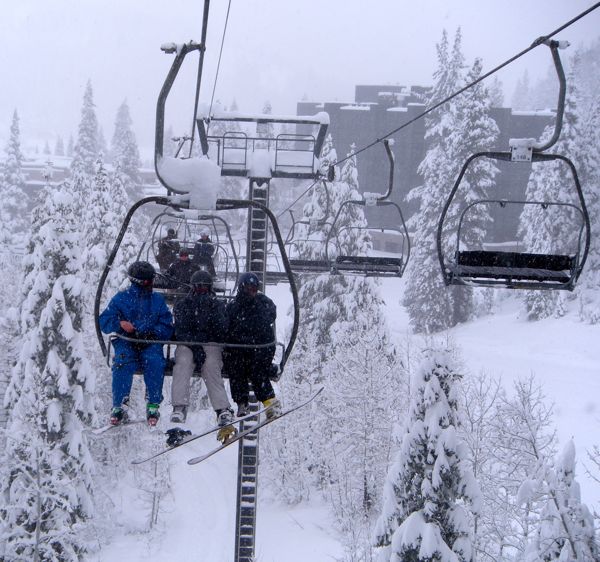 “Certain things can cause serious injuries at resorts,” said Penniman, a former ski patrol supervisor at Sugar Bowl and Alpine Meadows. “Some resorts are doing things to address them and some are not.”
Resorts were surveyed anonymously last winter. The report gives them a numerical grade on safety measures to avoid impacts with structures such as lift towers and snowmaking equipment and on efforts to address hazards on the slopes through trail design and maintenance.
By Kathryn Reed
It was a who’s who of transportation gathered in one room to disseminate information in a casual format.
Tahoe Transportation District officials assembled the players who affect transit in the Lake Tahoe Basin for two nights of open houses. Wednesday’s was in South Lake Tahoe, Thursday’s was in Tahoe City.
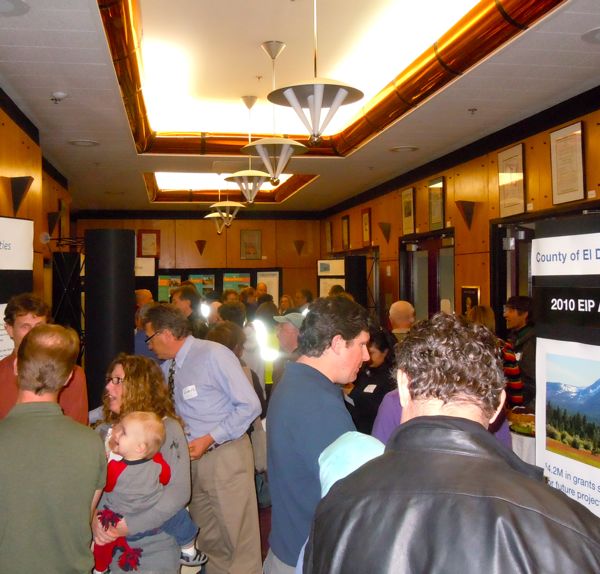
People learn about Lake Tahoe transportation issues on Jan. 19. Photo/Kathryn Reed
Meandering through the foyer of Duke Theatre on the campus of Lake Tahoe Community College, citizens were engaging the decision-makers, planners, consultants and agency employees about what is coming down the pike as well as what they would like to see happen.
Scott Morgan with Douglas County Parks and Recreation Department was paired with Peter Eichar of the California Tahoe Conservancy to talk about bike trails.
At the far end was Karen Fink with the Tahoe Regional Planning Agency dispensing information about what is being done to reduce green house gas emissions.
In between them was Donaldo Palaroan with El Dorado County talking about the quarter mile of Class 1 bike trail that will be laid this construction season from Lake Tahoe Boulevard to Echo View Estates on Sawmill Road. The Echo View Estates to Highway 50 portion comes in 2012.
“We figured fewer people would come if there were talking heads,” Carl Hasty, TTD executive director, said.
No speeches were made. People could come and go at their own pace, reading the material or talking to representatives.
People had to literally rub elbows for much of the night Jan. 19. This format allowed people who might not like to speak in a formal setting or in public to ask questions one-on-one with people who had the answers.
Other representatives at the open houses included people from the jurisdictions where the meetings were located (South Lake Tahoe on Wednesday, Placer County on Thursday), BlueGo and Tahoe Area Regional Transit, U.S. Forest Service, Tahoe Metropolitan Planning Organization, and Caltrans.
Information about water transit and the Highway 50 loop road were available ,too.
By Michael Doyle, McClatchy News Service
WASHINGTON – Rep. Tom McClintock, R-Elk Grove, could start making waves in California water.
As new chairman of the House water and power subcommittee, McClintock can promote his pet projects while he squeezes environmentalists. Politically, this means renewed talk of an Auburn dam, stricter scrutiny of San Joaquin River restoration and more support for hydropower.
“We need to change the central objective of our federal water and power policy to one of abundance,” McClintock said in an interview. “That means building more water projects.”
In theory, McClintock’s position strengthens the staunch conservative’s ability to pursue his agenda. The House panel writes water legislation. It oversees spending by the Bureau of Reclamation, which operates California’s Central Valley Project. It holds administration officials’ feet to the fire.
In practice, McClintock’s ability to convert stature into action remains an open question.
The subcommittee’s other members have not yet been named, including the key position of senior Democrat.
Publisher’s note: This is the second of four days of stories about issues pertaining to Vail.
By Susan Wood
VAIL – Things are looking up for businesses from markets and restaurants to ski resorts and sporting goods shops in this snowsports tourism area, following a rough recession-based year for the United States.
Overall, November sales tax revenue in the town of Vail nudged upward to $660,141, an increase of 1.2 percent compared to the same month in 2009. Plus, this figure is estimated to go up another $33,000 because of late collections, improving collections to 6.3 percent from the previous year, according to a recent memo by Vail sales tax administrator Sally Lorton.
Vail businesses are in recovery mode from the recession. Photos/Kathryn Reed
More than $14.6 million was collected for the town in sales tax revenue in 2010. In 2009, the figure was $14.3 million.
Food and beverage sales tax receipts came in with 8.8 percent more sold this past November, the town of Vail reported Jan. 7.
“It’s been a great last few months,” Stacey Gibson of Tavern on the Square said, while admitting that more Americans are saving money than they used to spend. “Everybody needs to get away and go on vacation. People save in different ways.”
Further, she acknowledged Vail the town appeals to an upscale visitor. The bar/restaurant located inside the Vail Resorts owned Arrabelle hotel is also fairly new to the Lionshead village. There’s a fine dining option called Centre V to offset the bar’s casual atmosphere – which is a short walk from the slopes for skiers and boarders.
While the lodging tax was down by 4.2 percent in November 2010, retail made up for the loss with a 4.8 percent increase in sales compared to a year ago. The villages of Vail, Lionshead and West Vail came on strong with double-digit increases in sales tax collections – anchoring Vail areas outside the villages that show a 19.2 percent dip in receipts.
“Business is bouncing back in Lionshead. We survived,” Bart & Yeti’s bartender Kevin Foley said, serving a crowd on a January weekday night. Foley was referring to the tough economy as well as his 36-year-old employer being located in the shadow of redevelopment that tore up the street for years.
“It was a war zone around here,” Foley said.
Although most everything is new around this locals’ retreat, the multi-level Arrabelle puts the outdoor area of Bart & Yetti’s in the shade.
Buoyed by La Nina conditions bringing an early winter to the West and a perceived pent-up holiday demand for fun among recession-weary consumers, sporting goods led the way in sales in November. Shops collected 36.2 percent more money than in 2009. The Vail Economic Advisory Council received the optimistic city reports on Jan. 11.
Vail Resorts, which owns Heavenly Mountain Resort on Lake Tahoe’s South Shore and Northstar-at-Tahoe in Truckee, has a high stake in these reports with more than half the town carrying the name of Vail or its lodging division RockResorts. Vail Resorts also runs the ski areas of Vail, Beaver Creek, Breckenridge and Keystone.
As of a few weeks ago, the ski resort corporation reported lift ticket revenue amounting to 7.4 percent more than the previous year.
Vail’s good economic news hasn’t necessarily surprised marketing officials from the Beaver Creek ski area to the RockResorts lodging division.
“People are still traveling. They may have dinner in their condos, but they’re still doing what they want to do,” Beaver Creek spokeswoman Jen Brown told Lake Tahoe News while steps from the slopes. Beaver Creek, which appropriately operates under the advertising tag line “not exactly roughing it,” has offered specials to get on the slopes as well as discounts once skiers and riders are there. The same goes for Vail, and customers are taking advantage of it.
Events are king with both resorts. These include “Holidaze” activities at Vail and Beaver Creek’s plans to host the World Cup Championships in 2015.
“Clients were skipping their ski vacations (prior to this year). We’re seeing the repeat guests dedicated to these resorts, and now we’re seeing the economy coming back. We’re quite fortunate,” said Marcella Bettis, RockResorts regional director of marketing.
Transient occupancy rates were down this past December by 0.3 percent to 57.1 percent compared to the previous year, but lodging establishments could be cautiously optimistic by making adjustments. The average daily rate went from $407 in December to $389 this month. The drop contributed to an increase of bookings to bring occupancy up to 57.4 percent.
Then, of course, not every place is Vail – where the highest real estate sale in 2010 was a 5,631-square-foot Solaris property penthouse that went for $14.8 million, according to the Vail Board of Realtors. The lowest sale was a 695-square-foot condominium at $249,900.
The upward swing in most tax reports for everyday purchases seems to mirror national trends in terms of spending over the holidays among bargain-hunting consumers.
“We’ve seen an increase (in business) this year at Christmas,” Pepi Sports buyer Shaun Filiault said of December’s receipts for his Vail Village store. Filiault added he’s noticed that when the hotels run deals, the people show up to rent skis and boards and buy accessories. But they may be more discriminating based on the state of the economy.
“I feel people buy what they need. We’re seeing more value-conscious consumers,” he said.
Either way, store results appear in-line with the national snowsports market reaching $1 billion in sales last year, an increase of 14 percent from 2009, according to a recent SnowSports Industries America report. The U.S.-based trade association also reported alpine equipment sales up 23 percent this season in comparison to last year’s.
At Kid Sport store in the Vail Village, workers have noticed a better ski season business than last year’s.
“Last year was the hardest year,” Dana Smith said, noting more locals are spending money on gear and clothes for their children. Anna Cutts mentioned the website sales are up.
The nearby market has seen a brisk business as well. Property manager Bob McNichols of Daedalus Real Estate attributes part of the success of his marketplace with the development of units to bring people into the area.
“Business is growing each year. Grocery sales are way up. I think more people are eating in, but they’re coming,” he said. “For us, these are the good old days.”
ngg_shortcode_1_placeholder (Click on photos to enlarge.)
Stella Ortega of South Lake Tahoe is one of four finalists invited to compete in the Auténtico Challenge Cook-off at Chef Aaron Sánchez’s restaurant Centrico in New York City.
Cacique, the largest Hispanic cheese brand in the U.S., and Sanchez have partnered to find the best Latin-inspired recipes featuring Cacique’s products.
Finalists are:
• Ortega with her spicy and complex Chicken a la Diabla.
• Leah Lyon of Ada, Okla., with Shrimp Rajas al Carbon Panela Tostaditos.
• Helena Giesea of Monte Rio, Calif., with her recipe for Cactus Frittata. and authentic, mild Panela cheese.
• Susan Ten Pas of Myrtle Creek, Ore., with her recipe for Roast Squash and Pear Soup with Chorizo Meatballs.
Fans may tune in to watch the finalists preparing their dishes in a series of vignettes during the cook-off on the Cooking Channel in February to see who earns bragging rights as the most unique, Latin-inspired recipe using Cacique’s products.
The winner of the Go Auténtico Challenge Cook-off receives an all-expense paid trip for two to Napa Valley and a five-day culinary boot camp at the Culinary Institute of America.
Daughters in Arm will play at Fallen Angel in South Lake Tahoe on Jan. 22. Doors opne at 9pm.
Address is 3819 Saddle Road.
For info about cover charge or anything else, call (530) 600.1800.