Opinion: Sandoval hits some crucial points head-on

Publisher’s note: This editorial first ran Jan. 24, 2011, in the Reno Gazette-Journal.

The first is always the most difficult, but the challenge that faced Gov. Brian Sandoval as he prepared his first State of the State address was as difficult as any new governor has faced in Nevada’s history.

Sandoval was governor for just a few days past three weeks when he stepped before a joint session of the Nevada Senate and Assembly — as well as several million nervous Nevadans — on Monday evening as the leader of the state with the highest unemployment rate in the nation.

Unlike most previous governors who had the good fortune to be able to use the State of the State to propose new programs, there was no hope that there would be any good news from the always optimistic Sandoval. It’s been clear for months that whoever won the governor’s office in November would have to cut the state budget; Sandoval only made the task harder with his promise not to raise taxes.

Perhaps that’s why the budget he unveiled on Monday was laced with gimmicks — “monetizing” a part of the insurance premium tax, continuing to divert the room tax approved by voters for education to the general fund, shifting county funds to higher education, letting school districts use money from construction reserve accounts, and so on.

Read the whole story


Lively discussion leads to 5 strategies for S. Tahoe council

By Kathryn Reed

“Credibility is the currency of leadership.”

This was one of the nuggets of information Mike Levinson gave South Lake Tahoe city councilmembers during their three-hour strategic planning session on Jan. 25. Levinson, former city manager of Coral Springs, Fla., and now a consultant, was brought in for $1,500 to facilitate the meeting and offer insight.

After hours of lively discussion, the council came up with five broad priorities to focus on. In no particular order, they are:
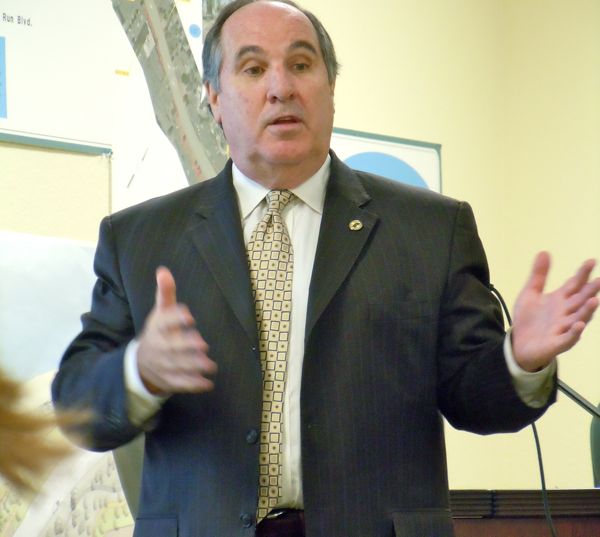
Consultant Mike Levinson leads the discussin Jan. 25 about the direction of South Lake Tahoe. Photo/Kathryn Reed

Consultant Mike Levinson leads the discussion Jan. 25 about the direction of South Lake Tahoe. Photo/Kathryn Reed

• Economic development

• Infrastructure/built environment, including public works and technology

• Public trust, including communication and accountability

• Financial stability

• Partnerships, with private entities, as well as on the local, regional, state and national levels.

From here City Manager Tony O’Rourke will devise bullet points – or action plans that flush out what those five statements mean based on dialog given Tuesday.

“We’ll put some meat on this bone,” is how O’Rourke put it.

Each councilmember will soon take ownership of one of the bullet points. The idea is to not micromanage the progress of staff, but to be the liaison from staff to the council, and when appropriate to be a voice in the public about the bullet point.

The reason to do this is to give each council person ownership as well as having to be accountable to the electorate they are doing something other casting votes every other Tuesday.

Part of the early discussion was on the results of the citizen survey. Compared against the SWOT (strengths, weaknesses, opportunities, and threats) analysis the council did of the city, the results parallel one another, according to Levinson. (Lake Tahoe News will be writing about just the survey in the near future.)

“If you take all the data, there is a bold case for change,” Levinson said. “There is a lot of room for improvement.”

In the free form discussion that led to the ultimate decision to focus on the five issues above, Mayor Hal Cole brought up the idea of the city being more intricately involved in what happens at the foreclosed would-be convention center site. This would be a 180-degree turn from where the city wanted to have no real part of the project — especially financially.

“We might say this would be our (cultural center),” Cole said. He added how the former contract was laid out, the city might have been able to have 10-days of events at the site.

Councilman Bruce Grego wants to engage Heavenly Mountain Resort or its parent company Vail Resorts about being annexed into the city. (The California Lodge is in El Dorado County.) He is also an advocate of taxing lift tickets even though an amusement tax cannot be implemented for 22 years based on previous contracts.

Banter back and forth culminated with the opinion Heavenly would come to the table, but the city would have to have something to offer – like X number of events a year.

A survey of tourists that was discussed Jan. 25 pointed to how special events get people to the South Shore.

The dialog was not always linear, with topics bouncing all over the place.

Councilwoman Claire Fortier wants to ensure technology, like WiFi, is easy for locals and tourists to tap into.

The sign ordinance was brought up, quickly followed by code enforcement.

“We need a balance between pro business and pro aesthetics,” O’Rourke said of signs.

He proposed working with businesses as Caltrans begins making improvements to Highway 50 this summer and for several years after that. He threw out the idea of making the business community conform based on where Caltrans does its improvements so it all is done in small, manageable segments.

Councilwoman Angela Swanson brought up the desire to get the Prosperity Plan off the ground and finding a way to do so.

Much discussion focused on land use issues, including the cog Tahoe Regional Planning Agency can be in the wheel of progress.

Cole brought up how an issue with the Mikasa building is that TRPA mandates any building more than 50 years old be studied for its historical significance. It was pointed out the better part of the South Shore would fall into this category. The irony being much of the city is deemed a redevelopment area, meaning it has considerable blight.

Playing nice with others was a big component. It was pointed out how the city barely got Lakeview Commons approved because of the acrimonious relationship with El Dorado County.

Cole pointed to how he sat on the TRPA Governing Board with current Nevada Gov. Brian Sandoval, adding that relationship should be pursued. Councilman Tom Davis pointed to how the city used to have a lobbyist in Washington who helped secure money for the city.

Grego wants to develop a pool of candidates of people “with our sympathies” to help get placed on boards like Lahontan so perhaps the city would receive favorable treatment.

Levinson said he was surprised this is the first workshop the City Council has had in years, as well as that it doesn’t have a public information officer to carry its message to the public.

The redesign of the city’s website was brought up, with the idea it could be a portal of information about city issues as well as point visitors to appropriate locations.

Davis kept bringing up media relations without elaboration.

Fortier wants to create a recreation hub.

Cole would like the city to work with sections of town to have something like what Ski Run Boulevard developed with its business improvement district.

The council is expected to drill down on the five priorities at the first meeting in February.



Obama sees global fight for U.S. jobs

By Sheryl Gay Stolber, New York Times

WASHINGTON — President Obama challenged Americans on Tuesday night to unleash their creative spirit, set aside their partisan differences and come together around a common goal of outcompeting other nations in a rapidly shifting global economy.

In a State of the Union address to a newly divided Congress, Mr. Obama outlined what he called a plan to “win the future” — a blueprint for spending in critical areas like education, high-speed rail, clean-energy technology and high-speed Internet to help the United States weather the unsettling impact of globalization and the challenge from emerging powers like China and India.

“The rules have changed,” he said.

But at the same time he proposed budget-cutting measures, including a five-year freeze in spending on some domestic programs that he said would reduce the deficit by $400 billion over 10 years.

Drawing a stark contrast between himself and Republicans, who are advocating immediate and deep cuts in spending, Mr. Obama laid out a philosophy of a government that could be more efficient but would still be necessary if the nation was to address fundamental challenges at home and abroad.

“We need to out-innovate, outeducate and outbuild the rest of the world,” he said. “We have to make America the best place on earth to do business. We need to take responsibility for our deficit and reform our government. That’s how our people will prosper.”

Just weeks after the shooting in Tucson that claimed six lives and left Representative Gabrielle Giffords, Democrat of Arizona, gravely injured, Mr. Obama received a reception that was muted and civil.

There were no boos or a shout of “You lie!” as in speeches past. Many Republicans and Democrats sat side by side — the first time anyone here can remember such mixing — and nearly all wore black-and-white lapel ribbons in honor of the dead and injured. Ms. Giffords’s colleagues held a seat open for her.

Read the whole story


SLT council delays moving forward on Lakeview Commons

By Kathryn Reed

Three items on the South Lake Tahoe City Council agenda pertaining to Lakeview Commons were postponed until the Feb. 8 meeting.

However, the council on Jan. 25 did meet in closed session to talk about the issue. Out of that discussion came the announcement an agreement is close with Reeve-Knight Construction, the firm originally awarded the bid for the work.

With a lawsuit and court decision ending their work on the more than $6 million project at El Dorado Beach, the city has been working out a dollar amount to pay the contractor and how to go forward.

The details are expected to be worked out by next week, with the agreement before the City Council next month, according to City Attorney Patrick Enright.

Enright said part of the agreement includes Reeve-Knight dropping its appeal against the court decision that ruled the contract invalid and not submitting a future bid on the project.

At the next meeting the council is anticipated to also decide whether to go out for new bids or award the contract to Clark & Sullivan, the firm that successfully sued based on the bid process being mishandled by the city.


STPUD working out water rates for metered customers

By Kathryn Reed

For the nearly 5,500 South Tahoe Public Utility District customers who have water meters, their rates for this quarter are not going to be what they are used to.

This is because of state mandates. California has required water districts with more than 3,000 connections have their jurisdictions all metered by 2025. STPUD has required all new construction since 1992 to be metered, but did not have a different billing structure.

Districts had to start reading the meters in 2010, with billing to begin no later than 2011.

Water meters are installed in South Lake Tahoe in 2010. Photo/Kathryn Reed

Water meters are installed in South Lake Tahoe in 2010. Photo/Kathryn Reed

“The state requirement is anyone with a meter now has to be billed volumetrically,” Dennis Cocking, spokesman for STPUD, told Lake Tahoe News.

The district’s board of directors had a workshop last week about what the rate structure would look like. Board member Mary Lou Mosbacher was absent.

Shawn Koorn and Kevin Lorentzen of HDR Engineering Inc. out of Washington spent 90 minutes giving the board information. They will likely be back before the board in a month when adoption of the rate structure will be voted on.

“I usually go with a higher fixed, then a lower consumption as a transition,” Koorn told the board.

With more than 80 percent of the costs involved with water being fixed, that leaves the rest based on consumption. As it is now, all STPUD customers have the same quarterly bill. It’s the bills sent out April 1 that will be different for those with meters.

Each structure that is built from now on will be billed partially on consumption. The district has no grant money to put in more meters this coming building season. About 3,000 were installed last year.

It costs about $1,300 to put in a meter in Lake Tahoe because not being able to move dir year-round, having to put them about 3-feet deep in a vault to deal with freezing, and the granite soil.

The state’s theory when the legislation was passed is meters will help people conserve water. What the consultants have found with other districts is water usage drops initially because people want smaller bills, but over time they use what they want and pay the consequences.

One consideration the South Tahoe PUD board has to consider is being able to bring in the same revenue it has been in order to pay bills and be within budget.

The goal is for people to have relatively the same bill if they are average water consumers. It’s the people who irrigate heavily who will undoubtedly see higher water bills in the future.


Tahoe crews prepare for avalanche rescues

Members of the Lake Valley Fire Protection District are taking part in avalanche rescue training this month. Avalanche danger has been higher than normal this season, and personnel from Lake Valley FPD as well as surrounding agencies have already been involved in one rescue incident.

avalancheLake Valley personnel would like to remind the public of the following avalanche safety tips:

• When enjoying the outdoors on snowshoes or skis, never travel alone. Know the capabilities of your companions, what equipment they have and their ability level, make a plan for your day, and let someone know where you’ll be going and when you plan to return.

• Be familiar with the terrain, and know the snowpack conditions for the area where you’ll be travelling.

• Check the weather forecast, and be prepared for fast changes in the weather.

• Wear an avalanche beacon and know how to use it; carry a shovel and a probe.

• Visit the Sierra Avalanche Center website for information regarding current avalanche danger and more safety information.


Ski report: Another bluebird day

curtisLake Tahoe continues to prove it receives more than 300 days of sunshine a year.

Here is the ski report from Curtis Fong, the Guy from Tahoe.


Mural in works to spruce up convention center site

By Kathryn Reed

This week work will begin on an 8-foot-high mural that will be erected in front of the foreclosed convention center project in South Lake Tahoe.

Normally Scott Blumenthal and his team from Dreams & Visions Art Company would do the mural onsite. However, with the fence being so close to the edge of Highway 50, the painting is being done elsewhere.

A mural will be put up in front of the fence near Stateline by March 1. Photo/Kathryn Reed

A mural will be put up in front of the fence near Stateline by March 1. Photo/Kathryn Reed

The plan is for the 600-foot-long piece of artwork to be assembled by March 1. Along Stateline Avenue, the first side street drivers see coming from Nevada into California, will have a bit of a face-lift as well. It will have a mural saying, “Welcome to South Lake Tahoe, America’s Year-Round Playground.”

The city is paying $10,000 for the South Lake Tahoe company to do the work. (The business relocated to South Tahoe from Long Beach last year.) City employees will be responsible for putting it into place.

“Hopefully, it will make people smile. It will be a definite improvement,” Blumenthal said.

He said the background will be scenery – with things like the lake and mountains. The foreground will be images of all things related to recreation that people can do in town – hiking, biking, skiing, fishing, horseback riding and more. It will also depict animals that are native to the area.

“The theme is the four seasons of South Lake Tahoe,” explained Gene Palazzo, South Lake Tahoe Redevelopment Agency director. It’s his budget from where the money is coming from to do the project.

He credits City Manager Tony O’Rourke for the idea of the mural. Blumenthal was one of two bids on the project.

The mural will go in front of the current fence.

The city is still looking into constructing a walkway in front of the 11-acre site. Bids for that project have not gone out.


Opera performance in South Tahoe

Tahoe Arts Project is hosting international opera singers Annalisa Winberg & Roy Stevens on Feb. 4 at 7pm at Lake Tahoe Community College Duke Theatre.

Joining them on stage will be the South Lake Tahoe Children’s Choral Society; Blue Ribbon Choir and Tahoe Belles.

This is not your traditional “Opera” performance, but an evening of voice and song.

Since their debuts in 1987, Winberg and Stevens have had professional engagements with opera companies, in recitals and in concerts with symphony orchestras in 23 countries and on five continents. Though they have performed with many of the leading performing organizations in the world (Metropolitan Opera, Teatro alla Scala, Dallas Opera, San Francisco Symphony, New York Opera Orchestra), they have taken particular pleasure in performing with many unusual and off the beaten track organizations.

Tickets are $10 for adults and $5 for children and seniors and can be purchased in advance at the Visitors Centers. To charge tickets by phone for information, call (530) 542.3632. If available, tickets will be sold at the door beginning at 6pm.


Barbera Festival coming to Amador County

Cooper Ranch in Plymouth (Amador County) is site of the first Barbera Festival on June 11 from 11am-4pm.

This outdoor wine and food festival will host more than 70 wineries from the Sierra foothills, Paso Robles, Napa, Sonoma, Mendocino, Lake County, the Santa Cruz Mountains, Ventura County, Lodi and the Bay Area. Approximately 1,500 people are expected to attend, with top area restaurants and caterers providing the best in cuisine.

Barbera originated in the Piemonte region of northern Italy. In California, about 8,000 acres of Barbera are planted. Louis Martini, a legend in California wine history with a winery in St. Helena was the first to produce a varietal Barbera in 1954. Today, nearly 200 California wineries produce Barbera wines.

Barbera is known for its generous acid structure. There are differing styles of barbera ranging from brighter versions with flavors of tart cherry, raspberry, and spice, to riper styles with flavors of black cherry, blueberry, blackberry, and vanilla.

In addition to tasting wine, guests may enjoy live music, art and artisan crafts.

The Barbera Festival is a Green Event and has taken measures to minimize the environmental impact of the festivities, including waste and transportation. The organizing team is also investigating renewable energy purchases and carbon credits. The Barbera Festival is intended to be an annual event with net proceeds going to charity.

Tickets will be available March 1 and are $30/person in advance and $40/person at the door.

For more information about the event, a list of participating wineries, map and directions, along with local lodging and tasting tips, click to the official website.