Ski report: Winds to pick up
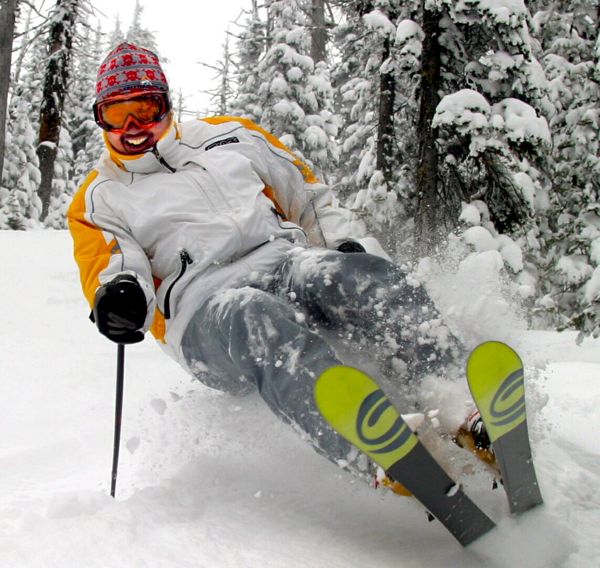 Finally, snow is in the forecast later tonight. Light to moderate winds are in the forecast, so don’t forget your windbreaker.
Here is the ski report from Curtis Fong, the Guy from Tahoe.
Finally, snow is in the forecast later tonight. Light to moderate winds are in the forecast, so don’t forget your windbreaker.
Here is the ski report from Curtis Fong, the Guy from Tahoe.
By Kade Krichko, U.S. Ski Team
ASPEN — The Frenchman Kevin Rolland relied on some last run heroics to edge out Americans Torin Yater-Wallace of Aspen and Simon Dumont of Bethel, Maine, Friday night in Aspen to win Winter X Games gold in halfpipe skiing.
On the final run of the entire competition, Rolland threw down a nearly impeccable display of amplitude and style to spoil Yater-Wallace’s X Games debut. Rolland’s last run went double cork 1080, alley-oop flat spin 360, switch 1080, switch 540, to double cork 1260, securing him the gold.
The real surprise of the night was Aspen’s Yater-Wallace. Just 15, the young skier electrified the home crowd with a stellar third run that put him in first ahead of halfpipe-skiing legend Dumont with only three riders to go. The freshman at Aspen High School punched his ticket to Winter X after a fifth at the Dew Tour on Dec. 10, becoming the third youngest male to ever compete at Winter X and the youngest competitor in the event this year.
A visibly disappointed Dumont took home the bronze, increasing his total medal count to nine at Winter X. Dumont had control of the lead after two runs, but was unable to improve upon his score in his third run.
Both Yater-Wallace and Dumont are anticipated to represent the U.S. at the FIS Freestyle World Ski Championships in Park City on Feb. 5.
Official results, Winter X Games 15, Jan. 28, 2011, Superpipe
1. Kevin Rolland, France, 93.66
2. Torin Yater-Wallace, Aspen, CO, 92.66
3. Simon Dumont, Bethel, ME, 90.33
–
4. Duncan Adams, Breckenridge, CO, 86.00
7. David Wise, Reno, NV, 56.66
By Kathryn Reed
After what seemed to be an endless quest to figure out what to do about a concessionaire for the marina and store at Fallen Leaf Lake, the Community Services District is back at square one.
“Right now we are negotiating the separation agreement,” Sandy Wirth told Lake Tahoe News. She and her husband, Rob, took over the operation last May. “It just didn’t work out. It was more than we bargained for.”
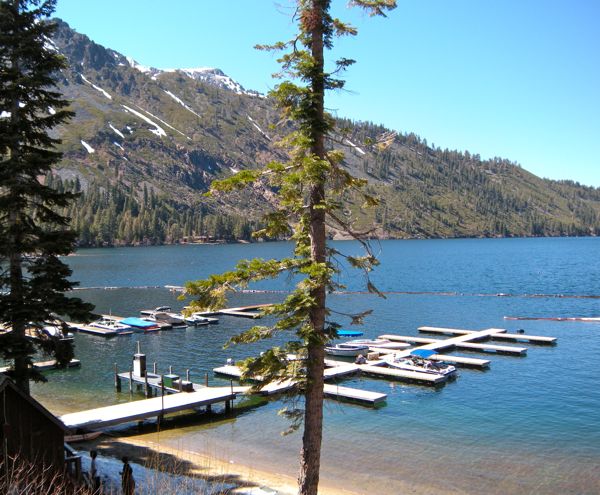
Fallen Leaf Lake needs someone to run the marina. Photo/Kathryn Reed
Tom Bacchetti, president of the Fallen Leaf Lake CSD board, said he hoped to have everything with the Wirths resolved by the Feb. 12 meeting in South Lake Tahoe.
“They did have a multi-year contract that allows them to withdraw after year one,” Bacchetti explained.
The district has sent out a request for interest. The RFI states the district is looking for people who have run a similar operation. Gary Gerren, who was brought on last year as chief of the volunteer fire department, is the point person for collecting proposals. He was made interim general manager when former interim General Manager Tom Barnes was let go.
Barnes is pursuing a wrongful termination lawsuit against the Fallen Leaf Lake CSD.
Gerren is not making any more money with the extra responsibilities.
By Kathryn Reed
Do we ever evolve? Will discrimination ever go away? Will equality for all ever be more than words on paper?
 Those are some of the questions I was left with after reading “Shanghai Girls” by Lisa See. Although this 319-page book is a novel, the global concerns are real even if the specific people are not.
It follows two sisters from Shanghai from 1937-57. It’s two decades full of tumultuous times in China and the United States.
Coming from a life of privilege, these young girls find themselves sold as brides to cover their father’s gambling debt. Much of the story unfolds from there. How they get to Angel Island and the hatred that is thrown upon them is gut wrenching.
Parts of the book are graphic – that’s what happens when men behave like barbarians.
Chinese were the lowest of the immigrants. The Chinese Exclusion Act did not allow them to become citizens of the U.S. until its repeal in 1943.
Issues surrounding immigration 70 years ago seem to have only changed in regards to who the hatred is focused on today. The lack of understanding of cultures is still so prevalent today.
This puts a whole new perspective on illegal immigration. I’m not condoning this practice. The book merely points out on a personal level how immigration affects people – that’s its so much more than laws.
Interwoven in their personal stories is the impact of the time period they were living. Their country was attacked by Japan. Their adopted country was attacked by Japan.
“Shanghai Girls” is also so very much about the bond of sisters. Perhaps that strikes a cord in me because I have three sisters.
“For every awful thing that’s been said and done, she is my sister. Parents die, daughters grow up and marry out, but sisters are for life,” See writes.
It is a story about their struggles of being married to men they did not know, the expectations of their in-laws, children, work, and society.
It’s a book that made me think and cry.
With funding for Nevada roads declining and double-digit unemployment rates, Nevadans have a chance to voice their transportation-related concerns and suggestions to Congress through the American Association of State Highway and Transportation Officials’ “I Told Congress About Transportation” social media campaign.
The national campaign uses Facebook, YouTube videos and written comments to help people share their ideas, concerns and videos with Congress to build awareness and support for greater investment in America’s transportation jobs and systems. The campaign is supported by the Nevada Department of Transportation.
“Nevada’s transportation system is facing a multibillion-dollar funding shortfall over coming years,” Susan Martinovich, NDOT director and president of AASHTO, said in a press release. “That is money that won’t be there to build new capacity and maintain the existing roads that each of us rely on and that support Nevada’s economy. Just as important is an investment in jobs; jobs which produce a product that will benefit thousands of people for many years. With this campaign, Nevadans can let Congress know how important our roads are, and let Congress know that federal funding is needed to keep people working and to keep roads open and operating.”
To see what has already been said or to make comments, Nevadans may log on here.
By Jane Honeck
With the new withholding tax tables announced by the IRS recently, many American families will have more money in their paychecks every week, but those dollars could disappear fast if they hold on to their old attitudes about money.
My experience is extra cash tends to disappear fast, because most people don’t manage their money — they let their money manage them.
According to the Census Bureau, the median family income in the U.S. is a little over $78,000 annually. Now, that means the 2 percent downward adjustment will put an additional $60 in the median two-week paycheck, or $1,560 per year, which will be gone in a heartbeat in most cases.
If people really want to make a difference in their lives this year, maybe this is a good stopping point to re-examine how we view money in our lives.
When we first encounter money, there are no instructions that come with it. We grow familiar and intimate with money and begin using it as soon as we start getting an allowance, and so we grow up thinking that we know how money works. However, when we encounter money problems in later life, try to strategize our investments, try to balance our monthly budgets or plan our retirement, the truth becomes clear: money is not so easily understood. The only way we can master it is to go back to the beginning and really think about what money really is, and examine our previously unexplored beliefs about how money works in our lives.
Here is a three-step guide to rethinking your relationship with money.
* Ask ourselves what we think money really is — Many of us can’t answer that question, because we never really thought much about money and its role in our lives. We simplify it as something we use to pay for the necessities of life, and once we use it, we have to make more. As important as money is in our lives, wouldn’t it follow logically that we really should have a deeper understanding of money as it relates to our lives? The first step is examining what we think it is, and then moving forward from there.
* Talk about money — Like sex, we never learned to talk about more than the mechanics of money. Consequently, we picked up messages, interpreted them ourselves and turned them into beliefs that run our financial lives. Talking more about money, and not less, not only enhances our understanding of it, but makes us more capable of controlling it instead of allowing it to control us. It’s a fact that conflicts over money are the number one cause of divorce, and this phenomenon is driven by dysfunctional communication about money. We need to learn to communicate more freely about money in order to take control.
* Create a new money philosophy — Money is not concrete or mechanical – it is a fluid force in our lives. Once we understand its role in our lives and how we view it, and we are able to talk about it, we can then begin to change it. Once we are able to see money as the slave and not the master, and work to realign our perspective on money and how our lives interact with it, we can begin setting and living by reasonable rules that put us in charge.
We focus too often on the minutiae of life, and forget that taking a look at the big picture can have such a dramatic impact on our lives. There is a vast difference between doing the monthly bills and balancing the checkbook and having a real money management philosophy. My advice isn’t to simply try to use the extra few dollars wisely, but rather, to look at the big picture, so all your dollars can make a difference in your life.
Jane Honeck is a CPA and money coach who specializes in tax and financial planning for professionals, small businesses and individuals.
North Lake Tahoe celebrates its long winter season with SnowFest, a 10-day carnival. SnowFest is scheduled for March 4-13 and will beat a variety of venues throughout North Lake Tahoe.
In its 30th year, SnowFest is expected to draw thousands of attendees, with the majority of events free to spectators. The annual favorites are back, along with expanded special events, including the Opening Night Ceremonies, Laser Show, Torchlight Parade and Fireworks; Mamasake Extreme Food Challenge for those with a strong stomach; 21th Annual Gar Woods Polar Bear Swim in Tahoe’s frigid waters; SnowFest Parades in Tahoe City and Kings Beach; Sunnyside Luau; the Great Ski Race, an annual cross country adventure; Kings Beach Ice Castle and Lighting Contest; Wacky Winter Human Bowling with snow saucers and inflatable pins; Tahoe City Golf Course’s “Dog Pull”; the Dragon Snow Palace; Dummy Downhill at Diamond Peak in Incline Village; the highly creative and 23rd Annual Snow Sculpture Contest at Tahoe City’s River Ranch Lodge; Special Olympics Polar Plunge at the Hyatt Regency Lake Tahoe; and the 3rd Annual Ta-Hoe Nalu Arctic Standup Paddleboard Race.
For more information about SnowFest and a complete list of events, visit the website.
By Katharine Greider, AARP Bulletin
Well, folks, it’s happening. The baby boomers, popularizers of tennis and skiing in the 1970s, inventors of jogging and step aerobics in the 1980s, are advancing through middle age to the very threshold of senior citizenship: The oldest boomers turn 65 this year.
And if their parents’ generation inaugurated the science of good nutrition — the five food groups and all that — the boomers’ adult years have, fittingly enough, produced a major new body of evidence on the benefits of “getting physical.”
In fact, this evidence suggests that exercising regularly during middle age and beyond is an enormously effective way to promote just the sort of old age boomers dream about: independent, robust and free of chronic disease or disability. “If you had to pick one thing, one single thing that came closest to the fountain of youth,” says James Fries, M.D., a pioneer researcher on healthy aging at Stanford University, “then it would have to be exercise.”
Exercise maintains healthy blood vessels for good circulation in the body and brain. It also helps people manage their weight and cope with stress. And exercise stems age-related losses in bone density and muscle mass while it keeps the heart and lungs strong.
The bottom line, reflected in dozens of studies, is that people who exercise, on average, live longer than those who don’t, with a reduced chance of heart disease, high blood pressure, stroke, type 2 diabetes, colon and breast cancers, depression, falls and even mental decline.
Tahoe-Reno is positioning itself to submit a proposal for the next opportunity to bid for hosting rights of a future Olympic Winter Games. Learn more about the vision and how individuals and businesses can join the effort during a presentation at Sierra Nevada College in Incline Village on Feb. 4 at 2:30pm.
Aside from hearing more about the work being done to prepare for a potential bidding opportunity, attendees will also learn how they can become directly involved with the project by becoming a member of the “Founder’s Ring.”
The meeting is on the SNC campus (999 Tahoe Blvd., Incline Village) in the Tahoe Center for Environmental Sciences, Room 139.
By Kathryn Reed
PHILLIPS STATION — Despite January producing more sunny days than snowy ones, the water content at the top of Echo Summit is greater now than it was a month ago, but percentage-wise the average has dropped.
Department of Water Resource officials were at the junction of Highway 50 and the entrance to Sierra-at-Tahoe on Friday for the monthly snow survey. Results at this location show the snow depth is 56 inches, with 24 inches of water content. The water content is 125 percent above average.
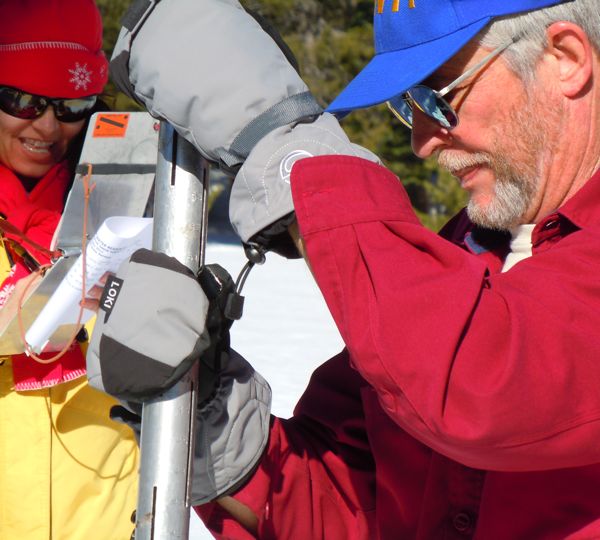
Frank Gehrke measures the water content at Phillips Station Jan. 28 as Tina Cannon Leahy records the figures. Photo/Kathryn Reed
In December, the figures were 55.9 inches for snow depth, 19 inches of water content, for a reading of 158 percent above normal.
“January was pretty much a non-event,” Frank Gehrke, chief of the California Cooperative Snow Survey Program, said of the precipitation. He said this is typical of La Nina years. What wasn’t normal was all the wet stuff in December.
The concern is if this weather pattern continues, it could mean depleted reservoirs downstream. The snowpack in the mountains provides for about one-third of the water for all California households, industry and farms.
In South Lake Tahoe, the average precipitation for January is 1.96 inches. As of Jan. 28, the National Weather Service in Reno had recorded 0.08 inches for January. That number is likely to increase with a storm blowing in Saturday that could linger until Monday morning. It is expected to bring 2 to 4 inches of snow at lake level and 4 to 8 inches at higher elevations.
What concerns Gehrke is if most of the remainder of the water year is below average for snowfall, it could mean a faster snowmelt. Already the above average temperatures are creating streams and puddling water that is not normal for January.
“As we move into spring, there is a lot more sun angle and increased snowmelt,” Gehrke explained on this bluebird day that had the mercury in the Sierra hitting 50-plus degrees. “(This is bad) because then we won’t have the water in the spring.”
Most of the major reservoirs in California have two purposes – storing water for use and flood control.
According to the Department of Water Resources, Lake Oroville, the State Water Project’s principal reservoir, is 102 percent of average and at 67 percent of capacity; Lake Shasta, the federal Central Valley Project’s largest reservoir, is at 112 percent of average and 76 percent of capacity.
“Virtually all the major reservoirs are releasing water. The releases are mandatory by federal law. It’s based on the flood control diagram,” Gehrke said.
Even with water being let out, users of the State Water Project are expected to receive 60 percent of what they’ve requested. In 2010 users were given 50 percent of allocations. The last 100 percent allocation year was 2006. That was the same year it continued snowing well into May even thought it, too, was a La Nina year.
“California weather is characterized by extremes,” Gehrke said.
| Location |
Elevation |
Snow Depth |
Water Content |
% of Long Term Average |
| Alpha |
7,600 feet |
60.6 inches |
28 inches |
133 |
| Phillips Station |
6,800 feet |
56 inches |
24 inches |
125 |
| Lyons Creek |
6,700 feet |
63.8 inches |
28.4 inches |
145 |
| Tamarack Flat |
6,500 feet |
60 inches |
24.4 inches |
126 |