CHP cracking down on cell phone users

California Highway Patrol officers will conduct a “zero tolerance” cell phone enforcement day, aimed at citing drivers who are distracted by their cell phones for 24 hours starting Feb. 8 at 6am.

The campaign is designed to deter people from using their cell phones if they don’t have a hands-free device or who are texting while driving.

Cell phones are one of the leading, identifiable, contributing factors in inattentive traffic collisions in California. According to the CHP’s Statewide Integrated Traffic Records System data, since the inception of the hands-free law, there have been 1,303 collisions throughout the state, where a contributing factor was inattention by the driver due to cell phone usage. Those same collisions resulted in 17 fatalities and more than 800 victims injured. The law, which went into effect July 1, 2008, prohibits the use of handheld cell phones by all motorists. In addition, it forbids anyone under the age of 18 from using any type of cell phone–handheld or hands free–while driving. Six months later, a ban on text messaging by drivers was put into effect.

Since the law’s inception in July 2008 through December 2010, CHP officers have issued 329,602 citations statewide to motorists who were in violation of the hands-free law and 5100 citations statewide for texting while driving, according to SWITRS.

Cell phone violations carry a minimum base fine of $20 for the first offense and $50 for the second. When court costs and other fees are added to the fines, the total cost of the violation exceeds $100 for the first offense.


Opinion: Voters should have a say in public pensions

By David Crane

In his State of the State address, Gov. Jerry Brown said that “it would be unconscionable (for the Legislature) to tell the electors of this state that they have no right to decide whether it is better to (extend taxes) or to chop another $12 billion out of schools, public safety, our universities and our system of caring for the most vulnerable.” Surely most Californians would agree.

But taxes are just one side of the budget coin, the other being expenses. At the same time as they vote on taxes to help close the deficit, shouldn’t voters also have a say about costs that contribute to that deficit?

Voters now have some rights in that regard. The state can issue general obligation bonds only with their approval, and voters have determined by initiative that the state must prioritize spending on K-14 education.

But voters don’t get a say over the largest expenditure by governments, which is employee compensation and benefits. Instead, that spending is determined through negotiations between labor, largely represented by public employee unions, and management, represented by the Legislature and the governor.

In the private sector, labor-management negotiations are generally at arm’s length, with management representing shareholders, union leaders representing workers, and neither side exercising influence over the other. But not so in the public sector, where labor can and does exercise influence over management through political contributions and activities. The California Fair Political Practices Commission reports that public-employee labor unions are the largest contributors to political campaigns. As a result, the citizens bearing the costs really aren’t at the table.

David Crane was an adviser to Gov. Arnold Schwarzenegger and now lectures on public policy at Stanford University. He serves on the UC Board of Regents and the California High Speed Rail Authority.

Read the whole story

Worse, politicians can incur debt for employee retirement benefits without voter approval. That debt – now the largest of what is owed by the state – is created when politicians promise retirement benefits but don’t fund them at all or fund them inadequately. The latter happens when public pension funds assume unrealistically high rates of return on investments. The more money assumed from investment earnings, the less money need be set aside by politicians when they make the retirement promises. Enabled by that fiction, politicians can promise retirement benefits for a fraction of their real cost – until the earnings don’t materialize. By then, those politicians are long gone and in their place is mountainous debt.


Hope Valley’s vast trail system goes on for miles

By Kathryn Reed

HOPE VALLEY — Two things about steadily climbing up are often true – a great view is usually the first reward, and then the trip down is often a breeze.

We found both to be true of our snowshoe in Hope Valley. This is one of those areas just outside the Lake Tahoe Basin that is worth visiting year-round. On this particular Sunday we park at the yurt where Joyce Coker operates Hope Valley Outdoor Center.
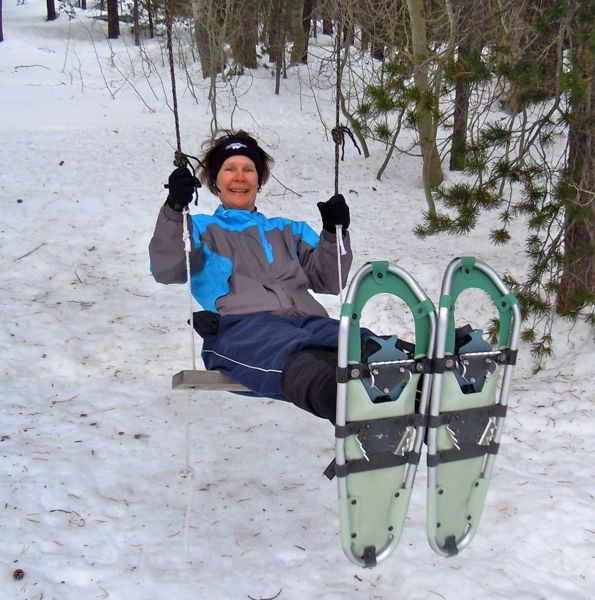
Kae Reed discovers a swing along the snowshoe trail. Photo/Susan Wood

Kae Reed discovers a swing along the snowshoe trail. Photo/Susan Wood

With more than 60 miles of marked trails, it has a variety of terrain to satisfy all levels of snowshoers and cross country skiers. Added bonuses include free parking and no trail fee. But Coker gladly takes donations. After all, it takes a tremendous amount of work to keep up this outdoor playground on the Humboldt-Toiyabe National Forest.

As we climb, the forest seems to surround us, to take us in, almost hug us. We forget there is a highway close by.

Although Burnside Road is drivable for a bit in the summer, in the winter no tires are going across the snow. We seem to have this oasis to ourselves. It’s not until we head back that we finally come across other people out playing.

This being my first time here in winter, it all looks unfamiliar. And that’s part of the fun. Despite Sue’s reluctance to head downhill, I convince her to follow the signs toward Secret Meadow. I just like the sound of it. I don’t care that it will mean a bit more work to hoof it uphill.

Meandering around in a loop, openings peak out to Hope Valley below us. Seeing the field of snow it makes me wonder what this meadow must look like in the spring and summer. Are there wildflowers? Is it grassy? Would it make for a great lunch spot? Is it as peaceful during hiking season as it is in snowshoeing season?

Continuing on a bit a smile crosses my face. I see a swing in the distance. I love to swing. That gentle rocking back and forth. With snowshoes on, it makes for an interesting dismount.

We continue on, circling back to the main road. We keep going up. A sign points to a vista. We go have a look-see.

I hope I never stop being awed by the majestic snow covered Sierra. The Carson Range seems to go on forever. Stevens Peak looms tallest from this vantage point. Maps and research are not consistent with its elevation – some say close to 10,000 feet, others have it topping that mark. The peak is named after J.M. Stevens who was a supervisor in Alpine County and ran a stagecoach in Hope Valley in the 1860s.

Sitting on the granite boulder having a bite to eat I take in the scenery. It’s sad to see the blackened trees still looking freshly charred, thought they are in their third winter since the 2008 Burnside Fire.

Clouds are moving in and the temperature is dropping. It’s time to start moving. We decide this is a good time to turn around.

Signs along the various trails are abundant, but not obnoxiously so. Maps are available in the yurt just in case that makes you feel more comfortable. Lessons, tours and equipment rentals are also available. More information is online.

Getting there:

From South Lake Tahoe, take Highway 50 west. Turn left onto Highway 89 in Meyers. Go over Luther Pass. At Picketts Junction (the four-way stop), go straight toward the yurt. Park. And don’t forget to leave a donation.

ngg_shortcode_0_placeholder (Click on photos to enlarge.)


Diverse speakers scheduled for Fireside Chats at SNC

The spring line up of Fireside Chats at Sierra Nevada College hosted by Andy Whyman includes a list of topics from global citizenry, to national security, and environmental preservation.

SNC’s Laura Brunel-Canale, a senior lecturer in the Humanities Department, tops the schedule with “Escaping Ethnocentrism Through Study Abroad” — a discussion about her decadelong research into the benefits of cultural immersion programs in places such as the Yucatan Peninsula and El Salvador. This community dialogue will be Feb. 17 at 7pm in Sierra Nevada College’s Tahoe Center for Environmental Sciences, rooms 139/141. Refreshments will be served.

March 24 is Keith Hansen, former National Intelligence Council official. Hansen served for more than three decades with the government in military and civilian assignments. As an expert on strategic nuclear force issues, he was deeply involved in negotiations on the disarmament of nuclear weapons. Hansen will address the balance between national security and the public’s right to know. A timely subject given the recent Wikileaks, Hansen will discuss this topic from a policy and intelligence perspective.

On April 28 is Joanne Marchetta, TRPA executive director. Marchetta oversees all aspects of the organization which is charged with regional planning, development and redevelopment oversight, regulatory enforcement and environmental protection and restoration programs for the region.

For more information on the events, contact Shelia Leijon at (775) 832.1310, or shelia_leijon@ivgid.org.


Tahoe Mountain Resorts donates $115,000 to community

With a special focus on local youth development programs, the Tahoe Mountain Resorts Foundation recently announced grants totaling $115,200 to 15 organizations through its winter 2011 granting cycle.

This year’s top grant recipient is Adventure Risk Challenge (ARC) who was awarded a $30,000 grant. ARC’s unique 40-day program is designed to support youth in gaining essential leadership and academic skills to support their equitable involvement in a diverse community and society.

Other youth-oriented grant recipients include Boys and Girls Club of North Tahoe, $10,000; Girls on the Run, $4,000; Get in the Act! Arts in Action, $2,500 and Jazz Artist in Residence, $7,500. The TMRF also awarded grants to outdoor focused groups including Disabled Sports USA Far West, $2,000; Northstar XC-Snowshoe Series, Tahoe Rim Trail Association, $7,500; Trails and Vistas, $1,000; Truckee Trails Foundation, $4,540 and Truckee River Watershed Council, $10,613. Additionally, grants were awarded to Project MANA, $3,550; Sierra Senior Services, $9,000 and Tahoe Family Solutions, $4,000.

This year the Foundation has launched a donor club, Friends of the Foundations, to help supplement the Foundation’s current grant giving. Friends will have an opportunity to serve as influential ambassadors for the Foundation’s select philanthropic programs and outreach efforts.

The Friends of the Foundation offers both a $10,000 and a $5,000 giving level and membership is open to just 30 donors at each level. Donor benefits include skiing, golfing, dining and cultural event privileges.

The mission of Tahoe Mountain Resorts Foundation is to serve as a catalyst for community enhancement by providing leadership and funding which will enrich the quality of life in the Truckee – North Tahoe region through cultural, environmental, educational and charitable pursuits.

For more information on the Tahoe Mountain Resorts Foundation and the Friends of the Foundation donor program, visit www.tmrfoundation.com.


Ski report: A Super morning to be outside

curtisIt’s Super Bowl Sunday, which could mean lighter crowds at the ski resorts in the morning. Waiting to hit the slopes mid-morning may be the answer to a slight softening of the snow.

Here is the ski report from Curtis Fong, the Guy from Tahoe.


Snippets about Lake Tahoe

bike• The Slow Rollers Bicycling Club is coordinating a bike parade for May 12 at 4pm as part of the Tour de California cycling event in South Tahoe.

• Employees and volunteers at North Lake Tahoe businesses and organizations will be recognized at the 57th Annual North Lake Tahoe Community Service Awards Dinner Feb. 16 at the Resort at Squaw Creek. RSVP by Feb. 7, (530) 581.8764 or kym@puretahoenorth.com.

• South Lake Tahoe planning commissioners on Feb. 10 at 3pm will discuss changing the Ski Run BID special use permit so more special events can be conducted and they could be on more streets in the area. The meeting is at council chambers, aka Lake Tahoe Airport.

• What’s going on in the greater Lake Tahoe area? Check out the Events page on Lake Tahoe News. Send info about an event to info@LakeTahoeNews.net.

• Squaw Valley comes alive in February with a two-week kids extravaganza Feb. 12-27.


Flood control issues divide Reno City Council

By Susan Voyle, Reno Gazette-Journal

Fourteen years after the New Year’s Day flood in 1997 roared into downtown Reno and left a shimmering lake at the Sparks industrial zone and the airport, Washoe County and Sparks have approved a new management authority to oversee the long-planned Truckee River flood control project.

The Reno City Council, however, remains split on creating a new government agency. If a vote were held today, it likely would be three for the project, two against and two undecided. A fourth vote is needed for passage.

While Sparks and Washoe approved it this week, the Reno council postponed its vote until Feb. 9 so Councilman Dan Gustin and Mayor Bob Cashell, who are undecided, have more time to study the 67-page agreement setting up the new authority.

Reno council members Jessica Sferrazza, Dave Aiazzi and Pierre Hascheff are in support, saying an agency focused only on the flood project will get it built.

Council members Sharon Zadra and Dwight Dortch opposed.

Zadra said she doesn’t want to create a new government agency at a time when local governments should be consolidating operations. “It flies in the face of being more efficient,” she said.

Dortch said he can’t ever see the federal government putting $1 billion into the project as expected. And without those federal dollars, he said there’s no sense in creating a new agency with the power to raise $520 million in fees from local property owners.


Ins and outs of butler service at hotels, including Harrah’s

By Steven Ferry, Hospitality.net

Why have butler service in a hotel? In the cases canvassed, there were two basic reasons: either because the hotel owners conceived they had the best property in the world/on the PGA tour/etc. and they believed the corollary on the service side could only be supplied by the addition of butlers. Or because they wanted to give their most important guests such a level of service. The five hotels participating in this article have provided guests with this butler service for the last 6-16 years, building the desired reputation and reaping the rewards. Contrasting this with hotels that have signed onto the butler concept and then disbanded the service, it is obvious that butler departments are not always guaranteed success.

How did they do it, those who succeeded?

First of all, by overcoming the obstacles they met on the way, starting with launching the service. In the case of the iconic Burj al Arab in Dubai, the problem was finding qualified staff in a country that did not have many locals to draw upon. When you have to man a department of something like 160 butlers, it is easy to see why this would be a challenge. In the end they sourced their staff from about 100 countries. Falling Rock in Pennsylvania, a privately held resort designed in the style of Frank Lloyd Wright and boasting a challenging Pete Dye-designed golf course, also provides 24-hour butler service to its 42 rooms and suites. Their main challenge, being on a huge estate in the countryside far from any cities, was likewise recruiting butlers, which they resolved by targeting regional colleges and universities. Harrah’s in Lake Tahoe did not have such issues, but struggled with the more prosaic problem of making their pantries flow sufficiently to keep up with the demand for butler services. In the ideally situated Seven Stars Galleria in Milan, their challenge was being able to deliver the same level of service required in a private estate, while being in a hotel environment. This resolved with a perception shift that each room or suite was a single house with the most important guest in it. One of these hotels also mentioned justifying a large payroll as a challenge, which they overcame by providing the expected level of service with concomitant guest satisfaction. They all also hired experts to train their staff, rather than trying to fudge the training by in-house solutions not based on the butler model.

Read the whole story


Opinion: Ski train idea worth pursuing

Publisher’s note: This editorial is from the Feb. 3, 2011, Sacramento Bee.

Every weekend in the winter, thousands of skiers make the long drive up Interstate 80 to visit resorts near Soda Springs, Truckee and Tahoe.

Many of them undoubtedly notice the train tracks that parallel the interstate and wonder, “Wouldn’t it be nice if I could take a train to the slopes?”

That’s not practical now because of Amtrak’s schedules, but moves are afoot to make a ski train a reality in future years. As The Bee’s Ed Fletcher noted recently, the new CEO of Squaw Valley, Andy Wirth, has been talking to managers of other resorts about a ski train from the Bay Area to Truckee. He deserves credit for giving new life to an old idea. But make no mistake, the obstacles are formidable.

The biggest is the Sierra’s mountainous terrain and steep grades that slow travel times. It can take five hours to get to the slopes by train from Sacramento, seven hours from the Bay Area. The only way to make a ski train work is to make rail improvements that speed travel times. Choke points have to be identified and eliminated.

Read the whole story