Ski report: Windy this afternoon
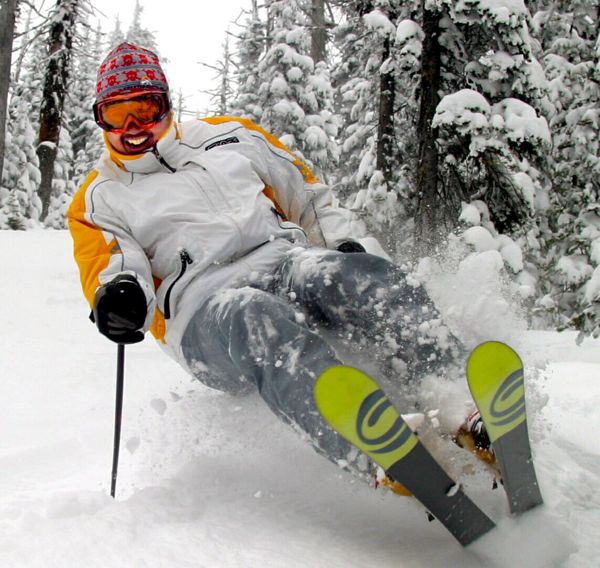 Bring the sun screen and an extra layer. The wind is likely to pick up this afternoon.
Here is the ski report from Curtis Fong, the Guy from Tahoe.
Bring the sun screen and an extra layer. The wind is likely to pick up this afternoon.
Here is the ski report from Curtis Fong, the Guy from Tahoe.
By U.S. Ski Racing
GARMISCH-PARTENKIRCHEN, Germany — Erik Guay is the World Champion. Once again Canada has taken the Worlds downhill title from under the noses of the Europeans. In 2009 it was John Kucera winning a difficult test at Val d’Isere. This time it was Guay with an early run down a decidedly changed Garmisch-Partenkirchen race course who stole the worlds most prestigious ski racing title.
Didier Cuche, a favorite in many eyes, was second. Christof Innerhofer had earned favored status with the super G gold medal three days ago and a courageous first in training run one. He finished third for the bronze medal.
Romed Baumann, in fourth, was more than a second off the winning time.
Travis Ganong of Squaw Valley apparently broke his hand hitting a gate high on the course and finished 24th.
“I think it’s kind of broken,” he said of his left hand packed in ice. “It hurts.”
He said he smacked the hand against the base of a gate about 30 seconds into the course. It hurt immediately and he said that was distracting at best.
“I can’t bend my finger. It hurt immediately. I could only hold my pole with two fingers it was so painful. I tried to cut inside all the bumps. … Ultimately I was really hurting and I was distracted.”
The Kandahar grew slower for those starting late.
Among those was Bode Miller, in bib 22. He appeared unable to generate speed at any point on course and finished a respectable 15th, but no where near any spot that counted for anything. Nyman, in 13th, led the Americans.
“I tipped over on my hip at the very top, but I don’t think that cost me all that much,” said Miller. “I made a great recovery and then gassed it from there down. I’m happy with the way I skied. I was pushing the line and cutting off the line almost every section of the course. My legs had good power, I felt strong all the way to the finish and I was concerned about that because it has been so bumpy. It’s disappointing, but some days in ski racing there’s just not much else you can do.”
 • Truckee ’s Dragonfly Restaurant and Sushi Bar is having a monthlong celebration to mark the restaurant’s 10-year anniversary. A 10th anniversary celebration bash has been set for March 1 that will feature live music and food specials.
• What is the value of daily online news about Lake Tahoe? You decide. Although LakeTahoeNews.net will continue to be free, donations help keep the operation going. Checks may be sent to: Lake Tahoe News, P.O. Box 13406, South Lake Tahoe, CA 96151 or use PayPal at the bottom right of the home page.
• Jean Stoess, former Washoe County commissioner, is chairwoman of the Toiyabe Chapter of the Sierra Club. This chapter covers all of Nevada and parts of the Eastern Sierra in California
• The Tahoe Rim Trail Association is hosting a two-day Wilderness First Aid course taught by the NOLS Wilderness Medicine Institute on April 30-May 1. Register online.
• UNR pharmacology researcher Dean Burkin’s work on a treatment for muscular dystrophy and the partnership with Prothelia Inc. to develop it are featured in the latest “Better World Report.”
Snow was starting to cover the parking lot Friday afternoon near the library at Lake Tahoe Community College.
That’s not unusual in February. But not a cloud was in the sky.
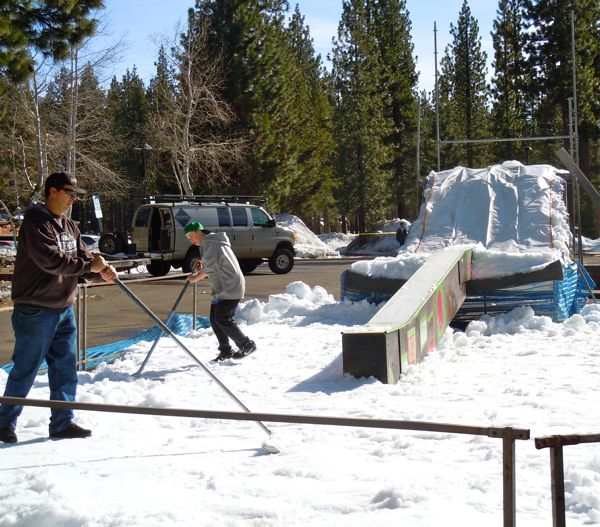
Tracy and Trenten Heer create the rail jam Feb. 11 at LTCC. Photo/Kathryn Reed
Crews from On Course Events were creating the rail jam apparatus for today’s Winter Expo at the South Lake Tahoe campus.
The inaugural expo starts at 2pm, with events scheduled until midnight. The rail jam is from 5-10pm. Sign ups are slightly before the competition begins.
Live music will be going on most of the time. A movie in the Duke Theatre will be the final activity.
— Lake Tahoe News staff report
By Brian T. Uhler
A recent concern expressed by some community members included the idea there has been an increase in the number of traffic citations issued by South Lake Tahoe police officers. Others may very well contend that our department should do more in the way of controlling unsafe drivers in our community.
This chart outlines annual citation and written warning data.
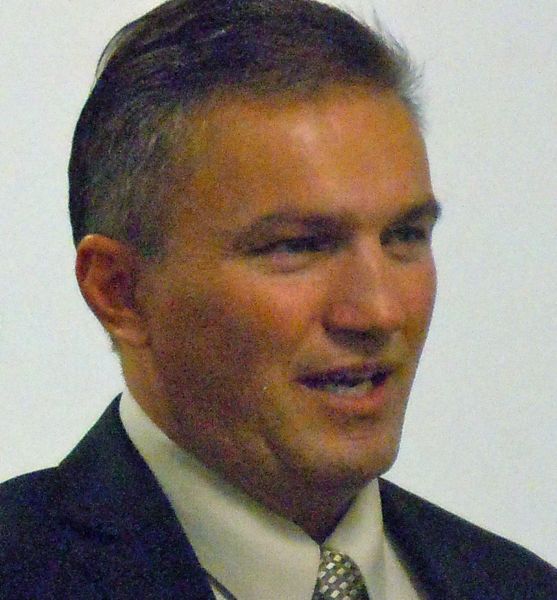
Brian T. Uhler
A few other important points include:
• When averaged among 30 field officers and sergeants, less than three citations per month were issued per officer/sergeant in 2010
• Speeding is the most frequent violation
• A mixture of productivity data such as the number of reports written, number of arrests, citations issued, and completed assignments are compiled to measure the work of our officers
• There are no special recognitions, incentive pays, or prizes of any type for any officer who write high numbers of traffic citations
• Enforcing traffic law oftentimes leads to significant arrests (example: Oklahoma City bomber Timothy McVey was initially stopped for a traffic violation a short time after the bombing)
• Our officers are permitted to exercise discretion in deciding to write citations or written warnings
• Scientific studies support the contention that effective traffic enforcement lowers accident rates
• A recent news article indicated that an officer wrote 310 citations in 11 months. This included warnings and citations—more than half of which were warnings. On some occasions, this officer was assigned specifically to traffic enforcement duties.
Our officers are encouraged by supervisors and managers to use their work time productively. We realize that it is a challenge to issue a citation to a person and have them pleased with police services but we endeavor to be professional and courteous when citing people for violating traffic law.
Brian T. Uhler, is the South Lake Tahoe police chief.
The Pacific Crest Trail and Tahoe Rim Trail associations are showing the National Geographic “America’s Wild Spaces: The Pacific Crest Trail” on Feb. 25 at 8pm.
This hourlong film chronicles the peaks and valleys of the epic 2,650 mile long Pacific Crest Trail. This trail stretches from Mexico to Canada, cutting through seven national parks and 24 national forests.
Each year more than 300 backpackers attempt to complete the entirety of this grueling route, hiking through the states of California, Oregon, and Washington and experiencing elevations changes equal to that of 10 Mt. Everest.
The PCT and TRT run concurrently for approximately 50 miles along the West Shore of Lake Tahoe.
The movie will be shown at Lakeside Pizza in Tahoe City. It is free.
By Chuck Myers, McClatchy Tribune
Its typical consequences aren’t nearly as severe for Sierra enthusiasts as those of the avalanche or blizzard, but frostbite is an ever-present danger of the snow season.
 Frostbite’s symptoms may be subtle at first: a slightly painful, prickly or itching sensation; skin that turns red, white, pale or grayish-yellow; numbness; and clumsiness due to joint and muscle stiffness.
The signs of frostbite should not go ignored. Winter campers and backcountry hikers run a particular risk of developing frostbite if they do not take proper protective measures.
Frostbite usually affects smaller or exposed areas of the body, such as fingers and the head. Because of numbness, a person may not realize he or she has frostbite until it’s pointed out by someone else.
Frostbite does not occur at once but in several stages.
By Kathryn Reed
Stationary for council members, how to get an item on the agenda and receiving text messages during meetings. Those were some of the heady issues the South Lake City Council spent a chunk of time on this week.
 It was all part of the council going over its protocols Feb. 8.
Apparently not realizing it doesn’t take a degree in graphic arts to create letterhead or even knowing the city has stationary, the electeds spent a good amount of time debating how it should look. All their names? A disclaimer at the bottom saying it was just from one member?
Finally, they agreed to spend taxpayer dollars to create note cards, which all but Mayor Hal Cole seemed to think they needed to send thank yous and what not.
Councilman Bruce Grego got his way after a lengthy discourse to change the requirement so only two councilmembers need to think an idea is worthy of being placed on a future agenda.
The reasoning behind this is so more ideas are vetted in public and don’t get discarded by a fractionalized council, as has been the case in the recent past.
Staff will bring back to the council a potential policy regarding social media, which will include how the Brown Act controls text messages with the public during meetings, and the constraints on the five when it comes to making comments online about stories.
Councilwoman Claire Fortier wants cell phones off during meetings. Her colleagues didn’t like that idea.
Councilwoman Angela Swanson’s desire to have only electronic agendas fell flat.
Grego wants to punish any council member who gives closed session information to the media, and presumably to the public in any manner. He thinks a $500 fine and removing their picture from what’s called city hall would be appropriate.
He didn’t get far with those ideas.
City Attorney Patrick Enright said the council’s every other year ethics training is coming up and maybe that would stave off any desire by the current council to leak information.
Swanson was successful in getting the council to reverse its policy about broadcasting public comments. They will be televised and heard via the web for the next six months on a trial basis.
By Kathryn Reed
Lake Tahoe Community College knows what it needs to work on, but how to get there is another matter.
“We want to develop a shared understanding of opportunities and challenges,” Tom Greene, vice president of Academic Affairs and Student Services, explained as the five tables of eight people chatted among themselves. “This is critical because everyone looks at data and interprets it differently. When everyone is on the same page you move forward together.”
By the time the stakeholders of the two-year college finished the five-hour session, to some degree a shared vision emerged. From the reams of information gathered Friday, specific goals will be developed, with the board of trustees ultimately signing off on everything after the other necessary leadership groups have given their input.
Greene led most of the 9am-2pm planning session, with the help of Aaron McVean, director of Institutional Research and Planning.

LTCC instructor Jon Kingsbury goes over his group's ideas. Photo/Kathryn Reed
The master plan is something the college does every six years. The strategic planning session is usually an annual event in the fall, but was delayed this year to accommodate a slew of changes at the college. Plus, the institution is in the middle of the self-study process of the six-year accreditation cycle.
Most tables had students, administrators, faculty, classified and a trustee at them so all sectors of the campus were heard. They spent the better part of Feb. 11 brainstorming how to put substance to the four strategic goals that will be part of the college’s Education Master Plan for 2011-17. Those goals are Student Access; Student Learning, Success and Achievement; Community Engagement; and College Sustainability.
When it comes to student access, data reveals the college population does not mirror the community or Lake Tahoe Unified School District. The college has more Caucasians.
“By and large we are white people over 40,” Virginia Boyar, director of Career and Technical Education, said of the group. “We cannot just assume what they want and need. We need to get them at the table and listen. We can’t listen if they are not here.”
It’s the Latino population she was speaking of.
Recruitment and outreach were repeatedly stressed when it comes to getting the Latino community interested in attending LTCC. Recognizing cultural and financial barriers exist was also talked about.
Creating a student ambassador was an idea – to have LTCC students talk to high school and middle school students about what college life is about, the benefits of an associate of arts degree or getting a certificate.
Looking at the curriculum, what is taught online and providing appropriate tutoring were other avenues to look at in regards to student access.
When it comes to the students’ learning, success and achievement it was noted these might be measured in different ways. For some it’s finishing the class, for others it’s graduating, still others it’s transferring to a four-year college.
“Can you separate learning from success and achievements?”
McVean asked the group to think about this as they delved into that strategy.
One table stressed the need for academic advisors for students, something the college does not have. Other support services such as counseling and financial aid were mentioned.
Preparedness was a recurring word – in terms of being ready for college level courses and ready to move on from LTCC.
Another group said students’ goals need to be defined before anyone can tell if they have been achieved.
Michael Ward, project manager for the Lake Tahoe Basin Prosperity Plan, spoke to the group before they dissected the community engagement strategy.
His overriding message was to “invite career pathways that are consistent with why people live here.” This means looking at what the curriculum has to offer related to the outdoors and recreation.
“We are growing tourists, not a middle class,” Ward said of Lake Tahoe as a whole.
He wants LTCC and the other institutions of higher education at the lake to focus on educating people who will stay in the basin. This in turn will help with the escalating unemployment rate. Ward said 50 percent of El Dorado County’s unemployed are on the South Shore. In the city limits the official rate is 17.2 percent, though with the underemployed it’s closer to 19 percent.
From there the groups came away saying the college is only selectively engaged with the community. Creating partnerships was a theme most of the groups championed – whether it is with other education outlets, the private or public sectors.
Hosting community-wide events, like today’s rail jam, is an opportunity for non-students to get a feel for the campus. Doing more of that was encouraged.
Knowing what the community wants was also pointed out. Being proactive instead of reactive was the message.
The last strategy talked about was how to keep the college sustainable, with money, facilities, human resources and technology being the components.
Greene stressed it’s time to look at moving from a state funded to a state supported institution.
A possible bond to raise money was floated, as were increasing summer programs and using the college when traditional classes are not scheduled.
Working with partners could also be a moneymaker. So could bringing in outside entities to host their meetings at the college.
Tying in with the community and recreation aspects, one table thought an intensive kids sports program is a good idea.
On the flip side, elder hostel was brought up.
“We will establish goal teams to establish clear, strategic goals. Don’t expect to see too many goals,” Greene told the group as he wrapped up the session.
To combat potential public outcry when the 50-acre Lake Christopher fuels reduction project starts this summer, officials have scheduled an outreach meeting for Feb. 16 at 6pm at Lake Tahoe Airport in council chambers.
South Lake Tahoe firefighters plans to use hand crews and low-impact equipment, including a helicopter, around the Trout and Cold creek meadows. The project is slated for the first three weeks of June from 7am-6pm.
One foot path between Martin Avenue and Golden Bear Trail may be temporarily closed.
The goal of the Lake Christopher project is to reduce the risk of catastrophic wildfire by thinning overcrowded forest stands within South Lake Tahoe.
The helicopter will be used to assist in transporting cut material from the treatment area to the processing area. Small trees and slash will be chipped and transported to the landing for removal for use in biomass energy generation facilities, while sawlogs will be removed and delivered to log processing facilities.
The project is a collaborative partnership between South Lake Tahoe, Lake Tahoe Community College, California Tahoe Conservancy and the South Tahoe Public Utility District.
The cost of the project is approximately $174,000 and is being paid for by a grant from the U.S. Forest Service.
For more information, contact Ray Zachau at (530) 542.6166.