‘Stone Monkey’ Kay’s passion for rocking climbing tamed by family

By Amy Alonzo Rozak, Union Democrat

Tucked away in Yosemite Valley is a granite pocket known as the “Coiler cave.” Hidden by a jumble of large boulders, it remains dry throughout the year. Despite Yosemite’s 30-day per year camping limit, for eight years Bryan Kay called it home.

“I was a criminal for living in the cave,” laughs Kay, who, as a member of an elite group of Yosemite climbers known as the “Stone Monkeys,” goes by the nickname “Coiler.”

Nowadays it would be hard to find anything illegal about Kay. Married, with two daughters, an arsenal of pets and a house in Chinese Camp, Kay’s life has done an 180-degree turn since his life as a member of Yosemite’s elite Search and Rescue (YOSAR) team and climbing bum living in the Coiler cave.

Kay first began climbing at age 13 while living in Irvine, introduced to the sport by the brother of a friend.

“It was game on from there,” he says.

He escaped the city as soon as he graduated high school in 1989.

“They handed me my diploma and I packed everything into my Volkswagen bus and headed to Yosemite,” Kay recalls.

Living the life of which most rock climbers only dream, he spent the summer in Yosemite, the winter in Joshua Tree, and had plans to spend the next summer back in Yosemite.

A head-on collision during the drive north altered Kay’s plans.

With injuries ranging from a broken arm to a leg crushed in around 75 places, Kay’s plans went from a summer of climbing to relearning to walk.

Read the whole story


Mt. Rose blooms with steeps, impressive day lodge

By Kathryn Reed

RENO — It’s one of those days when the slopes are as enticing as relaxing in the lodge.

At 8,260, Mt. Rose Ski Tahoe has bragging rights for having the highest base elevation of any Tahoe area ski resort. The summit is 9,700 feet.

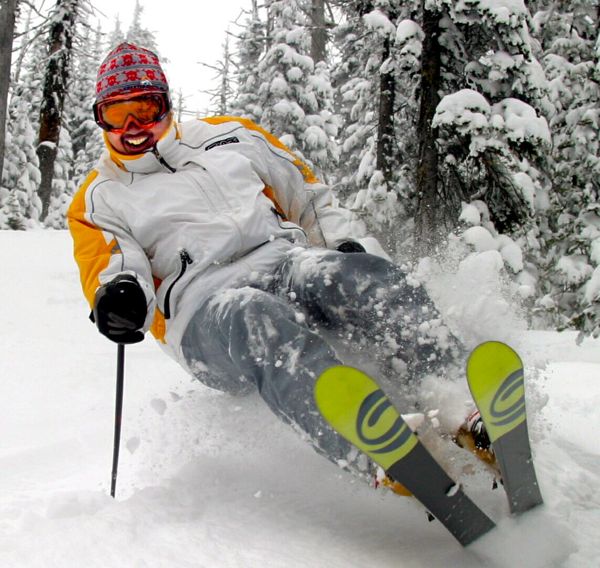
Being located on the Mt. Rose Highway between Lake Tahoe and Reno, it falls into a pattern that gets hit hard with good snow. And the elevation of the resort means if the groomers do their job right, the snow is good even when Mother Nature hasn’t dumped freshies in a while. A week ago when some area resorts had spring-like conditions, Rose was ripe for carving turns on the hard pack.

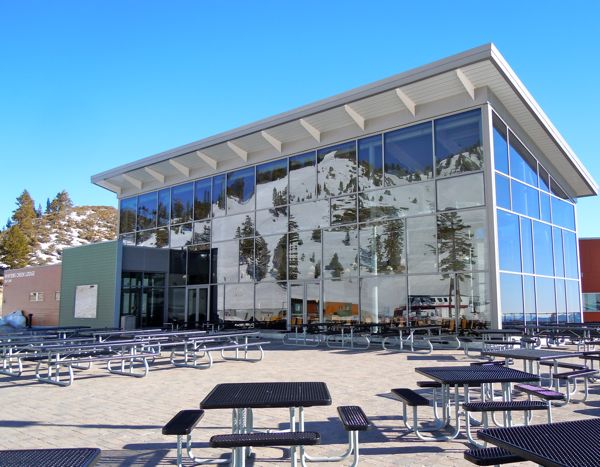
The slopes of Mt. Rose are reflected in windows of Winters Creek Lodge. Photos/Kathryn Reed

The slopes of Mt. Rose are reflected in windows of Winters Creek Lodge. Photos/Kathryn Reed

But it, like other exposed resorts, is susceptible to the wind wreaking havoc. It was blowing so hard Mt. Rose didn’t open Valentine’s Day.

Even with today likely to be a powder day, I wouldn’t go in the chutes. And I certainly wasn’t going down what looked like a glacial ice field last Thursday. I’m just not good enough.

All the chutes at Mt. Rose are 45- to 50-degree pitches. That’s something that sets the resort apart from most of Tahoe – the number of steep runs as well as the sustained pitch.

Resort officials say they benefit from a bit of a cult following. The chutes are one of the reasons. About 50 percent of the clientele is local – which is mostly Reno residents. The rest are primarily from the Bay Area, with the South Bay dominating that group.

Mike Pierce, marketing exec at the resort, isn’t exaggerating when he says Mt. Rose’s blues are equivalent to Northstar-at-Tahoe’s blacks. Going down Ramsey’s – a blue – I feel like this is a black at many Tahoe resorts.

With the amount of terrain, it’s easy to pick a side to ski, after all, this used to be two distinct ski reports – Mt. Rose and Slide Mountain.

Slide Mountain, the closest to Reno, opened in 1953. Both were in operation in 1964. Slide went bankrupt in 1987, when Mt. Rose bought it out. The Slide side is on U.S. Forest Service land, while the Rose side is privately owned.

The lack of lodging at the resort makes it a definite day-use area and not a destination resort. But the Rose side is slated to be developed – one day, with something. The market will dictate if it’s houses or hotels or condos or something else that gets built. Nothing it being talked about at this time.

The privately owned resort is doing better than a year ago, Pierce said. The early snow made for a base that all the Tahoe resorts have been living off of since Mother Nature has been chincy with the white stuff in 2011.

Another draw this season was the opening of Miller Time, the ninth gated chute.

Still looking brand new is the Winters Creek Lodge on the Slide side that opened last season.

Remnants of the old Reno Ski Bowl are no longer visible now that the Winters Creek Lodge has opened on the knoll that was home to the old structure. Employees used to be park here, too.

With nearly 360-degree views from the floor-to-ceiling windows, this high point of the base area is definitely being put to better use. So ideal is the setting, the lodge has a separate website from the resort’s because of its high demand for special events.

Washoe Lake shimmers on one side, while the snow covered slopes are in the opposite the direction. The contrast, especially this time of year, is stunning, as the Carson-Reno area seems a brown desolate desert in comparison to the winter scene on the mountain.

Jazz is playing as we walk up to the lodge in the morning. A few people are getting breakfast. Not many cars are in the lot. The Blazing Zephyr six-pack opens at 8:30am, 30 minutes before the rest of the mountain.

Lodge or slopes? A lot of both is the best answer.

Getting there:

From South Lake Tahoe, take Highway 50 east. Turn left on Highway 28 at the top of Spooner Summit. In Incline Village, turn right on Highway 431 – Mount Rose Highway.

The Mt. Rose base is the first entrance on the right. The Slide Mountain entrance is about a half mile farther on the right.

More information is online.

ngg_shortcode_0_placeholder (Click on photos to enlarge.)


History: Building Nevada’s highways in the basin

Publisher’s note: This is reprinted from the November 1973 Lake Tahoe Historical Society newsletter.

Construction of Lake Tahoe highways in Nevada during the years from 1927 to 1935 was reviewed last week by William Howard Smith of Glenbrook when he addressed members of the Lake Tahoe Historical Society.
historySmith, a former division engineer for the United States Bureau of Public Roads, directed the construction of Nevada Forest Highway Route 1, which is now known as State Route 28 from Spooner Summit to the North Shore stateline, and Nevada Forest Highway Route 3, now better known as U.S. 50 from Spooner Summit to the South Shore stateline.

The speaker explained that the surveying and building of the roads, as with all highways constructed under federal regulations and with Congress appropriated funds during the 1920’s and 1930’s, was spearheaded by the USBPR. Working with the federal agency were the various state highway departments and the U.S. Forest Service.

While all the actual construction was done by USBPR crews, the Forest Service approved the highway programs and inspected the completed projects. The various state highway department obtained right-of-ways.

A survey party started mapping out the route for Highway 28 in 1928, starting from the stateline and working south. The survey was done during the summer months of 1928 and 1929 with crews working out of a camp in Tahoe Vista, California.

“In making the surveys, advantage was taken of portions of the narrow gauge lumbering railroads that were constructed during the early days,” Smith recalled.

The railroad route came into use one-half mile from the lake shore on what is now Mill Creek near the junction of the old Mt. Rose highway and continued to Sand Harbor. Another two-mile section of the narrow gauge was used from five miles south of Spooner to three miles south of the summit.

Because of the mountainous terrain and the limited funds available for the project, the work was hard and the construction crews were forced to do all the day labor itself. That included clearing and burning as well as engineering, surveying and constructing the route.

During the summer of 1930, the first small grading contract was let out to the Isbell Construction Company. The terrain was difficult because of the steep sidehill extending above the lake with huge granite boulders and some solid granite outcroppings.

In the Crystal Bay area, the highway crew had to deal with Walter Hobart, Jr., owner of the property needed for the route.

“I will never forget him,” Smith said. “Mr. Hobart was a true conservationist and our survey crew couldn’t cut down even a little sapling in making the surveys.”

He added that before Hobart was satisfied, three different locations were suggested on long radius curves. Hobart finally agreed to the third routing.

“All the grading and base course surfacing was completed in 1933 and we had a celebration to mark the milestone,” the retired engineer told his audience.

Harry O. Comstock, owner of Brockway, acted as master of ceremonies for the celebration and actress Carole Lombard reigned at ribbon-cutting activities.

Smith then talked abut construction of Highway 50 from Spooner to the South Shore stateline, noting that because of the small amount of forest highway funds received during the period from 1927 to 1932 the route was split into six sections.

“An old existing one-way dirt road was in use between Spooners and the stateline in 1927. Portions of this road were built as a toll road in the early days. The first section covered the portion of the route between the summit and Glenbrook,” Smith explained.

“The old road was on the north side of Glenbrook Canyon, but the property owners, The Bliss Company, would not permit the new highway to pass through the resort of Glenbrook,” he added.

So, Smith said, the old dirt road was located closer to the lake and curved around Cave Rock on a wooden trestle bridge. The bridge was used until 1933 when the fist tunnel through Cave Rock was competed and opened to traffic.

During the period from 1930 to 1932, the construction was hampered by numerous federal laws under the W.P.A., Smith contended.

In complying with the special provision of the Emergency Relief and Construction Act, the project had to issue contracts meeting wage, hour and other provisions of employment. These called for maximum use of manpower and sometimes involved using “antequated equipment.”

Various contractors had trouble in obtaining some of the out-dated equipment required by the special provisions and some of the machinery was resurrected form second-hand shops and junk yards, Smith pointed out.

He recalled that when one old wooden wagon arrived, the wooden spokes in the wheels were so loose they had to let the wagon soak in Lake Tahoe until the spokes tightened up.

The construction year ranged from April 15th to December 15th during those years. An average of 15-20 engineers and 20-30 day laborers and maintenance workers were used. The route was finally completed on October 2, 1934, by the crew working out of an encampment on Marlette Creek.

Redefining the modern American family

By Andrew Solomon, Newsweek

Children used to make me sad. With the happy children in my adult life, I felt guilty, even mean, about being sad. The origin of that sadness was opaque, but I think it came most from how the absence of children in the lives of gay people had been repeatedly held up as my tragedy. When I came out, the prevailing view was that I was shortsightedly choosing sexual fantasies over producing a family. I was encouraged by my parents and the world to marry a woman and procreate. I spent years drifting between relationships with men and with women; I was mildly bisexual in a fluid era, but if children hadn’t been part of the equation, I wouldn’t have bothered with the other half. Even though I was in love with some of the women I dated, I felt mildly fraudulent in those intimacies. While I was becoming true to myself, the world changed. What I couldn’t know then was whether I truly wanted children, or whether I just wanted to prove wrong everyone who had pitied me.

Shortly after I met John, who is now my husband, we ran into his friends Laura and Tammy and their toddler, Oliver, at the 2001 Minnesota State Fair. John and Laura had been co-workers, and Laura had observed him for years before she and Tammy had asked him to be their child’s biological father. Though not especially close to them, he had agreed, signing legal documents in which he foreswore paternal rights and they foreswore claims to support. He had offered to be in the child’s life to the extent he was able, if the child so wished, but in deference to Tammy’s position as adoptive mother, he had so far remained uninvolved. Nevertheless, the women asked him to be a sperm donor again, and Lucy was born in 2004, by which time John was living with me in Manhattan.

The question of having biological children in unorthodox ways was familiar to me. A few years before I met John, during a trip to Texas, I attended a dinner that included my college friend Blaine. I had adored her for more than 20 years, but then, everyone adores Blaine; she is serenely beautiful and poised, and I had never felt indispensable to her as I do with more difficult friends. Blaine had divorced and shortly thereafter lost her mother, and she alluded to her yearning to become a mother herself. I said I’d be thrilled to father her child. The idea that she might actually want to have a baby with me was unimaginable; I suggested it with the rhetorical politesse with which I’d invited new acquaintances in remote countries to stop by for a drink if they ever found themselves in Greenwich Village. When I got home, however, I wrote her a letter, saying that I thought she would be a glorious mother, and that if she didn’t have a child with me, I hoped she’d have one with someone.

When Blaine came to my 40th–birthday party in New York three years later, in 2003, we realized that we both wanted to have that child together. I wasn’t ready to tell John, who was still living in Minneapolis. When I did tell him, he exploded. He had been a sperm donor, he argued; I would have a child who would bear my last name. I would be involved in an ongoing, profound relationship with Blaine that he feared would lethally triangulate our own. I did not know how hard it is to reinvent family, and he could not envision how fulfilling this particular reinvention might be. I nearly backed out but felt I couldn’t renege on my word, based on a wish I could likewise not forsake. John, whose benevolence invariably triumphs, finally relented, and Blaine and I conceived through IVF. Blaine, meanwhile, had met her partner, Richard, putting a reasonable if unusual balance in place.

Read the whole story


U.S. men out of contention in super combined

By U.S. Ski Racing

GARMISCH-PARTENKIRCHEN, Germany — In the end Aksel Lund Svindal made the Italians — silver medal winner Christof Innerhofer and bronze medalist Peter Fill — look like pretenders, claiming the gold medal of the World Championship super combined by an outstanding 1.01 seconds. But the Italians weren’t complaining.

It was the second straight combined gold in World Championship competition for Svindal, having also claimed the top prize in 2009, but it was his first medal of these championships in Garmisch-Partenkirchen, Germany and it was well earned.

The Italians were joyful. Fill tossed his ski poles high in air as he recognized his time and Innerhofer held his slalom skis aloft, celebrating his third medal of these championships, an unlikely circumstance from a man with one World Cup win to his credit and the two Italians quickly surrounded Svindal in the finish, anxious to pose for photographers.

The Americans had a rough go. Tim Jitloff of Reno had made a costly mistake in the downhill and pushed gamely from the second start of the slalom to make up a nine second deficit with predictable results. He put up the third fastest slalom run on the day, but wound up tied for 14th. Ted Ligety had a decent downhill (11th) and was definitely full-out attack in the slalom, but exited about half way down the slalom. And Bode Miller showed he can exit a race course with as much flamboyence as anyone, flying past the second gate on the hill horizonal to the ground, his skis above his head.

With the downhill leg of the race run an hour earlier than the men’s downhill on Saturday – going off at 10am versus 11 – and with a clear night allowing radiant cooling, the Kandahar course was icy and fast. It was a touch smoother than it had been for earlier training runs, but those ragged runs had already had their effect on the combined field. Many skiers had opted out, including Ivica Kostelic, already the World Cup combined champ with three wins in three eveents. The start list for the combined numbered 41 and that dropped to 34 after the downhill.

The slalom leg, across town, started at 2pm and long shadows crossed sections, but by no stretch, all of the steep Gudiberg hill. By the final racers the slalom hill did show rutting, but it held up well.


Ski report: Lots of love on the slopes

curtis

This just in from Curtis Fong at 8am: Heavenly’s upper mountain closed, Squaw’s upper mountain closed, Alpine’s upper mountain and back side closed, and Mt. Rose Ski Tahoe is closed.

Love and snow are blowing in the air this Valentine’s Day.

Here is the ski report from Curtis Fong, the Guy from Tahoe.


Winter about to return to Lake Tahoe

Winter is expected to return with a vengeance to the Lake Tahoe Basin this week.

A winter storm watch is in effect from Tuesday afternoon through Wednesday afternoon.

The National Weather Service in Reno is calling for possible snow accumulations of 12 to 18 inches at lake level, 1 to 2 feet above 7,000 feet and up to 3 feet near the sierra crest.

Winds will be out of the southwest at 20 to 30 mph, with gusts up to 50 mph on Tuesday. Ridge gusts may hit 110 mph.

Although the storm watch is in effect for that time period, the Weather Service is calling for snow today through Thursday night.

The highs will start off today in the 40s before dropping to the teens on Thursday. The overnight lows will be in the 20s, with 12 forecast for Thursday night. There is a six-degree spread for Thursday with the high that day in the basin slated to be 18 degrees.

— Lake Tahoe News staff report


Opinion: Does Tour de California lose clout without Armstrong?

By John Schumacher, Sacramento Bee

The Amgen Tour of California has displayed a deft touch in tweaking its route for the sixth annual pro cycling race.

Adding Lake Tahoe? A game changer. Returning to the Central Coast for a postcard ride down Highway 1? Breathtaking. Following the Solvang time trial with a Stage 7 climb up Mount Baldy? Dramatic.

But as cycling fans await the May 15-22 race – Stage 2 finishes at the state Capitol on May 16 – a bigger question hovers over the event.

Will Lance Armstrong compete?

Read the whole story


Valentine’s Day traditions stretch back centuries

Valentine’s Day is traditionally a day in which people express their love to one another by presenting gifts, such as cards, candy, flowers and other symbols of love or affection. Opinions differ as to who was the original Valentine, but the most popular theory is that he was a clergyman who was executed for secretly marrying couples in ancient Rome.

In A.D. 496, Pope Gelasius I declared Feb. 14 as Valentine Day. Through the centuries, the Christian holiday became a time to exchange love messages, and St. Valentine became the patron saint of lovers.

Esther Howland, a native of Massachusetts, is given credit for selling the first mass-produced valentine cards in the 1840s.

The spirit of love continues today with even young children exchanging valentine’s cards with their fellow classmates.

In 2008, there were 26,683 jewelry stores in the United States. In February 2010, these stores sold $2.4 billion in merchandise, according to the U.S. Census Bureau.

About 5,800 marriages took place each day in 2009 or 2.1 million that year, according to the National Center for Health Statistics. Of those, 108,150 ceremonies were in Nevada. The Silver State is ranked fifth nationally in marriages, even though its total population that year among states was 35th.

Romantic-sounding places to spend Valentine’s Day:

Rose City, Texas; Rose City, Mich.; South Heart, N.D.; Loveland, Colo.; Darling, Minn.; Loveland, Ohio; Romeo, Colo.; Sacred Heart, Minn.; Loveland Park, Ohio; Lovejoy, Ga.; Heart Butte, Mont.; Love County, Okla.; Loves Park, Ill.; Valentine, Neb.; Loveland, Okla.; Lovington, Ill.; Lovelock, Nev.; Lovelady, Texas; Romeoville, Ill.; Loving, N.M.; Loving County, Texas; Rosemont, Ill.; Lovington, N.M.; Valentine, Texas; Romeo, Mich.; Love Valley, N.C.; Rose Hill Acres, Texas.


NHP doing its part to train law enforcement

The Nevada Department of Public Safety has partnered with the National Highway Traffic Safety Administration and the Nevada Office of Traffic Safety to offer four advanced accident investigation and reconstruction classes to law enforcement officers in Nevada.

Funding for the classes was provided by a $58,996 traffic safety grant from the National Highway Traffic Safety Administration, through the DPS Office of Traffic Safety.

The classes are:

* Technical Accident Investigations

o This class focuses on the vehicle and roadway factors that may cause, or contribute to, an accident.

* Vehicle Dynamics

o This class focuses on the physics associated with vehicle collisions and the mathematical equations used to determine the speeds of vehicles based on the roadway and vehicle evidence.

* Motorcycle Traffic Collision Reconstruction

o This class focuses on the specific methodologies used to reconstruct collisions involving motorcycles. This course involves considerable field testing, involving staged motorcycle crashes to apply the theories. OTS has provided seven motorcycles, that were previously used during their new rider training courses, for use in the staged collisions.

* Event Data Recorder Technician

o This class teaches officers how to access and image the data collected by a vehicle’s collision data recorders. Vehicle collision data recorders can capture information such as: vehicle speed prior to impact, seatbelt usage by occupants, throttle and braking application, mechanical faults that could cause or contribute to the collision, and steering inputs by the driver.

This training is open to members of all Nevada law enforcement agencies. To provide the training to the greatest number of officers throughout the state, the Technical Accident Investigations and Vehicle Dynamics classes will be offered in Elko, Carson City, and Las Vegas.

The classes are:

* Technical Accident Investigations:

o Carson City: March 7-18

o Elko: March–April 1

o Las Vegas: Dates TBD

* Vehicle Dynamics:

o Carson City: May 23-27

o Elko: April 4-8

o Las Vegas: Dates TBD

* Motorcycle Traffic Collision Reconstruction: Aug. 22-26

* Collision Data Recorder Technician: Aug. 29-30.