Opinion: Pass the Marijuana Regulation and Tax Act of 2012

By Steve Kubby

The November 2012 presidential election affords proponents of a ballot initiative to change state law concerning the regulation of marijuana a strong opportunity for success. The most significant consideration is that the California electorate for the next presidential election will be considerably younger. Our analysis indicates that 21 percent of all voters will be under the age of 35, compared to just 16 percent in the November 2010 election.

Also, in November 2010, 27 percent of voters were 65 and older, but in November 2012 seniors are expected to comprise 20 percent of the electorate. It is worth noting that Proposition 215 was on the 1996 presidential election ballot.

Another factor in our favor is the lessons of Prop. 19 can be used to inform the development of the initiative and the campaign’s messaging, and pitfalls can be avoided. Finally, public opinion continues to evolve on the issue of drug policy, particularly in regards to marijuana. In fact, a recent Economist/YouGov nationwide poll found 58 percent agreed with the following statement, “Some people say marijuana should be treated like alcohol and tobacco. They say it should be regulated and taxed and made illegal for minors.” In addition, 62 percent of Western region respondents agreed with this statement-the highest of any region in the nation.
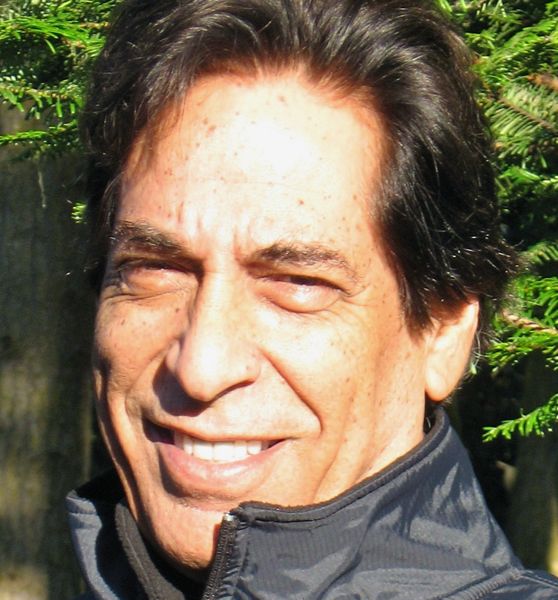
Steve Kubby

Steve Kubby

The Marijuana Regulation and Tax Act of 2012 is sponsored by Tax Marijuana 2012, a political committee, with James P. Gray as chief proponent. For further information about this new voter initiative, please visit the following links:

–Tax Marijuana 2012 campaign registers with the Secretary of State

http://cal-access.sos.ca.gov/Campaign/Committees/Detail.aspx?id=1336887&session=2011

–Compare our initiative with others. See for yourself why Tax Marijuana 2012 is our best path to full legalization.

http://www.facebook.com/photo.php?fbid=10150140126001955&set=a.71411121954.106184.620261954&theater

–The Marijuana Regulation and Tax Act of 2012 (Preliminary Draft)

This Act shall be known as “The Marijuana Regulation and Tax Act of 2012.”

The people of the state of California, recognizing that it is time to tax marijuana and to regulate its use, hereby repeal all California state laws that prohibit marijuana possession, sales, transportation, production, processing, and cultivation by people 21 years of age and older, and thereby remove marijuana from any other statutes pertaining to the prohibition and regulation of controlled substances, whether now existing or enacted in the future, except those related to driving a motor vehicle under the influence of marijuana; using or being under the influence of marijuana in public or in the workplace; smoking marijuana in the presence of, or providing, transferring or selling marijuana to, a person under the age of 21; the use, possession, cultivation, sales, transporting, or storing on premises of marijuana by people under the age of 21; and medical marijuana statutes as set forth in California Proposition 215 and its progeny. This act adopts the definition of marijuana as it is presently set forth in Health and Safety Code section 11018.

The people further direct and order the California state Legislature to enact reasonable regulations and establish reasonable taxes for the establishment of the farming, industry, distribution, and sales of marijuana with a THC level of 0.3 percent or higher, using the grape winery industry as a model, as long as the results support these intentions, purposes and goals; and to provide for the farming, industry, distribution, and sales of industrial hemp, which is hereby defined as marijuana with a THC level of below 0.3 percent, using the cotton and paper products industries as a model. However, the effect of this act and its direction is to be liberally construed to favor individuals, and business entities regarding the following:

(a) No taxes, fees, laws, rules, regulations, or local city and county zoning requirements can be adopted or enacted to defeat these commercial, agricultural and industrial purposes or those individual civil rights set forth in Civil Code section 54, Food and Agricultural Code sections 54033 through 54035, inclusive, and Civil Code 52.1, and all medical conditions as stated in Health and Safety Code section 11362.5. Any individual, association, or collective group not producing more than 99 plants or 50 pounds of marijuana per year shall be exempt from any winery model regulations, fees and taxes, except for income taxes and state sales taxes, if they apply, and

(b) No regulations, taxes or fees shall be enacted or imposed which are more severe or restrictive than those for comparable and reasonable usage in the commercial wine grape farming and winery industry model, including for farming, planting, cultivating, irrigating, harvesting, processing, brokering, selling, distributing, and establishing of cooperatives or collective associations.

The people further direct and order all state and local government elected, appointed and hired employees, officers and officials to refuse to cooperate with federal officials, or operate under U.S. contract or arrangement, to defeat this act directly or indirectly, or to follow or abide by any federal laws or regulations that are in conflict with this act. Further, no such person acting alone, or with any other person or legislative body, may contract or agree to cooperate with federal officials, employees, agencies or departments to obtain any money, property, gain or advantage by the arrest, prosecution, conviction or deprivation of property of anyone acting within the provisions of this act. Any such governmental or public person who knowingly and intentionally violates these provisions shall forfeit their government employment and office.

The people further direct and order that within 30 days of passage, both the state attorney general and the Department of Health Services shall inform the United States Department of Human and Health Services, attorney general, Congress, and Food and Drug Administration that in 1996 California recognized that using marijuana can have some positive medical effects, and for that reason demand that marijuana no longer be listed as a Schedule 1 drug.

The people further direct and order the attorney general of California to protect the provisions of this act from any and all attacks, whether from individuals, cities, counties, or the state or federal governments.

This act expressly enjoins the arrest and imposition of any criminal or civil penalties for people 21 years of age and older who are acting within the provisions of this act, including all California penal and nuisance marijuana laws, penalties, and zoning regulations, except for those affecting medical marijuana at Health & Safety Code sections 11362.5, and 11362.7 et seq.

This act expressly enjoins any and all commercial advertising of the sales, distribution and use of marijuana, except for medical marijuana and products made from industrial hemp, as defined herein, and this injunction shall be enforced by penalties as shall hereafter be set forth by the legislature.

This act expressly does not repeal, modify or change any present laws or regulations prohibiting the driving of a motor vehicle while under the influence of marijuana; the use or being under the influence of marijuana in public or in the workplace; the smoking of marijuana in the presence of, or providing, transferring or selling marijuana to, a person under the age of 21; the use, possession, cultivation, sales, transporting, or storing on premises of marijuana by people under the age of 21; or medical marijuana statutes as set forth in California Proposition 215 and its progeny.

The Legislature shall not modify, change, add to or subtract from, or amend any part of this act, and if any part of this act is found by any court of competent jurisdiction to be invalid or void, that finding shall not affect any of the remaining provisions.

Steve Kubby is a resident of South Lake Tahoe.



South Lake Tahoe rolls out plan to eliminate deficit

By Kathryn Reed

To wipe-out an ongoing $3.4 million annual deficit, South Lake Tahoe staff members are proposing getting rid of positions, freezing wages, raising the hotel tax, and revamping employee pension and health care options.

Some of the proposals brought forth during the City Council’s workshop Tuesday afternoon need to be vetted and approved by the bargaining units. But it was noted, if they don’t agree to them, more layoffs are probably the only other solution.

The council on March 15 is slated to vote on the reorganization plan and five-year budget proposals presented to them March 1 by City Manager Tony O’Rourke and Finance Director Christine Vuletich.

South Lake Tahoe Finance Director on March 1 goes over the five-year budget plan. Photo/Kathryn Reed

South Lake Tahoe Finance Director Christine Vuletich on March 1 goes over the five-year budget plan. Photo/Kathryn Reed

Eliminating positions, reclassifying jobs, early retirements and shifting things around would cut the annual deficit in half. That proposal was released last week.

Besides those proposals, the city is also looking at revamping what it contributes to employees’ pensions and health care plans.

“In most organizations salaries and benefits are about 65 percent (of the general fund). In ours it is 78 percent,” O’Rourke told Lake Tahoe News. “In the private sector it is closer to 45 percent.”

In the current budget the city is paying $3.1 million to CalPERS, the Public Employee Retirement System, for the nearly 200 employees. Pension costs are projected to increase by 5 percent per year for the next five years.

That 5 percent equates to about $900,000 during the next five years. Today, 11 percent of the general fund goes to employee pensions.

Councilman Tom Davis asked about the city’s unfunded liability. Vuletich said today it is about $26 million, whereas a few years ago it was at $42 million. The city is paying about $400,000 on that each year.

It wasn’t until last year that any employee in the city contributed a dime to his or her own retirement. Police officers now pay 6 percent of the 9 percent employee contribution.

If employees start paying their share – or the full 9 percent, this would save the city about $800,000 a year.

Lake Tahoe News, before the presentation to the council, asked O’Rourke about the possibility of having a flat fee the city would contribute instead of a percentage plan. Lake Tahoe Unified School District does this with its employees in regards to health care.

“There are some strong arguments to go to a defined contribution so you know each year your exposure,” O’Rourke said. “So then the risk is shifted to the employee.”

At this time, that is not being proposed.

When it comes to health care costs, the city doles out about $18,500 per employee and $14,900 per retiree — each year.

“On average, employees are contributing 4 percent, and retirees 12 percent, respectively, to the city’s annual health care cost,” the staff report says.

O’Rourke wants to revamp the system to “generate at least $550,000 annually in savings.”

After repeated questioning by Davis and Councilwoman Angela Swanson if the wage freeze is really that, Vuletich acknowledged the step increases built into the agreements with the bargaining units for employees who qualify would in fact get a raise. However, all cost of living increases are gone.

The pay freeze will save about $350,000 a year.

This year’s budget has $13.4 million allocated for salaries, which includes $1.4 million in retirement payouts.

The other way employees will be receiving more cash in their pocket is by eliminating furlough days. This equates to a 13.4 percent pay increase because workers have not legally had to be at work during that time. For those who were, it means actually getting paid for the work they are doing; for those who took the day off, it means being paid to work a full week.

Property tax is the city’s largest source of income at 23 percent of the general fund revenue. With revenues from the Stateline or Project Area No. 1 taking a 15.7 percent hit, it means $1.2 million less for the city. This is because the county reassessed the values on the property in that area.

Projections are for property taxes to decline next year, with increases for the following four years – the most being a 1.6 percent uptick in fiscal year 2016. The county Assessor’s Office is forecasting a 4 percent assessment decline for this fiscal year.

Hotel taxes are the second largest moneymaker for the city at 15 percent of general fund revenue. Today a rate of 10 percent is charged to people staying in most areas of town, while a 12 percent tax is added to a room in the redevelopment areas. Staff is proposing 12 percent throughout the city. This would have to go before voters, but is not likely to happen until 2014.

O’Rourke would like the $900,000 a year cash infusion from raising the TOT to be used on upgrading the roads.

Another way to bring in money is to ask the voters about creating a 5 percent amusement tax. This would be levied on recreation equipment rentals like bikes and skis, as well as ticket sales for the Tahoe Queen.

An agreement made by a prior council prohibits a tax on lift tickets at Heavenly Mountain Resort.

The forecast is a half million dollars a year could be generated from an amusement tax.

The other new source of revenue is via metered parking, especially near beaches. O’Rourke said most waterfront communities charge to park close to that body of water. The anticipation is this could bring in $450,000 a year.

The summary statement of the staff report says, “The strategy reflected in the Five Year Financial Plan allows the city to ensure long-term financial success and sustainability, Moreover, the strategy will allow the city to continue to provide essential, outstanding cost-effective service and capital improvement to our residents and businesses.”


Lake Triple Jump Line Competition

Alpine Meadows Ski Resort’s Take the Lake Triple Jump Line Competition is March 18-20.

Take the Lake hosts some of the country’s top amateur and pro-am skiers and snowboarders –- and this year’s competitors can expect a triple jump line judged by some of the industry’s most sought-after judges.

A $15,000 purse is on the line; and the top finishers of the ski and snowboard divisions will walk with the winnings.

In addition to this marquee competition, Take the Lake competitors, spectators, and party goers will have a chance to throw down their best tricks in the TTL Rail Jam, open to anyone. Starting at 4pm March 19, this on-snow rail jam invites skiers and riders to show off their style – right in front of the Alpine Meadows base lodge. Rail jam entry fee is $5 and prizes include swag as well as cold hard cash.

Registration fee is $100 and includes the March 18 practice day; the March 19 qualifying rounds; and for those who qualify, the March 20 finals. For a detailed competition schedule or to register, go online.


Water content well above average in Sierra Nevada

By Brenda Knox and Kathryn Reed

PHILLIPS STATION — With the amount of snow that has fallen and the sudden meltdown of it, people living in Lake Tahoe know there is plenty of water in that white stuff.

Officials from the California Department of Water Resources made it official Tuesday.

The measurements taken March 1 at the entrance to Sierra-at-Tahoe show 89 inches of snow, 31.7 inches of water content, which is 128 percent of normal. Statewide, water content is 124 percent of normal.

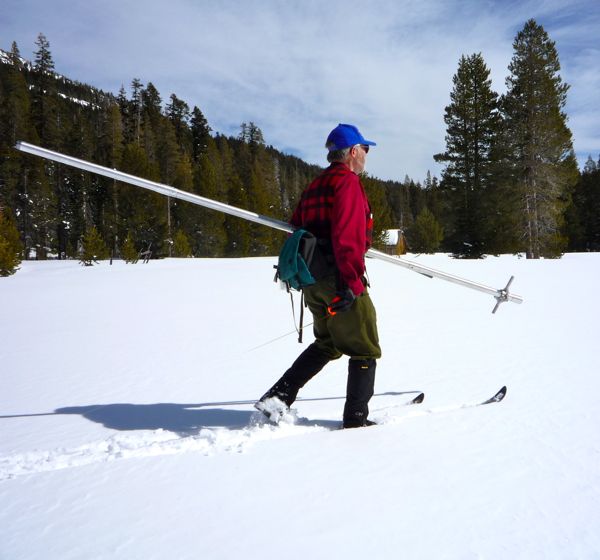
Frank Gehrke takes water samples March 1 near Sierra-at-Tahoe. Photo/Brenda Knox

Frank Gehrke takes water samples March 1 near Sierra-at-Tahoe. Photo/Brenda Knox

A month ago the content at Phillips Station was 125 percent of normal and in December it was 158 percent.

Even though the state is still technically in a drought – that designation is something the governor controls — the readings are much better than last year when the water content was 107 percent of normal, and in 2009 was 80 percent of normal.

Frank Gehrke, chief of the California Cooperative Snow Survey Program, said the state would be in “pretty good shape hydrologically speaking at the end of the season.”

So much snow was in the field that it was getting stuck in the core of the metal tube he uses for the seven samples. A month ago there was so little snow hiking boots could be worn instead of snowshoes or skis.

For a La Nina year, the amount of moisture coming down has been unexpected. A month ago Gehrke was concerned if the dry January continued, it could be trouble for water users downstream of the Sierra runoff. He acknowledged it has been quite an unusual winter.

“March 1 is a key date, flood control reservoirs can increase storage as of March 1,” Gehrke said. “It’s important to fill reservoirs.”

Typically, snow continues to accumulate at a decent rate through April 1, and then the meltdown begins. The peak runoff is usually in May.

The mountain snowpack numbers are important because approximately one-third of the water for California’s households, industry and farms come from this source.

Location

Elevation

Snow Depth

Water Content

% of Long Term Average

Alpha

7,600 feet

91.7  inches

36.8  inches

131

Phillips Station

6,800 feet

89  inches

31.7  inches

128

Lyons Creek

6,700 feet

101.1  inches

39  inches

153

Tamarack Flat

6,500 feet

Missing

Missing

Missing

Source: Department of Water Resources


Snowboarder dies at Northstar

Publisher’s note: Jeffrey Halperin of San Francisco has been identified as the snowboarder.

By FoxReno.com

TRUCKEE — Officials confirmed that an unidentified 30-year-old man was killed Sunday while snowboarding at Northstar-at-Tahoe.

According to a press release issued Monday afternoon by Northstar Spokeswoman Jessica Van Pernis, ski patrollers and officials with the Northstar Fire Department were alerted of an unconscious snowboarder at 10:38 a.m. Sunday; they found the man lying by a cluster of trees near the Challenger ski trail on the backside of the resort.

According to Northstar, patrollers said upon first contact they administered emergency medical care to the man, who was not wearing a helmet.

Read the whole story


Freeskier dies from injuries sustained at Kirkwood competition

Pete Thomas, GrindTV

Pro freeskier Ryan Hawks died early Tuesday of injuries suffered during an extreme competition in Northern California. He was 25 and a rising star in the sometimes dangerous sport of big-mountain freeskiing.

Hawks, a Utah resident originally from Vermont, had had been attempting a 40-foot backflip Sunday during the North American Freeskiing Championships at Kirkwood Ski Resort near Lake Tahoe. He fell hard after landing and was airlifted to Reno’s Renown Health Center, where he was being treated for internal injuries.

An official cause of death is pending an investigation, according to Reno’s Washoe County Medical Examiner.

Dan Abrams, president of FlyLow Gear, which sponsored the athlete, told Outside magazine: “The comp was in full swing. All of the heavy hitters were skiing, but a lot of the guys were falling. There was an opportunity for Ryan to go all out get on the podium. He has a history of back flips and basically going for it in comps.”

Read the whole story


Douglas County search and rescue team members honored

In a ceremony last week, Douglas County Sheriff Ron Pierini presented special recognition and achievement awards to several members of the Douglas County Sheriff’s Office Search and Rescue Team.

In the past 12 months, DCSAR has responded to numerous public service emergencies, including searching for lost or stranded skiers, hikers, mountain bikers, ATV and motorcycle riders, horseback riders, four-wheel drivers, river rafters and assisted with downed aircraft incidents.

Notably, DCSAR has responded to 23 call-outs for missing skiers/snowboarders since New Year’s Eve.

DCSAR members are prepared to respond at a moments notice, twenty-four hours a day, 365 days a year.

Citizens or groups wishing interested in learning more about the program are encouraged to call (775) 782.9930, (775) 588.0940; or by going online.


Former South Tahoe official interim Reno city manager

Publisher’s note: Sue Schlerf  is a former assistant city manager of South Lake Tahoe.

By Susan Voyles, Reno Gazette-Journal

Practicing what it had just preached, the Reno City Council today rejected an offer from one assistant city manager to serve as interim manager for the next six months after he wanted a raise for the extra work and instead picked the other assistant to fill the post for about a month.

Susan Schlerf, an 8-year employee, said she would consider only a brief appointment because she is getting married soon. She replaces Donna Dreska, who announced her intent to resign Feb. 18.

Mayor Bob Cashell proposed John Hester be named as interim director for six months and be paid $23,000 more than his $172,800 salary. That also would be more than what Dreska was paid.

“I think that’s too much,” Councilman Dave Aiazzi said.

Read the whole story


Storm system to dump snow overnight

weatherA winter weather advisory in effect from midnight tonight to noon Wednesday.

The National Weather Service in Reno is calling for snow to begin late tonight near the Sierra crest and spread into the Lake Tahoe Basin early Wednesday morning.

Expect 6 to 12 inches above 7,000 feet, with 2 to 6 inches at lake level.

Slick roads and poor visibility are likely during the Wednesday morning commute in the basin and over the passes.


Snippets about Lake Tahoe

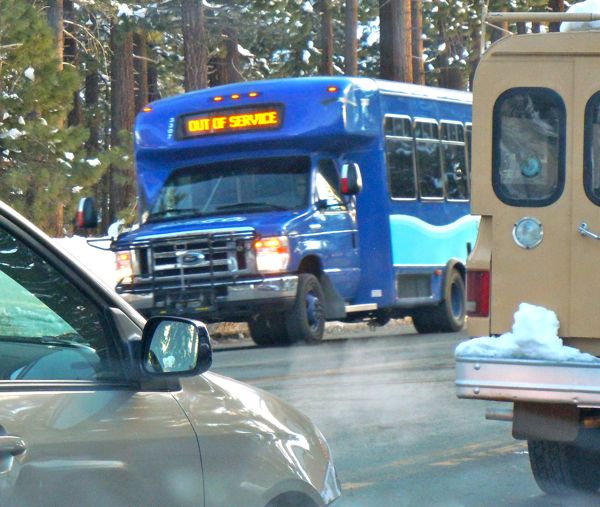
bluego• The bankruptcy hearing for South Tahoe Area Transportation Authority has been moved to March 14.

• A veteran of Truckee’s now-defunct Joe Coffee, Chris McCormick, is back at it lending his savvy barista expertise to Elijah Bleu’s House of Coffee & Good Eats in Truckee.

• According to the Reno Gazette-Journal, Richard Femenella, the Palmer Group’s senior VP of operations, has been scouting locations for a possible Palmer property – as in Charlie Palmer Steak — at Lake Tahoe.

• The third annual Mardi Gras Magic Dinner & Dance to benefit Austin’s House is March 4 at 6pm in the Valley Ballroom at the Carson Valley Inn. Austin’s House is the only emergency children’s shelter in rural Northern Nevada. For info, call (775) 267.6711.

• Cutthroat’s Saloon Beer Dinner on March 4 features Mammoth Brewing Company. Call the Incline Village restaurant at (775) 832.1234, ext. 6730 for a reservation or more information.