Ski report: Freshies all around
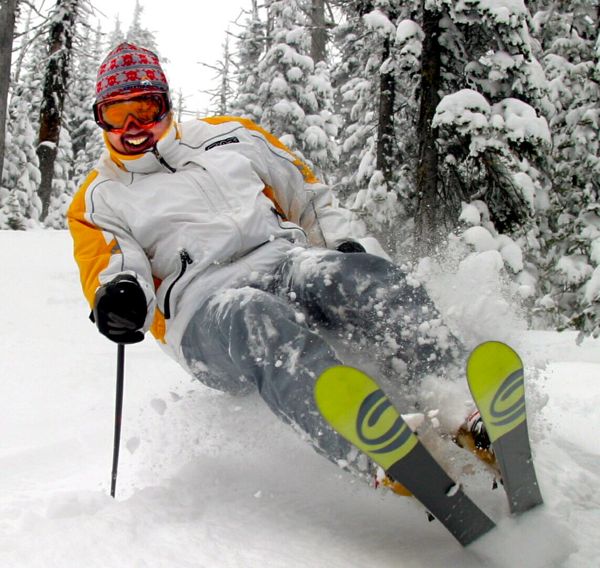 Snow fell overnight, with about 3 inches in South Lake Tahoe to shovel.
Here is the ski report from Curtis Fong, the Guy from Tahoe.
Snow fell overnight, with about 3 inches in South Lake Tahoe to shovel.
Here is the ski report from Curtis Fong, the Guy from Tahoe.
An Incline Village woman will be sentenced in May for the stabbing death of her husband in October 2009.
Mary Arlayne Baymiller, 73, pleaded guilty to voluntary manslaughter with the use of a deadly weapon in the killing of Charles Alan Baymiller, 73.
She faces a maximum sentence of 20 years in jail. Baymiller is out on bail.
— Lake Tahoe News staff report
By Freddy Perryman, U.S. Ski Team
GRINDELWALD, Switzerland -– X Games champion John Teller of Mammoth Lakes just missed the podium, finishing fourth in Thursday’s World Cup skicross race in Grindelwald. World Championship bronze medalist Andreas Matt of Austria topped the men’s field, while Norway’s Marte Hoeie Gjefsen won the women’s race.
Teller, who qualified 14th, fought his way through the finals bracket, finishing second in each heat behind World Champion Chris Del Bosco of Canada, earning himself a spot in the final four.
Teller has been having a strong season. He has qualified for the finals in all but one World Cup, with two podium finishes, including a win at St. Johann, Austria.
Patrick Duran of Fayson, Vt., skied his way into his second World Cup finals after qualifying ninth. Duran finished in third in the quarterfinals, ending a career best 19th.
Matt has been on a tear this season, on the podium in six out of the eight World Cups with two wins. Joining Matt on the podium was World Championship silver medalist Jouni Pellinen from Finland in second with Del Bosco third.
Joining Norway’s Gjefsen was Ophelie David of France in second and Heidi Zacher of Germany third.
Teller currently sits fifth in the World Cup skicross standings with 254 points, just nine points behind Canada’s Nick Zoricic. Thursday’s winner Matt tops the leader board with 599 points.
Official results, FIS World Cup, Grindelwald, Switzerland, Skicross
Men
1. Andreas Matt, Switzerland
2. Jouni Pellinen, Finland
3. Chris Del Bosco, Canada
–
4. John Teller, Mammoth Lakes, CA
19. Patrick Duran, Fayson, VT
Women
1. Marte Hoeie Gjefsen, Norway
2. Ophelie David, France
3. Heidi Zacher, Germany
By Gordon Hamilton, Vancouver Sun
Climate change is expected to drive lodgepole pine, the backbone of the central Interior forest industry, from most of its range in B.C. by 2080, says a study by researchers at the University of B.C. and Oregon State University.
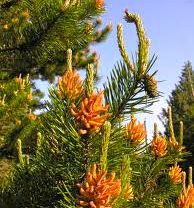 The study, to be published in the journal Climate Change, measures how trees respond physiologically to changes in their environment, resulting in precise forecasts for researchers Nicolas Coops at UBC and Richard Waring at OSU. Although lodgepole pine will be mostly gone by 2080, as early as 2020, its habitat will begin shrinking. It is expected to move northward into the Yukon.
The researchers used NASA satellite maps to trace changes in tree physiology, using sophisticated techniques that, for example, can measure the impact of drought by changes in the reflectivity of a tree’s needles as seen from space. It is the first time such precise modeling has been undertaken to measure tree response to climate change.
The satellite images show climate-change induced drought is already affecting lodgepole pine. Coops said drought stresses the tree, making them more susceptible to disease and pests like the pine beetle.
The researchers say that lodgepole pine will be gone from almost all of the Pacific Northwest and wiped out in 83 per cent of its range in B.C. by 2080. That’s within the lifetime of seedlings now being planted in the wake of the mountain pine beetle epidemic.
“Even though lodgepole pine is a hardy species, it’s very susceptible to climate change, so it is going to be pushed out of the space where it grows very well,” Coops, a professor at the UBC Faculty of Forestry, said in an interview.
Although the December unemployment numbers for South Lake Tahoe are higher than the state and national averages at 17 percent, some people on the South Shore are making money.
Smith Travel Research says hotel occupancy was up 3 percent on the South Shore in December compared to 2009.
MontBleu casino in Stateline has seen a consistent 15 percent increase in year-over-year hotel occupancy and 50 percent increase in food and beverage, showroom and nightclub covers, according to officials.
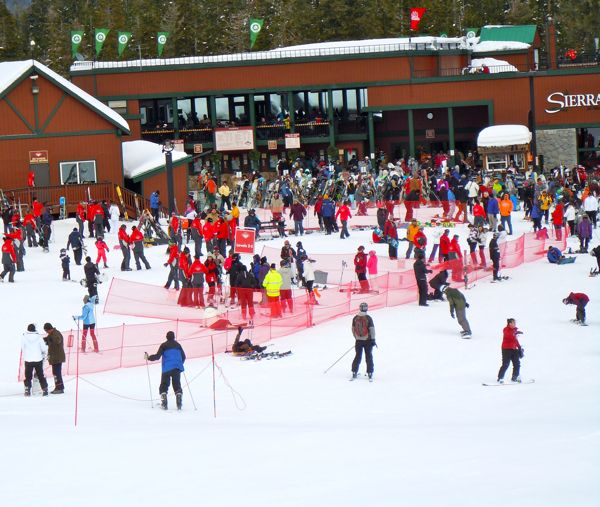
More skiers have been coming to Lake Tahoe this year than last season. Photo/LTN file
Lakeshore Lodge & Spa is doing well this winter, but is also getting calls for summer.
“We’re seeing solid indicators and positive momentum in the South Shore lodging community,” Jerry Bindel, general manager of Lakeland Village, said in a press release. “Not only is winter being reported above last year in many locations, there’s strong advance summer bookings. It’s a very encouraging sign that our tourism economy is rebounding.”
The boon in more heads in beds has South Lake Tahoe officials forecasting a 2.5 percent increase in transient occupancy tax for fiscal year 2011-12.
Sierra-at-Tahoe is up 14 percent in skier visits through February.
Vail Resorts, which owns Heavenly Mountain Resort and Northstar-at-Tahoe, will release stats March 10 for its second fiscal quarter ending Jan. 31 which should give an indication how the Colorado-based company is doing in terms of skier visits and lodging.
— Lake Tahoe News staff report
Publisher’s note: This editorial is from the Feb. 26, 2011, Sacramento Bee.
More than 20,000 public school teachers in California have received pink slips during each of the last three years. The state’s ongoing economic and budget troubles mean that trend is likely to continue with upcoming March 15 layoff notices.
Unfortunately, the distribution of layoffs is anything but equitable because districts rely on “last-in, first-out” rules.
Few veteran teachers experience layoffs, while the newest teachers are hit hard. Sign a contract a few minutes later than your colleagues and you’re out, regardless of how effective you are as a teacher.
And because the newest teachers tend to be the lowest paid, districts have to lay off more teachers than if layoffs were balanced across the teacher corps.
The result is that many schools experience no layoffs, while high-poverty, high-minority schools often are decimated – creating a cycle of turnover and instability.
It doesn’t have to be that way. For this March 15 round of layoff notices, districts should vow to do things differently.
The U.S. Forest Service on Wednesday honored staff from the Lake Tahoe Basin Management Unit with the 2010 National Forest System Invasive Species Program Award in recognition of their work with more than 50 external partners as part of the Lake Tahoe Aquatic Invasive Species Working Group to prevent and control aquatic invasive species.
Forest Aquatic Biologist Richard Vacirca accepted the award on behalf of the Lake Tahoe Basin team at an awards ceremony in Washington, D.C. Also recognized were biologists Holly Eddinger, Sarah Muskopf and Maura Santora, recreation staff members Bob Becker and Jonathan Cook-Fisher and public affairs officer Cheva Heck.
In nominating the team, the Pacific Southwest Regional Office noted the significant efforts of partners, including the Tahoe Regional Planning Agency, Tahoe Resource Conservation District, Lake Tahoe Water Trail Association, Washoe Tribe of Nevada and California, California State Parks, California Department of Fish & Game, Nevada Department of Wildlife and the U.S. Fish and Wildlife Service.
In collaboration with partners during 2010, the LTBMU team’s accomplishments included working with California Land Management to develop a screening process at Forest Service-staffed recreation sites to prevent the spread of aquatic invasive species through non-motorized watercraft and staffing a roving inspector at Fallen Leaf Lake to inform the public of aquatic invasive species risks and prevention. Team members also helped to organize cutting-edge research and coordinate education and outreach efforts.
By Stephen Ward
INCLINE VILLAGE – Bugs. They are missing from Lake Tahoe.
While most people might think it’s a good thing not to swim or kayak with these seemingly invisible critters, the fact is their disappearance is contributing to the changing ecosystem of this massive body of water.
Their demise is being blamed on invasive species.
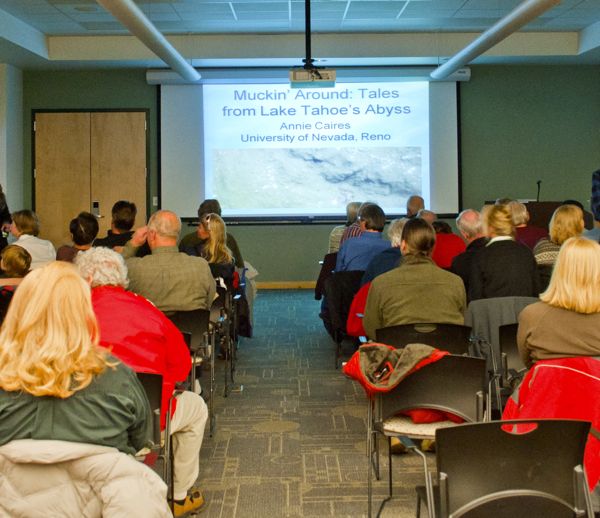
Dozens of people learn about life below the surface of Lake Tahoe. Photos/Stephen Ward
After watching videos showing various species of bugs inhabiting the bottom of Lake Tahoe, coupled with information detailing their assistance in keeping the lake clean, the audience sat in silence as the presenter showed a graph demonstrating how light transmittance and plant life are plummeting in unison.
This was the overarching tone Tuesday at the Tahoe Environmental Research Center, where Annie Caires gave an hourlong presentation about the impact on endemic species found in Lake Tahoe.
Caires is a researcher from UNR’s Aquatic Ecosystems Analysis Laboratory and has studied benthic invertebrate since 2004. She has been studying Lake Tahoe since 2008 and believes the bugs, or the lack thereof, has a dramatic affect on the lake.
“When we look at Lake Tahoe, we don’t think about what’s in the depths of the lake,” Caires said. “The point is these bugs perform important ecological processes.”
The evidence Caires cited for a fleeting critter population was clear – 25,400 bugs were collected from 389 samples in a two-year study in 1963. When a similar experiment was conducted with 394 samples less than 50 years later, only 7,400 bugs were unearthed.
One species discussed was the blind amphipod, a white, many-legged creature found hundreds of feet below sea level on the sea floor. Caires noted the amphipod’s reputation for being aggressive just before showing a video of them fighting viciously over territory.
When an audience member asked about the size of the amphipod, Caires scattered a jar of 3,500 grains of rice across a table to show the relative size of the bugs.
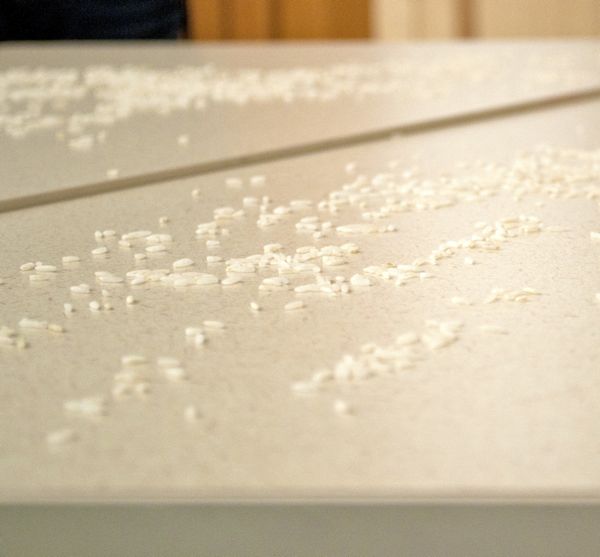
Rice represents the size of bugs in Lake Tahoe.
“Yeah, I know, I’m dedicated,” Caires added after the example.
But now, after being the most populous creature in the 1963 study, no trace of the amphipods remains today.
Caires said species such as the blind amphipod are gone because of invasive species and eutrophication, or the addition of natural and artificial substances through sewage and other substances.
Caires also said the decrease in water clarity has reduced the ability for plant beds to grow. She linked the introduction of mysid shrimp and other invasive species with the fisheries of the 1930s. The introduction of invasive species was meant to enhance the productivity of the fisheries. The mysid shrimp, that were not supposed to compete with the blind amphipods, ended up overpowering their frumpy counterparts.
Another invasive species attributed to harming the lake is crayfish; opportunistic feeders that hinder plant growth. They are another invasive species introduced to Tahoe 80 years ago when the fisheries started.
Caires added that preliminary research has suggested that the crayfish are eating the amphipods in the lake.
To Caires, the lack of bugs at the bottom of Lake Tahoe is not just the process of evolution.
“These things can be great indicators of lake health,” she said.
As for what can be done, Caires said public support for agencies such as the Tahoe Regional Planning Agency and California Tahoe Conservancy is crucial to reverse eutrophication because both agencies are helping fight invasive species.
“We’re seeing huge declines in native species, but I think we can reverse the trends if we continue to focus on cleaning up,” Caires said.
The public support Caires described seemed to be gaining momentum shortly after the presentation. Steve Hale, a retired forest worker who worked in the South Lake Tahoe area for 20 years, called the information sobering.
“This is why it’s so important people come to lectures so they can learn from scientists,” Hale said. “To hear silence from the audience and see their reaction was remarkable.”
Dolly Tillman, a registered nurse from South Lake Tahoe, will be recognized by the Nevada Highway Patrol on March 4 with the agency’s Life Saving Award.
Also receiving the award is Pierce Ackerman with the Folsom Fire Department.
“Mr. Ackerman and Ms. Tillman had stopped at the accident scene to render aid to the victim, Charles P. Murray, of Glendale, Calif. Mr. Murray sustained life-threatening injuries after rolling his vehicle several times adjacent to the two-lane highway and both first responders acted quickly and provided life saving medical attention until public safety personnel arrived on scene,” the NHP said in a press release. “The medical attention they were able to provide to Mr. Murray ultimately saved him from an untimely death.”
The ceremony will by at the NHP-Northern Command Headquarters, 357 Hammill Lane, Reno starting at 1pm.
As part of the Harrah’s and Heavenly “Winter Snow Blast” weekends, the Sun Kings will be in town March 18 at 7:30pm.
This show is free to Heavenly same-day lift ticket holders; Heavenly season pass holders; and Harrah’s, Harveys and Heavenly employees. All others pay $15 per ticket.
The Sun Kings eschew the usual haircuts, costumes and on-stage manner of Beatles “tribute” bands and just play the heck out of some of the best popular and rock music ever written.
For tickets, call 800.786.8208.