Incline student claims high school ski championship

By Reno Gazette-Journal

Incline’s Grace Dolan on Tuesday repeated the feat she accomplished last year, winning a state skiing championship.

The junior Dolan claimed the Tahoe Basin League’s state slalom title by nine-hundredths of a second at Sierra-at-Tahoe to secure the overall championship, after she won the giant slalom title on Monday.

Dolan won the overall title a year ago, when there was just one state meet. This year, there was the Northern Region championships and the Tahoe Basin championships.

“There was a lot of pressure on her and a lot of competition from North Tahoe, South Tahoe and Truckee,” Incline coach Joe Humasti said. “But she responded with four great runs. She was real centered, in the zone.”

North Tahoe claimed both the boys and girls team titles.

The Lakers won the girls title by three points, 198-195, over Truckee, and the boys title by eight points, 210-202, over South Tahoe.

Dolan edged out North Tahoe’s Jessica Tidd for the slalom championship.

North Tahoe’s Zach Richenbach posted the fastest time in each of the two slalom runs to claim the boys slalom title by 28-hundredths of a second over South Tahoe’s Michael Suglian.


Kayaking Lake Tahoe — not just a summer sport

By Rachel Levin, New York Times

Bumping along a freshly plowed road in Lake Tahoe, I felt oddly unburdened. No skis were locked on top of my car, no clunky boots rattled in the trunk. After more than a decade of ski trips to the region, I kept feeling as if I were missing something. Sure, it was sunny, but also a biting 17 degrees — and I was going kayaking.

“You’re going what?” asked my friend when she heard I wasn’t joining her for another powder day at Squaw Valley. “Seriously?”

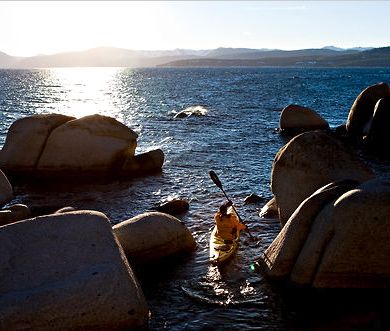
A less congested Lake Tahoe in the winter. Photo/Max Whittaker/New York Times

A less congested Lake Tahoe in the winter. Photo/Max Whittaker/New York Times

Seriously. It was the week between Christmas and New Year’s Day — the most crowded week of the season at one of America’s most visited ski destinations. Thanks to a record-setting December snowfall, the actual skiing had been phenomenal. But I was sick of struggling to find a parking spot, tired of waiting in all those lift lines that were as congested as the bumper-to-bumper traffic that led to them.

Of course, Tahoe offers more than just downhill skiing: snowshoeing and cross-country are the go-to alternative snow sports for most crowd-dodgers. But kayaking? In the dead of winter? Not so much. Not even on the largest alpine lake in the United States, and the second deepest in the country. A lake that never freezes over, where the surface appears so placid and the snowcapped scene so screen-saver-serene that it makes you want to leap off the chairlift into the hallowed blue water. For most, though, the primary function of Lake Tahoe in winter is as a breathtaking backdrop.

Read the whole story


Snippets about Lake Tahoe

Amgen logo• South Lake Tahoe officials are putting together a festival along the Amgen Tour of California route through town on May 15. Check out the flyer for more information about getting your business or nonprofit a booth during the cycling event.

• A 6-foot-tall, nearly1,000-pound copper kettle made in 1914 was stolen from outside the Washoe Valley Chocolate Nugget Candy Factory on Highway 395.

• Placer County has reduced costs for the use of cell phones and other mobile communication devices by 58 percent over the last three years. The county spent approximately $900,000 during the 2007-08 fiscal year on mobile communication devices compared to the budgeted $375,000 for 2010-11.

• Freelance artist Justin Majeczky shot this time lapse of the Milky Way over Lake Tahoe.

• Thunder Canyon, the private golf and country club in Washoe Valley, was a finalist for Golf Course of the Year Award by the National Golf Course Owners Association and was named by the group as Nevada’s top course for the year.


California boosts traffic fines to help budget

By Jim Sanders, Sacramento Bee

Justin Jachens learned of California’s soaring traffic penalties when he got slapped for a red-light violation.

Ticketed drivers have been squeezed hard during the budget crisis, perhaps because few complain until they get fined – then it’s too late.

“We’re the ones taking the brunt for everything,” said Jachens, 21, a student at California State University, Sacramento. “It’s outrageous.”

Jachens was nabbed by a red-light camera for not making a complete stop at the intersection of Watt Avenue and Fair Oaks Boulevard. Three years ago, the offense would have cost Jachens $371.

Now it’s $470.

Read the whole story


Opinion: How can state justify traffic fine shakedown?

Publisher’s note: This editorial is from the Feb. 25, 2011, Sacramento Bee.

Unwilling (in the case of most Republicans) or unable (in the case of most Democrats) to approve new taxes, state lawmakers are squeezing citizens to raise revenue in less obvious but nonetheless onerous ways.

We are talking about soaring traffic fines that have nothing to do with deterrence but all to do with revenue generation. They cause disproportionate harm to students and people of modest means, and they undermine our system of justice.

Three years ago, it would have cost $371 if you were caught by a red-light camera failing to make a complete stop before turning into an intersection.

Today, that same violation costs $470, a 37 percent increase. Is the crime 37 percent more egregious? Or are state and local governments, the courts and other publicly financed enterprises that support themselves with these fines just more desperate?

Desperation is the answer.

Read the whole story


STHS grad: Peace Corps struggling to be relevant

Publisher’s note: The Peace Corps turns 50 this month. Two 2005 South Tahoe High School grads are in the Peace Corps having different experiences. Jessica Wackenhut today weighs in with her thoughts from Paraguay. On March 11, Michelle Aguilar will share her opinions from Panama.

By Jessica Wackenhut

ENCARNACION, Paraguay — When one thinks of Peace Corps, the first thing that tends to come to mind is living in a mud hut in the middle of Africa, experiencing incredible hardships in a new culture, but overcoming such obstacles by bonding with community members and bringing in amazing infrastructure such as a new school, library, or modern bathrooms.

Jessica Wackenhut

Jessica Wackenhut

This, however, is far from my experience as an Environmental Education Volunteer in Peace Corps Paraguay (2009-2011), where during the last 17 months I have truly questioned whether we should be celebrating or, instead, re-evaluating Peace Corps as an institution.

Peace Corps, founded in 1961 by President John F. Kennedy, was created to encourage development and cultural exchange for recent college graduates who had little to no experience abroad. During the first two decades of Peace Corps, volunteers were able to help their communities develop through sharing the technical knowledge they acquired from their bachelor’s degrees — a level of education way beyond that of their community counterparts. Additionally, volunteers had to integrate with their communities because if they did not, they would have no one to talk to.

It was incredibly challenging to visit other volunteers because of little infrastructure, and conveniences such as cell phones and Internet were still decades away. In fact, much communication with family from the States was limited to snail mail that took more than months to arrive.

Now let’s fast forward 50 years to Peace Corps 2011: Today’s Peace Corps has changed significantly since its creation because of globalization, higher rates of education for host country nationals, and the rapid spread of technology. As a Peace Corps volunteer in Paraguay, my life is a bit easier than those volunteers who served in the first years of Peace Corps’ existence. If I am tired of traditional Paraguayan food, I can find Coca Cola, Sprite, Doritos, M&Ms, Pringles, among many other American foods, in my local supermarkets. If I am feeling homesick, all I have to do is insert the Internet device that I pay for monthly with my Peace Corps salary into the laptop I brought with me and call my parents on Skype. And if I’m not close to my computer, I can use my Peace Corps issued cell phone to call my volunteer friends and talk for free, thanks to the Peace Corps phone plan.

Now don’t get me wrong, I’m not complaining. It’s truly impressive how far technology has come. And while the rate of globalization can be a bit overwhelming at times, it’s nice to get a small reminder of home.

The problem lies in the fact that Peace Corps continues to recruit the same recent college graduates they were searching for 50 years ago, even though more host country nationals are obtaining higher education degrees from universities in big cities or abroad. In this sense, globalization has so profoundly affected Peace Corps that many volunteers no longer have a higher knowledge base than their community counterparts. Therefore, it is not hard to find agriculture volunteers whose prior experience is limited to a summer of landscape architecture or a construction job, a health volunteer who was qualified based on her undergraduate biology degree, or an environmental education volunteer who was accepted based on her minor in environmental studies.

Fortunately, upon entering their country of service, each volunteer must undergo roughly three months of mandatory training. Many volunteers, however, finish training feeling like they touched the surface of so many different themes but never truly learned about anything that will actually be of assistance in their sites. For example, one of the largest environmental problems in Paraguay is trash. However, during training, my group had only a 45-minute session dedicated to trash where we learned several different activities about how to teach trash decomposition and stories about why burning trash is bad.

We never learned that throughout all of Paraguay there is only one sanitary landfill, nor did we learn how to set up a trash management system in our own sites. The general consensus post-training is the only thing we get out of it is language training, which, I must admit, Peace Corps does an exceptional job with.

This, in essence, is the question I have been struggling with for the past year and a half while I’ve been in Paraguay: what makes it OK, then, for a recent college graduate turned Peace Corps volunteer to come into a foreign culture and try to tell their community how they should change their way of life because she thinks it will be better that way? Who am I as an environmental studies major from the U.S. to come into Paraguay and say how to plant crops and trees when I have never studied this climate and most farmers in the country will know the soil, weather, pests, and plants far better than I ever will since they have been working on the land for their entire lives.

There are college graduates who have come to Peace Corps and completed impressive projects with their counterparts. Many times all communities need is a little cheerleading and organization to make their projects come to fruition. But my project area, which is to increase environmental awareness in Paraguay, doesn’t include making modern bathrooms or libraries. And because my projects are harder to conceptualize, it’s harder to receive grants from Peace Corps Partnerships. Additionally, I’ve found very little resources at the Peace Corps Office in the capital. My bosses seem more concerned with placing new volunteers in their sites and expanding the number of volunteers in Paraguay than helping current volunteers acquire the resources and knowledge needed to have successful projects.

When I ask the workers in the office of possible projects ideas and what has been done in the past, I am almost always pointed to the same five classroom activities instead of actual community projects. Many times my community members ask me examples of what Peace Corps has done to develop their country. I have yet to respond to them because Peace Corps Paraguay has no collection of examples of their work in Paraguay over the last 45 years they’ve been here. This is especially discouraging when I hear about some of the projects more professional Japanese (JICA) and Korean (KOICA) volunteers are doing within Paraguay as they work with large institutions such as the Ministry of Agriculture and Ministry of Education — two powerful institutions that rarely work with Peace Corps Volunteers who they view as inexperienced and immature.

I want to be clear, I do thank Peace Corps for giving me an opportunity I would have never had otherwise. I have learned a great deal about myself, others, the world, and how to do projects without the support of the institution who I am supposed to be working under. I came to Peace Corps in the hopes that I would be doing some small-scale projects that would be positive development models that in turn help my community grow more sustainably. After I got here, I quickly realized Peace Corps is not a development organization as it advertises, but is more of a cultural exchange program. The projects I have done or am working on have had little to no support by Peace Corps, some of my projects were even discouraged.

In my experience, I have had many hardships thus far in my service and although some of them were a result of mere cultural differences, a majority of the stresses arose from Peace Corps as an institution and the lack of resources or even support given to myself and many volunteers. This experience will be one of a lifetime, one I will never forget. The people I have met, the relationships created, the projects I worked on with various counterparts throughout my site will never be replaced.

As Peace Corps celebrates its 50th anniversary, I hope this organization refocuses to become more meaningful if it wants to be a development organization, or be clear if its intentions truly are to be a cultural exchange program via the social responsibility department of the U.S. government. During the celebrations, Returned Peace Corps Volunteers will lobby Congress to increase the number of volunteers, is this making this organization more quality?

Peace Corps embarks on its 50th anniversary and what does it have to celebrate?


Tahoe skiers put the fun into freeskiing competition

By Jessie Marchesseau

KIRKWOOD — Last weekend’s Subaru North American Freeskiing Championships was quintessential Kirkwood. Postponed two days due to a gnarly storm, Day 1 boasted blue skies, 4 feet of fresh powder and the steep, rocky, forbidden terrain of the Cirque.

Freeskiers traveled from as far away as New Zealand, Chile, Sweden and France to be part of this year’s competition. And Kirkwood did not disappoint.

But one does not need to venture into the closed terrain of the Cirque to find extreme here. Kirkwood is teeming with rocks, cliffs, cornices and some of the deepest snow in the Sierra.

The Cirque at Kirkwood is closed except during competitions. Photos/Jessie Marchesseau

The Cirque at Kirkwood is closed except during competitions. Photos/Jessie Marchesseau

“Kirkwood terrain pushes you,” Dan Durkin, a local freeskier, said. “I mean everywhere you look there’s jumps to jump, there’s chutes to go through, there’s just natural rock airs that are going to progress you and make you look for the next bigger line.”

And in the end, skiing Kirkwood terrain on almost a daily basis paid off for local competitor Josh Daiek, 27, who took home this year’s title. Daiek, who won the Freeskiing World Tour in 2008, dominated the entire weekend, earning the highest score in the qualifying round, winning Day 1 of the finals and solidifying his place on top with a smooth run on Day 2.

Daiek attributed his win to “good snow and skiing at Kirkwood all the time. It’s one of the coolest training grounds.” He added, “It’s what I do every day; I go out, jump off rocks and try and land on my feet.”

Having primarily stepped away from competition for the last two seasons due to injury, Daiek spends most of his days skiing at Kirkwood or in the nearby backcountry with friends like Durkin and fellow freeskier and two-time winner of Kirkwood’s North American Freeskiing Championships, Craig Garbiel.

Garbiel was prequalified for the weekend’s competition as a result of being in the top 10 overall on the tour last year. He stuck solid runs during both days of the finals earning him a 12th place finish.

Though they both call Kirkwood their home mountain, neither Daiek nor Garbiel grew up in Tahoe. Garbiel, 35, hails from Vermont where he dabbled in ski racing as a kid, but spent most of the rest of his time on a snowboard. He moved to Tahoe 15 years ago because someone told him that it snowed every night and was sunny every day. He has been here ever since.

Daiek, on the other hand, never had any formal ski training.

“I grew up skiing trash heaps in Michigan,” he said. “Basically, when I came here, I couldn’t really buy a turn. I didn’t know how to turn very well or ski very well and just started following Craig (Garbiel) around and skiing with him a bunch, and my skiing definitely got a lot better.”

That was nine years ago, around the same time Garbiel began entering freeskiing competitions. He recalled how a group of friends paid for his first one at Kirkwood:

“The night before they were like ‘OK, who’s got money?’ and they all just pulled out cash and paid for me to do it. I’ve been doing it ever since,” he said.

Garbiel was ranked the seventh best freeskier in the world three years ago, a standing that earned him the opportunity to spend two seasons skiing around the world as part of the Freeride World Tour. However, a knee injury during the second season took him out of the competition.

Daiek and Garbiel are healthy again and hungry to regain their places on the podium. They ski together often, sometimes at Kirkwood, sometimes hiking in the backcountry, sometimes using snowmobiles. Daiek admits his style and line choices somewhat mimic that of Garbiel because he basically learned to ski by watching and skiing with him. There are, however, still some notable differences.

“Josh is younger and crazier so he goes full out all the time: big backflips, lots of 360s, just kind of full bore going for it,” said Durkin who skis with the duo regularly. “Craig is a little bit older and more reserved .… He’s just real calculated and just nails his lines. Everything he looks at, he just seems to stomp like a cat, just landing on his feet all the time, and real fluid.”

The money to ski

These are the skills that earned both skiers sponsorships from big-name companies like Blizzard and Moment skis and Smith Optics. Moment, who sponsors Garbiel, even created a signature ski that bears his nickname, Garbones.

Sixpoint Snowwear, owned by South Shore local Teri Jones, also sponsors Garbiel and Daiek. Jones said she has known both skiers for years and was honored when they agreed to ride for her company. A Kirkwood rider herself, Jones admits she cannot keep up with them on the hill, and calls them “friends that are some of the best skiers in the whole world.” She is currently working on the design for a limited edition line of Garbones beanies.

Sponsors are a big part of being able to compete in events like the one at Kirkwood. Entry fees generally run $200 to $300, not including travel, lodging and lift tickets. While the winner of a competition can take home thousands of dollars, skiers can often spend more than they make entering contests.

Money and sponsors add to the pressure to do well in competitions, and both men admit to feeling a little added pressure on their home turf.

Even though they ski Kirkwood all the time, neither skier said they felt like it gave them an advantage. Unlike some of the other mountains on the tour, the terrain Kirkwood offers for the competition is closed except during the competition.

“The local skiers here have no advantage over the other skiers because it’s closed terrain,” Daiek said. “We ski it once a year like everyone else.”

So they choose their lines by looking at the slope from the bottom just like the rest of the field, and hope for the best.

“I got a little off my line and I didn’t quite hit what I wanted to hit,” Garbiel said of his final run. “But I skied fast and that’s what I wanted to do. I skied fall-line top-to-bottom through the Hour Glass.”

However, in a competition that’s judged heavily on factors such as steepness, exposure and airtime of the skier’s chosen line, getting a little off can have big effects. Both Daiek and Garbiel plan their lines ahead of time and stressed the importance of trying to stick to it, but also having a backup plan.

“I have a visual idea of exactly what I want to do. What I want to hit, where I want to land, where I want to take off,” Garbiel said. “It’s ideally 100 percent planned. But it doesn’t always work out that way; sometimes you improvise.”

Back at the comp

Whether they were carefully calculated, or improvised, nearly all the descents at this year’s competition seemed larger-than-life. Big-name pros including JT Holmes, Sebastian Hannemann and Henrik Windstedt from the Freeride World Tour joined the field of competitors making this one of the most stacked competitions of the winter.

And judging by the technicality of the lines and the amplitude of the crowd, no one was holding back. Some skiers, like Garbiel and Daiek, were sticking their lines. Others, like Holmes, were blowing up. However, with this degree of all-out skiing comes inherent danger. Competitors and spectators alike commented on the higher than usual number of skiers coming off the hill with injuries. Two competitors were taken to nearby hospitals by helicopter on Sunday, and at least that many came down in toboggans.

Ryan Hawks, 25, was the second skier to be taken out by helicopter. Just after 3pm on Sunday, as the sun was starting to move behind the peak and the light on the Cirque was getting a little flat, he dropped in for his turn at the rocky terrain. Mid-run, Hawks threw a backflip off a 40-foot cliff, but showed little movement after landing.

Ski patrol immediately tended to the injured Hawks, and the waiting Care Flight helicopter rushed him to Renown Medical Center in Reno. He was treated for internal injuries, but passed away early Tuesday morning.

Still on a high from his recent win, Daiek’s voice went somber when asked about Hawks. Daiek had befriended the young skier earlier this season at a competition in Revelstoke, Canada.

“He was a super positive guy,” he said, “always had a smile on his face.”

Daiek said he lives by the philosophy that life is short, so you better live it up while you’re here. In the past, he found himself getting stressed out preparing for competitions, but has tried to let that mentality go.

“That’s never why I fell in love with skiing,” he said. “Skiing’s just an awesome sport and an awesome feeling of freedom. That’s why I do it .… It’s not about the comp, or it’s not about being the raddest skier or anything like that. Skiing’s about having fun.”

Daiek and Garbiel plan on competing in the Freeskiing World Tour Championships at Snowbird, Utah, March 8-13.

ngg_shortcode_0_placeholder (Click on photos to enlarge.)


South Tahoe couple jailed on child abuse charges

A South Lake Tahoe couple was arrested Wednesday on child abuse charges.

Demetrius and Leann Jones have been under investigation since the beginning of the year by South Lake Tahoe police officer after bringing their 3-month-old daughter to Barton Memorial Hospital alleging she became unresponsive at home. Because of the severity of her injuries, the baby was airlifted to Renown Medical Center in Reno. Officers said the Joneses told them there had been an accident at home.

Doctors became suspicious of the story because the injuries didn’t match the account of the accident, according to law enforcement. The infant had severe brain damage, bleeding in the brain, and retinal hemorrhages.

As a result, Child Protective Services removed the baby from the Joneses.

The Joneses were also charged with attempting to obtain a money under false pretenses after they solicited several churches in the area for money to help with transportation to visit the baby. The Joneses were not allowed to visit the baby, except for supervised visits, after she was removed from their custody.


Mounainteer Robinson to help raise funds for Snowlands Network

Mountaineer, climber, skier, and award-winning author Doug Robinson will speak in Reno on March 10 at a special benefit for the Reno-based advocacy group Snowlands Network.

The lecture and slideshow “Wild in the Sierra: Backcountry Skiing the Highest Sierra” will feature Robinson’s reflections about his 50 years of climbing and skiing throughout the Sierra.

Robinson, the recipient of the 2010 American Alpine Club Literary Award, has given voice to the thoughts and concerns of the climbing community ever since he articulated his ideas about “clean climbing” in the early 1970s arguing that rock climbers should climb in a way that left no trace of their ascents. Robinson’s writing has led some to call him the “bard of the climbing community;” he has been referred to as a “modern day John Muir” because of the poetic way in which he combines adventure and observations about the natural environment. His climbing video, “Moving Over Stone,” was a best seller, and has taught several of generations of climbers how to take to rock and mountains.

Robinson will speak at the Patagonia Service Center, 8550 White Fir St., Reno.

Tickets are available on the Snowlands website, and at the event if still available. Prices are $20 in advance for Snowlands Network members and $25 in advance for non-members, $30 at the door for everyone. Doors open and silent auction begin at 6:30pm.

The nonprofit Snowlands Network is the only organization in California and Nevada dedicated to representing the needs of backcountry skiers, snowshoers, snowboarders and other outdoors people who value the physical and spiritual joys of winter and winter travel using their own muscle power. The goal is to promote safety and serenity on every winter adventure.


Sensors in snow country help predict water levels

By Neetu Puranikmath, Daily Cal

UC Merced Professor Roger Bales realizes that California has a dire problem: a water problem.

According to Bales, California is currently in a drought. But with 70 to 90 percent of the state’s water supply coming from snow in the state’s mountains, Bales said scientists have traditionally been unable to accurately and precisely measure this potential water source – until now.

Bales has been collaborating with UC Berkeley professor in the Department of civil and environmental engineering Steven Glaser for the past several years on CITRIS MOTES – a joint UC Merced-UC Berkeley project that has developed a network of computers and radios that can measure the amount of water in snow atop the Sierra Nevada and other Californian mountain ranges.

“From a scientific perspective, our goal is to figure out what is going on in hydrology,” said Branko Kerkez, a UC Berkeley civil engineering graduate student working with Glaser and Bales. “From an engineering perspective, it is to get as much data as possible.”

Bales said the research team currently has several papers based on their findings in review by academic journals and are hoping their research will get published in the summer or fall.

Currently, the project has two wireless networks that were fully established last year: one in Shaver Lake – with around 300 sensors and measuring a square kilometer in area – and a second in Lake Tahoe with around 25 sensors.

Read the whole story