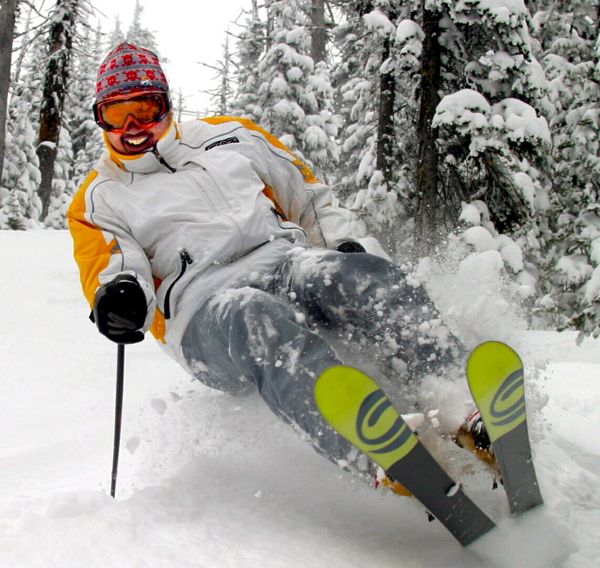
Reno’s Jitloff takes second at Winter Park

WINTER PARK, Colo. – Tommy Ford (Bend, OR) captured his fourth straight U.S. title with a giant slalom victory to open the Putnam Investments U.S. Alpine Championships Thursday in Winter Park. Ford swept the giant slalom, slalom and super combined titles at the 2010 U.S. Championships. Tim Jitloff (Reno, NV) was second followed by 2011 World Champion and World Cup giant slalom title winner Ted Ligety (Park City, UT) in extremely soft snow conditions. Top junior honors went to Ryan Cochran-Siegle (Starksboro, VT), who’s uncle Bobby Cochran will be inducted into the U.S. Ski and Snowboard Hall of Fame on Saturday.

OFFICIAL RESULTS

Putnam Investments U.S. Alpine Championships

Winter Park, CO – March 31, 2011

Giant Slalom

1. Tommy Ford, Bend, OR, 2:22.24

2. Tim Jitloff, Reno, NV, 2:22.33

3. Ted Ligety, Park City, UT, 2:22.54

Juniors

1. Ryan Cochran-Siegle, Starksboro, VT, 2:25.03

2. Brennan Rubie, Salt Lake City, UT, 2:25.13

3. Jared Goldberg, Halladay, UT, 2:25.56


Placer County accepting applications for mental health grants

Grant applications for the Innovative Community Grants Program will be accepted until April 21 by the Placer County Department of Health and Human Services.

The Innovative Community Grants Program aims to support the various groups and natural networks in Placer County that are currently providing assistance in keeping people well and preventing the need for intensive mental health services, as well as determining whether, given additional support and resources, communities can develop effective and long-term solutions to fit the specific mental health needs of their own populations.

Grants will be awarded in amounts from $50,000 up to $100,000 per grantee. This program is funded through the State’s Mental Health Services Act.

For additional information including an application, call (530) 889.6701.


Ski report: Short lines, pack wax

curtisThe good news: Lift lines are small, and pockets of powder can still be found. But with the sun comes iffy conditions carry wax. Here is the ski report from Curtis Fong, the Guy from Tahoe.


Opinion: Thinking about natural gas and clean water

Publisher’s note: This editorial first ran in the March 22, 2011, New York Times.

Interior Secretary Ken Salazar told a House subcommittee recently that a drilling technique known as hydraulic fracturing could be the “Achilles’ heel” that kills the natural gas industry. Like many others, Mr. Salazar sees natural gas, which America has in great abundance, as cleaner and more climate-friendly than coal or oil and a useful transition to alternative fuels. But he also fears, as we do, that public support for drilling will diminish unless the industry and its state and federal regulators do a better job of making sure the gas does no harm to drinking water.

Hydraulic fracturing involves blasting water, sand and chemicals into underground rock formations to unlock the gas they contain. The technique has been around for many years and has been used, mostly without incident, in hundreds of thousands of natural gas wells. But the risks have multiplied as the wells are drilled deeper and stretched vertically and horizontally to get at remote deposits. A single well can cough up a million gallons of wastewater laced with carcinogens like benzene and radioactive elements like radium.

The technique has become especially controversial in Pennsylvania, the epicenter of a big push for natural gas locked in the Marcellus Shale, a formation stretching from West Virginia to upstate New York. Ian Urbina’s recent series in The Times found that conventional wastewater treatment plants in Pennsylvania could not prevent radioactive contaminants from entering rivers that provide drinking water for millions of people. The series also identified many instances of poor regulation.

Read the whole story


Miss ‘wonderful’ returns to South Shore

The sultry jazz sounds of singer, pianist Diana Krall has made the lineup for the Harveys Outdoor Summer Concerts series, Harrah’s Lake Tahoe announced Wednesday.

Krall is expected to take the stage June 18 at 8pm.

Tickets go on sale April 8 at 10am.

The Grammy award-winning artist was named Best Jazz Musician in 1999.

Her album, “The Look of Love” quickly climbed the charts in 2001, becoming platinum by making it to Billboard’s top 10.

Interested parties may purchase tickets at www.ticketmaster.com.


E-books rule out ability to write in the margins

By Dirk Johnson, New York Times

CHICAGO — Locked in a climate-controlled vault at the Newberry Library here, a volume titled “The Pen and the Book” can be studied only under the watch of security cameras.

The book, about making a profit in publishing, scarcely qualifies as a literary masterpiece. It is highly valuable, instead, because a reader has scribbled in the margins of its pages.

The scribbler was Mark Twain, who had penciled, among other observations, a one-way argument with the author, Walter Besant, that “nothing could be stupider” than using advertising to sell books as if they were “essential goods” like “salt” or “tobacco.” On another page, Twain made some snide remarks about the big sums being paid to another author of his era, Mary Baker Eddy, the founder of Christian Science.

Like many readers, Twain was engaging in marginalia, writing comments alongside passages and sometimes giving an author a piece of his mind. It is a rich literary pastime, sometimes regarded as a tool of literary archaeology, but it has an uncertain fate in a digitalized world.

“People will always find a way to annotate electronically,” said G. Thomas Tanselle, a former vice president of the John Simon Guggenheim Memorial Foundation and an adjunct professor of English at Columbia University. “But there is the question of how it is going to be preserved. And that is a problem now facing collections libraries.”

Read the whole story


Eldorado roads remain closed

By Cathy Locke, Sacramento Bee

The seasonal closure of dirt roads in the Eldorado National Forest has been extended to May 1 due to wet weather and muddy road conditions.

Forest supervisor Ramiro Villalvazo said soil conditions and weather forecasts will be re-evaluated every two weeks to determine whether the routes are dry enough to reopen.

For the past two years, the seasonal closure has been extended beyond the minimum closure months of January through March, according to a Forest Service news release. Last year, the dirt roads reopened in May.

Visitors to the forest are advised to contact the nearest ranger station or to visit the Eldorado National Forest website, www.fs.fed.us/r5/eldorado, for the latest information on the seasonal dirt road closure. The website also describes the sampling and evaluation methods used to determine when the closure might be lifted.

Read the whole story


Temperature change threatening famous French vineyards

By Allan Hall, The Telegraph

The steady rise in global temperatures is threatening vineyards around Bordeaux that produce some of the most esteemed and expensive wines on earth.

Experts say that the region may be unsuitable for wine-growing by 2050, making the supreme wines of chateaux like Lafite, Petrus and Latour nothing but memories.

Winegrowers are already switching to heat-resistant grape varieties as a precaution, Germany’s Der Spiegel magazine reported this week.

“The most pessimistic scenario says that the climate will no longer be suitable for Cabernet and Merlot wines by the middle of the century,” said Jean-Pascal Goutouly, a wine expert at the French National Institute for Agricultural Research in Paris.

Read the whole story


Heart Opening Retreat at Zephyr Point

The Heart Opening Retreat at Zephyr Point Conference is May 5-8.

Find your authentic voice and be completely supported in the process as you deepen your awareness of the real you, outside of your roles and stories. Experience a true connection with yourself and others as you practice honoring yourself and communicating your true feelings.

The retreat is facilitated by presenter/performing artist Kathy Zavada and meditation trainer Sarah McLean.

Retreat fees start at $375.

For more information, email sedonameditation@gmail.com or call (928) 204.0067.


Snow survey leads to drought lifting

By Susan Wood and Brenda Knox

PHILLIPS – The last snow survey of the season is for all Lake Tahoe residents who lamented over shoveling enough to skew the view of the neighborhood while others who chose the slopes to lose sight of their skis and boards.

Snow measurements taken by California Department of Water Resources hydrologists on Wednesday show the water content coming in at 154 percent of average for the Phillips site at the base of the Sierra-at-Tahoe road for this time of year.

The readings amount to 124.2 inches in snow depth and 43.5inches of water – nearly one foot more water than the site’s measurement last year but about one foot less than what would constitute as the big years of 1969 and 1983. And forget the epic winter of 1951-52 – which is honored with much humility at a South Lake Tahoe party every summer.

Essentially, the season has been phenomenal but not record breaking. One would need another 20 inches of water for that.
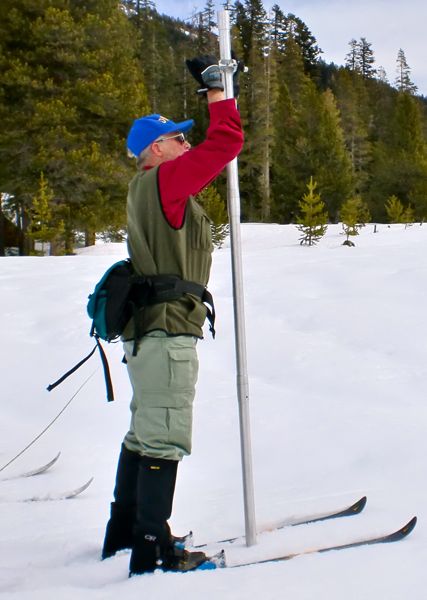
DWR hydrologist Frank Gehrke takes a snow measurement with a longer-than-usual pole. Photo/Brenda Knox

DWR hydrologist Frank Gehrke takes a snow measurement with a longer-than-usual pole. Photo/Brenda Knox

Still, the readings were large enough to prompt California Gov. Jerry Brown to lift the drought issued by his predecessor three years ago. The winter has also prompted Lake Tahoe ski areas including Squaw Valley among others to extend the season through Memorial Day weekend with a record 700 inches.

“It’s been 16 years since we’ve seen this kind of snow,” DWR chief hydrologist Frank Gehrke told Lake Tahoe News.

Overall, the long spine of the Sierra Nevada mountain range brought out water measurements in the snowpack of 165 percent. Electronic readings for the northern Sierra were as high as 174 percent for the April 1 seasonal average.

By contrast, reports on March 1 showed the central Sierra seasonal average at 106 percent. This latest reading was just the tip of the iceberg on summarizing a wild winter that roared over the region in December, cooled in mid January into February and returned with a vengeance in March. Ironically, the “Miracle March” tends to happen in drought years as in the period from 1987-1992.

DWR takes the readings to determine water allocations for the state’s 25 million Californians and almost one million acres of irrigated farmland. The state agency estimates it can deliver 70 percent of the requested amount for the State Water Project, the Central Valley’s flagship program.

“While this season’s storms have lifted us out of the drought, it’s critical that Californians continue to watch their water use,” Brown said in a statement upon ending the drought declaration. “Drought or no drought, demand for water in California way outstrips supply. Continued conservation is key.”

The statement serves as a reminder that abundance is one thing. Water management is quite another.

Currently all reservoirs in the state are filled to marks above average, but there’s more anticipated snowpack runoff than what can be stored in the reservoirs. This makes management of the flows more of a challenge.