Ski report: Time to shed a few layers
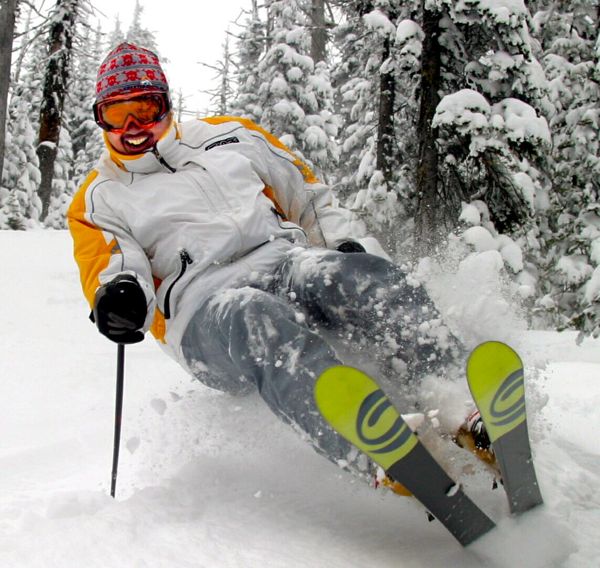 Perfect day to call in sick to work.
Here is the ski report from Curtis Fong, the Guy from Tahoe.
Perfect day to call in sick to work.
Here is the ski report from Curtis Fong, the Guy from Tahoe.
By Kathryn Reed
Travel adventure books written by journalists are often hard for me to criticize.
Not so with “Shooting the Boh: A woman’s voyage down the wildest river in Borneo,” which was first published in 1992.
 It has all the makings of a great story. And told by someone else, it probably was or would be. The problem with this version of the excursion is that author Tracy Johnston seems to spend more time talking about her bout with hot flashes in the rain forest than about running this wild river for the first time by anyone.
Johnston doesn’t paint a picture of harmony on the water, yet at the end she said a bond had been formed. It is hard to believe this.
She also says others wrote about the excursion, including one of the guides. Though I have not read other accounts of the trip, I would hope they would be better even if the authors don’t have a writing background.
Plenty of travel pieces have the author inserted throughout the copy. But usually it adds to the writing, instead of distracts. Though I don’t know what having menopause is like, I didn’t need to read about it ad nauseam. A reference or two is relevant to point to her state of mind.
It’s interesting that she writes that whining was not a big part of the trip despite the unexpected length of it, the need for food rationing, and the constant buzzing of bees. But she must have been whining in her journal to be able to come up with the 256-page paperback.
If you can get through her hot flashes without tossing the book aside, the river experience in this (at least at the time) untamed part of the world gives readers a glimpse of a river with rapids and challenges that are harrowing and at times shocking to realize they lived through the experience.
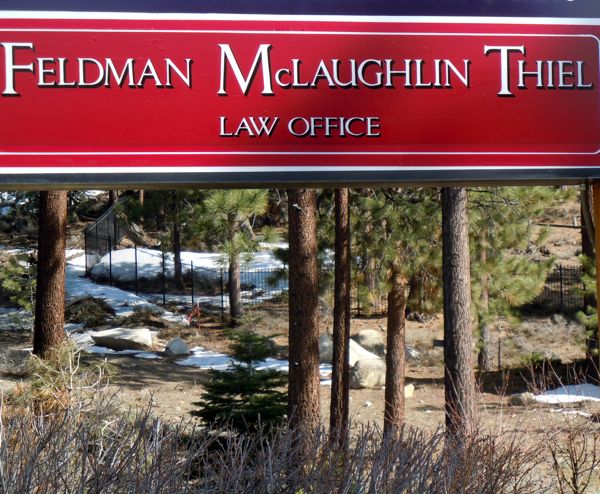 • Gone is the Shaw part of the Zephyr Cove law firm comprised on Lew Feldman and Michael McLaughlin. Added to the sign on Highway 50 is Kara Thiel’s name. New number for the partners is (775) 580.7431.
• Want to know more about county law libraries in California? Here is some info. And here is a video about what they do.
• Marshall C. Hopper, a 14-year veteran of the Placer County Probation Department, is now the county’s chief probation officer.
• Top real estate professionals from around the world came together recently for the Luxury Portfolio Summit in Las Vegas. Participants included Shari Chase, president and CEO of Chase International, and broker Trinkie Watson, who are members of Luxury Portfolio International.
• An item on the South Tahoe Public Utility District’s board agenda for April 21 is the Grizzly Mountain booster pump station, which is causing some consternation among residents.
• The world’s largest climbing wall is expected to open this summer in Reno on the old Fitzgerald’s property. It will be a multi-tiered 163-foot entity, plus a bouldering area.
By Carlos Alcalá, Sacramento Bee
Live by Cupid’s arrow, die by Cupid’s arrow.
El Dorado County has traditionally issued more marriage licenses per capita than the California average, but now its numbers are declining far faster than average.
 Lake Tahoe is the main reason El Dorado County’s per capita rate is nearly four times that of the state.
People want to get married in one of the world’s most beautiful places.
“We’ve had people fly in from Australia just to get married in South Lake Tahoe, just to say they’d done that,” said Bill Schultz, El Dorado County’s recorder/clerk.
Couples have skydiving weddings, beachfront weddings, state park weddings and even Gunbarrel (not shotgun) weddings at the top of the Gunbarrel ski run at Heavenly Ski Resort.
It makes for a multimillion-dollar industry.
In recent years, however, marriage has taken a dive at the lake.
The county issued almost 25 percent fewer licenses in 2010 than it did in 2006.
California licenses dropped only 5 percent during the same period.
The reasons are economic and social.
The social factor is that people just don’t get married like they used to.
Women don’t need a breadwinner, and couples don’t see a stigma to cohabitation.
Squaw Valley is hosting the second annual nationwide Helly Hansen Professional Ski Patrol Olympics April 26-28.
Ski patrollers from all over North America will be competing for glory and $10,000 in cash and other prizes such as avalanche probes, backpacks compliments of Helly Hansen, Alpine Traverse, Recco and BCA.
Competitions will include a randonée race, beacon competition, GS race, sled race, bamboo throw and simulated bomb throw. All competitions will be visible from the Cornice II snow lounge and BBQ area where spectators can partake in the excitement and suspense.
New this year, the Helly Hansen Professional Ski Patrol Olympics has added an Avalanche Rescue Dog competition where resorts’ top dogs will go head-to-head in a two-day challenge. Avalanche rescue dogs are an important component of any patrol team. The K-9 competition will include a timed retrieval of buried objects.
Registration for the event will take place April 26 from 6-9pm at the Papoose Discovery Center located across from Cornice Cantina. Registration to compete costs $89 per patroller and includes a two-day lift ticket to Squaw Valley and participation in the events.
A discounted entry fee is available for patrollers with Squaw Valley season passes.
Spectators are invited to watch the competition and enjoy the only the snow barbecue in the Cornice II Bowl.
For more information about the Helly Hansen Professional Ski Patrol Olympics, call (530) 452.7124 or email eknudson@squaw.com.
By Chris Roberts, SF Weekly
That familiar odor wafting from San Francisco street corners, storefronts, and the neighborhood growhouse? It’s the smell of legality. Medical cannabis is the law of the land in California, 14 other states, and the District of Columbia. Yet, as many marijuana users will tell you, protection under state law hasn’t guaranteed protection under federal law at all.
It was more obvious under the George W. Bush administration, which pledged to “ignore” state medical marijuana laws and go after marijuana users. For eight years, the federal government “subverted” the will of the states, according to the ACLU, and in the process ignored the Constitution’s guarantees of state sovereignty, as many a pot user has tried to argue in court.
So when Barack Obama’s new administration delivered a message on medical marijuana in February 2009, it was heard loud and clear: The federal government was getting out of the business of busting pot in California and other states where voters had approved medicinal application of the plant. Obama the candidate promised as much during the campaign, and now the new attorney general, Eric Holder, had made it so by issuing guidelines protecting those following state law. Federal policy on medical marijuana had changed.
For that campaign promise — and for pledges to end the Iraq war and reform health care — Obama won many votes from San Franciscans, including people like the 30 medical cannabis users gathered at a former brothel on Mission Street on a recent evening. The low- and no-income folk who constitute the patient advocacy and activist network Axis of Love cannot use their Medicare and Medi-Cal benefits to buy their preferred tonic — federal law makes it thus — and so they must rely on the charity of a few San Francisco cannabis dispensaries for their medicine. Pot and meals are dispensed daily, free of charge, under the supervision of activist Shona Gochenaur. “Obama got a ton of votes from our community,” she says, “for the many campaign promises he made that things would change.”
That the man in the White House was even willing to put “medical” and “marijuana” together in the same sentence was a step forward for California’s cannabis advocates. They had endured such spectacles as the sentencing to five years in federal prison of a pair of El Dorado County providers — Mollie Fry, a breast cancer survivor, and Dale Schafer, a hemophiliac — and the DEA seizing six plants belonging to Angel Raich, who had an inoperable brain tumor. Legal outdoor growers were living in fear after an unprecedented string of DEA raids in the state’s pot-producing counties in 2007. In the Bay Area, the U.S. Attorney’s Office, headed in the last years of Bush’s presidency by Reagan appointee Joseph Russoniello, sought stiff sentences against two brothers for running a dispensary in Hayward.
Publisher’s note: This update on the Leviathan Mine in Alpine County will be in the Lahontan Water Board’s May 2011 executive officer’s report.
By Chuck Curtis
The Lahontan Water Board’s emergency contractor has been successfully treating polluted water at the Leviathan Mine Superfund Site this spring to prevent ponds at the site from overflowing. The water board manages the site, a former sulfur mine, for the state of California, which owns the property.
The site is located north of Monitor Pass at an elevation of approximately 7,000 feet, between Markleeville and Topaz Lake.
Mining operations exposed sulfur in the rocks and mine wastes to air and water, and that caused the creation of sulfuric acid. The acid dissolves minerals, including arsenic, aluminum, nickel, and others, in the rock and waste materials. This metal-rich acidic wastewater is termed acid mine drainage, or AMD.
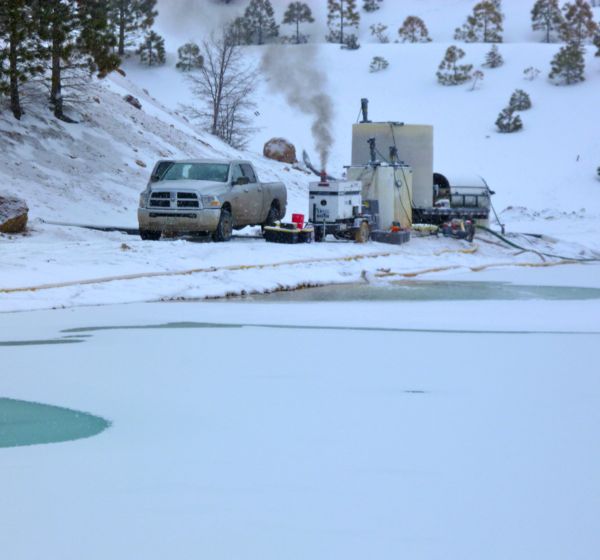
The treatment system at one of the ponds at the Leviathan Mine. Photos/Provided
The state purchased the site in the early 1980s to build a pollution abatement project, as the owner at the time had no means to reduce the flow of AMD from discharging to Leviathan Creek. Without capture or treatment, the AMD created toxic conditions in the creek, effectively killing aquatic life as far as about ten miles below the mine, where the creek joins the East Fork Carson River.
The state’s pollution abatement project included construction of a series of evaporation ponds to collect two sources of the AMD discharge at the site. Starting in 1999, the water board’s contractors have treated AMD in the ponds each summer to reduce pond overflows that happened in the spring following wet winters. Since 2000, there have been essentially no polluted water discharges from the ponds managed by the State.
Due to heavy precipitation at the site this winter (160 percent of normal as of April 14, 2011), water board staff determined that the ponds would overflow this spring without emergency treatment actions. Water board staff arranged an emergency contract to treat the AMD in the ponds to prevent an uncontrolled pond discharge.
On April 1, the contractor cleared the 10-mile-long road to the site of snow, and, on April 5, treatment operations at the site began. Those operations, in which lime is mixed with the water in the smallest of the ponds, have continued every day since. The lime neutralizes the acid, and the toxic metals in the AMD settle to the pond bottom.
Successful treatment and discharge of the first batch of pond water occurred on April 9, and the second batch was discharged on April 14. Approximately 800,000 gallons of AMD was treated and discharged to the creek in those two batches. Treatment operations will continue until the threat of pond overflow has passed. A significant precipitation event this spring could still overwhelm the ponds and our emergency treatment operations, but that possibility decreases with each day of treatment.

The overflow structure at the upper ponds has about 3 inches to go before overflow.
Doug Carey, engineering geologist with the water board’s Leviathan Mine Unit, led a tour of the site for the U.S. Environmental Protection Agency’s Superfund project manager and U.S. Forest Service staff on April 13. The USEPA was pleased with the actions that the water board has taken under difficult conditions to prevent pond overflow and its harmful effects on the creek and its aquatic life. Those difficult conditions have included snowstorms and single digit nighttime temperatures.
The Forest Service acknowledged that snow removal was completed in compliance with its specifications, and no damage to the road base occurred as a result of snow removal activities; the Forest Service owns the Leviathan Mine Road that provides access to the site.
In addition to observing the water board’s emergency treatment operations, the tour included viewing areas at and downstream of the site that are affected by the former mining operations. In addition to the water board, Atlantic Richfield Company is conducting pollution abatement activities at the Leviathan Mine site, and it has been required by the USEPA to conduct a Remedial Investigation and Feasibility Study to evaluate the nature and extent of contamination and to develop a final cleanup remedy for the site. The USEPA named Atlantic Richfield as a potentially responsible party for the pollution at Leviathan Mine due to its purchase of Anaconda Mining Company, which conducted mining at the site in the 1950s and 1960s.
Chuck Curtis is division manager of the Cleanup and Enforcement Division of the California Regional Water Quality Control Board, Lahontan Region.
El Dorado County sheriff’s deputies arrested two Sacramento men April 14 in regards to stolen catalytic converters.
Deputies pulled the two over at 2:45am in Cameron Park near Bass Lake and Green Valley roads.
The deputy identified both subjects determined Xeng Vue was on probation for stolen property, specifically catalytic converters.
Deputies conducted a probation search of the vehicle and located a pipe cutter and other tools which could be used to cut and remove catalytic converters from vehicles. In the trunk was a catalytic converter, deputies said.
Vue and Thao Xioong were arrested on charges of possession of stolen property and conspiracy to commit grand theft.
— Lake Tahoe News staff report
By Kathryn Reed
Heavenly Mountain Resort will begin improving the ski area next month, days after this season ends April 24, if all the approvals from the U.S. Forest Service go through.
The U.S. Forest Service Lake Tahoe Basin Management Unit is seeking comments until April 29 on proposed capital improvements at Heavenly. The resort wants to build of a permanent ski school structure and create of a Kids Adventure Zone near the top of the gondola, widen some ski trails in the Sky Express area and improve vehicle access to the top station of the tubing lift.

Six more days of this ski season, then Heavenly begins improvements for 2011-12. Photo/LTN
These projects are part of the resort’s master plan.
“The children’s ski school building will be consistent in look and feel to the Tamarack Lodge, which our guests have really enjoyed. While the temporary yurts have served us well over the years, this permanent structure will elevate the ski school facilities to the same world-class level as our ski school instruction,” resort spokesman Russ Pecoraro told Lake Tahoe News.
With General Manager Pete Sonntag having risen from the ski school side of the industry, this is close to his heart – to have such a facility that complements the philosophy of parent company Vail Resorts – “experience of a lifetime”.
The improvements are part of a nearly $90 million cash infusion by the Colorado-based company into its six ski resorts before the 2011-12 begins.
The ski school building will be nearly 3,000-square-feet, with a height between 25 and 30 feet.
Trails on the California side of the mountain that will be widened to increase capacity and ease congestion include: Ellie’s, Liz’s, Upper Ridge, Canyon, Jackpot and High Roller. Trees will be taken out via over-the-snow removal methods. Some boulder will be moved to the edge of the trails. The total cleared area is approximately 4.16 acres.
“The trails in upper California were originally built in the 1960s. We have chosen to widen these trails to accommodate the new ski and snowboard equipment and techniques, which will improve the overall ski and ride experience,” Pecoraro explained.
For more information on the proposals and how to comment, go online or call Jonathan Cook-Fisher at (530) 543.2741.
Although the last day to ski at Heavenly is Easter, the resort will be open May 13-15 and May 28-30 for sightseeing and tubing. Summer operations begin June 7.
By Jaclyn O’Malley, Reno Gazette-Journal
Joseph Naso is a 77-year-old self-employed photographer whose life experiences — on the surface — don’t seem different from those of many other men.
After a 1950s stint in the U.S. Air Force, he married and soon became a father. Decades later, he divorced, but maintained a relationship with his former wife. During the past several years, he became caretaker to his extremely mentally ill middle-aged son, often lashing out against the system by making legal challenges regarding the son’s treatment. Naso thought he could do better than health care workers, some whom he deemed incompetent and refused to let inside his home.
But Naso amassed a criminal history dating back to 1955 and seemed to have a fondness for women’s underwear — including an arrest relating to the alleged theft of underwear in the 1990s from a department store, according to the San Jose (Calif.) Mercury News. and asking a female neighbor in Yuba City, Calif., if she was selling women’s underwear at her garage sale, according to Sacramento News 10.
Neighbors in Lemmon Valley described Naso, who had dozens of addresses spanning the country throughout the last several decades, to news media as strange and mentioned the fences around his modest home, which allowed no view into his backyard.
And when dozens of law enforcement officers and forensics crews stormed Naso’s home in April 2010, removing boxloads of his property, they felt their unease was validated.
On Tuesday, law enforcement accused him of being a serial killer who murdered women in crimes that, at least in three of the cases, can make him eligible for the death penalty if convicted, according to the Mercury News. Such special circumstances can include robbery, kidnapping or rape. The four women he is charged with killing had the same initial in their first and last names, which suggests some organization and planning. It also suggests the name alliterations could have been his calling card.